
End-to-end encrypted analytics gives finance and AI transformation leaders accurate adoption and ROI numbers while shrinking the privacy exposure that usually comes with usage tracking. It works by pairing privacy-first architecture, PII stripping and encryption, with measurement disciplined enough to satisfy a CFO and a data protection officer at the same time. The practical next step is a 30 to 90 day pilot aligned to NIST’s Measure function, run before any organization-wide rollout.
TL;DR:
- Privacy-first analytics require PII stripping at ingestion and encryption of telemetry to protect employee content while enabling usage and cost tracking.
- Regular, documented re-identification risk testing and strict data retention limits are essential to maintain GDPR compliance and minimize privacy exposure.
- Collecting metadata instead of raw prompts through API integration and structured tags allows accurate usage measurement without exposing sensitive information.
- Pilot programs should last 30 to 90 days, focusing on a few teams and one use case, with success measured by adoption lift, cost clarity, and privacy risk assessment.
- A clear operating cadence involving weekly, monthly, and quarterly reviews helps integrate privacy-preserving analytics into enterprise AI governance frameworks.
Table of Contents
- What This Kind of Analytics Covers, and What It Doesn’t
- Core Metrics and KPIs for Adoption, Usage, Spend and ROI
- Privacy Controls, Anonymization Limits and Legal Cautions
- Architecture: Encryption, Data Minimization and Deployment Friction
- Governance, Cadence and NIST Alignment
- Evaluation Checklist and Pilot Design for a Privacy-First Rollout
- Data Collection Methods Compatible With End-to-End Encryption
- Performance and Scalability in Encrypted Analytics
- Limitations and Challenges of This Approach
- Compliance Beyond NIST: GDPR, CCPA and Privacy-First Analytics
- A Practitioner’s View on Pilot Outcomes
- How Configurato and Tekkr’s Services Fit This Picture
- FAQ
- Sources
What This Kind of Analytics Covers, and What It Doesn’t
This guide is about a specific product class: analytics built to track enterprise AI tool usage, spending and outcomes, using privacy-first design and end-to-end encryption so that raw prompts and personal data stay protected. It tells you who is using Claude, Codex or similar tools, how much each team spends, and whether that spending produces measurable work outcomes, without exposing the contents of what employees typed.
It is not a guide to the general cryptography of encrypted communications, and it does not cover inspecting encrypted network traffic. Those are different technical subjects with different audiences. Here, “end-to-end encrypted” describes how an analytics platform protects telemetry and prompt data as it moves from an employee’s AI tool to an executive’s dashboard.
The trust anchors worth knowing: the NIST AI RMF sets the measurement bar most enterprise AI governance programs now reference, GDPR anonymization guidance sets the legal bar for what counts as genuinely de-identified data, and products like Tekkr’s Configurato illustrate what this architecture looks like in practice: usage tracking and cost allocation running on an encrypted, PII-stripped pipeline.
Core Metrics and KPIs for Adoption, Usage, Spend and ROI
Executives need four categories of metrics, and each one answers a different question a board or CFO will ask.
- Adoption: percentage of employees with tool access, active users, and adoption rate broken out by team or use case.
- Usage: daily and monthly active users for specific workflows, frequency of use, depth of use, and use-case tagging.
- Cost: spend per tool, cost per active user, team-level allocation, and trend over time.
- Outcome and ROI: process time saved, measurable effects on revenue or margin where they exist, and comparison against an experiment baseline.
Organizations that track well-defined KPIs and keep a documented adoption road map tend to capture more value from their AI investments, according to McKinsey’s survey work on enterprise AI, while many organizations still lack that tracking altogether.
A useful benchmark: McKinsey’s research finds that KPI tracking and a clear adoption road map correlate with stronger value capture, which means the metrics themselves are a lever, not just a report.
None of this works as a one-off snapshot. NIST’s Measure function calls for repeatable metrics, documented benchmarks and stated uncertainty, with testing, evaluation, verification and validation (TEVV) built into a regular cadence rather than a single audit.
Privacy Controls, Anonymization Limits and Legal Cautions
A hashed username or a swapped employee ID is not anonymization. Pseudonymised data, where identifiers are replaced but a mapping still exists somewhere, can remain personal data under data protection law, and official guidance from UCL’s data protection office is explicit that organizations must test and document re-identification risk before claiming a dataset is truly anonymized.
Before approving any AI analytics pilot, legal and privacy teams should require:
- PII stripping at the point of ingestion, before raw prompt content ever reaches a dashboard.
- Separation of identity stores from usage and content data, so no single system holds both.
- Documented re-identification risk testing, repeated whenever the data model changes.
- Retention limits that delete raw telemetry on a defined schedule.
- Role-based access and audit logging for every person who can query the data.
Pro Tip: Ask any vendor for their re-identification testing documentation before the demo, not after the contract; a platform that cannot produce it is asking you to take anonymization on faith.
Our guide to data privacy in AI walks through these controls in more depth for DPOs building out a review process, and a 90 to 180 day GDPR checklist covers the pilot-approval sequence step by step.
Architecture: Encryption, Data Minimization and Deployment Friction
“End-to-end encryption” for an analytics platform should mean something concrete: raw prompt content stays minimized or stripped before it leaves the source, telemetry travels encrypted in transit and at rest, and key management is documented clearly enough that a security team can audit it without a vendor call.
A few architectural choices matter more than others for both security and adoption speed.
- PII stripping at ingestion removes names, emails and other identifiers before data is stored, not after.
- No browser extension requirement reduces rollout friction and removes a common source of shadow IT and security exceptions.
- SSO and API-level integration with existing tools (Claude, Codex, finance systems) keeps setup fast, often around 10 minutes for a basic connection.
- Retention policies and access separation should be configurable, not fixed, so legal teams can tune them to their own risk tolerance.
Our security and privacy page for Configurato describes this architecture in detail, including how encrypted telemetry channels avoid broad raw-prompt access.
Governance, Cadence and NIST Alignment
Measurement only becomes management when it is tied to an operating rhythm. NIST’s framework maps cleanly onto this: the Map function calls for a maintained inventory of AI systems in use, the Measure function calls for TEVV plans tied to that inventory, and the Manage function closes the loop by using measurement outputs to adjust spend and training.
A workable cadence looks like this:
- Weekly: adoption dashboards reviewed by the AI transformation lead or a designated owner.
- Monthly: TEVV summaries and cost allocation reviewed with finance.
- Quarterly: strategic review tying adoption and ROI data to budget and governance decisions.
A minimal RACI splits ownership three ways: finance owns cost data, the AI transformation lead owns adoption and usage metrics, and the DPO or security lead owns privacy controls and testing documentation. Our guide to AI integration strategies for executives covers how to build this cadence into an existing governance structure rather than bolting on a separate process, and NIST’s RMF explained for primer purposes offers useful background on how the four core functions fit together.
Evaluation Checklist and Pilot Design for a Privacy-First Rollout
Before signing anything, run a short vendor checklist and a scoped pilot.
- Ask for proof of end-to-end encryption architecture, not just a claim in a sales deck.
- Request a live PII-stripping demonstration using sample data.
- Review documented re-identification risk testing and how often it is repeated.
- Confirm TEVV support: can the vendor produce repeatable, benchmarked metrics on request.
- Time the integration: how long does SSO and tool-API setup actually take.
- Check SLA terms and data residency commitments in writing.
Pro Tip: Scope the pilot to two or three teams and one clear use case rather than the whole company; a narrow pilot with a real baseline tells you more in 30 days than a broad rollout tells you in 90.
Include finance, the DPO, security and the relevant product owners in the stakeholder matrix from day one. Success criteria should cover adoption lift, cost clarity and a privacy risk score, not adoption numbers alone. A 90 to 180 day GDPR checklist gives a workable timeline for getting legal sign-off without stalling the pilot.
Data Collection Methods Compatible With End-to-End Encryption
Collecting usage data without exposing prompt content requires a different approach than typical product analytics. Instead of logging raw text, encrypted analytics platforms typically capture structured metadata: which tool was used, when, for how long, and under which use-case tag, with the prompt body stripped or encrypted before it ever reaches a central store.
API-level integration is the most common collection method, since it allows a platform to pull usage and cost signals directly from a provider like Claude or Codex without requiring a browser extension on every employee’s machine. That matters for both security and adoption: fewer endpoints to secure, and less friction for employees who would otherwise need to install and maintain a separate plugin.
Event-level logging, where each action is tagged with a use case and team identifier but not with message content, lets a platform build adoption and usage metrics without ever storing what was typed. Cost data typically comes from a separate feed, usually the provider’s own billing API, and is joined to usage data only at an aggregate level.

The common thread across workable collection methods is that identity and content are kept apart from the start. A platform that collects everything into one store and promises to encrypt it afterward is solving a different problem than one that minimizes what gets collected in the first place.
Performance and Scalability in Encrypted Analytics
Encryption and PII stripping both add processing overhead, and at enterprise scale, that overhead has to be designed around rather than ignored. The practical question for a transformation lead is not whether encryption slows things down, it is whether the platform’s architecture accounts for that cost at the volume your organization actually produces.
Three things determine whether an encrypted analytics pipeline holds up as usage grows. First, where stripping and encryption happen: doing it at the edge, close to the source, scales better than doing it in a central processing step that becomes a bottleneck as more teams onboard. Second, how aggregation is handled: dashboards built on pre-aggregated, encrypted summaries respond faster than ones that decrypt and recompute on every query. Third, how the platform handles growth in the number of connected tools and teams, since each new integration point adds both data volume and a new surface to secure.
For most enterprise deployments, the realistic test is not a synthetic load benchmark but whether dashboards stay responsive as more teams, tools and use cases get added over a normal rollout timeline. A platform that performs well with three teams, and the metadata-only collection approach above, should scale to several dozen without a redesign, since the privacy controls that make data smaller and more structured also tend to make it faster to query.
Limitations and Challenges of This Approach
Privacy-first architecture solves the exposure problem, but it does not solve every measurement problem, and executives should go in with realistic expectations.
Stripping PII and minimizing raw content means some outcome metrics become harder to attribute precisely. If a platform never sees prompt content, it cannot tell you exactly why a particular interaction saved time, only that a workflow tagged to a use case showed a time or cost change. That is a real tradeoff: privacy controls that protect employees also remove some of the granularity a product team might want.
Re-identification risk never drops to zero. Even with identifiers stripped and stores separated, enough usage metadata (team, frequency, timing) can sometimes make an individual identifiable in a small group, which is why documented re-identification testing has to be an ongoing practice, not a one-time certification.
Adoption measurement itself is often harder than it looks. Industry surveys consistently find that data privacy and security concerns are among the biggest barriers to scaling AI adoption, according to Deloitte’s research on AI and tech investment ROI, which means an analytics platform can show clean metrics while the underlying adoption problem (trust, training, unclear use cases) remains unsolved. Measurement surfaces the gap; it does not close it on its own.
Finally, integration coverage is uneven. Provider APIs for newer AI tools do not always expose the same granularity of usage data, so cross-tool comparisons sometimes rest on metrics that are not perfectly equivalent across platforms.

Compliance Beyond NIST: GDPR, CCPA and Privacy-First Analytics
NIST’s AI RMF sets a measurement standard, but it is not a privacy law, and compliance teams still need to satisfy GDPR, CCPA and whatever regional framework applies to their workforce.
Under GDPR, the core question is whether analytics data counts as personal data at all. As UCL’s guidance makes clear, pseudonymised data can still be personal data, which means a platform that merely swaps employee names for IDs has not necessarily escaped GDPR’s scope. True anonymization, the kind that removes GDPR obligations entirely, requires documented testing against re-identification risk, not just a technical claim.
CCPA and similar US state privacy laws focus on different mechanics, particularly consumer rights to access and delete personal information, but the same principle applies: if employee usage data can be tied back to an individual, it is covered. Retention limits and role-based access, the same controls that support GDPR compliance, also reduce CCPA exposure by shrinking what exists to be requested or deleted.
The practical approach for most enterprises is to build to the stricter standard (GDPR-style documented anonymization and retention limits) rather than maintaining separate compliance tracks for each region. A platform built that way tends to clear CCPA and similar frameworks as a byproduct, since the technical controls (PII stripping, access separation, retention limits) are the same ones that satisfy GDPR. Our privacy-preserving analytics guide for finance covers how this plays out when finance teams need audit-ready reporting.
A Practitioner’s View on Pilot Outcomes
Across enterprise AI adoption programs, the recurring pattern is a quiet gap between what leadership assumes is happening and what usage data actually shows: spend concentrated in two or three teams, shadow adoption in others, and real movement only after a structured playbook or gamified rollout gives people a reason to change habits.
— TekkrTools
How Configurato and Tekkr’s Services Fit This Picture
We built Configurato to answer the exact question this guide is about: who is actually using the AI tools you bought, what they cost by team, and whether that spending is producing results, without putting raw prompt content or employee identity at risk.
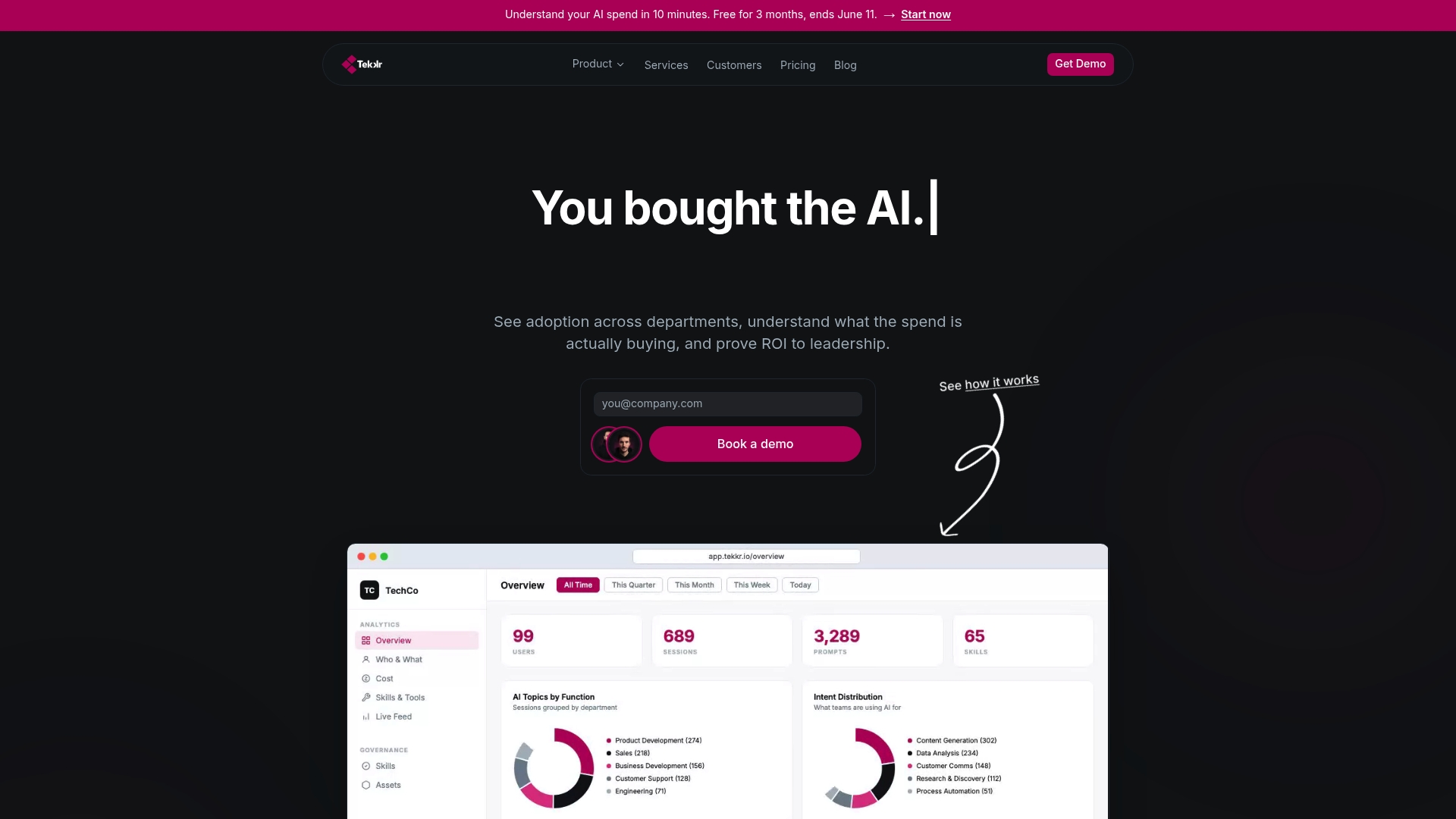
- We track usage across AI tools, broken down by team and use case.
- We allocate cost at a granular level so finance can see spend by department.
- We strip PII automatically and run on an end-to-end encrypted, privacy-compliant architecture.
- We set up quickly, with no browser extension required.
For organizations that want the rollout handled alongside the measurement, our consulting team runs AI adoption programs and end-to-end transformation engagements that pair Configurato’s reporting with playbooks and gamified enablement, typically lifting adoption inside the pilot window rather than after a slow, unmeasured rollout. Start with a free look at Configurato to see what your own usage and cost data actually shows.
FAQ
What Is End-to-End Encrypted Analytics for AI Adoption?
It is analytics software that measures how employees use AI tools, what each team spends and what outcomes result, built on an architecture that encrypts telemetry end-to-end and strips personal data before it is stored. Configurato is one example, tracking tool usage and cost while keeping prompt content and identity separated.
How Is This Different from Simple Usage Logging?
Standard usage logging often stores raw prompt content and identifiers together, which creates both a privacy and a compliance risk. Privacy-first analytics strips PII at ingestion and separates identity from content, so re-identification risk can be tested and documented rather than assumed away.
Does Pseudonymised Data Satisfy GDPR on Its Own?
No. Official guidance confirms that pseudonymised data can remain personal data under data protection law, so organizations need documented re-identification testing and access controls before claiming compliance, not just swapped identifiers.
What Metrics Should a Pilot Track First?
Start with adoption rate by team, cost per active user and one outcome metric tied to a specific workflow, measured against a baseline period. Programs that track well-defined KPIs and keep an adoption road map tend to capture more value, according to McKinsey’s enterprise AI research.
How Long Should a Privacy-First Analytics Pilot Run?
A pilot scoped to two or three teams and one clear use case typically runs 30 to 90 days, long enough to establish a usage baseline and show adoption movement. Success criteria should cover adoption lift, cost clarity and a documented privacy risk assessment, not adoption numbers alone.
Sources
- AI RMF Core — NIST
- Anonymisation and pseudonymisation guidance — UCL
- The state of AI — McKinsey
- AI and tech investment ROI — Deloitte