
GDPR applies to AI analytics whenever outputs, model weights, or logs could reasonably identify a person, and regulators are setting a high bar for claiming otherwise. If your model or dataset isn’t proven anonymous under the EDPB test, treat it as personal data. The immediate to-do list: run an anonymization assessment, document your legal basis through an LIA or DPIA, and schedule technical testing. The EDPB and the UK’s ICO set the standards; tools like Tekkr help you operationalize them.
TL;DR:
- Models are considered personal data under GDPR unless they pass the strict anonymization test, which requires no record isolation, linkage, or inference of individual identities.
- Risk mitigation involves layered controls such as PII stripping, differential privacy, synthetic data, and rigorous testing against membership inference, model inversion, and data leakage attacks before claiming anonymization.
- Ongoing vendor management and regular re-evaluation are critical, with continuous testing, audits, and contract updates to maintain GDPR compliance over the model’s lifecycle.
- Conduct comprehensive DPIAs and LIAs for high-risk AI processing, documenting risk assessments, mitigation measures, and technical testing results, especially when profiling or handling sensitive data.
- Use tools like Tekkr to inventory AI tools, track data flow, and automate privacy controls, enabling organizations to meet compliance requirements while demonstrating ROI and operational efficiency.
Table of Contents
- When AI Analytics Outputs Count as Personal Data Under GDPR
- Reducing Reidentification Risk in AI Analytics Pipelines
- What Legal Basis and Documentation Do DPIAs Require?
- How Should You Vet AI Vendors for Compliance?
- Your 90 to 180 Day GDPR Compliance Checklist for AI Analytics
- TekkrTools Perspective: Privacy and AI ROI Aren’t in Tension
- Track AI Usage and Build Your Compliance Evidence in One Place
- Sources
- FAQ
When AI Analytics Outputs Count as Personal Data Under GDPR
Pseudonymization is not anonymization, and that distinction trips up more analytics teams than any other GDPR question. A pseudonymized dataset, one where names are swapped for tokens but the underlying record is still traceable, remains personal data unless the link back to the individual is technically severed. Keep the original data sitting next to the pseudonymized output, and you’ve likely undermined any anonymity claim before you’ve made it.
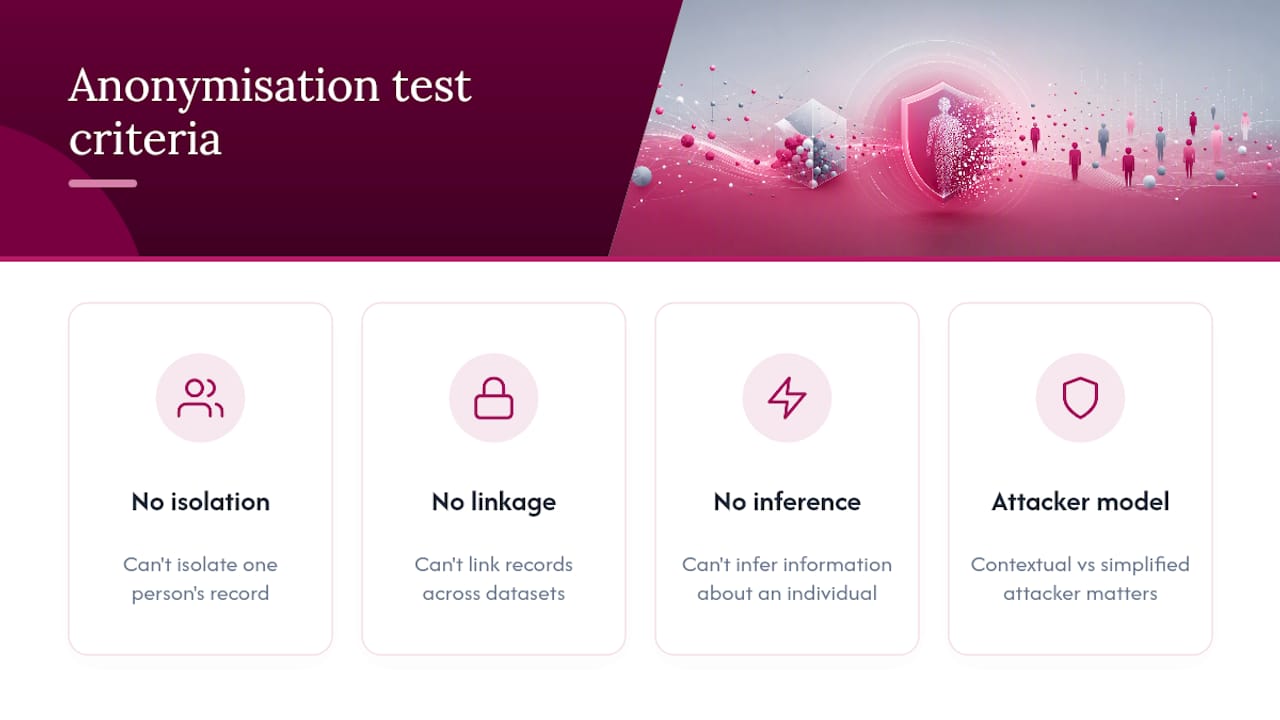
The EDPB’s Opinion 28/2024 lays out the test that matters here: a model counts as anonymous only when the likelihood of identifying someone, directly or indirectly, is insignificant. That’s evaluated against three criteria. No record isolation means an attacker can’t isolate one person’s data within the training set. No linkage means they can’t connect records across datasets to re-identify someone. No inference means they can’t deduce information about a specific individual even without isolating or linking a record.
Guidelines 02/2026 on Anonymisation sharpens this further by distinguishing a contextual approach, which weighs what a realistic attacker with realistic resources could actually do, from a simplified approach that assumes a more capable adversary. The capability of the attacker you’re modeling against changes the answer entirely.
For analytics teams, this plays out in specific ways: high-dimensional usage logs that, combined, narrow down to one employee; membership inference attacks that reveal whether a specific record trained a model; and model regurgitation, where a language model reproduces training data verbatim in its output. Each of these can turn a “clean” analytics pipeline back into a GDPR problem overnight.
Reducing Reidentification Risk in AI Analytics Pipelines
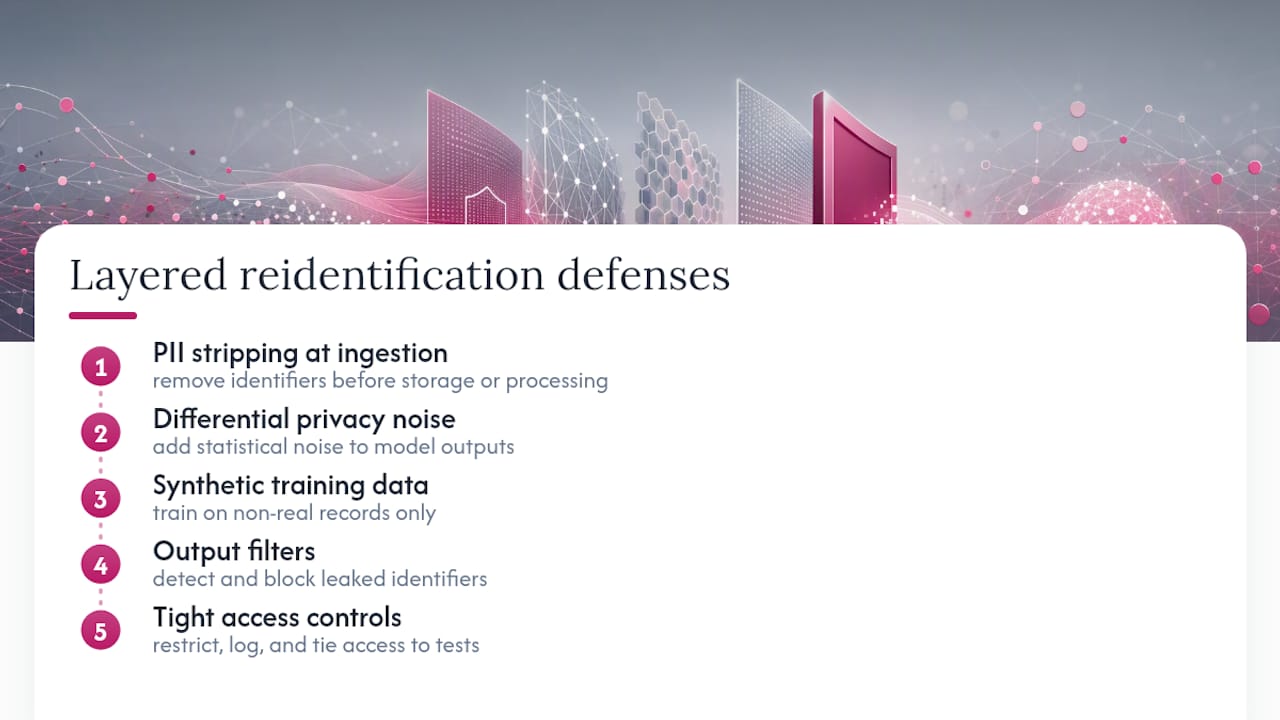
Reducing risk starts with minimizing what you collect and hardening what you keep. PII stripping at ingestion, differential privacy techniques that add statistical noise to outputs, synthetic training data that never touches real records, output filters that catch leaked identifiers, and tight access controls all reduce reidentification risk and support the necessity argument regulators expect under the EDPB’s framework. None of these controls works alone. Layer them.
Controls only count if you’ve tested them against a real attack model. Three tests matter most for analytics teams. Membership inference testing checks whether an attacker can determine if a specific person’s data was used to train a model. Model inversion testing checks whether an attacker can reconstruct training inputs from outputs alone. Exfiltration and regurgitation testing checks whether a model leaks verbatim training data, prompts, or outputs under adversarial querying. Run all three before you claim anonymization, not after a regulator asks.
Testing once and moving on is the most common mistake here. Models get retrained, fine-tuned, or repointed at new data sources, and each change resets the risk calculation. Build a governance layer around this: a documented threat model for each dataset and use case, version control tied to specific test results, logging that captures who accessed what and when, and a retesting cadence triggered by model updates rather than a calendar. A tool like Tekkr’s security architecture handles the PII stripping and encryption layer automatically, which removes one recurring manual check from your team’s list. For a deeper walkthrough of minimization techniques specific to AI projects, see this data minimization checklist.
What Legal Basis and Documentation Do DPIAs Require?
Legitimate interest is usable for AI analytics, but only after you’ve done the work to prove it. The EDPB requires a genuine necessity test (could you achieve the same outcome with less data?) followed by a balancing test that weighs your business interest against the individual’s rights and reasonable expectations. This isn’t a checkbox exercise. It’s a documented legitimate interest assessment that a regulator can review, and it needs updating whenever the processing context shifts, including model upgrades or a new deployment scope.
DPIAs become mandatory when AI analytics involves systematic profiling, large-scale processing of sensitive categories, or automated decisions with legal or similarly significant effects on individuals. A defensible DPIA for AI analytics includes the risk assessment itself, the specific mitigation measures applied, and the raw test records from your reidentification testing, not just a summary.
Auditors will expect a specific paper trail: data source provenance, testing evidence tied to model versions, completed LIAs and DPIAs, and supplier risk assessments for any third-party model you’re using. The EDPB explicitly recommends documenting DPO advice and technical measures per data source, not just per project. For more on the underlying compliance obligations when deploying AI-powered analytics, see this GDPR guide for AI deployment.
How Should You Vet AI Vendors for Compliance?
A black-box model doesn’t make you a passive bystander. Debevoise & Plimpton’s analysis is blunt about this: using a third-party AI provider does not remove your accountability under GDPR, even when you have no visibility into the model’s internals.
Before signing anything, check the vendor’s training-data provenance, any published testing results against membership inference or regurgitation attacks, a signed data processing agreement, and clear policies on who can access your data and for how long. That’s the pre-contract phase. The harder part is what comes after.
Ongoing monitoring matters more than the initial vetting. Build in periodic audits, contractual requirements for change notices when the vendor updates or retrains their model, SLAs covering security incidents, and a right to inspect their practices. Debevoise frames this as an ongoing obligation, not a one-time procurement gate. Capture every check, contract clause, and audit result in your technical file. If a regulator asks how you vetted a vendor eighteen months ago, “we checked once at signing” won’t hold up. For a structured approach to this, Tekkr’s vendor management framework walks through what to track.
Your 90 to 180 Day GDPR Compliance Checklist for AI Analytics
Work through this in order. Each step builds evidence the next one needs.
- Inventory every model and dataset touching personal data, including shadow AI tools your teams may already be using without formal approval.
- Run an anonymization assessment against the EDPB’s three criteria and decide your legal basis (legitimate interest versus consent versus another basis).
- Complete or update a DPIA or LIA for each high-risk use case, with the balancing test documented in writing.
- Implement and test technical controls, including membership inference and regurgitation testing, and record the results.
- Update vendor contracts to include audit rights, change notices, and ongoing monitoring obligations.
- Set an executive reporting cadence so leadership sees compliance status alongside usage and cost data, not as a separate silo.
Assign clear ownership: engineering for technical controls, the privacy team for DPIAs and LIAs, procurement for vendor contracts, and an executive sponsor to keep the timeline honest. Most organizations can complete steps one through four within 90 days; vendor renegotiation often stretches the full 180.
Pro Tip: Don’t wait for a full DPIA to start collecting testing evidence. Log every membership inference and regurgitation test result as you build the model, so the DPIA is a compilation exercise, not a scramble.
TekkrTools Perspective: Privacy and AI ROI Aren’t in Tension
The conventional wisdom treats privacy compliance and AI ROI measurement as competing priorities, one slowing the other down. That’s backwards. The same instrumentation that tracks who’s using which AI tool, at what cost, and with what outcome is exactly the evidence a DPIA needs. Configurato was built with end-to-end encryption and automatic PII stripping so usage tracking never becomes a new source of identifiable data. When finance asks for ROI numbers and your DPO asks for audit trails, one well-instrumented system should answer both.
— TekkrTools
Track AI Usage and Build Your Compliance Evidence in One Place
Every step in that checklist, from inventorying models to logging test results to reporting to executives, needs a system behind it, not a spreadsheet someone forgets to update. Some platforms map directly onto that work: they inventory which AI tools your teams actually use, allocate spend by department, strip PII from prompts automatically, and generate the executive reports auditors and finance both want to see.
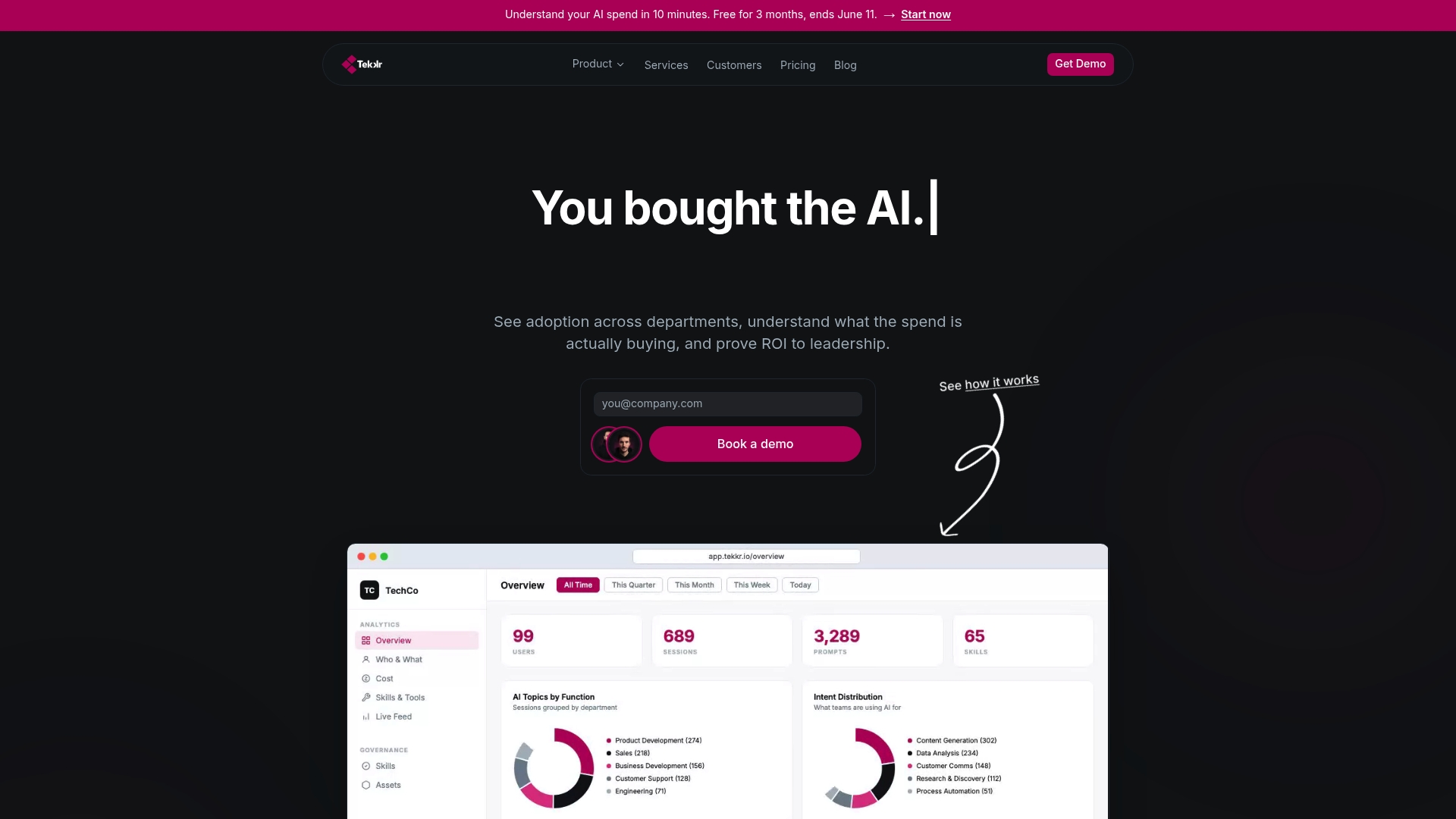
You don’t need a six-month rollout to start. Tekkr’s free tier gets you usage visibility in about 10 minutes, no credit card, no browser extension. If your organization is past the pilot stage and needs the full picture, from AI adoption tracking to hands-on transformation consulting, that’s where the paid tiers come in. Start with the free adoption tracking tier and see what your current AI spend actually looks like before your next audit lands on your desk.
Sources
Go directly to the primary documents when in doubt: the EDPB’s Opinion 28/2024, Guidelines 02/2026 on Anonymisation, and the ICO’s AI guidance. For practical use-case mapping, this AI use-case catalog by role helps identify which analytics outputs carry the most reidentification risk.
- Opinion 28/2024 on certain data protection aspects related to the processing of personal data in the context of AI models
- GDPR Considerations When Developing and Deploying AI Models: The EDPB’s Opinion on Compliance – Debevoise Data Blog
FAQ
Does GDPR Apply to AI Analytics Tools?
Yes, whenever the AI analytics tool processes data that could identify a person, either in its inputs, outputs, or the model itself, based on the EDPB’s anonymity test.
What’s the Difference Between Anonymization and Pseudonymization?
Pseudonymization replaces identifiers with tokens but keeps the data technically traceable back to a person, so it stays regulated as personal data; anonymization requires that reidentification be genuinely and irreversibly impossible.
Is Pseudonymized Data Enough for CCPA Compliance?
CCPA anonymization requirements are stricter than pseudonymization alone; data must be reasonably incapable of being linked back to a person, similar in spirit to the GDPR standard the EDPB describes.
When Is a DPIA Mandatory for AI Analytics?
A DPIA becomes mandatory for systematic profiling, large-scale processing of sensitive data categories, or automated decisions with significant effects on individuals.
Can Tekkr Help With GDPR Compliant Analytics?
Tekkr’s Configurato platform runs on a privacy-first architecture with automatic PII stripping and end-to-end encryption, which supports GDPR compliant analytics while tracking AI adoption and spend.