
Zero trust analytics is privacy-first measurement of AI adoption, spend, and decision outcomes: it tells you who’s using AI, what it costs by team, and whether it’s actually improving decisions, without exposing raw prompts or personal data. The fix for most leaders isn’t another dashboard. It’s picking one decision stream this week and instrumenting it end to end. Tools built for this package the tracking and the privacy engineering together so you’re not building either from scratch.
TL;DR:
- Most enterprises should focus on a single decision stream during a pilot to gather meaningful data within 30 to 90 days.
- Privacy-preserving techniques like differential privacy and tokenization are essential for measuring adoption and cost without exposing personal or sensitive data.
- Tracking decision override rates, time-to-action, and cost per decision by team provides actionable insights into AI ROI.
- Operational ownership should be assigned to a small cross-functional board to manage privacy budgets, metric ownership, and compliance.
- Automating measurement with end-to-end encrypted tools like Configurato enables fast setup and reliable baseline comparison for AI effectiveness.
Table of Contents
- What Does Zero Trust Analytics Mean in Practice?
- What Metrics Actually Prove AI ROI?
- How Do Privacy-Preserving Techniques Enable Trustless Measurement?
- How Do You Instrument Your AI Estate Fast?
- Who Owns Privacy Budgets and Metrics?
- What Does a 30 to 90 Day Zero Trust Analytics Pilot Look Like?
- Why Privacy-First Measurement Is the Right Operational Bet
- Turn Instrumentation Into Measurable AI ROI
- Sources
- FAQ
What Does Zero Trust Analytics Mean in Practice?
Forget the network security definition you might have encountered elsewhere. In the context of enterprise AI measurement, zero trust analytics means treating every data point about AI usage as sensitive by default, then measuring adoption, spend, and decision quality without ever exposing the underlying content.

That distinction matters because most AI measurement tools ask you to trade privacy for visibility. You either see raw prompts and outputs, or you fly blind on adoption numbers. Neither works for a finance team trying to justify a seven-figure AI budget to a board.
A working zero trust analytics setup needs four capabilities:
- Adoption telemetry that tracks who’s using which tools, how often, and for what, without logging content.
- Spend allocation that breaks inference and API costs down by team, project, or use case.
- Decision observability that captures whether an AI-assisted decision actually got acted on.
- Privacy-preserving transforms that strip or mask personal data before it ever reaches a report.
Done right, this gives you measurable outcomes: adoption lift by department, cost per decision, and a clear read on which use cases are actually paying for themselves.
What Metrics Actually Prove AI ROI?
Most AI ROI reporting fails for a simple reason: it tracks model performance instead of business outcomes. EY’s analysis of enterprise AI found that companies get stuck because they measure things like accuracy or latency instead of quantitative KPIs tied to what the business actually cares about.
A workable framework organizes around three buckets:
- Decision Velocity metrics — time-to-action after an AI recommendation, override rate (how often a human rejects the AI’s output), governance coverage (percentage of decision streams with audit trails), and ROI per decision stream.
- Adoption metrics — active users by tool, depth of use (are people using it once a week or ten times a day), and adoption rate broken out by team rather than company-wide averages that hide laggards.
- Cost metrics — cost per decision or interaction, spend allocation by team, and total inference and API spend rolled up across every provider in use.
Governance coverage deserves particular attention. Enterprises with governance and observability tooling in place see more AI projects reach production than those without it, which suggests measurement infrastructure isn’t just a reporting nicety. It’s part of what gets a pilot past the finish line.
Pro Tip: Report leading indicators alongside financial ones. When ROI is genuinely hard to quantify in month one, adoption rate, satisfaction, and workflow friction give your board something concrete while the financial case matures.
How Do Privacy-Preserving Techniques Enable Trustless Measurement?
Differential privacy is the mechanism that lets you report aggregate patterns, like “Team X’s adoption rose 40% this quarter,” without ever exposing which individual employee did what. It works by injecting calibrated statistical noise into query results, and it’s production proven at this point, not an experimental technique.
The catch is that differential privacy runs on a budget. Every query against a dataset consumes a slice of what’s called a privacy budget, denoted by the Greek letter epsilon (ε). Spend too much of it too fast, and either your data becomes identifiable or you have to stop querying. That’s why the discipline has to include:
- An ε ledger that tracks how much privacy budget each use case has consumed and how much remains.
- Context-preserving tokenization at the prompt, retrieval index, and agent-log layers, so PII gets swapped for tokens without breaking the model’s ability to reason over the data.
- Runtime PII stripping applied automatically before any prompt or output reaches a report, dashboard, or human reviewer.
Which technique you reach for depends on the situation. Differential privacy fits aggregate reporting across many users. Tokenization fits pipelines where you need to preserve structure, like a support ticket that still needs to reference “the customer” without naming them. Federated approaches or multi-party computation come into play when data can’t leave its source system at all, which is common in regulated industries. Protecto’s guidance on privacy-first AI systems recommends layering these controls at every point in the pipeline: prompt, RAG index, API response, and agent log, rather than picking just one.
Report uncertainty honestly, too. A confidence interval next to your adoption number tells a CFO more than a false-precision figure that implies certainty you don’t actually have.
How Do You Instrument Your AI Estate Fast?
You don’t need to wire up every system before you learn anything. You need the right handful of measurement points and a tight timeline.
Start by mapping where usage actually happens: prompts going into models, embeddings and retrieval indexes powering RAG systems, agent tool calls, and the final outputs and logs that record what happened. Most organizations discover blind spots at the agent-log layer first, since that’s where shadow AI usage tends to hide.
A 30-day pilot doesn’t need elaborate telemetry. It needs four things:
- Adoption data — who’s using which tool, and how often.
- Decision timestamps — when an AI output was generated and when a human acted on it.
- Override events — every case where a human rejected or changed the AI’s recommendation.
- Grouped cost data — spend by team, tagged at the point of API or license consumption.
Before you turn any of this on, capture a baseline. Nearly half of enterprises running AI in production can’t prove it’s working, and the single biggest reason is skipping the pre-deployment baseline entirely. Without one, you have no “before” to compare your “after” against. A typical first sprint runs two to three weeks with one data engineer and one business owner involved part-time. That’s a manageable resource ask for the visibility it buys.
Who Owns Privacy Budgets and Metrics?
Zero trust analytics doesn’t run itself. It needs an operating model with clear ownership, or the privacy budget quietly runs out and nobody notices until a query fails.
Form a small privacy-analytics board pulling from legal, security, data engineering, and business analytics. This group doesn’t need to meet weekly, but it does need authority to approve new use cases and adjust ε allocations.
From there, the mechanics matter:
- Allocate a specific epsilon budget per use case rather than pooling it company-wide, and freeze that allocation at release time so it can’t be silently drained by later queries.
- Maintain an audit ledger showing remaining budget per use case, refreshed on a defined cadence like quarterly.
- Assign a single owner for each decision stream’s metrics, ideally the business leader who owns that outcome, not the platform team that built the pipeline.
- Surface trust signals directly in executive reporting: end-to-end encryption status, confirmation that PII stripping ran, and a note that audit logs are immutable.
Regulators and boards increasingly want decision-level audit trails, not model performance dashboards. Building that expectation into your reporting cadence now saves a scramble later.
What Does a 30 to 90 Day Zero Trust Analytics Pilot Look Like?
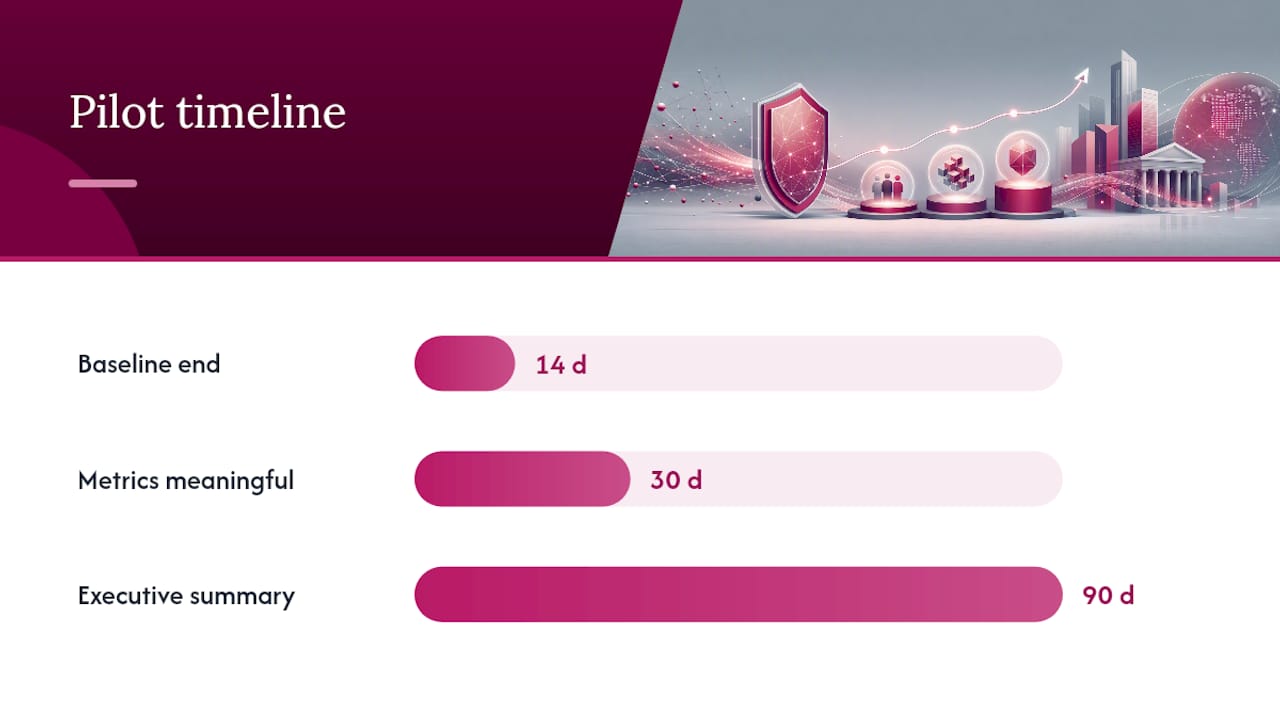
Pick one decision stream. Not five, not “AI across the company.” One process, like contract review or customer support triage, where you can define success before you start.
The runbook has five steps:
- Baseline — measure the current state for two weeks minimum before touching anything.
- Instrument — deploy adoption, cost, and decision tracking with PII stripping active from day one.
- Run — let the AI tool operate in production for 30 to 60 days.
- Measure — compare override rate, time-to-action, and cost per decision against baseline.
- Present — report decision-level outcomes to a steering committee, not raw model metrics.
Set a weekly telemetry review internally, a steering committee snapshot every two weeks, and one executive summary at the 90-day mark. The three most common ways pilots fail: skipping the baseline, leaving metric ownership ambiguous between IT and the business unit, and running the privacy budget dry without anyone tracking consumption.
Pro Tip: Choose a decision stream with a sufficient number of recurring instances a week to ensure statistically meaningful on-premises telemetry metrics. Fewer than that, and your override-rate and time-to-action numbers won’t be statistically meaningful by day 30.
Why Privacy-First Measurement Is the Right Operational Bet
Measurement that requires exposing raw data will eventually collide with a privacy officer, a regulator, or a nervous board member, and the program stalls right when it’s proving value. Privacy-first analytics sidesteps that collision entirely by design, not as an afterthought bolted on later.
The bigger shift is operational, not technical. Dashboards don’t move adoption. Operationalizing measurement, tying it to gamified rollouts, team-level accountability, and executive reporting cadences, is what actually gets a pilot to scale. That’s the gap between organizations that can show decision-level ROI and the ones still presenting usage graphs nobody trusts.
— TekkrTools
Turn Instrumentation Into Measurable AI ROI
One solution built specifically for the problem this article just walked through is designed to prove AI ROI without exposing what your employees actually typed into Claude or Codex. 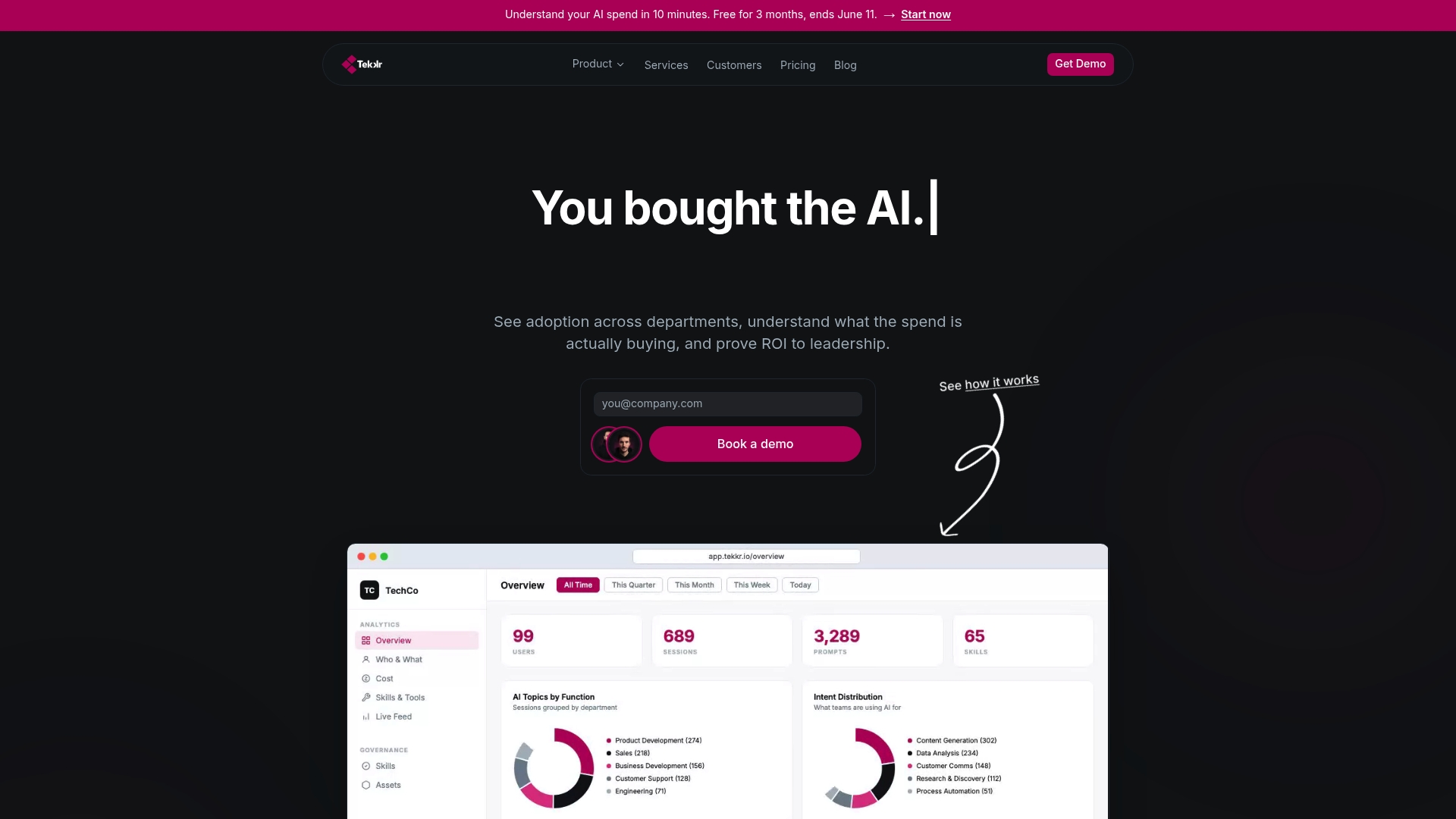
Tekkr’s flagship product, Configurato, tracks real adoption by team, breaks down AI spend department by department, and surfaces which use cases are actually earning their budget, all running on end-to-end encrypted, GDPR-compliant infrastructure with automatic PII stripping built in. Setup can be fast, requires no browser extension, and some offerings include a free tier to explore adoption numbers before committing. Leaders using this kind of setup can gain a clean baseline relatively quickly, along with cost breakdowns that finance teams can act on. If your rollout needs more than software, Tekkr’s consulting team also runs hands-on AI transformation engagements for companies scaling AI adoption company-wide. Check current pricing and the free tier to start measuring your first decision stream this week.
Sources
For deeper technical grounding, see EY’s breakdown of why enterprises fall into the AI ROI trap, CIO’s guidance on measuring AI ROI, and Forbes’ survey on enterprise AI production gaps. Tekkr’s own guides on privacy-preserving analytics for finance and 30-day AI analytics setup go deeper on implementation.
- How tech companies can break out of the AI ROI trap | EY
- Why is it so hard to measure the ROI of AI? | CIO
- Privacy-preserving analytics: differential privacy
FAQ
What Is Zero Trust Analytics?
Zero trust analytics is privacy-first measurement of AI adoption, spend, and decision outcomes that never exposes raw prompts or personal data, using techniques like differential privacy and PII stripping.
How Is This Different From Zero Trust Security?
Zero trust security governs network access and identity verification. Zero trust analytics, as used here, is about measuring AI usage and ROI while treating every data point as sensitive by default.
What KPIs Should We Track First?
Start with adoption rate by team, override rate, time-to-action, and cost per decision. These four give you both a leading indicator picture and a financial one within the first pilot cycle.
How Long Does a Pilot Take to Show Results?
A focused pilot on one decision stream typically shows measurable results in 30 to 90 days, provided you capture a baseline before instrumenting anything.
Does Tekkr Handle the Privacy Engineering for Us?
Yes. Tekkr’s Configurato product runs on end-to-end encrypted, GDPR-compliant infrastructure with automatic PII stripping, so adoption and spend tracking don’t require exposing raw prompt content.