
The strongest Worklytics alternatives for enterprise AI adoption and productivity measurement in 2026 are ActivTrak, Lattice, 15Five, Visier, and Tekkr. Each solves a different problem, and picking the wrong category costs more than the subscription fee.
Here is where each one lands:
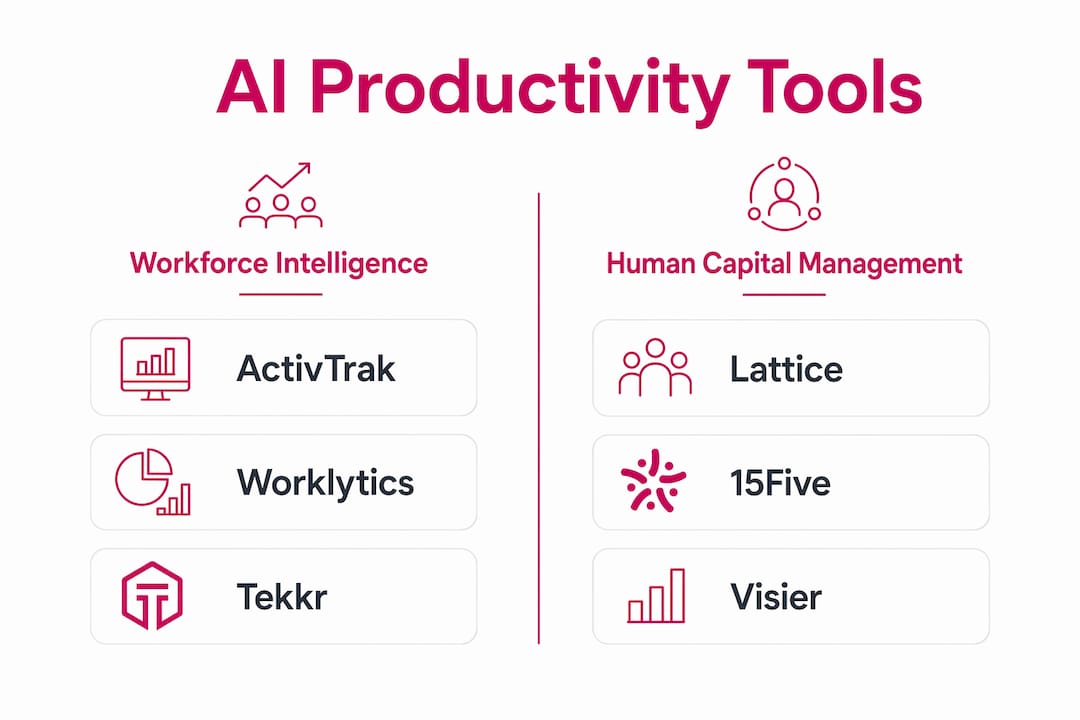
- ActivTrak — workforce intelligence focused on real-time productivity diagnostics and work activity data; cloud-native deployment means you can start collecting data in minutes
- Lattice — performance and engagement platform built for talent management, goal alignment, and manager feedback cycles, not granular productivity metrics
- 15Five — employee engagement and continuous feedback tool oriented toward culture and retention rather than workflow analysis
- Visier — people analytics platform suited for large enterprises running workforce planning and HR data modeling at scale
- Tekkr (Configurato) — privacy-first AI adoption measurement platform that tracks who is actually using tools like Claude and Codex, breaks down AI spend by team, and actively drives adoption higher through gamified rollouts
Privacy architecture and deployment model vary sharply across this group. Some platforms hash data through pseudonymizing proxies before ingestion, which protects content but requires AWS or GCP infrastructure to manage. Others deploy natively through cloud marketplaces like the Google Workspace Marketplace, which cuts setup time considerably. Your organization’s privacy threshold and existing cloud infrastructure will narrow the field faster than any feature checklist.
What are the best Worklytics alternatives for your enterprise?
The five platforms above split cleanly into two categories: workforce intelligence tools and human capital management tools. Confusing the two is one of the most common reasons AI software investments underdeliver.
| Platform | Primary Focus | Privacy Architecture | Deployment Model | Key Features | Setup Speed | Pricing Model |
|---|---|---|---|---|---|---|
| ActivTrak | Productivity diagnostics | Cloud-native, activity data | SaaS agent | Work activity monitoring, productivity scoring, workforce planning | Minutes | Per-user, tiered |
| Lattice | Engagement and talent management | Standard SaaS | Native cloud | Performance reviews, OKRs, employee surveys | Hours | Per-user, annual |
| 15Five | Engagement and feedback | Standard SaaS | Native cloud | — | Hours | Per-user, tiered |
| Visier | Workforce planning and HR analytics | Enterprise data warehouse | Cloud or on-prem | Headcount planning, attrition modeling, DEI analytics | Days to weeks | Custom enterprise |
| Tekkr (Configurato) | AI adoption and productivity measurement | End-to-end encrypted, PII stripping | No browser extension needed | AI tool usage tracking, spend by team, gamified adoption, playbooks | ~10 minutes | Free tier available |
ActivTrak sits firmly in the workforce intelligence category. It collects work activity data at the application and URL level, giving managers a clear picture of how time is actually spent versus how it is reported. The cloud-native platform scores consistently high on TrustRadius for deployment speed and ease of use, which matters when you are rolling out to hundreds of seats.

Lattice and 15Five are a different animal entirely. Both are built around the manager-employee relationship: structured check-ins, performance review cycles, and engagement pulse surveys. They tell you how people feel about their work, not how much of it they are completing or which AI tools they are actually opening. For organizations that need to diagnose productivity gaps or measure AI tool adoption, these platforms will leave a gap.
Visier is the enterprise-grade option for HR data modeling at scale. It connects to your HRIS, ATS, and payroll systems to answer workforce planning questions like attrition risk and span of control. The tradeoff is setup complexity and pricing that reflects an enterprise data warehouse deployment, not a quick pilot.
On the privacy and deployment side, pseudonymizing proxy architectures add real operational overhead. Managing AWS or GCP infrastructure for data hashing requires skilled engineering support and ongoing maintenance. Native marketplace integrations sidestep most of that friction. Worklytics itself enforces a minimum of 100 users at $2,500/month on annual billing, which makes pilot deployments expensive. Alternatives with per-user pricing and no minimums give you more flexibility for phased rollouts.
Pro Tip: Before evaluating features, write down whether your primary question is “how productive is my team?” or “how engaged is my team?” Those are different questions requiring different tools. Mixing them up is the fastest way to buy a platform that answers neither well.
How do you choose the right AI productivity measurement platform?
The right platform choice depends less on feature parity and more on two things: what your organization actually needs to measure, and how much privacy infrastructure you can realistically manage.
- Productivity vs. engagement: If your goal is measuring AI tool adoption and diagnosing workflow inefficiencies, you need a workforce intelligence tool. If you are running performance review cycles and culture surveys, you need a human capital management platform. Buying the wrong category wastes budget and creates noise.
- Privacy threshold: Platforms that hash data through pseudonymizing proxies before ingestion offer strong content privacy but require external cloud infrastructure. Native integrations are simpler to deploy and maintain, though they may offer less granular data anonymization. Know your legal and compliance requirements before committing.
- Pricing and minimum user counts: A 100-user minimum at $2,500/month is a real barrier for pilot programs. Flexible per-user pricing lets you test at smaller scale before committing to an enterprise contract.
- Integration fit: Check whether the platform connects natively to your existing stack. Google Workspace, Microsoft 365, Slack, and Jira integrations are table stakes for most enterprise environments. Anything requiring custom connectors adds time and engineering cost.
- Setup speed: A platform that takes weeks to configure delays the insights you need. For AI adoption measurement specifically, speed matters because adoption curves move fast in the first 90 days of a rollout.
For technology managers evaluating enterprise analytics platforms in 2026, the practical question is whether you want a tool that tells you what happened in your workforce or one that actively helps you change what happens next.
Why Tekkr stands out as a privacy-first AI productivity platform
Tekkr’s flagship product, Configurato, was built specifically for the problem most enterprise technology managers face in 2026: you have licensed AI tools across the organization, but you have no reliable way to know who is using them, how much it is costing by team, or whether the investment is producing anything measurable.
Configurato addresses that directly:
- AI adoption tracking: Monitors actual usage of tools like Claude and Codex across teams, not self-reported usage
- Spend visibility: Breaks down AI costs by department so you can see where budget is going and where it is sitting idle
- Privacy-first architecture: End-to-end encrypted with automatic PII stripping and full GDPR compliance, with no browser extensions required
- Gamified adoption tools: Company-wide AI playbooks and gamified rollouts that move adoption rates rather than just measuring them
- Fast setup: The platform is live in approximately 10 minutes, with a free tier that requires no credit card
The difference between measuring adoption and driving it is where most platforms stop and Tekkr starts. Tracking a low adoption rate is useful. Having a built-in mechanism to fix it is what actually moves the needle on AI ROI.
Tekkr’s privacy and security architecture is particularly relevant for enterprises operating under GDPR or handling sensitive workforce data. The automatic PII stripping means prompts are anonymized before any analysis occurs, which removes a significant compliance concern that comes with monitoring AI tool usage at scale.
Key Takeaways
The best Worklytics alternative is the one that matches your actual measurement goal, not the one with the longest feature list.
| Point | Details |
|---|---|
| Match tool to goal | Workforce intelligence tools measure productivity; human capital management tools measure engagement. Buying the wrong category answers neither question. |
| Privacy architecture matters | Pseudonymizing proxies offer strong data protection but require AWS or GCP infrastructure; native integrations are faster to deploy and maintain. |
| Pricing minimums affect pilots | Worklytics requires a minimum of 100 users at $2,500/month; alternatives with per-user pricing and no minimums suit phased rollouts better. |
| Setup speed drives early adoption | Platforms that go live in minutes, not weeks, capture AI adoption data during the critical first 90 days of a rollout. |
| Tekkr measures and drives adoption | Configurato tracks AI tool usage, spend, and ROI while actively increasing adoption through gamified playbooks, with a free tier and 10-minute setup. |
The bifurcation of AI productivity tools is accelerating
The people analytics market is splitting into two distinct lanes, and the gap between them is widening faster than most buyers realize. Workforce intelligence tools are getting more granular, more real-time, and more focused on AI-specific behavior. Human capital management platforms are going deeper on engagement, culture, and long-term organizational design. The overlap that once justified buying a single platform for both is shrinking.
The conventional wisdom that an all-in-one platform reduces complexity is increasingly wrong for enterprises with serious AI adoption goals. Specialized stacks consistently outperform monolithic platforms when the use case is specific and measurable. A tool built to answer “is our AI investment working?” will always outperform a general HR platform that added AI reporting as a feature.
Privacy architecture is also becoming a genuine differentiator, not a checkbox. As enterprises scale AI tool usage across departments, the volume of prompt data being generated creates real compliance exposure. Platforms that strip PII automatically and operate with end-to-end encryption are not just more compliant. They are easier to get approved by legal and security teams, which shortens the procurement cycle considerably.
The technology managers who will get the most out of their AI investments in 2026 are the ones who stop asking “which platform has the most features?” and start asking “which platform was built for the specific problem I am trying to solve?”
Tekkr gives you visibility and adoption in one platform
Most platforms on this list tell you what is happening. Tekkr’s Configurato tells you what is happening and does something about it. For enterprise technology managers who have already licensed AI tools and need to prove the investment is working, that distinction is the whole point.
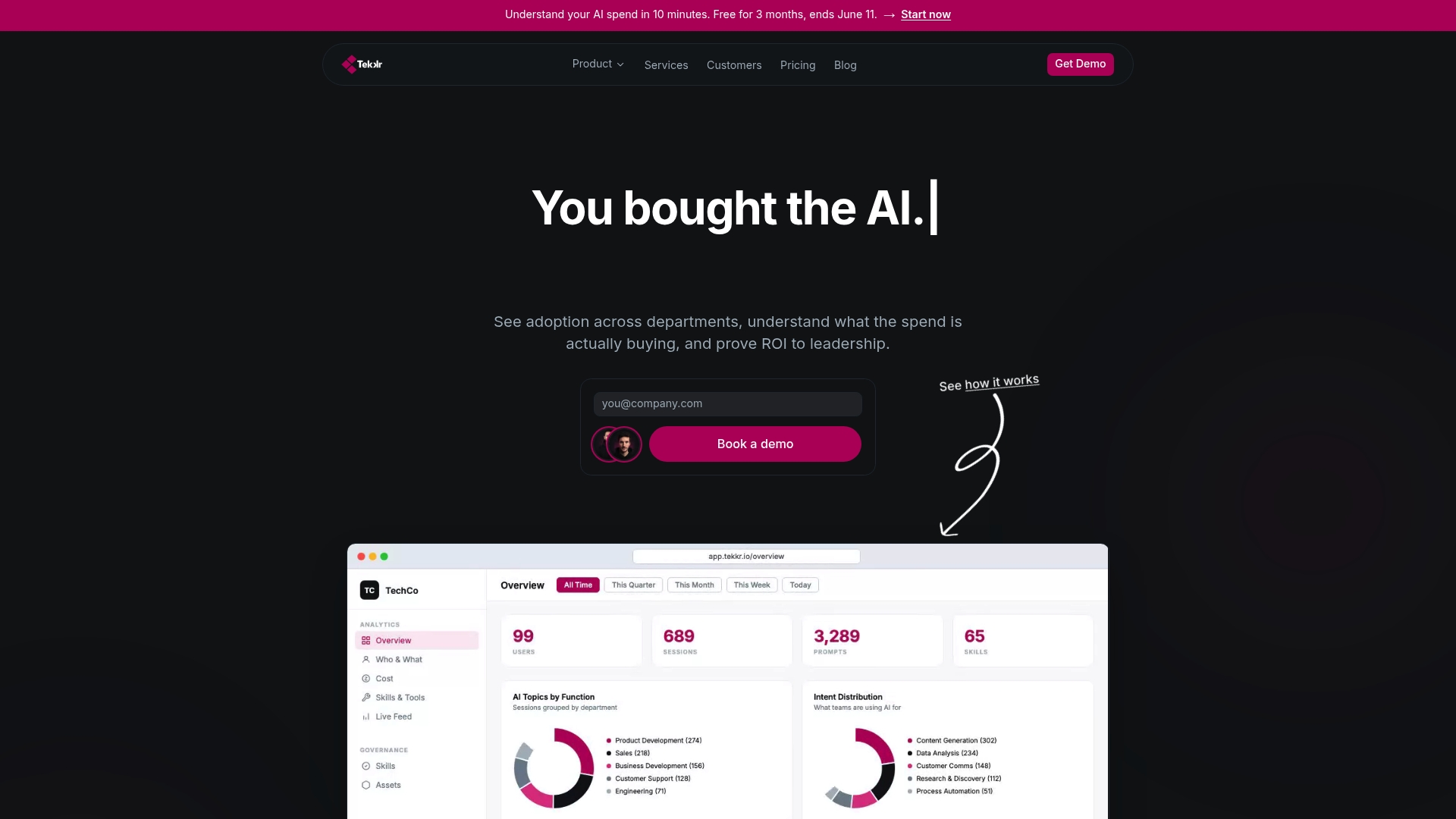
Configurato tracks real AI tool usage across every team, breaks down spend by department, surfaces which use cases are actually generating value, and runs gamified adoption programs that move the numbers rather than just report them. The AI adoption platform is GDPR-compliant, requires no browser extensions, and goes live in about 10 minutes. There is a free tier with no credit card required, so you can see exactly what your organization’s AI adoption looks like before committing to anything. Start your free account at tekkr.io today.