
A lean AI stack is the smallest set of governed, modular AI components your team needs to move work reliably from input to execution — without duplicated context, unclear ownership, or tools nobody actually uses. Think of it as the minimal viable architecture for AI operations: every layer earns its place or gets cut.
Lean expert Art Smalley frames it precisely: AI impact equals Technology × Behavior × Management. If any factor is zero, the product is zero. That formula is the governing logic behind a lean AI stack. Tekkr’s Configurato is built around exactly this model, measuring all three dimensions across your organization so you can see where the multiplier is breaking down.
Three things to take away immediately: first, governance is what makes a stack lean, not just the tool count. Second, start with a pilot scoped to one value stream before you add components. Third, you can’t prove ROI on what you can’t measure.
Table of Contents
- What does a lean AI stack actually include?
- Why a lean stack beats best-in-class tool stacking
- How to design your lean AI stack from scratch
- Governance and cost control: what keeps a stack lean
- Which KPIs actually prove your stack is working?
- A minimal reference stack for US growth-stage teams
- Pilot-to-scale timeline and who does what
- Anti-patterns that will bloat your stack fast
- Key Takeaways
- The measurement gap nobody talks about
- Configurato gives your lean AI stack a control layer
- Useful sources for going deeper
What does a lean AI stack actually include?
A lean stack has eight layers, each with a clear job. Strip any of them out and you lose either capability or auditability.
- Input/ingestion: Raw data, documents, or API events entering the system.
- Vector store/memory: Embeddings that give the model retrievable context (Pinecone, Weaviate, or pgvector are common choices).
- Retrieval (RAG): Pulls relevant context at query time so the model answers from your data, not just its training weights.
- Model layer: A managed LLM API (OpenAI GPT, Anthropic Claude) or a self-hosted open-source model. Swappable via a model gateway.
- Orchestration/workflow: LangChain, LlamaIndex, or a lightweight custom router that sequences calls and handles retries.
- App/integration layer: The surface your users actually touch — Slack bot, internal dashboard, API endpoint.
- Monitoring and observability: Latency, failure rates, token costs, and prompt logs. Non-negotiable from day one.
- Governance/metadata: Ownership tags, access controls, PII redaction rules, and audit trails.
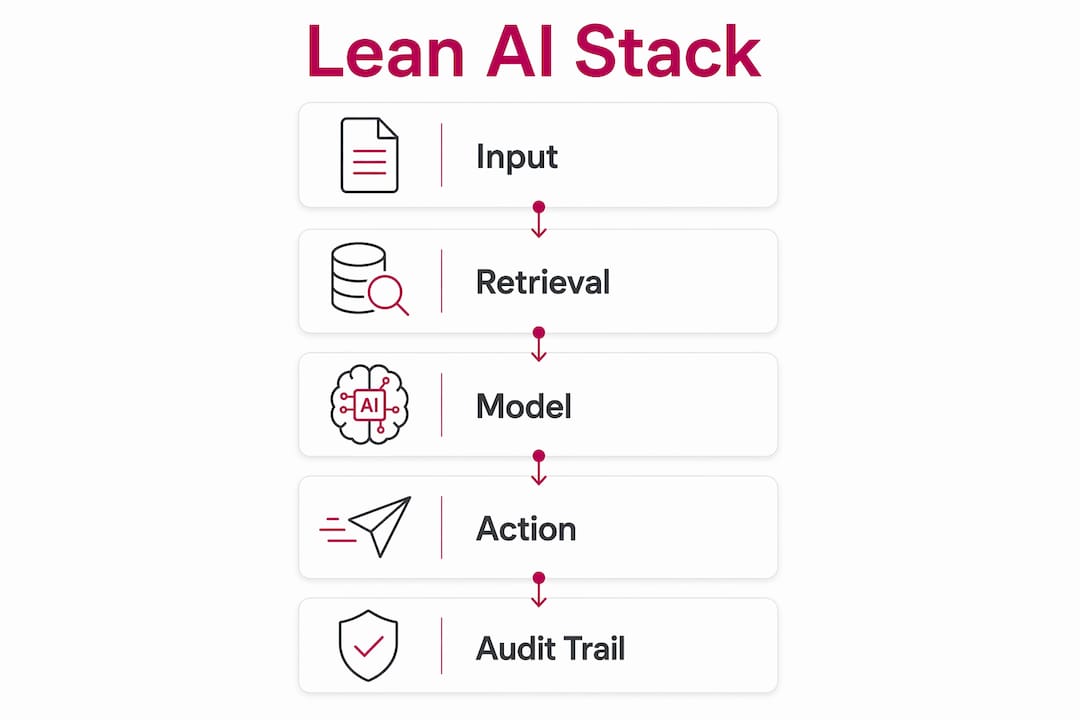
The data flow is linear: input → retrieval → model → action → audit trail. The key architectural decision is the model gateway. A LiteLLM-style toggle lets you swap GPT-4o for Claude 3.5 Sonnet without rewriting orchestration code, which is the practical meaning of modular, swappable components.
Pro Tip: Apply the 2-Tool Rule for early-stage teams: one primary coding or reasoning surface (say, Claude for drafting and analysis) and one fallback layer (GPT for structured output). Add a third tool only when you can name the specific bottleneck it solves.
Why a lean stack beats best-in-class tool stacking
The Lean Enterprise Institute draws a sharp line between extraction and amplification. Extraction replaces people. Amplification makes people more effective problem-solvers. A lean stack is built for amplification, and that distinction shapes every architectural choice.
Best-in-class stacking feels rational at the time. You pick the top-rated tool for each job. But tool sprawl creates system-level chaos: fragmented context, handoff friction, and hidden operating costs that dwarf the subscription fees. The primary failure mode is building from tools outward instead of from workflow inward.

A lean approach delivers four concrete business outcomes: faster iteration (weeks to pilot, not quarters), predictable costs because every component has an owner and a budget tag, clearer accountability because ownership is explicit, and safer pilots because the scope is narrow enough to measure.
How to design your lean AI stack from scratch
The Lean AI methodology is explicit: define and optimize the business problem before you touch a tool. Value-stream mapping comes first. Tool selection comes last.
- Define the value stream. Pick one workflow with a measurable output — support ticket resolution time, contract review cycle, code review throughput.
- Map data and decision points. Where does a human currently make a judgment call? That’s where AI can amplify.
- Select minimal components. Use the eight-layer checklist above. Start with managed APIs to minimize ops overhead.
- Assign ownership and SLAs. Every component needs a named owner and an uptime/latency expectation.
- Instrument observability first. Wire up logging before you go live, not after something breaks.
- Pilot with human-in-the-loop. The model suggests; a human approves. Expand automation only after the suggestion quality clears your threshold.
| Role | Primary Responsibility | Escalation Point |
|---|---|---|
| Engineering Lead | Component selection, integration, SLA monitoring | Architecture decisions, vendor changes |
| Product Manager | Use-case scoping, adoption metrics, user feedback | Scope creep, feature prioritization |
| AI Governance Owner | Policy, PII rules, audit trail, compliance | Any data-handling exception |
| Data Steward | Data quality, ingestion pipelines, vector store hygiene | Schema changes, data access requests |
Pilot success criteria include measurable improvements such as increased adoption, low latency, controlled token costs, and tangible KPI gains like time saved or error rate reduced, all demonstrable via dashboards.
Governance and cost control: what keeps a stack lean
Governance is the operational cost that defines whether a stack is lean or bloated. Without it, subscription creep sets in within months.
The AI necessity test involves quick checks before adding any tool: whether it addresses a specific bottleneck, has an assigned owner with a budget, and whether its impact can be measured promptly. Tools that fail these criteria should be deferred.
Effective cost-control involves usage caps per team, spend alerts near budget limits, centralized billing by departments and uses, and regular audits that consolidate or remove tools with low active usage.
On privacy: strip PII from prompts before they leave your network. Encrypt data in transit and at rest. For US companies handling data from EU users, GDPR-aligned prompt anonymization is not optional. Tekkr’s Configurato handles this automatically with end-to-end encryption and automatic PII stripping — no browser extensions required.
Which KPIs actually prove your stack is working?
Measure both operational health and business effect. Operational metrics tell you the stack is running; business metrics tell you it’s worth running.
| Metric Category | Metric | Target / Threshold |
|---|---|---|
| Usage | Active users / total licensed users | Above 40% weekly |
| Usage | Tasks completed via AI vs. manual baseline | Trending up month-over-month |
| Technical | request latency | Under 3 seconds |
| Technical | Failure / error rate | Below 2% of requests |
| Technical | Token cost per task | Within budgeted cap |
| Business | Time saved per user per week | Measurable vs. pre-pilot baseline |
| Business | Cycle time reduction on target workflow | Quantified in weekly review |
Weekly review: check latency, error rate, and active user count. Monthly review: compare cycle time and time-saved against the pre-pilot baseline, review token spend by team, and flag any tool with declining usage. For AI adoption best practices that tie these metrics to executive reporting, Tekkr’s playbooks are a practical starting point.
- Report adoption rate and cost-per-task to the executive team monthly.
- Flag any metric that misses threshold for two consecutive weeks as a governance escalation.
- Version your prompts and treat prompt regression tests as part of CI, not an afterthought.
A minimal reference stack for US growth-stage teams
A workable baseline for a 20–200 person company: OpenAI GPT-4o or Anthropic Claude 3.5 Sonnet as the managed model layer (swap via LiteLLM), Pinecone or pgvector for retrieval, LangChain or LlamaIndex for orchestration, Datadog or LangSmith for observability, and Tekkr’s Configurato for governance, spend tracking, and adoption analytics.
Prefer managed APIs when you need to ship fast and ops bandwidth is limited. Move to self-hosted open-source models (Llama 3, Mistral) only when you have a compliance requirement that prohibits third-party data processing, or when token costs at scale justify the infrastructure overhead. Startups that favor managed LLMs consistently ship pilots in weeks rather than quarters. Add fine-tuning or dedicated inference infrastructure only after the managed baseline proves the use case.
For teams with no dedicated IT function, bootstrapping AI adoption without heavy infrastructure is achievable with this stack.
Pilot-to-scale timeline and who does what
A 6–12 week cadence keeps pilots governable without stalling momentum.
- Weeks 0–2 (Discovery): Map the value stream, define success criteria, assign roles, confirm data access.
- Weeks 3–6 (Build and instrument): Wire up components, deploy observability, run internal testing with human-in-the-loop review.
- Weeks 7–9 (Controlled rollout): Release to a defined user group (10–20 people), collect feedback, monitor all KPIs daily.
- Weeks 10–12 (Measure and decide): Compare results to success criteria. Scale, pivot, or stop — with data, not opinion.
| Role | Weeks 0–2 | Weeks 3–6 | Weeks 7–12 |
|---|---|---|---|
| Engineering Lead | Architecture, data access | Build, integrate, test | Monitor, fix, optimize |
| Product Manager | Scope, success criteria | User stories, feedback loops | Adoption tracking, reporting |
| AI Governance Owner | Policy, PII rules | Audit trail setup | Compliance review |
| Data Steward | Data audit, pipeline design | Ingestion, vector store | Quality monitoring |
| Security | Threat model | Encryption, access controls | Incident response readiness |
The role of leadership in AI adoption is to remove blockers at each gate, not to approve every technical decision. Escalation paths should be defined in week one.
Anti-patterns that will bloat your stack fast
Most lean stacks fail not at launch but at week six, when the first round of “just add one more tool” requests arrives.
Subscription creep: You add tools faster than you retire them. Fix: enforce the AI necessity test before every new procurement. Any tool that fails the three-question check goes on a 30-day hold.
Duplicated context: Two tools solving the same problem with different data sources, producing inconsistent outputs. Fix: consolidate to one authoritative retrieval layer and one model gateway. Why AI tools go unused often traces back to exactly this — users distrust outputs when they can’t tell which source the model used.
Replacing people instead of amplifying them: Automating a workflow end-to-end before you understand it, then discovering the edge cases that required human judgment. Fix: keep human-in-the-loop for any decision with downstream consequences until the model’s accuracy clears a defined threshold.
Quick-fix checklist: run an ownership review (every component has a named owner or it gets flagged), consolidate context sources to one retrieval layer, and kill any subscription with under 40% active usage in the last 30 days.
Key Takeaways
A lean AI stack delivers value only when governance, measurement, and a minimal set of components work together from the start.
| Point | Details |
|---|---|
| Governance defines leanness | A stack is lean because of ownership rules and an AI necessity test, not just a low tool count. |
| Start with value-stream mapping | Define the business problem and map data flows before selecting any component. |
| 2-Tool Rule for pilots | One primary model surface, one fallback — add a third only when you can name the bottleneck it solves. |
| Measure both layers | Track operational health (latency, error rate) and business effect (time saved, cycle time) every week. |
| Tekkr’s Configurato | Tracks adoption, spend, and ROI across your stack with automatic PII stripping and a 10-minute setup. |
The measurement gap nobody talks about
Most articles on lean AI stacks spend 80% of their words on architecture and about two sentences on measurement. That’s backwards. The architecture is the easy part — there are only so many ways to wire a RAG pipeline. The hard part is proving, six months after launch, that the stack is still earning its keep.
The teams that get this right treat AI adoption incentives and measurement as first-class design requirements, not afterthoughts. They instrument before they ship. They define what “working” looks like in week one, not week ten. And they use governance not as a compliance checkbox but as the mechanism that keeps the stack from drifting into bloat.
The amplification framing from the Lean Enterprise Institute matters here too. If your stack is replacing judgment calls that humans were actually good at, you’re not building a lean stack — you’re building a liability. The goal is a system where your best people make better decisions faster, with AI handling the retrieval and synthesis work that doesn’t require their judgment.
Configurato gives your lean AI stack a control layer
Most teams that build a lean AI stack get the architecture right and then lose visibility the moment it scales. Costs drift. Adoption stalls in certain departments. Nobody knows which use cases are actually delivering value.
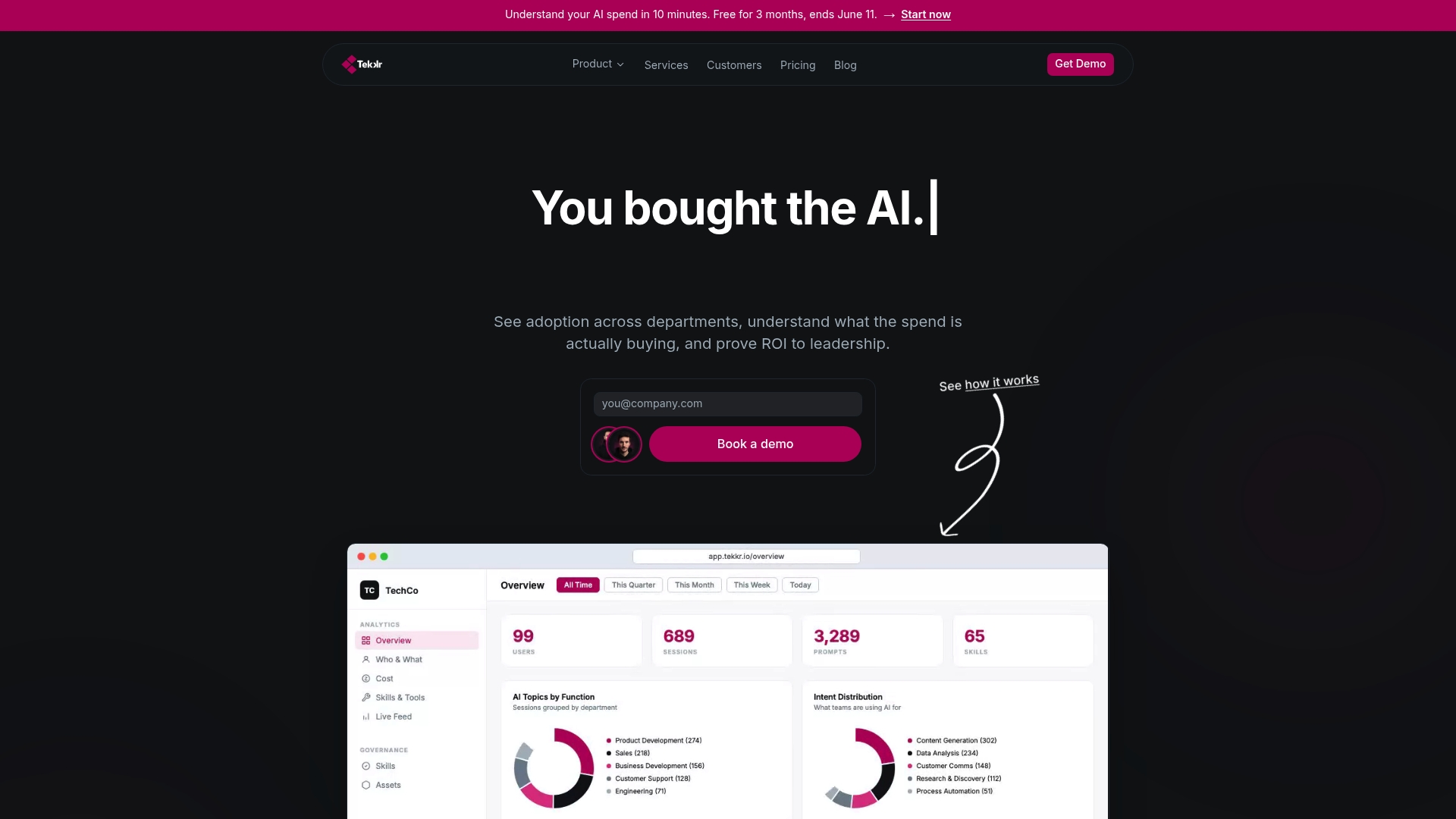
Tekkr’s Configurato is the governance and measurement layer your stack is missing. It tracks who’s using Claude, Codex, and other tools across your organization, breaks down token costs by team, surfaces which use cases are generating real productivity gains, and drives adoption through gamified playbooks and leaderboards. Everything runs in a privacy-first, end-to-end encrypted architecture with automatic PII stripping — no browser extensions, no IT project, setup in about 10 minutes. There’s a free tier with no credit card required.
If you’ve built the stack and now need to prove it’s working, see how Configurato fits your governance and reporting needs.
Useful sources for going deeper
- Lean AI: Extraction vs. Amplification — Lean Enterprise Institute. The foundational read on why amplification beats extraction. Start here for the philosophical grounding.
- Art Smalley on Lean AI. The Technology × Behavior × Management framework in full. Essential for governance and organizational design.
- Build Your First Lean AI System. Practical component-level guidance on modular architecture and model gateways. Best for engineering leads.
- Lean AI and the Seven Wastes — Artefact. Maps classical lean waste categories to AI project failure modes. Use for governance design.
- Lean AI Stack for Startups — ASEANup. Managed-first blueprint for growth-stage teams. Best for reference stack and timeline decisions.
- Lean AI Stack Case Study — Entrepreneur AI Tools. Real-world framing of stack creep and context fragmentation. Read before your first subscription audit.
- Tekkr Blog — AI Adoption Strategies. Tekkr’s practitioner playbooks for prioritizing AI investments and measuring enterprise value.