
End-to-end encrypted AI means your organization’s data stays encrypted from the moment it leaves your device until it returns as a model output, with plaintext accessible only at your enterprise endpoints, never by the AI provider, cloud infrastructure, or any intermediary. That single architectural guarantee is what separates genuine AI privacy protection from the standard “we encrypt your data in transit” assurance most vendors offer.
TL;DR for executives:
- E2EE AI satisfies core GDPR data minimization principles and aligns with NIST AI RMF governance controls by ensuring the provider never sees sensitive plaintext.
- The most consequential procurement decision is whether you trust a hardware enclave (TEE) or require a cryptographic guarantee (FHE/MPC) — each carries different cost, latency, and risk tradeoffs.
- Standard TLS and encryption at rest are not E2EE. If your vendor’s AI processes plaintext on their servers, you do not have end-to-end encryption.
- Start with a narrow, high-value pilot workflow before committing to infrastructure investment.
Table of Contents
- What is end-to-end encrypted AI, and how does it differ from standard encryption?
- What does E2EE actually protect against in an AI pipeline?
- Which deployment pattern fits your privacy, cost, and latency requirements?
- Common misconceptions that derail enterprise E2EE AI deployments
- How to evaluate vendors: a procurement checklist and 10 questions to ask
- A three-phase roadmap from pilot to scale
- How Tekkr’s Configurato approaches E2EE and enterprise AI privacy
- Authoritative sources and further reading
- Key Takeaways
- What to prioritize in the next quarter
- Tekkr helps you measure AI adoption without the privacy risk
What is end-to-end encrypted AI, and how does it differ from standard encryption?
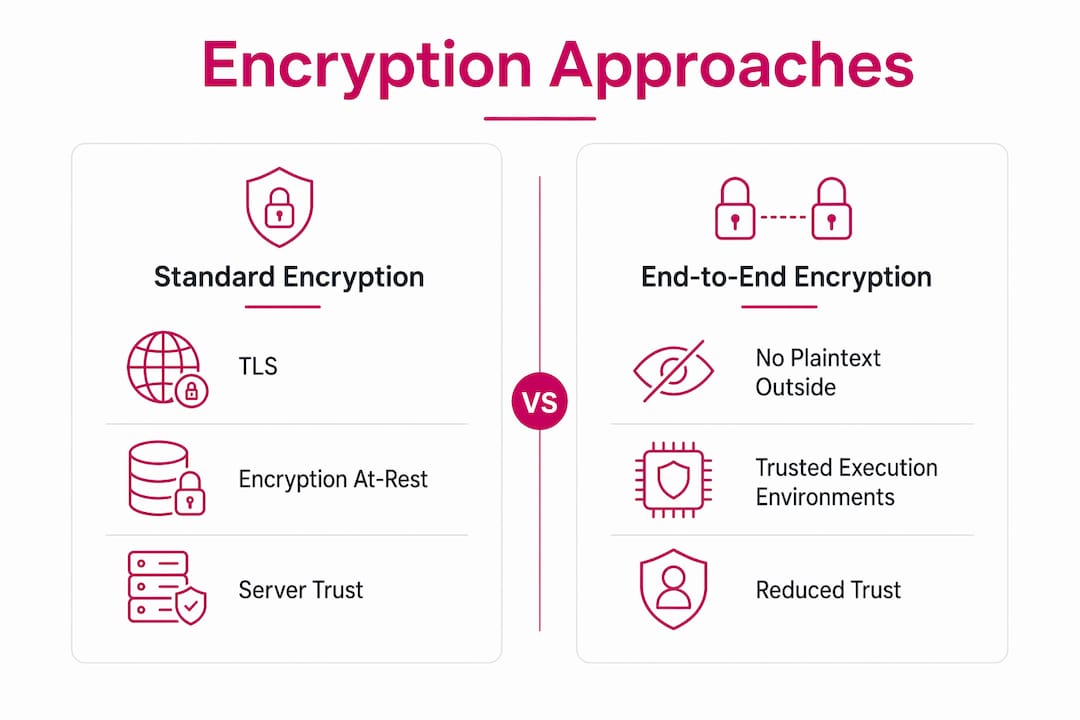
Most enterprise AI deployments encrypt data in two places: in transit (TLS between your browser and the server) and at rest (encrypted storage). Both are table stakes, and neither is E2EE. The difference is where decryption happens. With standard cloud AI, your prompt travels encrypted to the provider’s server, decrypts there, gets processed in plaintext, and the response travels back encrypted. The provider’s infrastructure sees everything.
True end-to-end encryption for AI closes that gap. Plaintext never exists outside your device and the protected processing environment. The AI provider’s operations team, cloud hypervisor, and any network intermediary see only ciphertext throughout.
| Approach | What it guarantees | Who you must trust | Cost/feasibility |
|---|---|---|---|
| TLS + encryption at rest | Data protected in transit and storage | Provider sees plaintext during inference | Low cost, standard |
| Client-side encryption | Data encrypted before leaving device | Provider cannot read inputs; outputs may still be plaintext | Low-medium cost |
| TEE (Trusted Execution Environment) | Inference runs in hardware-isolated enclave; provider cannot inspect memory | Hardware vendor + attestation integrity | Medium cost, available now |
| MPC (Multi-Party Computation) | Computation split across parties; no single party sees full plaintext | Participating nodes | High cost, limited model support |
| FHE (Fully Homomorphic Encryption) | Computation on ciphertext; no decryption ever | Mathematics only | Very high cost, improving rapidly |
TEEs are the most practical near-term option for off-device inference. FHE offers stronger mathematical guarantees but carries significant compute overhead, though that gap is narrowing. NYU researchers Austin Ebel, Karthik Garimella, and Professor Brandon Reagen introduced Orion, a framework that achieves a notable speedup over prior FHE methods on ResNet-20 and demonstrated the first high-resolution FHE object detection using YOLO-v1 with a large number of parameters, a meaningful step toward practical FHE for enterprise workloads.
Pro Tip: For most enterprises in 2026, TEEs are the realistic starting point. Require hardware attestation verification from any vendor claiming TEE-based E2EE — attestation is the mechanism that lets you confirm the enclave is genuine, not just a marketing claim.
What does E2EE actually protect against in an AI pipeline?
E2EE is designed to neutralize a specific set of adversaries: external attackers who compromise the provider’s servers, provider insiders with database or log access, and network-level eavesdroppers. If your threat model centers on the AI vendor seeing your proprietary data or a breach of their infrastructure exposing your prompts, E2EE addresses that directly. Encrypting data throughout the AI pipeline prevents the infrastructure provider from accessing sensitive information even when processing it.
What E2EE does not protect against is a longer list than most vendors acknowledge:
- Endpoint exfiltration: A user copying a plaintext response into an unprotected app, taking a screenshot, or syncing outputs to an unencrypted backup breaks the guarantee entirely.
- Metadata leakage: Query timing, frequency, token counts, and routing headers remain visible even when content is encrypted.
- Agentic AI behavior: When an AI agent takes actions (browsing, writing files, calling APIs), those actions occur in plaintext environments outside the encrypted pipeline.
- Policy and authorization gaps: Encryption protects data content, not who is authorized to request it. A compromised credential grants the same access as a legitimate user.
- Model output logging: If your deployment logs model responses for debugging or quality review, those logs may contain plaintext even when the pipeline is encrypted.
Researchers warn that integrating AI features into E2EE applications does not automatically preserve E2EE guarantees. Unless processing remains endpoint-local or is cryptographically protected, offloading to a cloud AI service silently voids the encryption promise — and user consent for that tradeoff must be explicit, not buried in terms of service.
Source: “How To Think About End-To-End Encryption and AI”, cryptography research, 2024
The Cloud Security Alliance makes the same point from a governance angle: encryption is not a substitute for access controls, policy enforcement, and audit trails. An encrypted pipeline with weak authorization is still a serious risk.
Which deployment pattern fits your privacy, cost, and latency requirements?
| Pattern | Privacy | Cost | Accuracy/Capability | Latency |
|---|---|---|---|---|
| On-device inference | Highest | High (device hardware) | Limited (small models) | Lowest |
| Edge-assisted split inference | High | Medium | Moderate | Low-medium |
| Cloud inference in TEEs | High (trust hardware) | Medium-high | Full cloud models | Medium |
| MPC workflows | Very high | Very high | Limited | High |
| FHE workflows | Highest (math-based) | Highest | Limited, improving | Highest |
On-device inference keeps data entirely local but restricts you to smaller models. TEE-based cloud inference gives you access to full-scale models with strong privacy, provided you verify attestation. TEEs decrypt inside a hardware enclave and require trusting the hardware vendor; FHE performs computation on ciphertext with no decryption, but compute costs remain substantial. AWS SageMaker with FHE via concrete-ml demonstrates that fully encrypted ML inference is achievable today, though it requires asynchronous inference patterns due to evaluation time.

Primary cost drivers: model size, required latency, key management infrastructure, audit and compliance overhead, and whether you need real-time or batch inference. A TEE-based pilot for a document classification workflow will cost far less than an FHE deployment for real-time NLP.
Pro Tip: Restrict your first pilot to one high-value, low-throughput workflow — legal contract review or HR document processing are common starting points. This limits infrastructure spend while generating real attestation and latency data before you commit to broader architecture decisions.
Common misconceptions that derail enterprise E2EE AI deployments
The most expensive mistake is conflating TLS with E2EE. TLS protects the channel; it says nothing about what the server does with your data once it arrives. Vendors who describe their service as “encrypted” without specifying where decryption occurs are almost always describing TLS, not E2EE.
A second common failure: trusting provider attestations without independent verification. Attestation is only meaningful if you verify the cryptographic proof yourself or through an independent auditor. A vendor’s self-reported claim that their TEE is secure is not attestation.
Operationally, weak key management is where many deployments break down. Using the same encryption key across multiple tenants, failing to rotate keys after personnel changes, or storing keys in the same environment as the data they protect all undermine the architecture. The Cloud Security Alliance recommends dedicated key management systems with separated custodian roles and regular rotation policies.
Two scenarios that appear regularly in post-incident reviews: a developer copies production prompts into a staging environment that lacks encryption controls, and those prompts contain customer PII. Or a model fine-tuning pipeline inadvertently ingests E2EE content as training data. Using E2EE content to train shared AI models is fundamentally incompatible with E2EE unless processing stays endpoint-local and third parties never see the content.
How to evaluate vendors: a procurement checklist and 10 questions to ask
Priority checklist (weight in this order):
- Independent third-party audit of the encryption architecture (not a self-assessment)
- Hardware attestation verification available to the customer, not just the vendor
- Key management: customer-controlled keys, dedicated KMS, documented rotation policy
- Contractual guarantee that E2EE data is never transformed to plaintext for support or model improvement
- GDPR data processing agreement with explicit data residency and retention terms
- NIST AI RMF alignment documentation
- Logging and auditability: what is logged, where, and who can access it
- Training data policy: explicit prohibition on using customer data for model training
10 procurement questions:
- Where does decryption occur, and can you provide cryptographic attestation proof?
- Does your support team ever access plaintext customer data? Under what conditions?
- Is our data used to train or fine-tune any shared model?
- What key management system do you use, and do customers control their own keys?
- How do you handle key rotation, and what is the documented rotation policy?
- What third-party audits have been conducted on your E2EE implementation, and can we see the reports?
- What metadata is retained (query timing, token counts, routing data)?
- How do you handle agentic AI actions that occur outside the encrypted pipeline?
- What is your breach notification process, and what data would be exposed in a TEE compromise?
- How does your architecture align with NIST AI RMF Govern and Manage functions?
Weight privacy guarantees and independent attestation above all else. A vendor with a polished compliance dashboard but no independent audit is a higher risk than one with a simpler interface and a verified TEE attestation chain.
A three-phase roadmap from pilot to scale
Phase 1 — Pilot (weeks 1–8): Select one workflow with high data sensitivity and low transaction volume. Deploy with TEE-based inference or on-device processing. Track: successful E2EE attestations per session, data-exposure incidents (target zero), latency delta versus unencrypted baseline, and model accuracy delta.
Phase 2 — Validate (weeks 9–16): Run a security review against your GDPR data processing obligations and NIST AI RMF Govern controls. Bring in an independent auditor to verify attestation integrity. Measure adoption rate and cost per use case. Confirm key management procedures are operational and documented.
Phase 3 — Scale (weeks 17+): Extend to additional workflows using the governance and observability framework built in Phase 2. Implement automated PII stripping at ingestion, enforce non-export policies for model outputs, and add AI governance strategies that complement your technical controls. Monitor cost drivers quarterly: TEE infrastructure costs, key management overhead, and audit effort tend to grow nonlinearly with data volume.
Pro Tip: Assign a named key custodian before Phase 1 ends. Key management failures are almost always organizational, not technical — someone needs to own rotation schedules, access reviews, and incident response for the KMS.
How Tekkr’s Configurato approaches E2EE and enterprise AI privacy
Tekkr built Configurato on a privacy-first architecture specifically because enterprise AI adoption data is sensitive. The platform tracks AI tool usage, spend, and productivity across your organization without exposing employee behavior or prompt content to Tekkr’s infrastructure.
Configurato’s privacy design includes:
- End-to-end encrypted architecture for all adoption and usage data
- Automatic PII stripping that anonymizes prompts before any analytics processing
- GDPR-compliant data handling with no browser extensions required
- Auditability controls that let your security team verify what data is collected and how it is processed
- Setup in approximately 10 minutes, with a free tier and no credit card required
For enterprises running pilots on tools like Claude or Codex, Configurato provides the security and privacy controls needed to measure adoption without creating new data exposure risks. Optional consulting support is available for teams designing their pilot architecture and governance framework.
Authoritative sources and further reading
The sources below are the most credible references for enterprise decisions on E2EE AI:
- NYU Tandon — Orion FHE framework: Demonstrates practical FHE for deep learning, including a 2.38x speedup over prior methods and the first high-resolution FHE object detection — the clearest evidence that FHE for enterprise AI is approaching viability.
- Matthew Green — “Let’s talk about AI and end-to-end encryption”: The most precise public explanation of the TEE vs. FHE distinction and why E2EE technically ends at the device edge when outputs are exported.
- arXiv — “How To Think About E2EE and AI”: Academic framework for evaluating when AI integration voids E2EE guarantees; essential for procurement and consent policy design.
- Cloud Security Alliance — Data security within AI environments: Industry guidance on encryption in use, governance, segmentation, and audit trails across the AI lifecycle.
- AWS — E2EE ML inference with SageMaker and FHE: Practical implementation reference for FHE-based inference in a managed cloud environment, including known constraints on model size and latency.
- Trustible — Data Encryption and AI Risk Mitigation: Concise mapping of how E2EE satisfies GDPR and NIST AI RMF requirements by preventing provider access to plaintext.
Key Takeaways
End-to-end encrypted AI requires controlling the full pipeline from ingestion through inference to output delivery — encryption at rest and in transit alone does not qualify.
| Point | Details |
|---|---|
| E2EE vs. standard encryption | TLS and at-rest encryption are not E2EE; plaintext must never exist outside your endpoints and the protected processing environment. |
| TEEs vs. FHE | TEEs are the practical near-term option but require trusting hardware attestation; FHE offers math-based guarantees at higher compute cost. |
| What E2EE doesn’t cover | Endpoint exfiltration, metadata, agentic actions, and authorization gaps all fall outside E2EE’s protection scope. |
| Procurement priority | Weight independent audits and verifiable attestation above all vendor claims; require contractual guarantees on training data usage. |
| Tekkr Configurato | Tekkr’s Configurato measures AI adoption with a privacy-first, end-to-end encrypted architecture, automatic PII stripping, and GDPR compliance built in. |
What to prioritize in the next quarter
The gap between “we use encryption” and “we have genuine E2EE AI” is where most enterprise risk lives right now. My recommendation for the next 90 days: narrow your pilot to one workflow where data sensitivity is highest and transaction volume is low enough to measure carefully. Assign your security team to run the vendor checklist above against every AI tool currently in production, not just the ones under evaluation. Require independent attestation as a non-negotiable procurement condition before any new AI contract is signed. These three steps cost almost nothing compared to the exposure of discovering, post-breach, that your “encrypted” AI pipeline decrypted everything on the provider’s server.
Tekkr helps you measure AI adoption without the privacy risk
If you’ve invested in AI tools across your organization, the next problem is proving they’re working without creating new data exposure. Tekkr’s Configurato gives you full visibility into AI adoption, spend, and productivity by team — with a privacy-first, end-to-end encrypted architecture that anonymizes prompts automatically and requires no browser extensions.
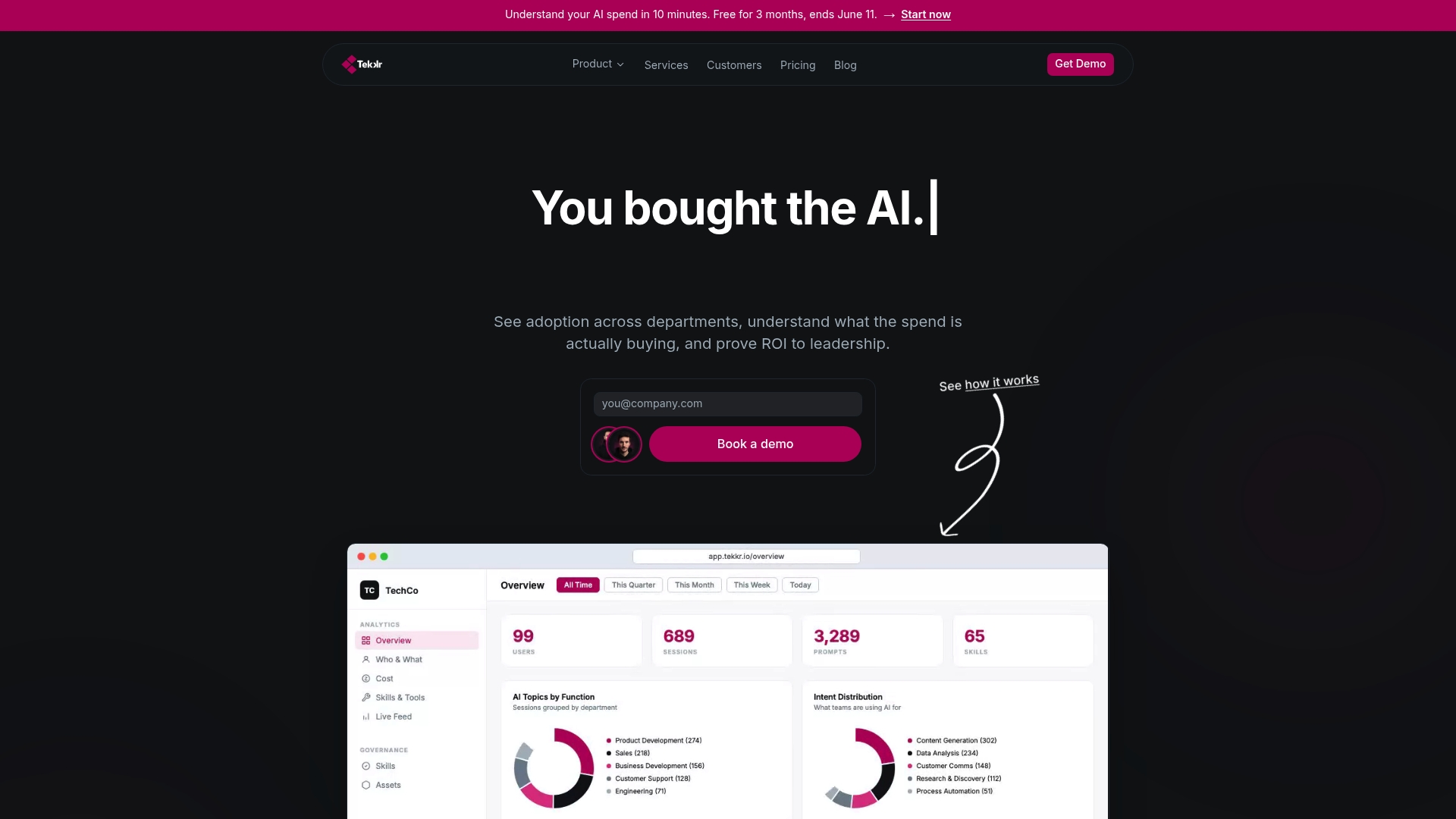
You get the adoption analytics and ROI reporting your leadership team needs, built on the same privacy principles this article covers. For enterprises designing their first E2EE AI pilot, Tekkr’s AI adoption consulting can help scope the architecture, set KPIs, and run the governance review. Setup takes about 10 minutes. Start with the free tier at tekkr.io — no credit card required.