
What is AI implementation speed, and why does it define competitive advantage?
AI implementation speed is the total elapsed time from when an enterprise commits to an AI initiative to when that system runs in production and generates measurable business value. It covers every stage: scoping, data preparation, model selection, integration, testing, and live deployment. The faster that cycle runs, the sooner the organization captures returns on its AI investment.
The numbers tell a striking story. Median time from pilot to production for Global 2000 enterprises dropped to 4.2 months in Q1 2026, down from 11 months in 2024. That compression did not happen by accident. Inference costs fell 99% over two years as chip efficiency and software frameworks advanced, making rapid iteration far more affordable. At the same time, 78% of Global 2000 companies already have AI workloads running in production, which means the baseline expectation has shifted. Speed is no longer a differentiator for early adopters. It is the entry requirement.
Why does this matter to you specifically? Because the window between “we’re piloting AI” and “our competitor has AI in production” is now measured in weeks, not years. Executives who treat deployment as a slow, careful, one-time project are operating on a timeline that the market has already abandoned.
Key reasons AI implementation speed has become a strategic priority in 2026:
- Competitive positioning: First movers capture market share, customer data, and operational learnings that compound over time.
- Cost efficiency: Faster deployments reduce the carrying cost of AI projects, including team time, infrastructure spend, and opportunity cost.
- Organizational learning: Teams that deploy quickly iterate, building institutional knowledge that slower organizations cannot replicate.
- Executive mandate: 88% of CEOs now rank deployment velocity above model accuracy as their primary AI priority.
- Market valuation: Investors and boards increasingly reward companies that demonstrate operational AI velocity, not just AI investment.
Typical AI implementation timelines and phases enterprises can expect
The five core phases of an AI deployment
Every enterprise AI project moves through roughly the same sequence, even when the tools and teams differ. Understanding where time actually goes is the first step toward compressing it.
Phase 1: Discovery and scoping This phase defines the business problem, identifies data sources, and sets success metrics. Teams that skip or rush this phase almost always pay for it in Phase 3 or 4, when misaligned requirements surface as expensive rework.
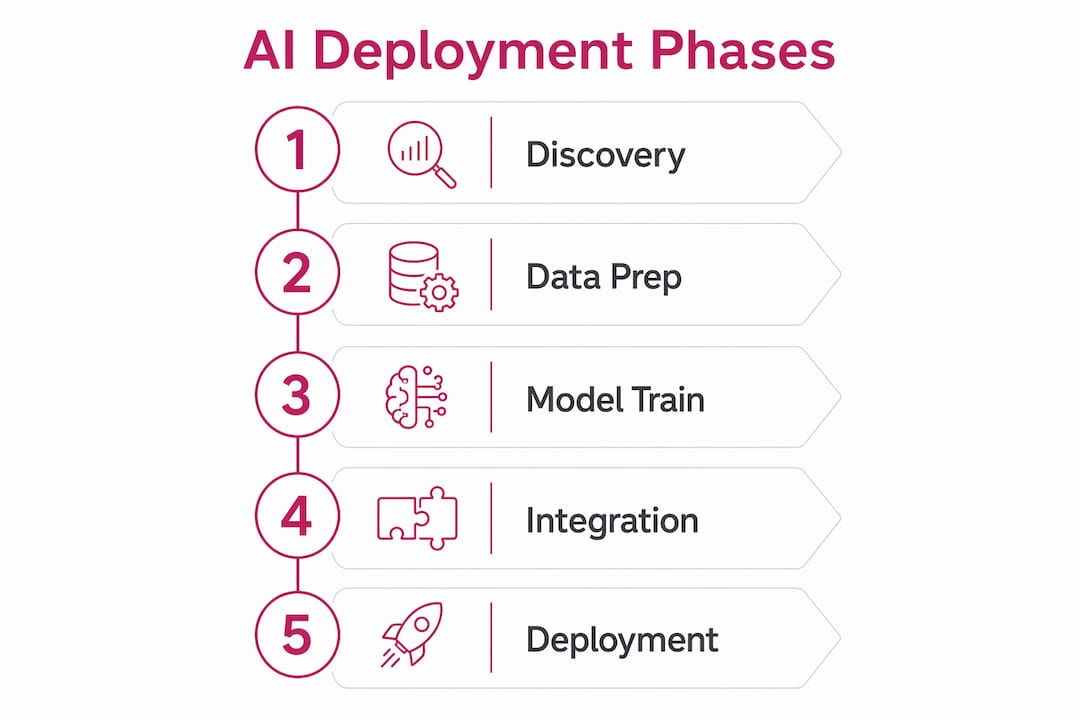
Phase 2: Data preparation and pipeline setup Data quality is the single most common reason AI projects run late. Cleaning, labeling, and structuring data for model training or fine-tuning takes longer than most project plans anticipate. Organizations with mature data infrastructure can compress this significantly.

Phase 3: Model development and training
For most enterprise use cases in 2026, this phase involves fine-tuning a foundation model rather than training from scratch. That shift alone has cut weeks off typical timelines. Tools like PyTorch’s torch.compile and quantization techniques have further accelerated model readiness.
Phase 4: Integration and testing Connecting an AI model to existing systems, APIs, and workflows is where many projects stall. Security reviews, compliance checks, and user acceptance testing all add time. This phase also surfaces the gap between a model that performs well in isolation and one that performs well inside a real production environment.
Phase 5: Deployment and iteration Production deployment is not the finish line. Monitoring model drift, retraining on new data, and rolling out improvements are continuous activities. Enterprises that treat deployment as a one-time event consistently underperform those that build for ongoing iteration.
How long does AI implementation actually take?
Timeline varies significantly by project complexity and organizational readiness.
| Project type | Typical timeline | Primary time driver |
|---|---|---|
| Simple automation (RPA + AI) | 4 weeks | Integration complexity |
| NLP or classification model | 8 weeks | Data preparation |
| Generative AI feature (fine-tuned) | 6 weeks | Model evaluation and safety review |
| Custom ML system (full build) | 4 months | Data pipeline and model development |
| Enterprise-wide AI platform | — | Governance, change management, integration |
The previously mentioned median pilot-to-production time applies to mid-complexity deployments at well-prepared organizations, while others with more challenges experience significantly longer timelines.
Pro Tip: Map your data readiness before you finalize any AI project timeline. Data preparation consistently accounts for 40–60% of total project time, and most initial estimates undercount it by half.
Why faster AI rollout translates directly into business success
Speed of AI rollout is not just an operational metric. It is a revenue and competitive variable that compounds over time.

First-mover advantages in AI are real and durable
The first organization in a market segment to deploy a working AI system gains something its competitors cannot easily replicate: production data. Every interaction a live AI system handles generates feedback that improves the next version. A company that deployed six months earlier has six months of that feedback loop running. By the time a slower competitor reaches production, the gap in model quality and operational learning has already widened.
Cost reduction compounds with deployment speed
Faster deployments cost less, and the savings are not trivial. Every week a project sits in staging or testing carries real costs: team salaries, infrastructure spend, and the opportunity cost of a capability your organization does not yet have. When AI deployment cycles shorten from 11 months to 4.2 months, the freed capacity can be redirected to the next initiative. Organizations that move fast on AI are not just saving money on individual projects. They are building a portfolio of deployed capabilities faster than their peers.
Slower implementations carry compounding risk
The risk of a delayed AI rollout is not just “we launched late.” It is that competitors who launched earlier have already learned what works, iterated past their early mistakes, and moved on to the next capability. A company that takes 18 months to deploy what a competitor deployed in 5 months is not just 13 months behind. It is behind by the full value of 13 months of production learning, customer feedback, and operational refinement. That gap rarely closes on its own.
Key business outcomes tied to faster AI deployment speed:
- Reduced time to revenue from AI-enabled products and features
- Lower total cost per AI project through shorter development cycles
- Higher employee adoption rates when tools reach users faster and with less friction
- Stronger board and investor confidence in the organization’s AI execution capability
- Earlier identification of what works, enabling faster reallocation of resources
Key factors that accelerate or delay AI implementation in enterprises
Technical factors
Infrastructure readiness is the most common technical bottleneck. Fragmented and manual infrastructure processes slow deployment far more than model development itself. When environment setup requires manual configuration, teams lose days or weeks to tasks that a well-structured infrastructure-as-code approach handles in hours.
Memory bandwidth, not raw compute power, is the primary constraint on AI inference speed. During inference, a model’s weights must be read from memory for every token generated. A GPU with high memory bandwidth consistently outperforms a higher-compute GPU with slower memory access. Enterprises that optimize for bandwidth rather than headline GPU specs see faster, more responsive AI applications.
Data pipeline quality determines how quickly a model can be trained, evaluated, and updated. Clean, well-labeled, consistently formatted data cuts development time. Messy, siloed, or inconsistently structured data multiplies it.
Integration complexity with legacy systems adds weeks to most enterprise deployments. APIs that were not designed with AI in mind, authentication layers, and data format mismatches all require custom engineering work that is difficult to parallelize.
Organizational factors
Key insight: Bottlenecks in AI deployment most often stem from organizational and infrastructure complexity, not model training. Systemic changes to how teams collaborate and how infrastructure is managed have a larger impact on speed than any individual technical optimization.
Team expertise gaps slow every phase. When an organization lacks in-house ML engineers, data engineers, or AI product managers, each handoff between teams introduces delays. Cross-functional collaboration between IT, data science, legal, and business units is a prerequisite for fast deployment, not a nice addition.
Governance and approval processes that were designed for traditional software projects often add weeks to AI deployments without adding proportional risk reduction. Organizations that adapt their governance frameworks specifically for AI, with clear pre-approved criteria for common use cases, move significantly faster than those applying legacy review processes to every model update.
Change management is underestimated in almost every AI project plan. A model that is technically ready but organizationally unaccepted will not generate value. Teams that invest in user readiness in parallel with technical development consistently hit their go-live dates more reliably.
Factors that most commonly delay AI implementation:
- Undocumented or inconsistent data sources requiring manual remediation
- Legacy systems with no modern API layer, requiring custom middleware
- Security and compliance reviews that were not scoped into the original timeline
- Lack of clear ownership between IT, data science, and business teams
- Insufficient compute resources provisioned for training and inference workloads
Statistic callout: 88% of CEOs prioritize deployment velocity over model accuracy, yet many enterprise AI projects still stall in the integration and testing phase due to infrastructure and organizational friction rather than model performance.
For a deeper look at the specific blockers executives encounter when moving AI from pilot to production, Tekkr’s analysis of common AI adoption blockers covers the patterns that appear most frequently across enterprise deployments.
How responsible AI governance can speed up deployment rather than slow it down
The instinct to treat responsible AI as a speed tax is understandable but wrong. Organizations that bolt ethics reviews and compliance checks onto the end of a deployment process do experience delays. Organizations that embed those practices from the start do not.
What responsible AI means in the context of deployment speed
Responsible AI in an enterprise deployment context means building bias mitigation, privacy safeguards, audit trails, and explainability requirements into the development pipeline rather than treating them as a final gate. When these elements are designed in from Phase 1, they do not add time. They prevent the far more expensive rework that happens when a model reaches production and fails a compliance review.
IBM’s research on AI implementation confirms that ethical compliance integrated early maintains speed without compromising trust or regulatory adherence. The organizations that struggle with governance delays are almost always those that treat it as a separate workstream rather than an integrated one.
Governance practices that affect deployment timelines
- Bias auditing during development: Running bias checks on training data and model outputs during development, not after, prevents late-stage failures that require full retraining.
- Privacy-by-design architecture: Building PII handling, data anonymization, and access controls into the data pipeline from the start eliminates the compliance retrofit that delays many deployments.
- Explainability frameworks: Documenting model decision logic during development satisfies regulatory requirements and reduces the time needed for legal and compliance sign-off.
- Pre-approved use case templates: Organizations that maintain a library of governance-cleared patterns for common AI use cases can deploy new instances of those patterns without repeating the full review process.
- Continuous monitoring setup: Deploying model monitoring alongside the model itself means governance is ongoing rather than a one-time gate, which regulators increasingly require.
Embedding responsible AI practices early creates a continuous feedback loop that prevents delays and maintains trust without sacrificing speed. The organizations that move fastest on AI in 2026 are not the ones that skip governance. They are the ones that made governance fast.
Pro Tip: Build a reusable responsible AI checklist for each major use case category (e.g., customer-facing NLP, internal automation, predictive analytics). The first deployment in each category takes full review time. Every subsequent deployment in that category moves significantly faster.
What the latest 2026 data says about accelerating AI deployment speed
The numbers that define the current state
The compression in enterprise AI timelines is one of the more dramatic shifts in recent technology history. The drop from 11 months to 4.2 months median pilot-to-production time represents a fundamental change in how enterprises approach deployment, not just incremental process improvement.
The Federal Reserve’s monitoring of AI adoption in the U.S. economy found that about 18% of firms had adopted AI as of year-end 2025, with over 20% of firms expecting to use AI in the first half of 2026. Work-related generative AI adoption among individuals stands at about 41% as of November 2025. The gap between firm-level adoption and individual-level usage points to a critical insight: many organizations have purchased AI tools that their employees are not yet using at scale.
Infrastructure and organizational design patterns driving faster deployment
Industry-leading enterprises have restructured their AI deployment approach around continuous integration and delivery. Building CI/CD pipelines for AI enable hundreds of deployments monthly, treating AI infrastructure as code rather than as a one-time configuration project. This approach turns deployment from a bottleneck into a repeatable, automated process.
The organizations moving fastest share several structural characteristics. They have dedicated ML platform teams that maintain reusable infrastructure components. They use structured, reusable environment definitions that eliminate the manual configuration work that slows most deployments. And they measure deployment frequency and time-to-production as first-class engineering metrics, the same way they measure uptime or latency.
For enterprises building or refining their approach, Tekkr’s AI integration strategies for executives covers the organizational and technical patterns that consistently reduce deployment timelines.
2026 AI deployment speed benchmarks
| Metric | 2024 baseline | 2026 benchmark | Primary driver |
|---|---|---|---|
| Median pilot-to-production time | 11 months | 4.2 months | Infrastructure automation, foundation models |
| Global 2000 firms with AI in production | Minority | 78% | Reduced barriers, executive mandate |
| CEO priority: deployment velocity vs. accuracy | Minority | 88% | Market competition, ROI pressure |
| Individual work-related GenAI adoption (U.S.) | Lower | ~41% | Tool availability, organizational enablement |
The Stanford HAI 2025 AI Index documented that inference costs for a GPT-3.5-level system dropped over 280-fold between november 2022 and october 2024, with hardware costs declining 30% annually. That cost trajectory directly enables faster, more frequent deployment cycles for enterprises that would previously have been constrained by infrastructure expense.
Understanding where your organization sits relative to these benchmarks requires tracking the right metrics. Tekkr’s guide on measuring AI ROI covers the specific indicators that connect deployment speed to business outcomes, which is where the conversation with boards and investors ultimately lands.
How Tekkr helps enterprises close the gap between AI investment and AI results

Most enterprises have already bought the AI tools. The gap is not in the technology. It is in knowing whether those tools are actually being used, by whom, and whether they are generating the returns that justified the investment. That gap is exactly what Tekkr’s Configurato platform was built to close.
Configurato tracks adoption across tools like Claude and Codex, breaks down AI spend by team, surfaces which use cases are generating real productivity gains, and drives adoption higher through gamified rollouts and company-wide AI playbooks. Setup takes about 10 minutes. There is a free tier and no credit card required. Everything runs in a privacy-first, end-to-end encrypted architecture with automatic PII stripping, so you get full visibility without exposing sensitive data.
If your organization has deployed AI but cannot answer “who is actually using it and what is it worth,” Tekkr gives you that answer.
Key Takeaways
Deployment velocity is now the primary competitive variable in enterprise AI, with median pilot-to-production time dropping from 11 months in 2024 to 4.2 months in Q1 2026 for well-prepared organizations.
| Point | Details |
|---|---|
| Speed defines competitive position | The median enterprise AI deployment now takes 4.2 months, down from 11 months in 2024. |
| CEOs prioritize velocity over accuracy | 88% of CEOs rank deployment speed above model accuracy as their primary AI metric. |
| Infrastructure is the real bottleneck | Fragmented, manual infrastructure processes slow deployment more than model development itself. |
| Governance accelerates when embedded early | Responsible AI practices built into the pipeline prevent costly late-stage rework and compliance delays. |
| Adoption gap is the next frontier | 78% of Global 2000 firms have AI in production, but individual work-related GenAI adoption sits at only about 41% in the U.S. |