
For enterprise leaders who need a straight answer: Tekkr’s Configurato is the recommended platform for measuring and accelerating AI adoption in 2026. It combines privacy-first telemetry, spend-to-ROI mapping by department, and gamified enablement features that the Stanford AI Index 2026 and Deloitte’s State of AI research confirm enterprises need most right now. Setup takes about 10 minutes, there’s a free tier, and no credit card is required to start a 30-day pilot.
Quick picks for enterprise AI adoption dashboards in 2026:
- Tekkr Configurato — privacy-first telemetry, spend-to-ROI, gamified enablement, integrates with Claude, Codex, Gemini, and ChatGPT
- Anthropic Claude — high enterprise adoption growth; tracked natively by Configurato
- OpenAI Codex — developer-focused assistant; usage and cost captured via Configurato’s API connectors
- Google Gemini — rapid enterprise rollout; Configurato surfaces Gemini usage by team and use case
- ChatGPT — the most widely deployed AI assistant; Configurato tracks active users and prompt volume
Table of Contents
- Why measuring AI adoption is urgent right now
- What the best AI dashboards in 2026 must actually track
- How Configurato measures adoption and drives it higher
- How to run a 30–90 day pilot evaluation
- Key Takeaways
- The measurement-enablement gap nobody talks about enough
- Tekkr Configurato: start your pilot in 10 minutes
- Research and sources
Why measuring AI adoption is urgent right now
Organizational AI adoption hit 88% in 2026, and generative AI reached 53% adoption among the U.S. population, with an estimated $172 billion in annual consumer value. That sounds like a success story. The problem is that buying AI and actually using it well are two entirely different things.
- The median organization now runs 31 distinct AI apps; Global 2000 firms average 133 apps, according to the Netskope AI Index.
- Deloitte’s 2026 research found that worker access to AI rose 50% in 2025, yet insufficient worker skills remains the single biggest barrier to scale.
That gap between access and capability is exactly where most enterprise AI budgets leak. Without a dashboard that measures both usage and enablement, you’re flying blind on ROI.
What the best AI dashboards in 2026 must actually track
The evaluation criteria below reflect what finance, security, and product teams each need from an enterprise AI analytics tool.
KPI reference table
| KPI | Data source | Why it matters |
|---|---|---|
| DAU/MAU ratio | SSO logs, API telemetry | Reveals adoption depth vs. license waste |
| % employees using AI weekly | Usage logs, LLM connectors | C-suite headline metric |
| Model-call volume by tool | API integrations (Claude, Codex, Gemini) | Identifies which assistants drive real work |
| Cost per active user | Cloud billing + active-user count | Finance’s primary efficiency signal |
| ROI per initiative | Billing + output metrics | Justifies continued or expanded spend |
| Tagged use cases | Prompt classification, usage logs | Surfaces where AI creates the most value |
Governance and trust checklist
Any dashboard you evaluate should clear these before procurement:
- Automatic PII stripping on all prompt data
- End-to-end encryption at rest and in transit
- Audit logs with data lineage for compliance reviews
- GDPR-aligned controls and documented data flows
- No browser extension required (reduces attack surface)
Pro Tip: For C-suite reporting, lead with three metrics: % of employees actively using AI, cost per active user, and ROI per initiative. Product and engineering teams need model-call volume and use-case tagging. Running two separate reporting views from day one prevents the “one dashboard, nobody reads it” failure mode.
How Configurato measures adoption and drives it higher
Tekkr’s Configurato is built around a single premise: measurement without enablement is just a report nobody acts on. The platform covers both sides.
What it measures:
- Organization-wide usage telemetry across all connected AI tools
- Spend-to-ROI mapping broken down by team, department, and initiative
- Use-case discovery that classifies what employees are actually doing with AI
- App inventory showing which tools are in use, how often, and by whom
How it drives adoption:
- Gamified rollouts with leaderboards and progress tracking
- Company-wide AI playbooks that give employees structured paths to productive use
- Automated executive reporting templates ready for board-level review
Integrations: Configurato connects natively with Anthropic Claude, OpenAI Codex, Google Gemini, and ChatGPT for usage and cost telemetry. It also pulls from cloud billing APIs, SSO providers, and custom API sources. Claude’s organizational adoption grew from 63.9% to 95.3% between September 2025 and June 2026 alone, which means any dashboard that can’t track Claude usage is already missing a dominant signal.
Security architecture: End-to-end encryption, automatic PII stripping, GDPR-aligned controls, and no browser extension requirement. These aren’t checkbox features; they’re what gets a dashboard past your security review without a six-month delay.
Pro Tip: Stage your data sources. Connect SSO and one primary LLM (usually ChatGPT or Claude) in week one to establish a baseline. Add billing APIs and secondary tools in week two. Trying to ingest everything simultaneously is the most common reason pilots stall at the data-plumbing stage.
How to run a 30–90 day pilot evaluation
A structured pilot separates dashboards that look good in demos from ones that actually change behavior. Here’s how to run it.
Phase 1: Discovery and setup (Days 1–30)
- Define pilot scope: one business unit, two to three AI tools, one finance stakeholder.
- Connect SSO and primary LLM telemetry; verify PII stripping is active.
- Establish baseline metrics: current DAU/MAU, cost per active user, active use cases.
- Assign stakeholder roles: CIO or Head of AI owns the pilot; finance validates cost data; security reviews data flows; data engineering manages connectors; LOB champions drive employee engagement.
Phase 2: Ingestion, baseline, and enablement (Days 31–60)
- Add billing APIs and secondary tool connectors.
- Launch the first enablement playbook for the pilot cohort.
- Track week-over-week change in % of employees using AI actively.
- Decision gate: if baseline data is clean and adoption is moving, proceed to full rollout planning.
Phase 3: Governance and executive demo (Days 61–90)
- Complete security review: encryption verification, third-party data flow audit, PII stripping confirmation, compliance documentation.
- Run an executive reporting demo with real pilot data.
- Calculate ROI snapshot: cost per active user change, use-case value estimates, productivity signals from Deloitte’s finding that 66% of organizations report productivity gains from AI.
- Go/no-go decision based on data quality, adoption lift, and security clearance.
Key Takeaways
The most effective enterprise AI adoption dashboards in 2026 combine privacy-first telemetry, spend-to-ROI mapping, and active enablement features — measurement alone does not move adoption numbers.
| Point | Details |
|---|---|
| Run a 30-day pilot first | Connect SSO and one primary LLM, establish a baseline, and validate data quality before expanding. |
| Validate privacy controls early | Confirm PII stripping, end-to-end encryption, and GDPR-aligned controls before security review. |
| Align finance and LOB on KPIs | Cost per active user and ROI per initiative must be agreed on before the pilot, not after. |
| Enable with playbooks | Measurement without structured enablement leaves adoption flat; gamified rollouts lift active-user rates. |
| Tekkr Configurato | Covers telemetry for Claude, Codex, Gemini, and ChatGPT with a free tier and 10-minute setup. |
The measurement-enablement gap nobody talks about enough
Most enterprise AI pilots fail the same way: the dashboard goes live, the CIO gets a report showing 40% of licenses are unused, and then nothing changes. The report becomes evidence of a problem, not a solution to it.

The Stanford AI Index 2026 and Deloitte’s research both point to the same structural issue: organizations have invested heavily in access, but the capability layer hasn’t kept pace. Measurement tools that stop at telemetry are necessary but not sufficient. The dashboards worth deploying in 2026 are the ones that close the loop between “here’s what the data shows” and “here’s what employees do next.”
There’s also a governance tradeoff that rarely gets discussed honestly. Prompt-to-dashboard tools generate answers fast, but they sacrifice data lineage and auditability. Warehouse-backed reporting is slower to set up but survives a compliance audit. For most enterprises, the right answer is a platform that handles both: real-time telemetry for operational decisions, governed reporting for finance and the board. Trying to solve governance with a speed-first tool is a mistake that tends to surface at the worst possible moment, usually during an audit.
The AI transformation strategy for executives that actually works treats measurement and enablement as one program, not two separate workstreams.
Tekkr Configurato: start your pilot in 10 minutes
If your organization has already deployed ChatGPT, Claude, Gemini, or Codex and you still can’t answer “who’s using it, what for, and what’s it worth,” Configurato solves that problem directly. It tracks usage across all four assistants, breaks costs down by team, surfaces which use cases are generating value, and runs gamified enablement so adoption actually climbs after the dashboard goes live.
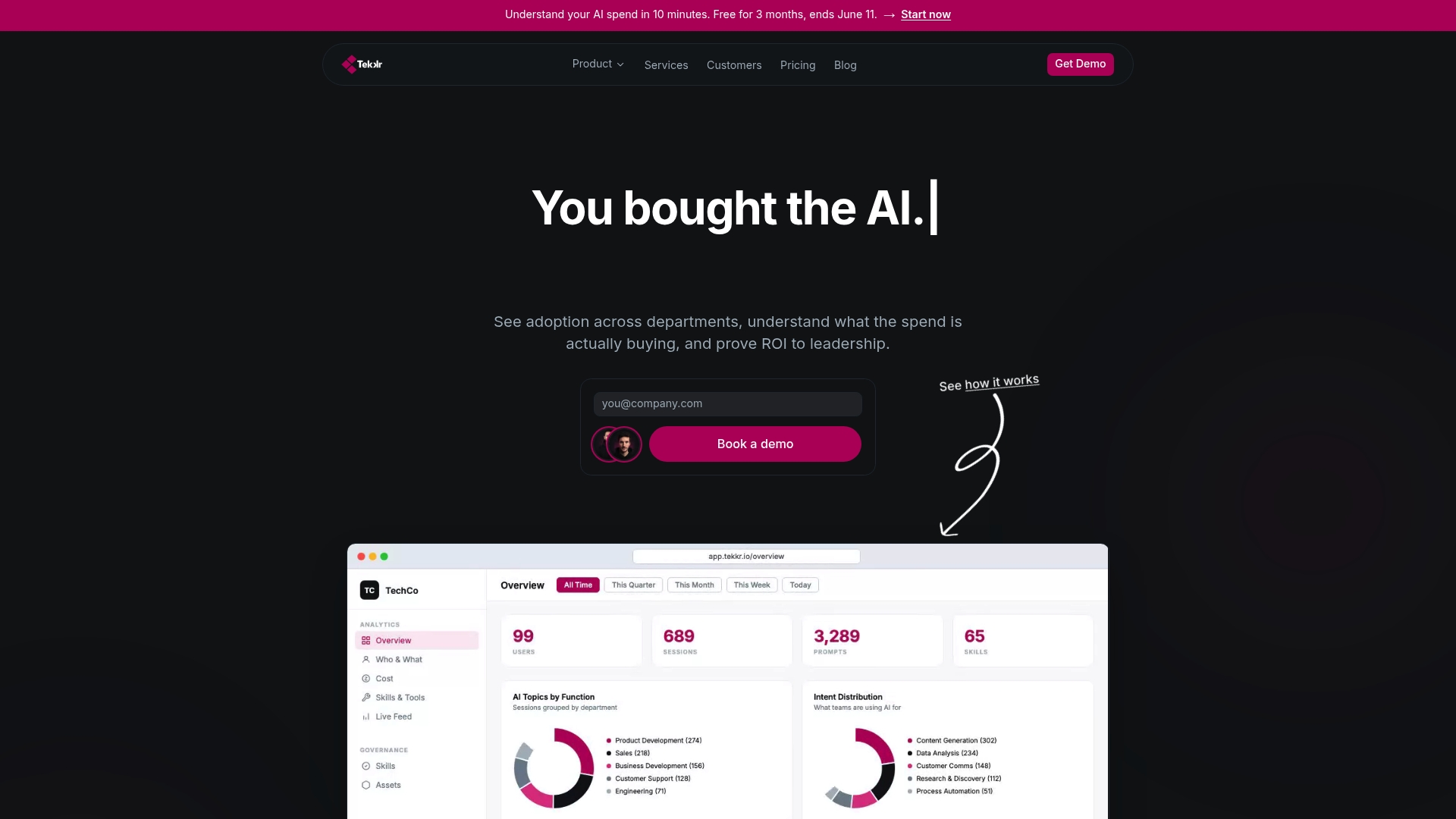
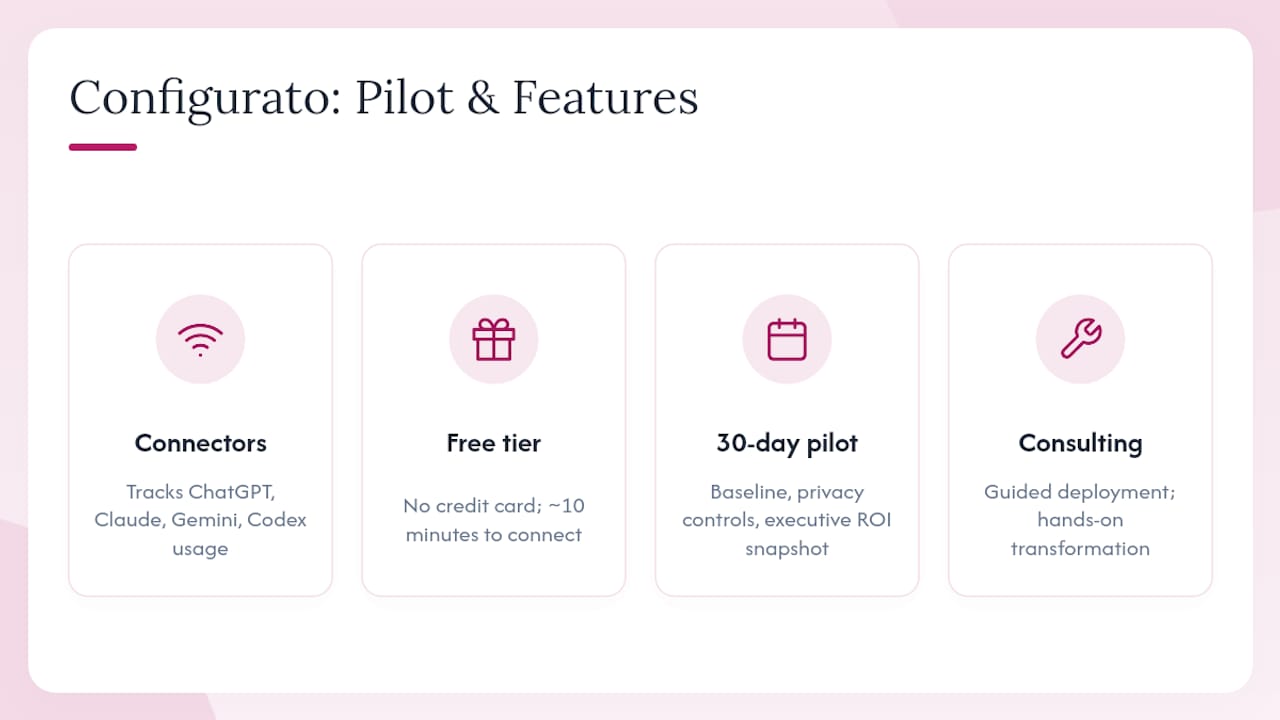
The free tier requires no credit card and takes about 10 minutes to connect your first data source. A 30-day pilot gives you a clean baseline, validated privacy controls, and an executive-ready ROI snapshot before you commit to a full rollout. For organizations that need a guided deployment or hands-on transformation strategy, Tekkr also offers consulting engagements.
Start your Configurato pilot or explore the product features to see what the dashboard covers before you sign up.
Research and sources
| Source | What it covers | Best for |
|---|---|---|
| Stanford AI Index 2026 | Organizational and consumer adoption rates, economic value estimates, frontier model production | Adoption urgency stats and executive context |
| Netskope AI Index — Global Report | App sprawl data, median org app counts, Global 2000 vs SMB comparisons | Governance and inventory evaluation criteria |
| Netskope AI Index — Global Dashboard | LLM-specific adoption growth (Claude, NotebookLM), enterprise size patterns | Integration priority decisions |
| Deloitte State of AI 2026 | Worker access growth, productivity gains, skills as adoption barrier | Pilot KPI design and enablement justification |
| Cognistry — AI Adoption Is a Capability Problem | Enablement-first argument, change management as core adoption driver | Pilot design and stakeholder engagement |
| Tekkr | Configurato features, privacy architecture, enterprise positioning | Product deep dive and trial information |