
Yes, Google Calendar data combined with AI usage signals can produce a board-grade time-saved and ROI measurement. It requires treating calendar activity and AI interaction logs as linked inputs to one system that tracks capability, not just access, and validates every time-saved claim against a pre-deployment baseline. Three things belong in the system:
- Depth metrics modeled on the Intelligence Impact Quotient (IIQ), which weight AI usage by novelty and autonomy rather than raw volume
- Frontier comparison data, the kind OpenAI’s B2B Signals tracks, showing tokens-per-worker against typical usage patterns
- Instrumented, privacy-safe usage and cost data, the layer a platform like Tekkr’s Configurato provides
The action item is simple: run a 90-day pilot. Baseline your calendar-derived workflows, instrument AI interactions, and use workflow sampling or A/B comparisons to convert raw signals into verified minutes and hours saved.
Key Takeaways
Verified time-saved measurement requires linking calendar-derived baselines, IIQ-style depth scoring, and instrumented AI usage logs, converted to dollars only through documented realization rates.
| Point | Details |
|---|---|
| Seat counts aren’t proof | Access metrics show who can use AI, not who generates verified value from it. |
| Depth beats volume | IIQ-style scoring weighted by novelty and autonomy separates real leverage from prompt volume. |
| Baseline before rollout | Three to six weeks of pre-deployment calendar and workflow measurement makes every later claim defensible. |
| Discount before you dollarize | Apply adoption (around 60%) and productivity-capture (around 50%) haircuts before reporting ROI. |
| Tekkr instruments the pilot | Configurato tracks usage depth, cost by team, and rework rates in a privacy-first setup ready in about 10 minutes. |
Table of Contents
- Why Seat Counts and Usage Volume Mislead Finance Teams
- A Measurement Framework That Finance Will Actually Trust
- How to Convert Usage Signals into Verified Time Savings
- Finding Frontier Teams and Locking Down Governance
- What Enterprise Case Studies Show About Verified Time Savings
- A 90-Day Pilot Checklist to Run This Quarter
- Why Measurement Discipline Changes What Leaders Fund
- Turn Calendar and AI Signals into Numbers a CFO Will Sign Off On
- Frequently Asked Questions
- Sources
Why Seat Counts and Usage Volume Mislead Finance Teams
License counts tell you who has access. They tell you nothing about who is actually getting value. That gap is exactly what trips up most CFO conversations about AI spend.
Token or prompt volume looks like a better proxy, but it isn’t much better. High message counts often reflect repetitive, low-leverage prompting rather than deep, consequential work. OpenAI’s B2B Signals research found frontier firms demand roughly 3.5 times as much intelligence per worker as typical firms, with gaps as wide as 16x on agentic and developer-assist tools. Two teams can generate identical token counts and deliver wildly different business value.
There’s a second trap hiding in the “time saved” headline number itself. Verification and rework can quietly erase it:
- A well-known Copilot productivity claim of roughly 40 minutes saved per week ignores time spent checking AI output for errors
- Rework rates on unverified AI-generated work can consume a large share of the reported savings
- Without a documented pre-deployment baseline, there’s no defensible way to prove any of it happened at all
A Measurement Framework That Finance Will Actually Trust
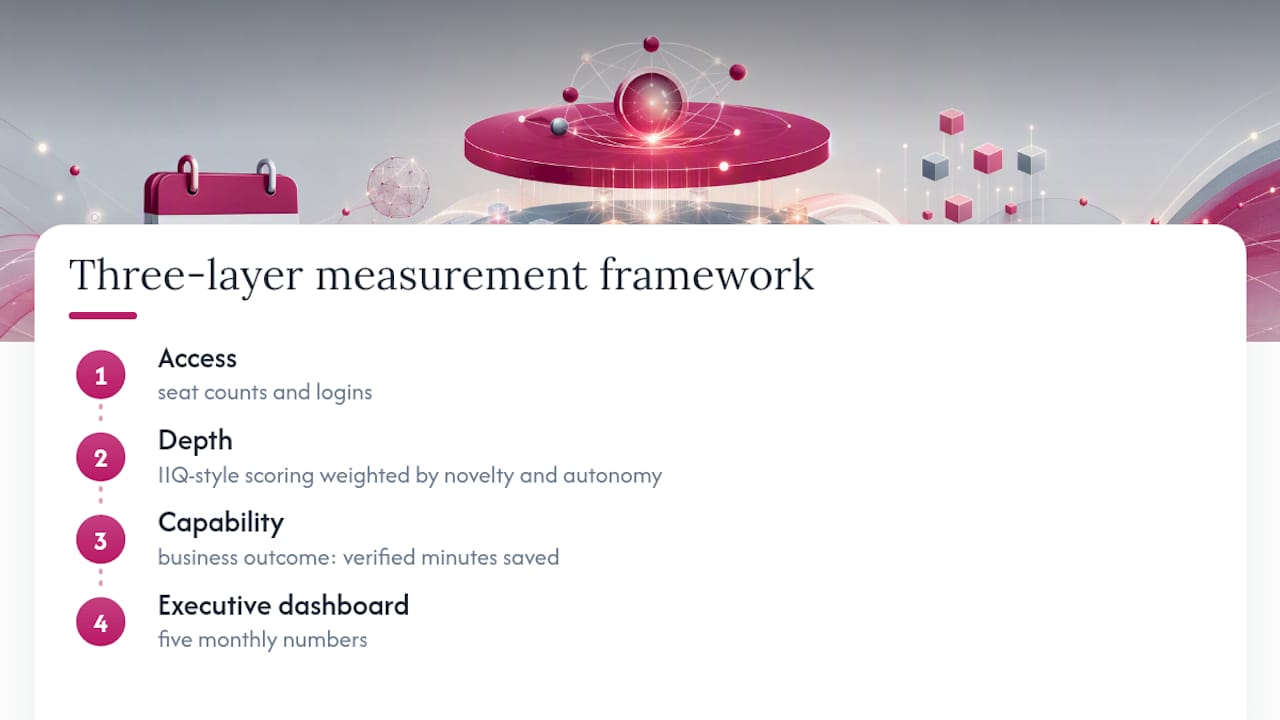
Build reporting around three linked layers: access, depth, and capability. Access is seat counts and logins. Depth is IIQ-style scoring, weighted by novelty (how far the task deviates from routine prompting) and autonomy (how much of the workflow the AI completed without human intervention), an approach the IIQ proposal outlines directly. Capability is the business outcome, measured in verified minutes saved per calendar-linked workflow.
Translating this into dollars is a straightforward formula: minutes saved per workflow, multiplied by frequency per month, multiplied by the fully loaded hourly rate, multiplied by a productivity-capture factor (the share of freed time actually redeployed to valuable work).
Your executive dashboard should carry five numbers every month: verified time-saved per worker, rework rate, IIQ score distribution across teams, cost per seat, and realized ROI against the pilot’s baseline.
How to Convert Usage Signals into Verified Time Savings
Pilot design starts before you deploy anything. Spend three to six weeks measuring calendar-derived workflows exactly as they run today, no AI involved. That baseline is what every later comparison depends on.
- Set the baseline. Track meeting time, review cycles, and focused-work blocks by category for three to six weeks.
- Roll out to a matched cohort. Compare AI-enabled teams against a similar, unenabled cohort rather than the whole org at once.
- Sample and verify. Pull a random sample of AI-assisted outputs each week and check them against quality standards before counting the time saved.
- Apply realization discounts. Use conservative haircuts, commonly around 60% for adoption and 50% for productivity capture, before converting minutes into dollars.
Workflow sampling works by pairing anonymized calendar event types (meeting, code review, document drafting) with AI interaction logs, then estimating the time delta per event type net of verification overhead. When a true A/B split isn’t feasible, a matched-cohort comparison adjusted for team size and workload confounders is an acceptable substitute, provided the sample is large enough to produce real confidence rather than a single anecdote.
Time saved is only a leading indicator until someone documents where the freed capacity went, whether that’s headcount avoidance or a new revenue project. Middle managers should track four things weekly: average minutes saved per event type, the rate at which AI output gets accepted without verification, rework rate, and how many saved hours convert into redeployed high-value work versus simply disappearing into the day.

Finding Frontier Teams and Locking Down Governance
Some teams will pull ahead fast. Use IIQ and token-depth scores to find them, then run structured transfer experiments, moving their specific prompting patterns and workflow sequences to a second team and measuring whether the lift repeats. If it does, you’ve found a scalable practice instead of a fluke.
Governance has to travel with that scaling effort:
- Strip PII from prompts and outputs automatically, never manually
- Restrict raw usage data to a small measurement team with audit logging
- Keep calendar data limited to event metadata, never meeting content
- Document retention and deletion policies before the pilot starts, not after
Scaling levers that actually work include shared playbooks, gamified leaderboards tied to verified (not raw) usage, and rotating “office hours” where frontier users teach their patterns to others.
Pro Tip: Track an “acceptance-with-verification” rate separately from raw adoption. A team that accepts AI output without checking it will always show the biggest time-saved number and the worst actual outcomes.
What Enterprise Case Studies Show About Verified Time Savings
A handful of enterprise examples show what board-ready measurement actually looks like once you connect AI usage to calendar-linked workflows and business KPIs.
- Cisco used Codex inside engineering workflows and reported roughly 20% faster build times, with more than 1,500 engineering hours saved per month and higher defect-resolution throughput. The gain was measured against pre-Codex build and resolution baselines, not self-reported estimates.
- Rakuten cut mean time to recovery on production incidents by about 50% after deploying Codex, attributing the gain by comparing incident timestamps before and after rollout.
- Balyasny Asset Management rolled an AI research platform out to roughly 95% of its teams and compressed a workflow that used to take two days down to around 30 minutes, validated by comparing task completion timestamps against the prior process.
Each case ties the same three things together: instrumented AI interactions, a documented pre-existing baseline, and a business KPI finance could already recognize.
A 90-Day Pilot Checklist to Run This Quarter
- Weeks 0 to 3: Baseline calendar-derived workflows by category, instrument AI logs with anonymized user IDs and task types, and define success KPIs before anyone touches a rollout.
- Weeks 4 to 8: Deploy to one or more matched cohorts, sample verification weekly, track rework rate, and stand up your first executive dashboard.
- Weeks 9 to 12: Analyze results, apply realization and adoption discounts to convert verified minutes into dollar impact, and build a one-page executive summary with confidence ranges and stated assumptions.
A pilot is worth funding further when it shows verified minutes-per-worker rising with a rework rate under a set threshold, adoption clearing a meaningful floor, and a positive net present value even under conservative realization assumptions.
Why Measurement Discipline Changes What Leaders Fund
Disciplined measurement moves the budget conversation away from license volume and toward capability investment and change management. Once time-saved is verified rather than estimated, leaders stop buying more seats reflexively and start funding the specific workflows and teams already proving frontier-level returns. That shift lowers risk. It replaces one large annual bet with a phased funding model tied to evidence you can actually defend in the boardroom.
Turn Calendar and AI Signals into Numbers a CFO Will Sign Off On
Building the measurement system described above from scratch, baselines, instrumentation, IIQ-style scoring, dashboards, takes months most transformation teams don’t have. Tekkr’s Configurato platform does that work out of the box: it tracks who’s genuinely using tools like Claude and Codex, breaks spend down by team, and surfaces verified usage depth instead of raw seat counts.
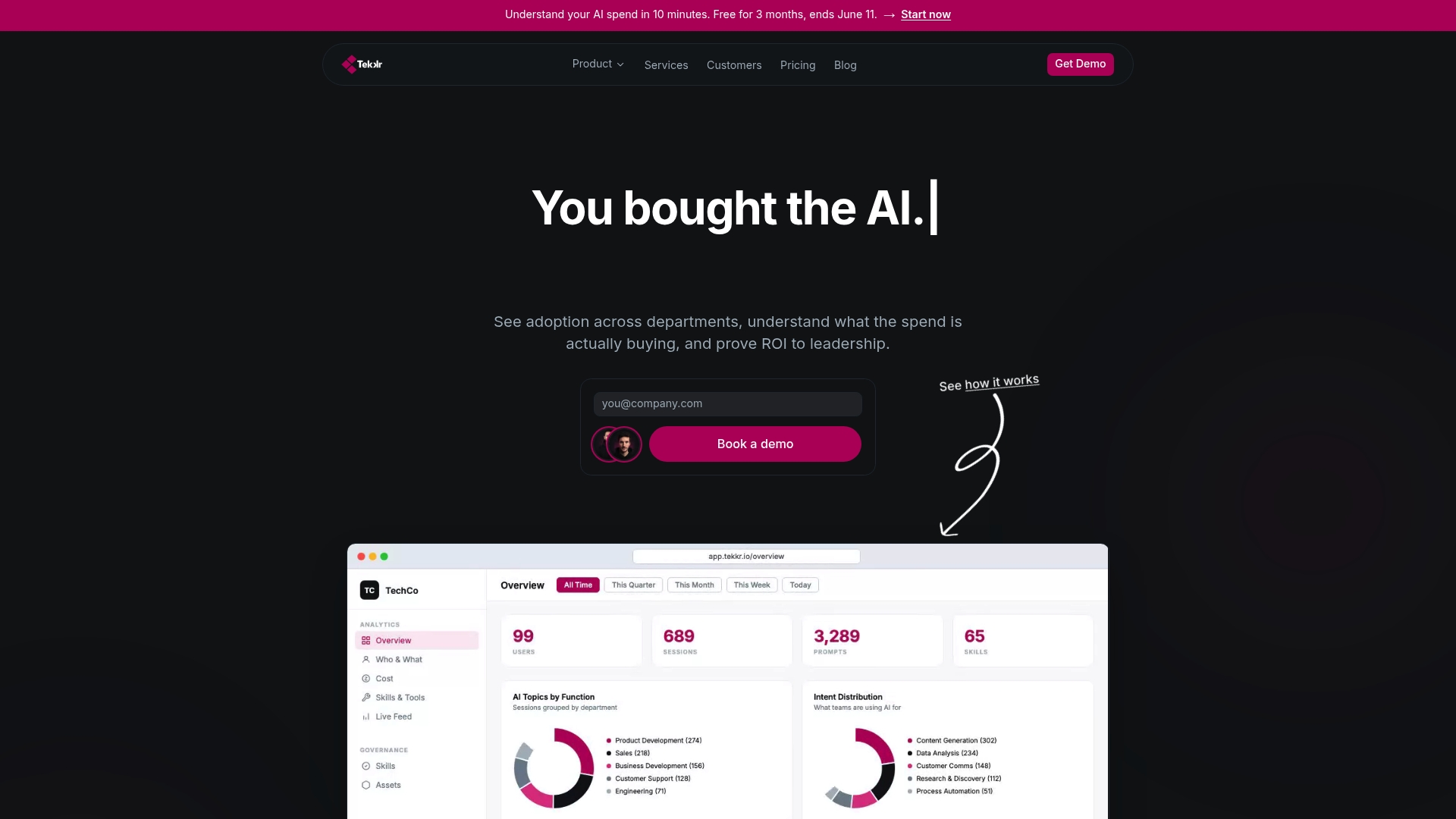
Configurato runs on a privacy-first, end-to-end encrypted architecture that’s GDPR-compliant, strips PII from prompts automatically, and needs no browser extension to install. Setup takes about 10 minutes, and a free tier is available with no credit card required. For teams that want hands-on support running the 90-day pilot itself, Tekkr’s AI adoption solution pairs Configurato with consulting to help identify frontier teams and build the playbooks that scale their practices. If you’re building your own measurement approach first, Tekkr’s guide on AI usage tracking for enterprise teams walks through the instrumentation patterns that make a pilot like this credible. Book a walkthrough of Configurato and see what your own frontier-versus-typical gap looks like before your next budget cycle starts.
Frequently Asked Questions
Can Google Calendar data alone prove AI time savings? No. Calendar data shows how time is currently allocated across meetings, reviews, and focused work. It only becomes a time-saved metric when paired with AI usage logs and a pre-deployment baseline for comparison.
What’s the difference between AI adoption and AI capability metrics? Adoption counts who has access, logins, and seats. Capability metrics track what people actually produce with that access, measured through depth scores like IIQ and verified against business outcomes.
How long should an AI time-saved pilot run? A 90-day structure works well for most enterprise teams: three to six weeks of baseline measurement, four to five weeks of controlled rollout, and a final analysis period to convert verified minutes into dollar impact.
Why do time-saved claims need a realization discount? Raw minutes saved rarely convert one-to-one into business value.
How does Tekkr fit into this measurement approach? Configurato instruments AI usage across an organization with privacy-first anonymization, breaks down cost and depth of use by team, and produces the dashboards finance teams need to validate time-saved and ROI claims.