
A finance-first AI budget allocation checklist works only when governance, chargeback rules, and kill criteria sit on the same page as the spending itself. Here is the whole thing, ready to bring into your next FP&A meeting: instrument usage before you scale it, charge costs back to the team that generates them, track cost-per-outcome instead of raw activity, and set a kill date before the pilot even launches.
Run this checklist now if you already have AI spend scattered across three or more teams with no shared reporting. Delay it only if you are pre-pilot with a single tool and a handful of users. Otherwise, the cost of waiting compounds every billing cycle.
The one-page checklist:
- Assign a single budget owner who signs off on every new AI line item, no exceptions.
- Set a usage baseline (last 90 days of manual-process time or cost) before funding anything new.
- Classify every AI cost into inference, data, integration, governance, and training buckets.
- Pick one chargeback model (per-team, per-use-case, or hybrid) and apply it everywhere.
- Instrument token and API logs before rollout, not after complaints arrive.
- Define cost-per-outcome as your primary KPI, with tokens-per-user as a secondary signal.
- Set kill criteria and a remediation window in writing before the pilot starts.
- Fold AI spend into the existing quarterly forecast cycle, not a side spreadsheet.
- Require PII stripping and encryption for any tool touching customer or employee data.
- Schedule a 30/60/90 day review with finance, the AI sponsor, and security in the room.
Pro Tip: If you can’t answer “what did this cost per completed task last month” in under sixty seconds, your instrumentation isn’t ready for a production budget increase.
Key Takeaways
A finance-first checklist that pairs token governance, chargeback templates, and pre-set kill criteria is what turns AI spend from a guess into a managed line item.
| Point | Details |
|---|---|
| Baseline before budget | Capture 90 days of pre-AI cost data before funding any new tool or pilot. |
| Track outcomes, not activity | Use cost-per-outcome as the primary KPI, with tokens per user as a secondary check. |
| Pick one allocation model | Choose per-team, per-use-case, or hybrid chargeback and apply it consistently. |
| Set kill criteria upfront | Define a remediation window before the pilot launches, not after it underperforms. |
| Use Configurato for visibility | Tekkr’s Configurato tracks usage by team, automates chargeback data, and reports adoption depth within a 10-minute setup. |
Table of Contents
- Startup AI Budget Allocation Checklist: The Operational Steps
- What Are Tokens, and Why Isn’t Token Volume Enough?
- Which Cost-Allocation Model Should You Use?
- How Should Governance and Kill Criteria Work?
- How Do You Model AI Cost Volatility and ROI?
- How Do You Get Visibility and Chargeback Running Fast?
- What Kills AI ROI, and How Do You Catch It Early?
- Why Finance-First Governance Actually Protects Margin
- How Tekkr’s Configurato Runs This Checklist for You
- Sources
Startup AI Budget Allocation Checklist: The Operational Steps
The checklist above only works if someone runs it in order. Skipping straight to chargeback before you have a baseline is the single most common reason finance teams lose the thread on AI spend within two quarters.
Start with scope, not tooling. Define which teams, tools, and use cases count as “AI spend” for reporting purposes because vague scope is why most cost-allocation projects stall in month one.
- Define scope and cost boundaries. Decide whether infrastructure, seat licenses, and consulting hours count toward the AI budget or sit elsewhere.
- Capture a 90-day baseline. Measure the manual cost of the process AI is replacing before you fund the replacement, using either trailing trend data or a pre-program comparison window.
- Assign cost categories. Split spend into inference, data foundation, integration, governance, training, and maintenance.
- Name owners for each category. Someone in finance owns P&L attribution; someone on the AI team owns token governance.
- Set approval gates by spend tier. Under a set threshold, a team lead can approve; above it, the CFO or AI sponsor must sign off.
- Instrument before you scale. Connect usage logs and model telemetry before doubling seat counts.
- Fund pilots separately from production. Pilot budget should never draw from the same line as scaled deployment.
- Require evidence to graduate a pilot. A pilot moves to production funding only with a documented cost-per-outcome improvement, not a satisfaction survey.
| Role | Owns | Typical Decision |
|---|---|---|
| CFO / Finance lead | P&L attribution, forecast integration | Approves tier 2+ spend, sets chargeback policy |
| AI sponsor | Token governance, model-mix choices | Decides which model serves which use case |
| Product/team owner | Use-case definition, adoption depth | Reports outcome metrics per sprint |
| FinOps / data lead | Instrumentation, cost dashboards | Builds and maintains the usage pipeline |
| Security/compliance | PII handling, encryption standards | Signs off before any customer data touches a model |
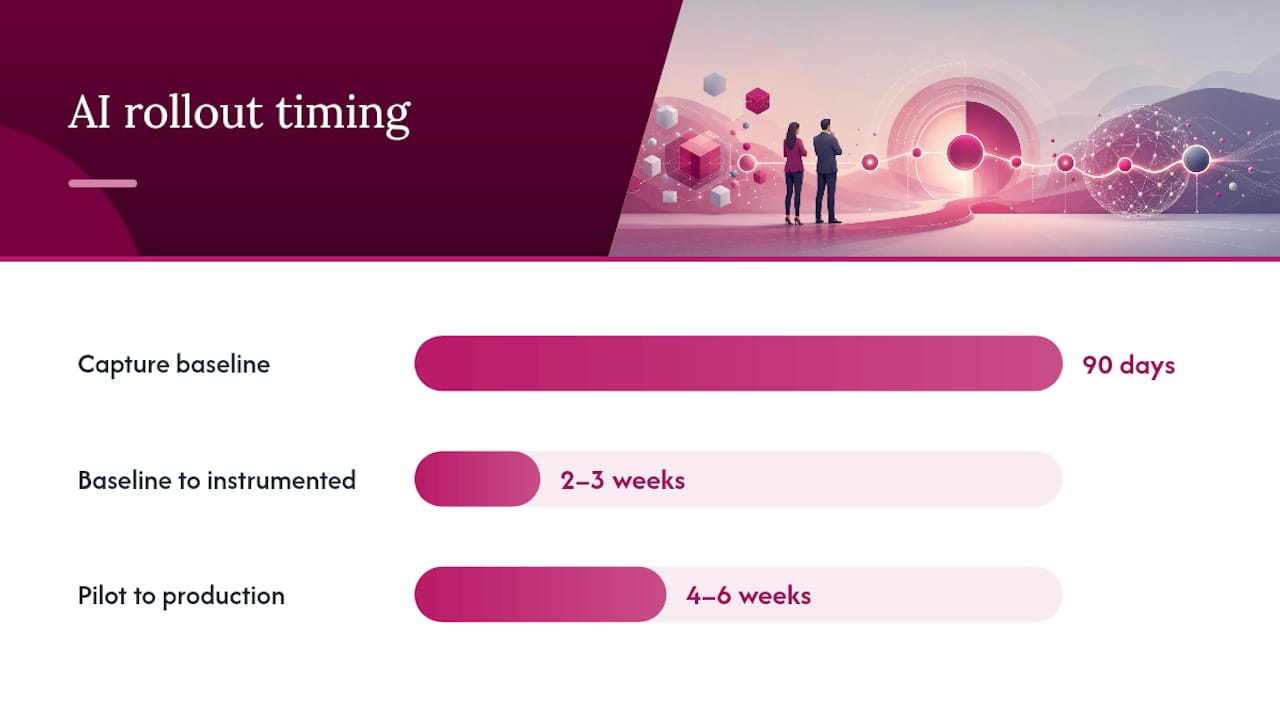
Most teams can get from baseline to instrumented dashboard in two to three weeks. Moving a pilot to production funding typically takes another four to six weeks, and only after cost-per-outcome data exists for at least one full billing cycle.
What Are Tokens, and Why Isn’t Token Volume Enough?
Tokens are the metered unit of AI consumption, counted separately for input (what you send the model) and output (what it returns), and priced per unit by the model provider. Cost-per-outcome is calculated as total tokens consumed for a task, multiplied by the blended input/output rate, divided by the number of completed outcomes.

Token volume alone tells you activity, not value. Deloitte’s guidance on token economics makes the point directly: high token spend per employee can actually be a good sign, if it correlates with a lower cost-per-outcome and stronger output quality. A team burning twice the tokens of another isn’t necessarily wasteful. It might be running deeper, more delegated workflows that get more done per interaction.
That distinction matters because OpenAI’s B2B usage analysis found that frontier firms generate roughly 3.5 times the “intelligence per worker” of typical adopters, driven by depth of use rather than headcount. Tokens per worker is a useful proxy for that depth, but it needs to sit next to outcome data or it just measures enthusiasm.
The KPIs worth putting on a dashboard:
- Tokens per outcome — raw consumption tied to a completed task, not a session.
- Cost-per-outcome — the dollar figure finance actually cares about.
- Tokens per active user — flags heavy users worth studying, not automatically cutting.
- Adoption depth — how many steps of a workflow get delegated to AI versus just used for drafts.
- Productivity uplift — time saved per task, converted to a dollar estimate against the baseline.
- Model-mix factor — the ratio of premium-model calls to lower-cost model calls, since that ratio swings cost more than volume does.
Pro Tip: Set a governance threshold, not a spending cap, on tokens per user. A cap punishes your best-adopted teams. A threshold that triggers a review conversation catches waste without punishing depth.
Which Cost-Allocation Model Should You Use?
Three models cover almost every situation finance teams face with AI spend, and picking the wrong one is a common reason chargeback initiatives get abandoned mid-year.
Per-team chargeback meters token consumption directly to the team generating it. It works well when usage is already siloed by department and the tooling supports per-team API keys or workspaces.
Per-use-case allocation assigns cost to the outcome, not the team, using cost-per-outcome as the unit. This model fits better when multiple teams share one AI tool for different jobs, like a shared coding assistant used by three engineering pods.
Hybrid allocation amortizes fixed infrastructure and platform fees evenly across all users, then meters variable usage (tokens, API calls) back to the actual consumer. Most VC-backed scale-ups land here once spend crosses a handful of departments, because pure chargeback punishes early adopters and pure showback lacks teeth.
| Cost category | Engineering | Sales/CS | Marketing |
|---|---|---|---|
| Platform/seat fees (amortized) | Fixed share | Fixed share | Fixed share |
| Token consumption (metered) | Actual usage | Actual usage | Actual usage |
| Pilot/R&D spend (discounted) | Reduced rate | Reduced rate | Reduced rate |
| Governance/compliance overhead | Fixed share | Fixed share | Fixed share |
Whichever model you choose, write governance rules into the template itself. Strategic R&D pilots often get a discounted internal rate so teams keep experimenting without fear of a budget hit, but cap that discount window at one or two quarters before the use case needs to justify itself at full cost.
How Should Governance and Kill Criteria Work?
Governance fails when it lives in a slide deck instead of the approval flow finance already uses. The rule that matters most: no AI budget line moves from pilot to production without a named sponsor, a security sign-off, and a pre-agreed kill date.
Approval should route through five roles in sequence: the product or team owner proposes the use case, the AI sponsor validates the model choice, FinOps confirms instrumentation is live, security/compliance clears data handling, and the CFO approves the funding tier.
- Define kill criteria before funding, not after a bad quarter.
- Set a remediation window of roughly two to three months for underperforming pilots before automatic sunset, a practice Deloitte’s enterprise AI governance research recommends to stop budget drift.
- Use tiered confidence levels for reported savings: bookable, GL-grounded savings in one tier; modeled indirect savings with a haircut in another; pure optionality narrated separately, never booked.
- Fold every AI budget line into the standing quarterly forecast cycle so it shows up in board reporting automatically, rather than as a footnote.
| Confidence tier | Definition | Reporting treatment |
|---|---|---|
| Tier 1 | GL-grounded, attributable, recurring | Bookable in forecast |
| Tier 2 | Modeled indirect savings | Report with haircut, not booked |
| Tier 3 | Optionality or future potential | Narrate only, no dollar figure |
Getting the CFO’s office involved from hypothesis design onward, not just at the invoice stage, is what actually turns finance into a strategic partner rather than a gatekeeper reacting to surprise bills. A governance framework built with clear roles and approval steps keeps that from becoming just another compliance form nobody reads.
How Do You Model AI Cost Volatility and ROI?
Total cost of ownership for AI runs well past the invoice from your model provider. A defensible TCO model needs seven categories: direct inference, data foundation, integration, evaluation and observability, governance and compliance, change management and training, and maintenance and migrations. Vendors’ quoted pricing almost always undercounts several of these, which is why FP&A teams get blindsided by the true run rate six months into a rollout.
Compute and infrastructure spending has climbed sharply as enterprise adoption scales, and Stanford’s AI Index economy analysis shows that pattern holding across functions and adoption methods, which is exactly why cross-team allocation has to account for shared infrastructure costs, not just per-seat licensing.
| Adoption level | Model-mix assumption | Cost trajectory | ROI signal |
|---|---|---|---|
| 60% | Mostly standard-tier models | Predictable, lower volatility | Modest, steady uplift |
| — | Mixed standard and premium | Moderate volatility, watch model-mix factor | Uplift accelerates if cost-per-outcome holds |
| — | Heavier premium-model reliance | Highest volatility, margin risk | Uplift strong only if depth-of-use scales with cost |
When the sensitivity table shows costs rising faster than outcomes at higher adoption, that’s the signal to renegotiate vendor terms, shift heavier workloads to private hosting, or tighten the chargeback model before the next board cycle. AI cost volatility modeling from Deloitte treats this variability as a normal input cost risk, not an anomaly, which is the right frame for FP&A to adopt.
How Do You Get Visibility and Chargeback Running Fast?
Days 1 to 30: Instrument usage logs across every AI tool in active use. Map existing spend into the seven TCO categories. Assign category owners. Run the 90-day baseline capture if it isn’t already done.
Days 31 to 60: Connect model telemetry to a shared dashboard covering tokens per outcome, cost-per-outcome, and adoption depth. Pick your chargeback model and apply it to one pilot team as a test case. Confirm PII stripping and encryption are active before any customer data touches a model.
Days 61 to 90: Run the first real chargeback cycle across all instrumented teams. Present cost-per-outcome and adoption depth to the board alongside the standing forecast. Set kill criteria formally for any use case still unmeasured.
- Confirm every AI tool logs usage at the token level, not just seat counts.
- Map cost categories against the seven-part TCO framework before month two.
- Connect telemetry feeds to a single dashboard finance and the AI sponsor both access.
- Run a pilot chargeback cycle with one team before rolling it out company-wide.
- Document PII handling and encryption status for every connected tool.
- GDPR compliance and PII stripping should be non-negotiable before any production rollout, not a “we’ll fix it later” line item.
- Audit-ready instrumentation means you can produce a cost-per-outcome figure for any team, on demand, without a manual spreadsheet reconciliation.
A platform like Tekkr’s Configurato plugs directly into this 30/60/90 flow, since it’s built to surface who is actually using tools like Claude and Codex, break down cost by team automatically, and run the gamified enablement piece that turns adoption depth into a number finance can trust.
Pro Tip: Don’t wait for month three to check adoption depth. If usage isn’t spreading past your pilot team by day 45, the kill criteria conversation should start early, not at the 90-day review.
What Kills AI ROI, and How Do You Catch It Early?
Most AI budget failures aren’t technology failures. They’re measurement failures, and research on enterprise AI ROI found that missing baselines, tracking activity instead of outcomes, and undercounted TCO account for the bulk of programs that quietly lose money without anyone noticing until the renewal invoice arrives.
The five pitfalls that show up most often:
- Measuring logins or messages sent instead of completed outcomes.
- Skipping the baseline, so nobody can prove the “before” state.
- Undercounting TCO by ignoring integration, training, and maintenance costs.
- Running pilots with no kill criteria, so underperformers linger for quarters.
- Letting SaaS contract terms leak margin through auto-scaling tiers nobody reviews.
Watch for these signals directly in your dashboard:
- A sudden token spike with no corresponding rise in completed outcomes.
- Adoption depth flatlining while raw seat counts keep climbing.
- Cost-per-outcome trending up two months in a row.
- A pilot still unmeasured 60 days after launch.
When a red flag hits, the response should be immediate and bounded: throttle the specific use case, not the whole tool; open a short remediation window (two to three months, per governance best practice); and reallocate the freed budget toward the use case with the strongest cost-per-outcome trend, rather than letting it sit idle until the next planning cycle.
Why Finance-First Governance Actually Protects Margin
CFOs who wait until the invoice arrives to ask about AI spend are managing risk after it’s already happened. The teams that get this right treat the finance office as a design partner from day one, not a checkpoint at the end. That single shift changes what gets measured, because a CFO in the room from the start asks about cost-per-outcome before the pilot even launches, not six months in when the bill triples.
Tiered confidence levels sound like bureaucracy until you’ve watched a board meeting where nobody can say whether a “successful” AI pilot actually saved money or just felt productive. Splitting savings into bookable, modeled, and narrative tiers forces that distinction into the open early, which tends to kill weak pilots faster and free up budget for the ones with real traction.
The mistake to avoid isn’t underinvesting in AI. It’s treating measurement as a one-time setup task instead of a standing process that runs every quarter alongside the rest of FP&A. Token spend shifts, model pricing changes, and adoption depth moves constantly. A checklist run once in Q1 and never revisited is close to useless by Q3.
How Tekkr’s Configurato Runs This Checklist for You
There are ways to build this instrumentation in house: custom logging pipelines, a homegrown dashboard, a finance analyst stitching together spreadsheets every month. That works until the third team adopts a new model and the spreadsheet breaks.
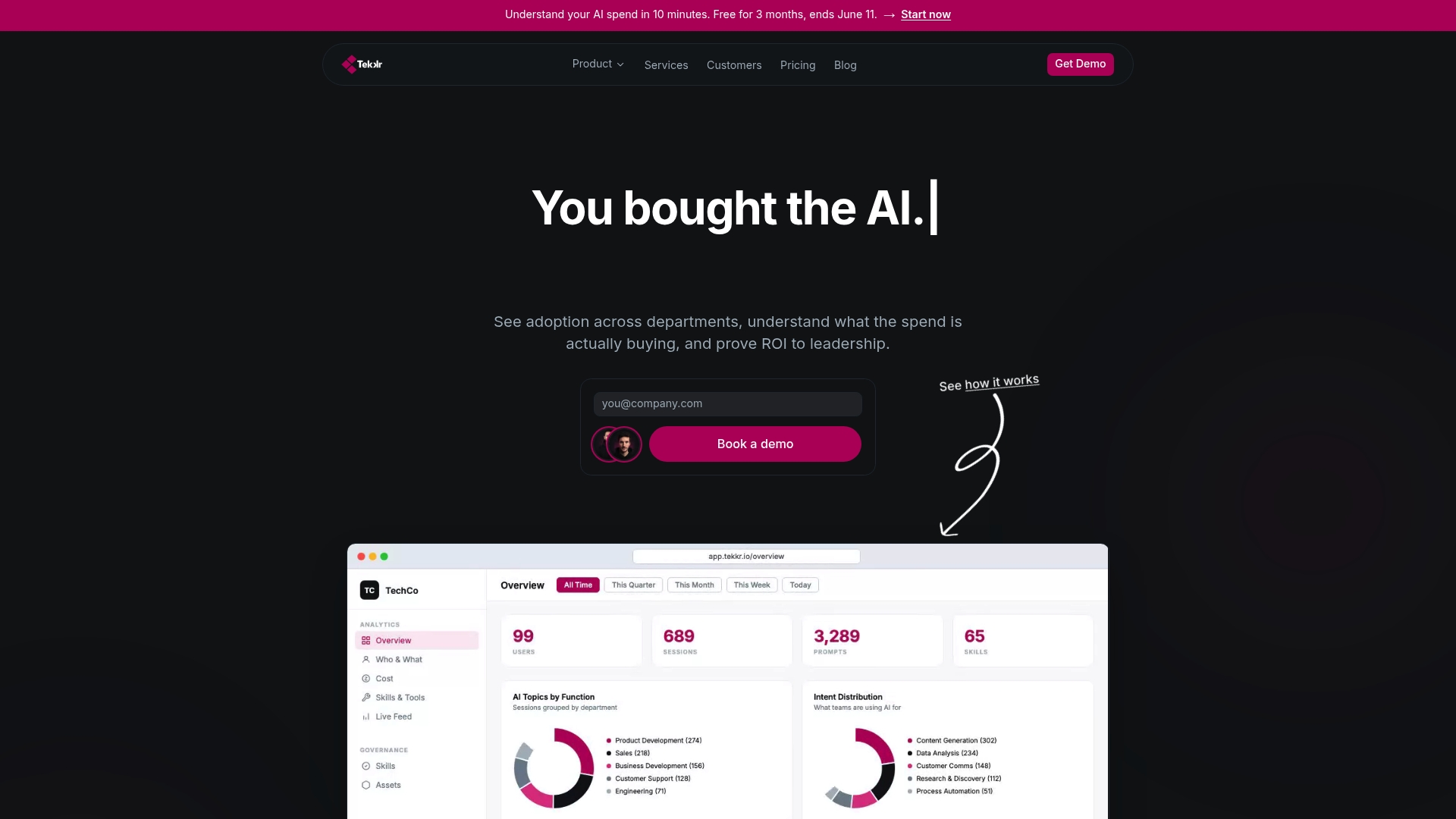
Tekkr’s Configurato was built specifically for the gap this checklist exposes: the space between buying AI tools and actually knowing whether they’re paying off. It tracks real usage across tools like Claude and Codex, breaks down cost by team automatically, and surfaces use-case intelligence so you’re not guessing which pilot deserves more budget. The privacy-first architecture handles the compliance side of the implementation plan for you, with automatic PII stripping, end-to-end encryption, and GDPR compliance built in from the start, no browser extensions required.
Setup takes about 10 minutes. On day one, you get visibility into who’s using what. By week one, you have team-level cost breakdowns ready for your next FP&A meeting. By month one, you have enough adoption and cost-per-outcome data to make the first real chargeback decision instead of a guess. There’s a free tier with no credit card required, so you can test the instrumentation before committing budget to it. Start with Tekkr’s AI adoption solution and see what your current AI spend actually looks like once it’s broken down by team.
Sources
The claims in this checklist rest on a handful of sources worth keeping on hand for board materials or audit prep.
- A CFO’s guide to governing AI token economics | Deloitte US
- B2B Signals: enterprise AI usage analysis | OpenAI
Keep these on file for the next board update. When someone asks how the cost-per-outcome figure was derived, having the source behind it is what makes the number stick.