
Yes, SOC 2 applies to AI analytics that process customer or sensitive data. The moment your models touch personal information, confidential business data, or regulated records, confidentiality, privacy, integrity, and availability become audit priorities. Start now with three moves: inventory every system that stores or moves that data, apply de-identification before information reaches a model, and map your existing controls to the Trust Services Criteria.
TL;DR:
- Implement strict access controls, encryption, and de-identification measures to safeguard sensitive data before it reaches AI models, meeting SOC 2 confidentiality and privacy standards.
- Maintain detailed, tamper-proof logs of all model training, deployment, and querying activities to demonstrate control effectiveness and support audit evidence collection.
- Conduct vendor risk assessments and enforce technical controls like anonymization, private hosting, and allowlists to manage third-party and foundation model risks within SOC 2 scope.
- Regularly monitor AI system behavior, perform bias and drift testing, and prepare incident response plans to ensure operational resilience and compliance during audits.
- Start early with documented policies and system configurations, focusing on evidence that controls function over time, and leverage tools that automate log and review generation to streamline SOC 2 readiness.
Table of Contents
- What SOC 2 covers for AI analytics and why it matters
- Key SOC 2 controls to implement for AI analytics workflows
- Mapping SOC 2 Trust Services Criteria to AI risks
- Preparing for a SOC 2 audit for AI analytics: evidence, timeline, and common gaps
- Managing third-party and foundation-model risks under SOC 2
- Operational best practices: monitoring, testing, and incident response for SOC 2-compliant AI analytics
- How Tekkr supports SOC 2 readiness for AI analytics
- Why aligning SOC 2 with AI RMF matters
- Get SOC 2-ready for your AI analytics stack
- Authoritative primary sources and standards
- Sources
- FAQ
What SOC 2 covers for AI analytics and why it matters
SOC 2 is a voluntary auditing framework developed by the AICPA that evaluates a company’s controls against five Trust Services Criteria: security, availability, processing integrity, confidentiality, and privacy. For AI analytics platforms, the last four carry particular weight because these systems ingest, transform, and often retain sensitive inputs. An industry primer on SOC 2 for analytics platforms frames it as the practical procurement standard: a Type I report confirms controls exist at a point in time, while Type II observes those controls operating over an observation period, which is what most enterprise buyers actually want to see.
That distinction matters for sales cycles. Buyers in healthcare and finance routinely will not shortlist an analytics vendor without a current Type II report.
For AI analytics specifically, this plays out through:
- Confidentiality: protecting prompts, embeddings, and training data from unauthorized exposure.
- Privacy: governing how personal data is collected, used, and deleted across the model lifecycle.
- Integrity: proving that model outputs and pipelines behave as intended.
- Availability: keeping inference services running and recoverable under real load.
Together, these criteria turn SOC 2 from a compliance checkbox into a procurement accelerator, especially once regulated buyers start asking pointed questions about model data flows.
Key SOC 2 controls to implement for AI analytics workflows
Auditors do not grade intentions. They grade evidence that a control operated consistently. For AI analytics teams, five control areas do most of the work.
- Access control and least privilege: restrict who can query raw data stores, call model endpoints, or modify training pipelines, and review those permissions on a set schedule.
- Encryption and key management: encrypt data at rest and in transit, rotate keys, and store model artifacts and checkpoints under the same key management discipline as production databases.
- Data handling before model exposure: mask, tokenize, or de-identify sensitive fields locally before they ever reach a third-party model or inference API.
- Logging and immutable audit trails: capture who trained, deployed, or queried a model, and when, in logs that cannot be quietly edited after the fact.
- Change management and versioning: require review and approval before a model, prompt template, or pipeline configuration ships to production, with a version history an auditor can trace.
Each of these maps to a specific piece of evidence: an access review spreadsheet, a key rotation log, a de-identification test result, an audit trail export, a change ticket with sign-off. Auditors want the artifact, not the policy statement.
Pro Tip: Build your evidence collection into the pipeline itself, so logs and approval records generate automatically instead of being reconstructed by hand before an audit.

Mapping SOC 2 Trust Services Criteria to AI risks
Generic SOC 2 guidance was not written with model pipelines in mind, so each criterion needs an AI-specific translation.
- Confidentiality maps to prompt leakage and dataset exposure. Controls include encrypted storage, strict endpoint access lists, and redaction before data leaves your perimeter. Evidence: encryption configuration, access logs, and redaction test results.
- Privacy maps to how personal data flows through training and inference. Controls include data minimization, retention limits, and privacy-preserving techniques like differential privacy or synthetic data where appropriate. Evidence: data flow diagrams and deletion request logs.
- Integrity maps to model poisoning and unclear data provenance. Controls include validated training data sources, checksums on datasets, and continuous output testing against known baselines. Evidence: provenance records and drift test summaries.
- Availability maps to model serving resilience. Controls include redundant inference infrastructure, defined incident SLAs, and tested failover. Evidence: uptime logs and recovery test reports.
The NIST AI Risk Management Framework offers a useful companion here. Its four functions, Govern, Map, Measure, and Manage, give AI analytics teams a way to structure trustworthiness work that produces exactly the kind of documentation a SOC 2 auditor expects to see.
Preparing for a SOC 2 audit for AI analytics: evidence, timeline, and common gaps
Audit readiness comes down to an evidence pack an auditor can walk through without asking you to explain it twice. For AI analytics, that pack typically includes:
- Written policies: access control, data handling, incident response, and vendor management, all specific to how models are trained and served.
- System screenshots and configuration exports: proving encryption, access restrictions, and logging are actually turned on.
- Access lists and review records: showing who can reach sensitive data and model endpoints, reviewed on schedule.
- Change and deployment records: tying every production model change to an approval.
- Test summaries: covering data provenance checks, drift monitoring, and incident drills.
Type I audits can happen relatively quickly once controls are documented, but Type II requires an observation window, commonly several months, before an auditor can confirm controls held up in practice. Enterprise buyers in regulated industries generally expect Type II, so start the observation window early rather than after a deal stalls.
The most common gaps specific to AI systems are missing data lineage (no clear record of where training data came from), thin vendor controls over third-party models, and logging that captures access but not model behavior or output changes.
Managing third-party and foundation-model risks under SOC 2
Most AI analytics platforms depend on external components: a foundation model API, a cloud inference service, or a managed vector database. SOC 2 auditors treat these as extensions of your own control environment, not someone else’s problem.
Start with a vendor risk assessment for every processor and model provider, and get contractual commitments on data handling, retention, and breach notification in writing. The NIST Generative AI profile recommends inventorying which AI systems and vendors you rely on, documenting data provenance, and running independent evaluations sized to the risk each dependency introduces.
Technical mitigations reduce how much you have to trust a vendor’s promises:
- In-proxy anonymization: strip or tokenize sensitive fields before a request leaves your infrastructure, so a third-party model never sees raw personal data.
- Private hosting: run sensitive workloads on dedicated or self-hosted model instances instead of shared multi-tenant endpoints.
- Allowlists: restrict which external models and endpoints your systems are permitted to call at all.
Document these controls the same way you document internal ones, with configuration evidence and periodic review logs, because auditors will ask for both the contract and the technical proof that it is enforced.
Operational best practices: monitoring, testing, and incident response for SOC 2-compliant AI analytics
Controls that exist only on paper fail audits and, more importantly, fail in production. Three operational habits keep AI analytics systems both compliant and reliable.
- Monitor continuously: track access logs, watch for model performance drift, run periodic integrity checks on outputs, and set alerts for anomalies rather than discovering them in a quarterly review.
- Test deliberately: red-team the system for prompt injection and data leakage, run bias and fairness checks on outputs, and audit data provenance on a recurring schedule rather than once at launch.
- Plan incident response before you need it: define who gets notified, within what timeframe, what evidence gets collected, and how a model gets rolled back if it starts producing unsafe or incorrect outputs.
Pro Tip: Run a tabletop incident drill against a realistic AI failure, such as a leaked prompt log or a poisoned data source, before an auditor asks whether you have ever tested your response plan.
Auditors increasingly ask for evidence tied specifically to model behavior, not just infrastructure security, so monitoring and testing logs deserve the same rigor as your access control records.
How Tekkr supports SOC 2 readiness for AI analytics
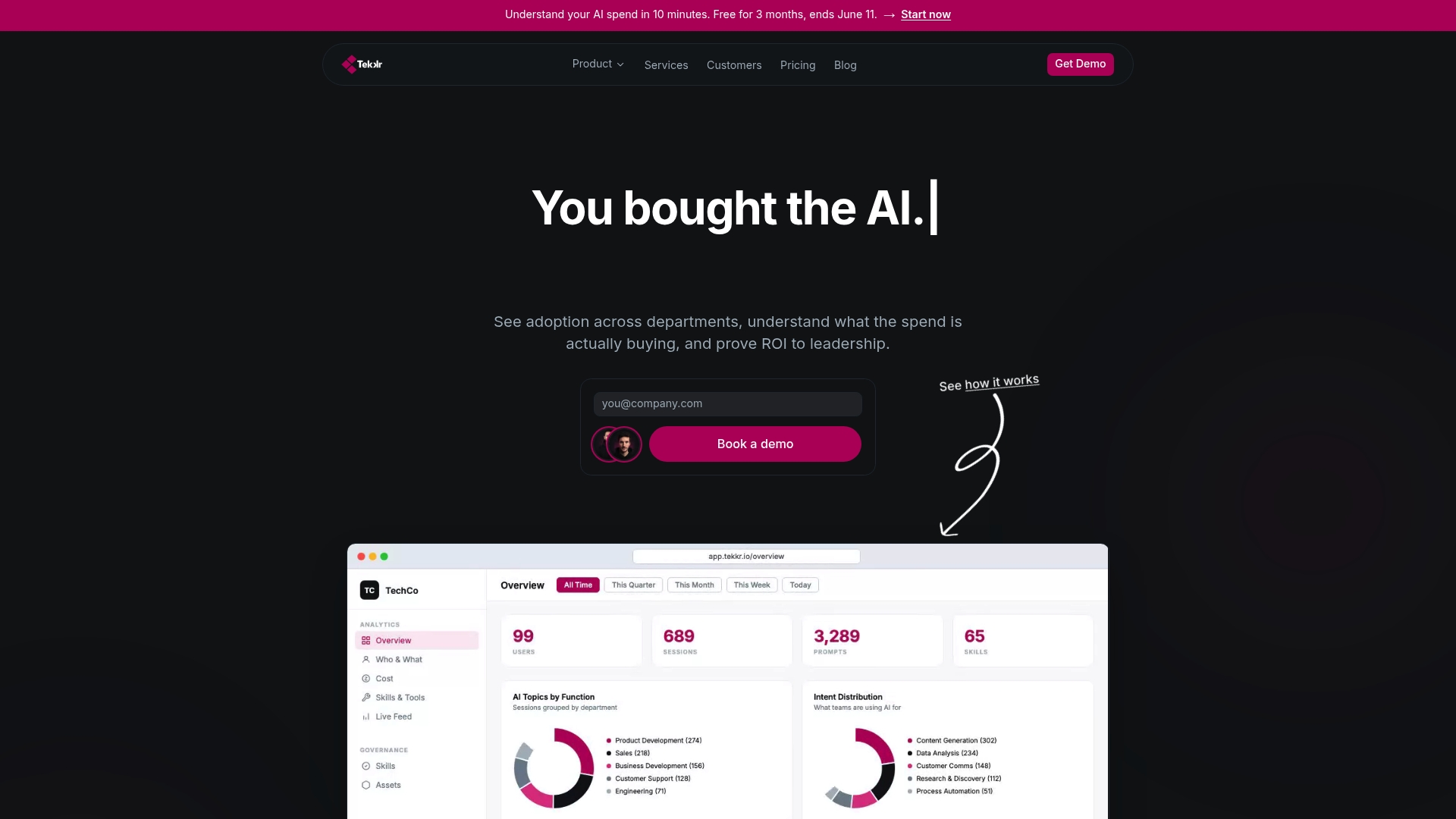
Some AI analytics platforms aim to provide organizations with visibility into how AI tools are used, by whom, and at what cost, which can also support SOC 2 evidence requirements.
- Privacy-first telemetry: Tekkr’s architecture is end-to-end encrypted and automatically strips PII from prompts, reducing exposure risk before data ever gets logged.
- Usage and access reporting: Configurato tracks who is using tools like Claude and Codex across an organization, breaking down usage and cost by team, output auditors can reference alongside access control evidence.
- No browser extensions, fast setup: Tekkr sets up in about 10 minutes, which matters when you need visibility before an audit window opens, not after.
Teams preparing for a SOC 2 audit can start with an AI Readiness Assessment & Strategy engagement or trial Configurato directly to see what usage and access reporting looks like in practice.
Why aligning SOC 2 with AI RMF matters
SOC 2 alone proves your controls exist and hold up under observation. The AI RMF pushes further, asking whether the model itself is trustworthy, not just whether the infrastructure around it is locked down. Treating these as separate exercises wastes effort: the same provenance log, the same drift test, the same vendor assessment can satisfy both.
Auditors are already asking sharper questions about model behavior, not just system access, and that trend will only continue. Compliance teams that treat controls as evidence generators, not paperwork, end up with something sales can actually use: proof, not promises.
— TekkrTools
Get SOC 2-ready for your AI analytics stack
Preparing SOC 2 evidence for AI systems means proving access controls, data handling, and model behavior all hold up over time, and doing that manually eats months of engineering time you would rather spend elsewhere. Tekkr gives you that visibility out of the box: encrypted telemetry, automatic PII stripping, and usage reporting through Configurato that doubles as audit-ready documentation of who is actually using your AI tools and how.
If you want hands-on help mapping controls to your specific pipeline, Tekkr’s AI Readiness Assessment & Strategy engagement scopes the gaps before an auditor finds them. For a broader look at pricing across Configurato and consulting options, check the Tekkr pricing page. An initial assessment typically starts with a review of your current data flows and access setup, so you know exactly where the evidence gaps are before you commit to an audit timeline.
Authoritative primary sources and standards
For definitions and report types, consult the AICPA-aligned SOC 2 primer and a vendor-agnostic guide to SOC 2 auditor expectations. For trustworthy-AI practices, the NIST AI RMF and its Generative AI profile are the primary references auditors and practitioners cite.
Sources
- The SOC 2 Primer: How Analytics Platforms Prove They’re Secure | Sigma
- AI RMF - AIRC
- Artificial Intelligence Risk Management Framework: Generative Artificial Intelligence Profile
FAQ
Does SOC 2 cover AI systems directly?
SOC 2 does not name AI specifically, but its Trust Services Criteria (confidentiality, privacy, integrity, availability) apply fully once an AI system stores, processes, or transmits customer or sensitive data. In practice, that means most production AI analytics platforms fall squarely within SOC 2 scope.
How does the NIST AI RMF relate to SOC 2 compliance?
The NIST AI RMF is a voluntary framework built around four functions, Govern, Map, Measure, and Manage, designed to operationalize trustworthy AI practices. It is meant to be used alongside existing frameworks like SOC 2, not in place of them, so mapping AI RMF activities to Trust Services Criteria strengthens both your governance posture and your audit evidence.
Is SOC 2 better than ISO 27001 for AI analytics?
Neither framework is categorically better since they serve different purposes: SOC 2 is an attestation report favored by enterprise buyers in the United States, while ISO standards provide internationally recognized certifications for information security management. Many AI analytics vendors pursue both, and the right choice depends on which standard your target buyers actually request.
What is the timeline for achieving SOC 2 for an AI analytics platform?
A SOC 2 Type I report can be completed once controls are documented and implemented, often within a few months, while Type II requires an observation period of several months to confirm those controls operated consistently. Enterprise buyers in regulated industries generally expect Type II before shortlisting a vendor, so teams should start the observation window early.