
Yes, SOC 2 applies to AI systems whenever they process customer data or touch a service commitment your company has made. Auditors don’t wait for a special “AI SOC” report. They map AI risk onto the existing Trust Services Criteria your company already reports against. Your first move: inventory every AI system in production, map each one to the relevant TSC categories, and start collecting continuous evidence now, not the week before your Type II window closes.
TL;DR:
- Auditors expect AI controls to be incorporated into existing SOC 2 frameworks, with model versioning, drift monitoring, and prompt handling documented in control narratives.
- Controls for model lifecycle management include maintaining a traceable model registry, validation reports before deployment, and documented approval and rollback processes.
- Evidence must be continuous, timestamped, and cover the entire audit window, with automated logs preferred over manual screenshots, to demonstrate control operation effectiveness.
- Managing vendor risk involves keeping an up-to-date inventory of AI vendors, collecting SOC reports and DPAs, and monitoring for unmanaged shadow AI tools.
- AI-specific controls require precise thresholds for accuracy and hallucination rates, with ongoing drift detection and output logging essential for compliance.
Table of Contents
- What SOC 2 for AI Actually Means for Auditors
- How Each Trust Services Criterion Maps to AI Controls
- Model Lifecycle Controls: Versioning, Validation, and Change Management
- Making Processing Integrity Work for Probabilistic Systems
- Data Privacy Controls Across the AI Data Lifecycle
- Managing Vendor Risk for Third-Party Models and APIs
- What Counts as Evidence, and How Long It Must Cover
- How Scope, Cost, and Timeline Decisions Play Out
- A Prioritized Checklist for Closing AI-Specific Gaps
- Why Continuous Evidence Beats Point-in-Time Screenshots
- Turn Adoption Tracking Into Audit-Ready Evidence
- Where to Go for Primary Guidance
- Sources
What SOC 2 for AI Actually Means for Auditors
SOC 2 rests on five Trust Services Criteria: Security, Availability, Processing Integrity, Confidentiality, and Privacy. Security is mandatory; the rest apply based on what your systems actually do. Add a large language model to your product, and none of that framework changes. What changes is the evidence.
Auditors aren’t inventing a parallel “AI SOC” standard. Baker Tilly’s analysis notes that SOC 2 reports are already widely used for companies running AI, with COSO and the TSC providing the structure to fold AI-specific risks into governance, risk assessment, and monitoring. The written criteria haven’t been rewritten. Interpretation has shifted, and evidence expectations have gotten sharper.
For procurement teams evaluating your company, this matters practically: they expect the same report format they’ve always reviewed, but with model versioning, drift monitoring, and prompt handling built into the control narrative. A SOC 2 report that ignores your AI stack now reads as incomplete, not compliant.
How Each Trust Services Criterion Maps to AI Controls
A criterion-by-criterion crosswalk turns abstract TSC language into controls your engineering team can actually build. Areebi’s mapping of Trust Services Criteria to AI workloads is a useful starting template:
- CC6 (logical access): access controls on model endpoints, prompt and completion logging, role-based access for training pipelines, and detection for shadow AI tools employees adopt without IT approval.
- CC7 (system operations): incident classification that includes prompt injection, model drift, and hallucination events, with logging that ties each incident to a remediation record.
- PI1 (processing integrity): documented definitions of “correct” output for a probabilistic system, accuracy thresholds, and control limits that trigger review when outputs drift outside them.
- P1 through P8 (privacy): provenance tracking for training data, documented consent where required, and controls preventing sensitive information from leaking through embeddings or retrieval systems.
None of these are new categories. They’re existing criteria pointed at a new class of risk.
Model Lifecycle Controls: Versioning, Validation, and Change Management
Auditors treat a model update the way they’d treat any production code change: they want a paper trail. That means a model registry with unique version IDs traceable back to the training data, hyperparameters, and configuration used to produce that version. Without it, you can’t answer the auditor’s basic question: which model version generated this output on this date?
Pre-deployment validation is where most AI companies underinvest. BeyondScale’s reporting on auditor expectations confirms auditors specifically ask about bias testing, held-out accuracy metrics, and safety testing before a model reaches production, not after a customer complaint forces the issue.
Pro Tip: Treat every retraining event as a change management ticket, not a background job. If your model updates weekly but your approval log updates quarterly, that gap is the first thing an auditor will flag.
Expect to produce these evidence types during fieldwork:
- Model registry entries with version history and rollback capability.
- Validation reports covering accuracy, bias, and safety testing prior to release.
- Documented approval records for retraining, fine-tuning, and configuration changes.
- Model cards summarizing intended use, known limitations, and evaluation results.
Controlled rollback matters as much as controlled rollout. If a new model version underperforms, auditors want proof you can revert quickly and that the decision to revert followed a documented process.
Making Processing Integrity Work for Probabilistic Systems
Processing integrity was written for deterministic systems. An AI model doesn’t produce the same output twice, which forces a redefinition: instead of “correct or incorrect,” you need measurable thresholds for accuracy, hallucination rate, and confidence score that define acceptable performance.
Four practices turn this into an auditable control:
- Set numeric thresholds. Define what accuracy rate or hallucination rate triggers a review, not a vague standard like “seems reasonable.”
- Run statistical drift detection. Population Stability Index (PSI) and Kolmogorov-Smirnov tests catch when input or output distributions shift enough to warrant investigation.
- Ground outputs where possible. Retrieval-augmented generation (RAG) and human-in-the-loop review gates reduce the chance of ungrounded, fabricated responses reaching customers.
- Sample and log outputs continuously. Periodic output audits, paired with incident logs when thresholds are breached, give auditors a timeline instead of a snapshot.
This reframes processing integrity as a statistical exercise: define the boundary of acceptable output, then prove you’re monitoring for breaches of that boundary.
Data Privacy Controls Across the AI Data Lifecycle
Privacy and Confidentiality become live audit scopes the moment training data, prompts, or embeddings touch anything resembling personal or customer information. Auditors want to see the full lineage of that data, not just a policy document describing intentions.
- Document data lineage and provenance for every training and validation dataset, including where it originated and how it was licensed or consented.
- Run quality checks and PII stripping on prompts and completions before they’re logged or used for further training.
- Set explicit retention policies for prompt logs and training data, with documented deletion procedures that actually execute on schedule.
- Apply access controls to embeddings stores, since vector databases can leak sensitive information just as easily as a raw database table.
If your product touches consumer data in any regulated category, both Privacy and Confidentiality typically need to be in scope, not just Security. Scoping them out to save audit time is the kind of shortcut buyers now notice during vendor review.
Managing Vendor Risk for Third-Party Models and APIs
Almost no AI company builds every model in-house. Most call an API from a foundation model provider, which makes vendor management one of the highest-risk, most-overlooked control areas.
- Maintain a current inventory of every AI vendor, API endpoint, and the data flows that pass through each one.
- Collect vendor SOC 2 reports, data processing agreements (DPAs), and contractual language governing how your data can be used or retained.
- Build in periodic review cycles and telemetry checks to catch vendor model changes that could silently alter your output quality or risk profile.
- Actively hunt for shadow AI: unmanaged tools or integrations employees adopt outside procurement, which auditors increasingly ask about directly.
SureCloud’s guidance points to growing auditor emphasis on named AI vendor inventories and documented, ongoing oversight, not just a signed contract filed away and forgotten.
What Counts as Evidence, and How Long It Must Cover
Type II reports require proof that controls operated effectively across an extended observation window over months. That means timestamped, continuous evidence, not a folder of screenshots taken the week before the audit.
Practitioners report that continuous-monitoring exports such as SIEM logs and timestamped configuration snapshots are now the preferred evidence format, with static screenshots facing more pushback during fieldwork. Evidence quality matters more than checklist completeness here: an auditor would rather see three months of consistent log exports than a thick binder of manual attestations with gaps.
- Common failure: manual controls with no automated attestation trail across the full window.
- Common failure: insufficient sampling, where evidence covers a handful of days instead of the full period.
- Fix: automate log collection early, and treat any manual control as a temporary bridge, not a permanent solution.
Start preparing well in advance before a Type II engagement to ensure sufficient evidence accrual. That gives you time to close control gaps and still bank enough observation window to satisfy the auditor.
How Scope, Cost, and Timeline Decisions Play Out
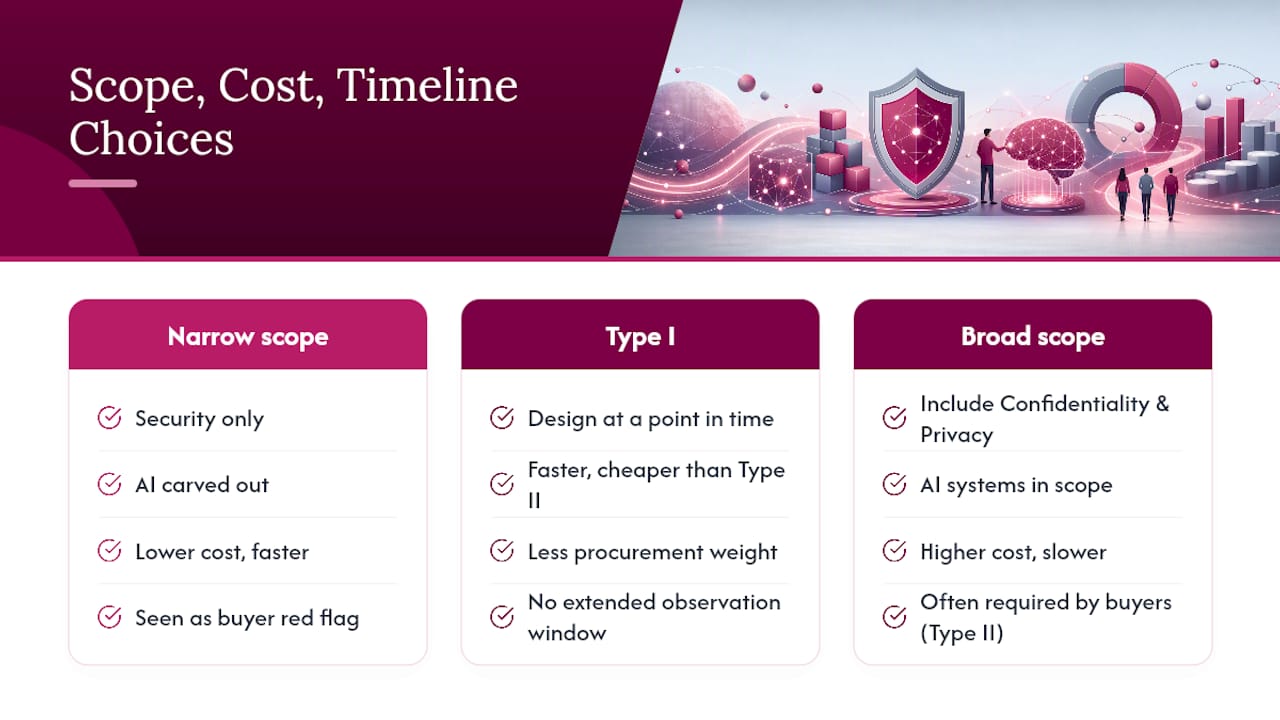
Scoping decisions carry real budget and credibility consequences. A narrow scope, Security only, with AI systems carved out, costs less and moves faster, but enterprise buyers increasingly read a narrow AI-adjacent scope as a red flag rather than a shortcut.
Type I engagements, which assess control design at a point in time, typically run faster and cheaper than Type II, which requires the extended observation window discussed above. EisnerAmper’s analysis of AI compliance frames SOC 2 as a competitive procurement requirement for AI vendors specifically because buyers now scrutinize bias handling, data protection, and vendor risk as part of the sale, not as an afterthought.
If your product touches customer data through AI features, plan on including both Confidentiality and Privacy in scope. Many enterprise buyers have quietly made SOC 2 Type II a hard procurement baseline rather than a nice-to-have, which means the cost of a broader scope is often lower than the cost of losing a deal to a narrower one.
A Prioritized Checklist for Closing AI-Specific Gaps
Work through these in order if you’re starting from close to zero:
- Inventory every AI system in production and map each to the relevant TSC categories.
- Stand up a model registry with version IDs traceable to training data and configuration.
- Implement drift and hallucination monitoring with defined alert thresholds.
- Automate continuous log and SIEM export collection across the full audit window.
- Run vendor assessments and collect SOC reports and DPAs from every AI provider.
- Document incident response procedures that explicitly cover AI failure scenarios like prompt injection and hallucination.
Pro Tip: Do the vendor assessment step early. Waiting on a third-party’s SOC report can add weeks to your timeline that no amount of internal readiness can compress.
A practical AI tool audit can help structure steps 1 and 5 before your formal audit begins.
Why Continuous Evidence Beats Point-in-Time Screenshots
Most of what makes SOC 2 for AI hard isn’t the criteria. It’s proving, continuously, that controls ran the way you say they did across models that change weekly. We built Tekkr’s approach around that gap: Configurato tracks who’s actually using which AI tools, logs anonymized usage patterns, and turns that into the kind of continuous, timestamped record auditors now expect instead of a screenshot from March.
That same telemetry that shortens audit prep also feeds directly into governance frameworks built around COSO and the TSC, so evidence collection and adoption tracking stop being separate projects.
— TekkrTools
Turn Adoption Tracking Into Audit-Ready Evidence
Manual spreadsheets and quarterly screenshots won’t survive a Type II observation window. What auditors want now is continuous, timestamped proof that your AI controls actually ran, and that’s exactly the gap between “we have a policy” and “we can prove it” that trips up most AI companies at audit time.
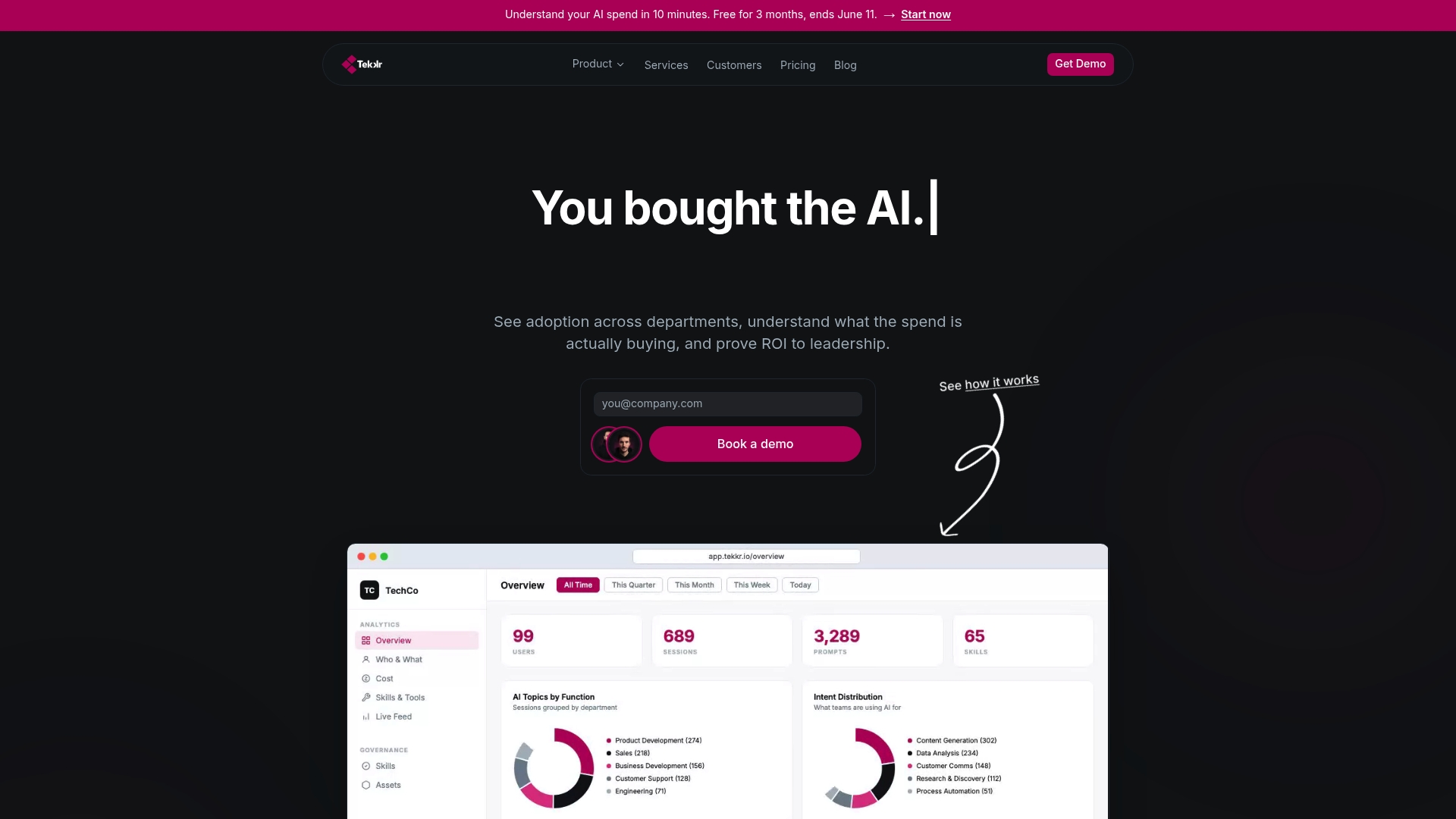
Configurato tracks which AI tools and models your teams actually use, anonymizes prompts automatically with PII stripping, and breaks down cost and usage by department, generating the kind of ongoing evidence trail your auditor will ask for anyway. Setup takes about 10 minutes, there’s a free tier with no credit card required, and everything runs on end-to-end encrypted, GDPR-compliant infrastructure you can point directly at your Confidentiality and Privacy controls. If you’re heading into a SOC 2 audit with AI in scope, evaluate the AI adoption tracking approach before you’re stuck rebuilding evidence manually six months from now.
Where to Go for Primary Guidance
For control mapping, review Baker Tilly’s SOC 2 and AI controls guidance. For evidence expectations, see SureCloud’s compliance guide. For bias testing methodology, Kreante’s bias mitigation guide covers lifecycle techniques auditors increasingly expect documented.
Sources
- Evolving SOC 2 reports for AI controls | Baker Tilly
- SOC 2 for AI Systems: What Your Auditor Will Actually Ask | BeyondScale
- SOC 2 Compliance Guide: 2026 Requirements & AI Controls | SureCloud
- SOC 2 + AI Workloads: How the Trust Services Criteria… | Areebi