
A Series B AI strategy has one job: prove that money spent on AI turns into money saved, time recovered, or revenue gained, without inviting a compliance mess. That means an inventory of every tool in use, named owners, baseline KPIs, a spend breakdown by team, and at least one validated ROI case ready to show the board. Platforms like Configurato exist specifically to produce that evidence without a six-month buildout.
TL;DR:
- Building a comprehensive inventory of all AI tools with clear ownership, purpose, and KPIs is crucial for effective governance and ROI measurement.
- Measuring AI success requires tracking reach, adoption, outcome impact, and financial value rather than simple usage counts.
- A phased rollout focuses on high-impact, low-risk workflows, with clear baselines, human review, and predefined expansion criteria to enable measurable progress.
- Effective reporting for boards combines coverage, specific use cases, spend breakdowns, validated ROI, and risk mitigation, presented through simple, narrative dashboards.
- A strong measurement-first governance approach, using frameworks like NIST or ISO, is essential for scaling AI responsibly and proving value to investors.
Table of Contents
- Building the Inventory and Lightweight Governance
- What Metrics Actually Prove AI Is Working?
- How Should You Sequence a Phased Rollout?
- How Do You Report AI ROI to a Board?
- The 90-Day Plan for Series B Teams
- Structuring an AI Team Without Over-Hiring
- Managing AI Risk: Bias, Compliance, and Practical Controls
- Integrating AI Into Existing Systems Without Breaking Them
- Modeling the Real Cost of an AI Investment
- Planning for Scale: Infrastructure and Data Strategy
- Why Measurement-First Governance Wins at Series B
- See Configurato in Action Before Your Next Board Meeting
- Sources
- FAQ
Building the Inventory and Lightweight Governance
You cannot govern what you cannot see, and most Series B companies cannot see their own AI sprawl. Marketing bought a writing assistant, engineering expensed Claude and Codex seats individually, and support quietly rolled out a chatbot nobody logged. The fix starts with a single inventory, not a policy document nobody reads.
Each entry needs specific fields: accountable owner, department, approved purpose, data classification, the workflow it touches, vendor and monthly spend, a baseline KPI, and a retirement trigger for when the tool underperforms or gets replaced. That last field matters more than founders expect. Tools get adopted and then quietly abandoned, and without a trigger date, they keep showing up on the invoice long after anyone uses them.
NIST’s AI Risk Management Framework breaks this work into four functions: Govern, Map, Measure, Manage. Govern means naming a decision owner for each tool category. Map means the inventory itself, plus an initial risk pass on where humans must review outputs before they ship. You do not need a compliance department to run this. You need one spreadsheet, four owners, and a monthly quarter hour of review.
Start with these controls before anything else:
- An approved-tool register that lists what is sanctioned and what is not
- Prohibited-data rules covering customer PII, source code, and financial figures
- An incident reporting flow, even if it is a Slack channel and a form
- A quarterly review cadence tied to the retirement trigger field
Pro Tip: Assign the incident reporting flow to someone outside the AI champion role. If the same person owns adoption and owns risk, incidents get quietly absorbed instead of escalated.
ISO/IEC 42001 frames this as Plan-Do-Check-Act. Even without pursuing certification, the discipline of scheduled review and documented incidents is what investors expect to see documented, not improvised. A governance framework built early scales far more easily than one bolted on after a data incident forces the issue.
What Metrics Actually Prove AI Is Working?
Adoption numbers alone tell a board almost nothing. A dashboard showing “400 active Claude users” answers a question nobody asked. What the board wants to know is what changed in a workflow and what that change is worth in dollars.
Build a four-tier metric tree instead of a single vanity number:
- Reach: how many people have access to the tool
- Adoption: how many use it weekly on a real workflow, not a login count
- Outcome: what changed, measured in cycle time, error rate, or ticket resolution
- Financial value: what that change is worth, translated into hours saved times loaded cost, or revenue attributable to faster turnaround
Sample thresholds by function help set expectations early. Engineering teams using AI coding assistants often see meaningful cycle-time drops on routine tasks, but broader financial gains tend to be modest. Stanford HAI’s 2025 AI Index found that while a large majority of organizations reported using AI in 2024 and many reported generative-AI use in at least one business function, most reported savings per function were modest, commonly below 10%. That is the realistic bar, not the marketing-deck bar.
The most common trap is counting licenses, prompts, or logins as ROI. McKinsey’s research on organizational AI value found that companies tying AI to workflow redesign, senior ownership, and defined KPIs are the ones actually capturing measurable impact, not the ones with the highest usage counts.
How Should You Sequence a Phased Rollout?
Rolling out AI everywhere at once guarantees you will not be able to trace any single result back to its cause. A phased approach protects both speed and your ability to prove what worked.
- Pick 2 to 4 workflows with high potential impact and lower risk. Support ticket drafting beats legal contract review as a first pilot.
- Baseline each workflow before launch. Record current cycle time, error rate, and cost per unit of work.
- Launch with a named owner and a human review step for anything customer-facing or financially consequential.
- Set expansion criteria in advance. Define the quality threshold and incident rate that triggers scaling to the next team.
- Retire or replace any pilot that misses its baseline improvement after a fixed evaluation window, typically 60 to 90 days.
Deloitte’s State of Generative AI research found that phased releases paired with interim metrics and centralized governance shorten the time it takes to reach measurable value, and that governance gaps remain a primary reason scaling stalls. Enablement matters just as much as sequencing. Role-based training beats a company-wide webinar, and a documented AI playbook with gamified milestones tends to outperform a policy memo nobody opens twice.
Pro Tip: Give your pilot teams a defined “graduation” moment, a specific point where the tool moves from experiment to standard workflow. Without that line, pilots linger indefinitely and nobody can say whether they succeeded.
How Do You Report AI ROI to a Board?
Board members and CFOs want five things on one dashboard: coverage across the organization, the top three or four measured use cases, spend broken down by team, at least one validated ROI case with numbers attached, and a short list of open risks with their mitigations.
Translate outcome KPIs into financial terms conservatively. Present a range rather than a single point estimate when the pilot sample is small. A board trusts a stated range of $40,000 to $65,000 in annualized savings more than a suspiciously precise $52,340.
| Dashboard element | What it should show |
|---|---|
| Coverage | Percentage of teams with an inventoried, governed AI tool |
| Top use cases | 3 to 4 workflows with measured before/after outcomes |
| Spend by team | Monthly cost per department, tied to the inventory |
| Validated ROI case | One workflow with a full baseline-to-outcome financial estimate |
| Open risks | Named risks and their current mitigation status |
A one-slide narrative works better than a data dump: name the business objective, the workflow that serves it, the metric that moved, and the dollar range that resulted. That structure holds up under investor questioning far better than a wall of usage charts. Teams that want this reporting without building it from scratch often lean on AI usage tracking tools that generate the spend and adoption view automatically.
The 90-Day Plan for Series B Teams
Thirty days is enough time to know where you stand. Ninety is enough to have proof.
Days 1 to 30:
- Build the tool inventory across every department, not just engineering
- Assign an accountable owner for each tool category
- Select 2 to 4 pilot workflows and record their baselines
Days 31 to 60:
- Run the pilots with named owners and human review checkpoints
- Measure adoption and outcome KPIs weekly, not just at the end
- Apply the lean governance controls: register, prohibited-data rules, incident flow
- Draft the first executive slide, even if the numbers are rough
Days 61 to 90:
- Validate one to two ROI cases with real financial estimates
- Recommend specific budget reallocations based on what worked and what did not
- Publish a board-ready report covering coverage, spend, ROI, and open risks
By day 90, you should be able to answer the question every investor eventually asks: what did the AI spend actually buy? Following adoption best practices built around this cadence turns that question into a five-minute answer instead of a scramble.
Structuring an AI Team Without Over-Hiring
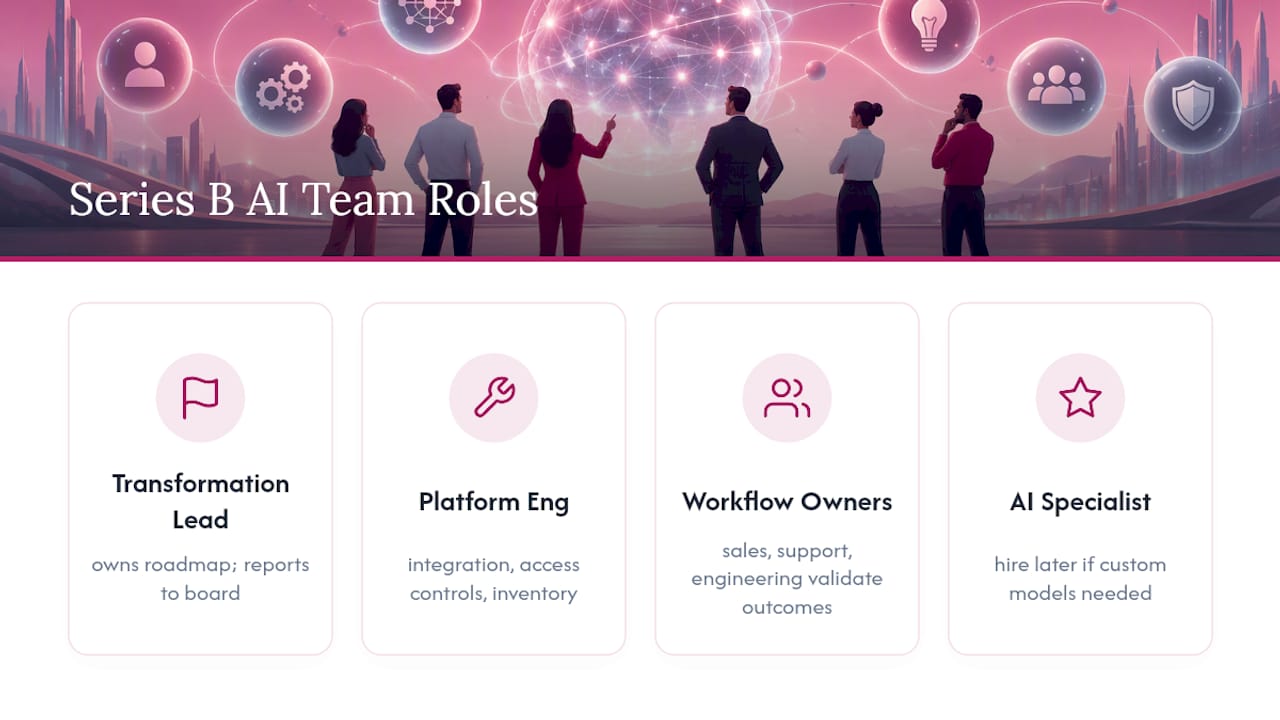
Series B companies rarely need a large AI team. They need the right three or four roles clearly defined. An AI transformation lead, whether that is the CTO wearing a second hat or a dedicated hire, owns the roadmap and reports to the board. A data or platform engineer handles integration, access controls, and the technical side of the inventory. A workflow owner in each major department, sales, support, engineering, evaluates whether a given tool is actually improving that department’s numbers.
The skill gap that catches most companies off guard is not machine learning expertise. It is prompt evaluation and workflow redesign literacy, the ability to look at a task and know whether an AI tool changes it meaningfully or just adds a layer of review work. Hiring a PhD-level ML engineer before you have that literacy is usually a misallocation of Series B capital.
Prioritize hires in this order: a workflow owner who understands both the business process and the tool’s limitations, a lightweight technical integrator, and only later a specialized AI engineer if the company’s core product depends on custom models rather than off-the-shelf tools. For most Series B companies building on top of existing AI assistants rather than training their own models, that specialized hire can wait until Series C.
Cross-functional literacy beats concentrated expertise at this stage. A support lead who understands how to baseline and measure a chatbot pilot delivers more provable ROI than an isolated AI team that never touches the workflows generating revenue. Structure the team around outcomes owned by the departments that feel them, not around a centralized AI function that reports results nobody outside the team can verify.
Managing AI Risk: Bias, Compliance, and Practical Controls
AI risk at Series B stage is rarely about exotic model failures. It is about mundane things: a customer-facing chatbot giving wrong pricing information, a hiring tool subtly favoring one resume format, or an engineer pasting proprietary code into a public model.
Bias mitigation starts with knowing where a model’s output touches a decision that affects people, hiring, pricing, credit, support prioritization, and requiring a human review step at exactly those points. You do not need a fairness research team to do this. You need a rule that says any AI output influencing a customer-facing decision gets checked before it ships, and a log of when that check catches something wrong.
Compliance considerations scale with the sensitivity of the data involved. A tool summarizing internal meeting notes carries far less regulatory weight than one processing customer financial data or health information. Classify data sensitivity in the inventory itself, and set stricter human oversight requirements for anything touching regulated categories.
Congressional attention to small-business AI risk management is increasing, with proposals like the AI-WISE Act aiming to create advisory resources for evaluating AI tools. That signals a direction: documented governance is likely to matter more, not less, as regulation catches up. Building the habit now, an approved-tool register, an incident log, a review cadence, costs far less than retrofitting it under a deadline. A clear acceptable use policy gives employees the boundary lines before a mistake forces the conversation.
Integrating AI Into Existing Systems Without Breaking Them
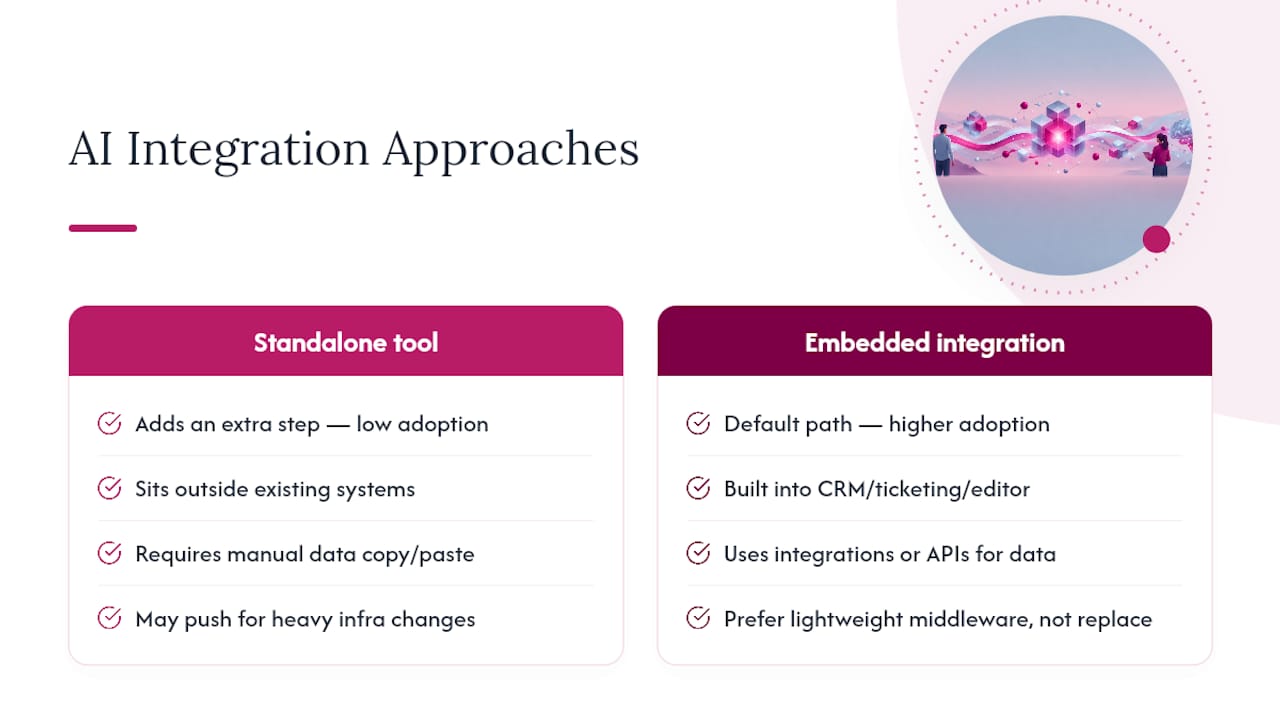
The integration problem at Series B is rarely technical incompatibility. It is workflow incompatibility, a tool that works beautifully in isolation but nobody actually routes work through it because it sits outside the existing system.
The pattern that fails: buying a standalone AI tool and asking teams to “also check” it alongside their existing software. Adoption dies within a month because it adds a step rather than replacing one. The pattern that works: embedding the AI tool directly into the platform a team already lives in, whether that is the CRM, the ticketing system, or the code editor, so using it is the default path, not an extra chore.
Data access is the second common snag. AI tools need enough context to be useful, but scale-ups often have data scattered across disconnected systems with inconsistent formats. Before rolling out a tool broadly, confirm it can actually reach the data it needs through an existing integration or API, not through someone manually copying and pasting context every time.
Legacy systems that predate the AI wave, an older internal tool or a homegrown database, often need a lightweight middleware layer rather than a full replacement. Replacing core infrastructure to accommodate one AI tool is usually the wrong trade at Series B, when engineering time is the scarcest resource in the company. Manufacturing and operations teams have found similar success embedding AI directly into existing shop-floor systems rather than layering on separate software, an approach documented in operational AI deployments where the tool becomes part of the existing process rather than a parallel one.
Modeling the Real Cost of an AI Investment
Total cost of ownership for AI at Series B stage extends well past the subscription line item. The visible cost is the per-seat license fee. The hidden costs are integration engineering time, ongoing prompt and workflow maintenance, the human review hours built into any high-stakes use case, and the governance overhead of keeping the inventory current.
A useful cost-benefit model separates three cost tiers: acquisition cost (licenses, setup), operating cost (integration maintenance, review hours, incident handling), and opportunity cost (what the team would have built if this project had gone elsewhere). Weigh all three against the financial value tier from your metric tree, not just against the license fee.
Expected returns should be modeled conservatively given what the data shows. With most organizations reporting savings under 10% per function, a Series B board should treat any pilot projecting 30% or 40% efficiency gains with real skepticism until a baseline-to-outcome comparison proves it. Build the model with a break-even point, not just a best-case projection, and revisit it every quarter as actual usage data replaces assumptions.
The payback window matters more than the headline savings figure. A tool that costs $2,000 a month but saves 15 hours a week of a $150,000-a-year engineer’s time pays back almost immediately. A tool that costs the same but saves 15 hours a week of an entry-level support agent’s time takes considerably longer, and that difference should drive which pilots get funded first.
Planning for Scale: Infrastructure and Data Strategy
What works for a 40-person pilot group often breaks at 400 people, and the failure point is usually data infrastructure, not the AI tool itself. Scaling AI usage means scaling the data pipelines that feed it: consistent formatting, reliable access controls, and a classification system that does not require manual tagging every time a new use case appears.
Plan infrastructure in layers rather than building for hypothetical future scale immediately. Get the current pilot’s data pipeline solid before assuming the entire company will use the same tool the same way. Data strategies also need to evolve as AI use spreads. What started as unstructured customer support tickets or engineering logs eventually needs a consistent taxonomy if multiple AI tools are going to draw on the same information without contradicting each other.
Vendor lock-in is a long-term scalability risk. Building deeply customized integrations around one AI provider’s specific API can make switching costly later, right as better or cheaper alternatives emerge. Favor provider-agnostic architecture where practical, so the company is not rebuilding its entire AI layer every time a new model generation ships. Teams exploring agent-based automation face this especially sharply, since agentic AI systems require even tighter oversight as autonomy increases, making flexible infrastructure a bigger priority than picking today’s fastest model.
Why Measurement-First Governance Wins at Series B
Most AI strategy advice treats governance and measurement as separate workstreams, one for the legal team, one for the growth team. That split is exactly backward. The same inventory that satisfies a risk review also produces the baseline data a CFO needs for an ROI case. Build one system that serves both purposes, and the board conversation shifts from “are we using AI” to “here is what it returned.”
Privacy-first telemetry matters more than most founders assume at this stage. Stripping PII from prompts and encrypting usage data end-to-end means you can measure real adoption patterns without creating a second compliance liability on top of the first. That is not a nice technical feature, it is what makes honest measurement politically possible inside a company where employees are (rightly) wary of surveillance.
The gap between companies that talk about AI ROI and companies that can prove it usually comes down to whether they built the measurement layer before the board asked for it.
— TekkrTools
See Configurato in Action Before Your Next Board Meeting
Every recommendation in this playbook, the inventory, the metric tree, the executive dashboard, is the exact workflow Configurato was built to run. It tracks who is actually using tools like Claude and Codex, breaks spend down by team automatically, and surfaces use-case intelligence so you are not manually assembling a spreadsheet the week before a board meeting.
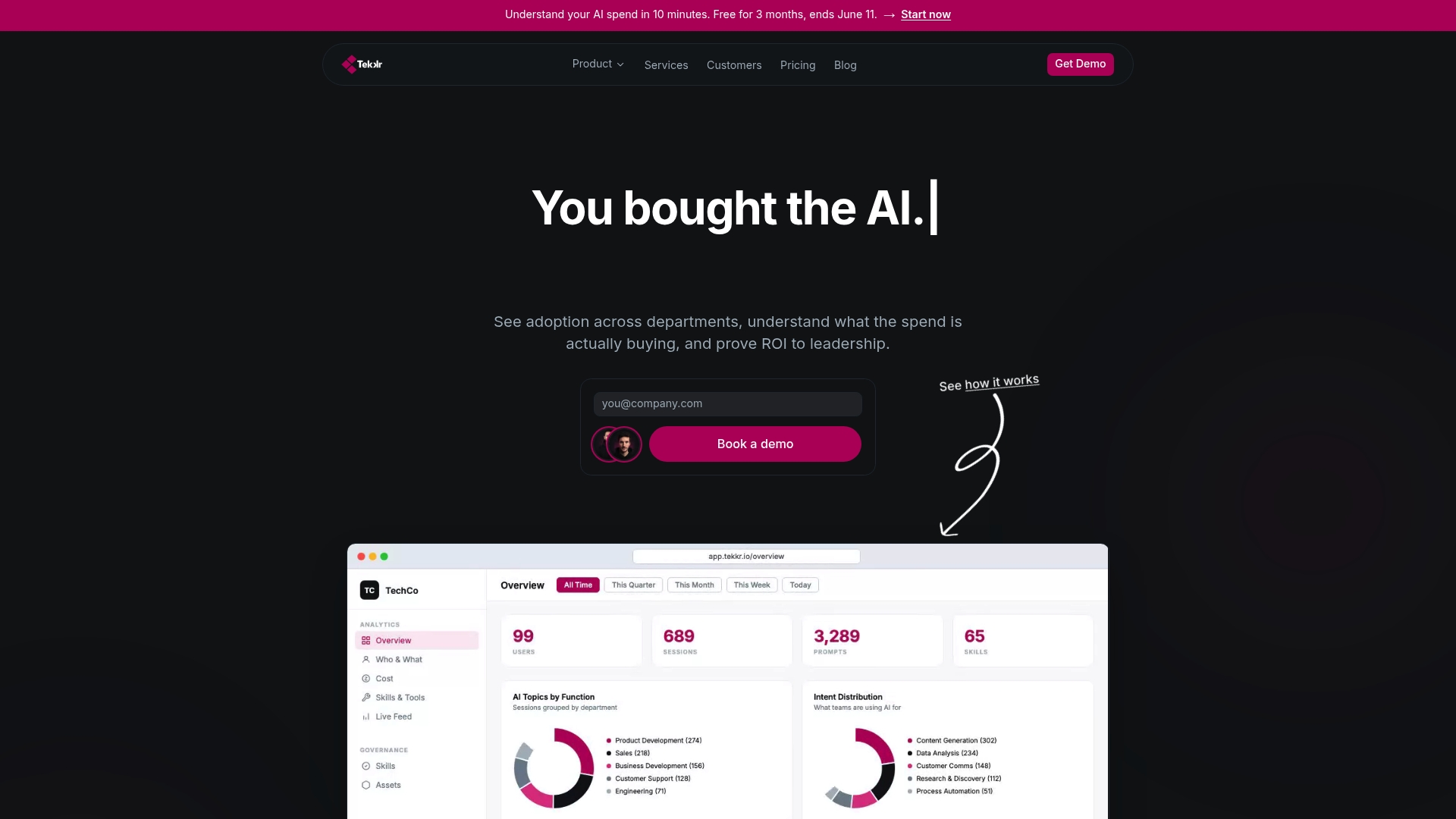
The privacy architecture matters as much as the reporting. The platform runs end-to-end encrypted, strips PII from prompts automatically, and needs no browser extensions to install across a company that is understandably cautious about new software touching employee activity. Setup takes about 10 minutes on the free tier, no credit card required, which means you can have a real inventory running before your next leadership sync. For companies that want the strategy work done alongside the tooling, Tekkr’s AI adoption programs pair the platform with hands-on rollout support. Check the pricing page to see which plan fits your team’s stage, or start with the free tier today.
Sources
- The 2025 AI Index Report — Economy | Stanford HAI
- Artificial Intelligence Risk Management Framework: Generative Artificial Intelligence Profile | NIST
FAQ
What Should a Series B AI Strategy Include First?
The first deliverable is a complete inventory of every AI tool in use, with an accountable owner and baseline KPI attached to each one. Governance and ROI measurement both build on that inventory, so skipping it forces every later step to be reconstructed from scratch.
How Do You Measure AI ROI Without Overstating It?
Use a four-tier metric tree that separates reach, adoption, outcome, and financial value, so a login count never gets mistaken for a business result. Stanford HAI’s research found most organizations report savings under 10% per function, which is a useful conservative benchmark when building financial estimates.
What Governance Framework Fits a Scale-Up Best?
NIST’s AI Risk Management Framework, built around Govern, Map, Measure, and Manage, scales down well for smaller teams because it is a cadence rather than a heavy compliance program. ISO/IEC 42001’s Plan-Do-Check-Act structure works as a complementary reference even without pursuing formal certification.
Does Tekkr Replace the Need for an Internal AI Strategy?
No. Tekkr’s Configurato platform measures adoption, spend, and ROI so you have the evidence base for a strategy, but the workflow selection, governance rules, and board narrative still come from your own team. Consulting services on AI adoption programs are available for companies that want hands-on help building both.
How Much Does Tekkr Cost?
Current pricing details for Tekkr’s plans and services are available on the pricing page. The platform offers a free tier with no credit card required to start measuring AI usage immediately.