
Scaling an AI pilot to production depends on one thing above all: a measurable business KPI with a named executive owner. Around that anchor, three pillars have to hold: production-grade data and infrastructure, governance that includes testing and validation, and an operational team that owns the system after launch. Get those right and payback can land in 6 to 12 months, according to McKinsey research on high-performing AI programs.
TL;DR:
- Effective scaling requires a clear KPI, named owner, and measurable business value established before further development begins.
- Most pilots fail due to data fragmentation, lack of ownership transition plans, and missing or vague KPIs, which hinder progress beyond testing.
- Following a five-phase roadmap with defined exit criteria ensures structured growth from validation to full operation and continuous optimization.
- Pre-scaling checklists should confirm executive sponsorship, data readiness, security compliance, and operational documentation to prevent delays.
- Monitoring infrastructure with tools that track usage, ROI, and data shifts is essential for sustaining performance and justifying scaling efforts.
Table of Contents
- Why pilots stall before they reach production
- A phased roadmap from validation to full operation
- A go or no-go checklist before you scale
- What data and infrastructure scale actually requires
- Governance and monitoring built on TEVV principles
- Getting the people and process right
- Where measurement tools like Configurato fit in
- Three priorities for the first 90 days
- Get started measuring and scaling your AI pilots
- Sources
- FAQ
Why pilots stall before they reach production
Most pilots die from the same handful of causes, and they rarely show up until you try to move past the demo stage. Data that looked clean in a sandbox turns out to be fragmented across systems, riddled with schema drift, or built on test sets too narrow to represent real traffic. Ownership is often the second failure point: a pilot built by a data science team with no clear handoff plan to IT or operations tends to stall the moment its champion moves to another project.
- Data fragmentation, thin test datasets, and schema drift that only surface at scale
- No named owner for the transition from pilot to live operations
- Missing or vague KPIs, so the pilot proves technical feasibility but never a business case
- Infrastructure gaps in latency, cost, or scaling headroom
- Compliance or vendor lock-in risks discovered late in the process
The Cloud Security Alliance points to data readiness as the single biggest lever: pilots that start with clean, well-governed data and a specific, high-value use case scale far more predictably than those chasing broad automation from day one.
A phased roadmap from validation to full operation
Treat scaling as five distinct phases, each with its own exit criteria rather than a vague “let’s expand it” mandate.
- Phase 0, confirm fit: define the KPI, name the business owner, measure the baseline, and agree on a payback target before writing another line of code.
- Phase 1, harden: make training reproducible, add unit tests, and run TEVV-style validation against edge cases the pilot never saw.
- Phase 2, platform: establish data contracts, logging, a retraining cadence, and model serving with defined service-level objectives.
- Phase 3, integration and rollout: stage the rollout by team or region, instrument every touchpoint, and build a real adoption plan, not just a technical deployment plan.
- Phase 4, operate and optimize: monitor continuously, set retrain triggers, define incident response, and track ROI as an ongoing metric rather than a one-time report.
Pro Tip: Treat Phase 0 as a gate, not a formality: if you cannot name the KPI owner in one sentence, the pilot is not ready to scale.
Each phase should produce a concrete artifact, a data contract, a runbook, a dashboard, so that the project doesn’t rely on tribal knowledge held by the original pilot team.
A go or no-go checklist before you scale
Before moving a pilot into production, confirm every item below. Treat a single “no” as a reason to pause, not a reason to push through and fix it later.
- An executive sponsor and a named business owner are both assigned
- KPIs are defined, a baseline is measured, and a target payback window is agreed
- Production-like test data exists and TEVV-style acceptance criteria are passing
- Security, privacy, and compliance sign-off is documented along with a deployment playbook
- An operational runbook for day-to-day monitoring and support is written and assigned
This checklist works because it forces the conversation that most pilots skip: who runs this thing once the original builders move on.
What data and infrastructure scale actually requires
Scaling reliably means building for conditions the pilot never faced: unpredictable load, messier inputs, and a much longer tail of edge cases. Data contracts and lineage tracking catch schema drift before it silently corrupts downstream models. For latency-sensitive use cases, a feature store or streaming feature pipeline usually replaces batch jobs that were fine in testing but too slow in production.
- Enforce data contracts and lineage so schema changes are caught, not discovered
- Use a feature store or streaming infrastructure for low-latency scoring needs
- Choose a model hosting pattern, serverless, managed infrastructure, or on-prem, based on your actual cost and latency tradeoffs
- Track data-distribution shifts, feature importance, and accuracy by cohort, not just an overall accuracy number
- Vet vendors and encrypt data end to end, with clear PII handling rules
Private investment in generative AI reached $33.9 billion in 2024, according to Stanford HAI’s AI Index. That scale of investment is pushing more workloads into production faster, which raises the cost of skipping observability and cost controls at the infrastructure layer. Analytics and instrumentation practices from adjacent fields, covered in depth by PlotStudio AI, offer a useful reference point for building the monitoring layer many pilots lack.
Governance and monitoring built on TEVV principles
Governance is what keeps a scaled AI system from becoming a liability the moment it meets messy, real-world inputs. The NIST AI Risk Management Framework recommends documenting performance criteria up front, assigning clear monitoring and incident response roles, and using tiered detection, automated scans first, human review second, to catch problems without burning reviewer time on every output.
- Test, evaluate, validate, and verify (TEVV) under production-like conditions, not just clean pilot data
- Assign specific people to monitoring and incident response, not a shared inbox
- Run automated scans first, then route flagged cases to human reviewers
- Log acceptance criteria and keep an audit trail for every model decision
- Define retraining triggers and a rollback procedure before you need one
Skipping these steps rarely causes an immediate failure. It causes a slow one, months after launch, when nobody notices the model has drifted until a business metric quietly turns south.
Getting the people and process right
Technology rarely fails scaling efforts on its own. McKinsey’s research on organizations rewiring for AI value finds that companies pairing clear KPIs with a defined roadmap and a dedicated team capture bottom-line impact far more consistently than those relying on ad hoc pilot teams.
- Give the pilot an executive sponsor and, where scale justifies it, a center of excellence to own repeatable practices
- Build translator roles that connect data teams to the business units inheriting the system
- Set adoption KPIs around usage, in-production accuracy, and the actual business metric you set out to move
- Train the workforce and align incentives so using the new system becomes the easy default, not an extra step
- Manage vendor relationships explicitly, with a documented plan for knowledge transfer back to internal teams
Our guide to AI adoption strategies covers how to structure this handoff in more detail.
Where measurement tools like Configurato fit in
Most of the roadmap above depends on visibility that spreadsheets and gut feel can’t provide. Certain AI adoption tracking platforms can monitor usage of tools like Claude and Codex, analyze spending by team, and highlight which use cases are generating real value, providing signals necessary to justify scaling past the pilot stage.
- Some AI productivity platforms measure adoption, spending, and ROI and include features aimed at increasing adoption beyond reporting
- Many run on privacy-first, end-to-end encrypted architectures with automatic PII stripping and do not require browser extensions
- Setup durations for such platforms can be fairly short, which is important when leaders are managing early rollout phases.
Our AI usage tracking guide walks through how this kind of visibility changes the adoption conversation.
Three priorities for the first 90 days
Secure the KPI and its executive owner first, then define TEVV acceptance tests and observability before any wider rollout. Pick an initial expansion path that fits existing workflows to shorten time-to-value. Pair measurement tools with real incentives, since adoption, not raw accuracy, is what determines whether the pilot ever pays back.
— TekkrTools
Get started measuring and scaling your AI pilots
If you’re staring at a pilot that worked in the demo but stalled at the KPI conversation, that’s usually a measurement gap, not a technical one. 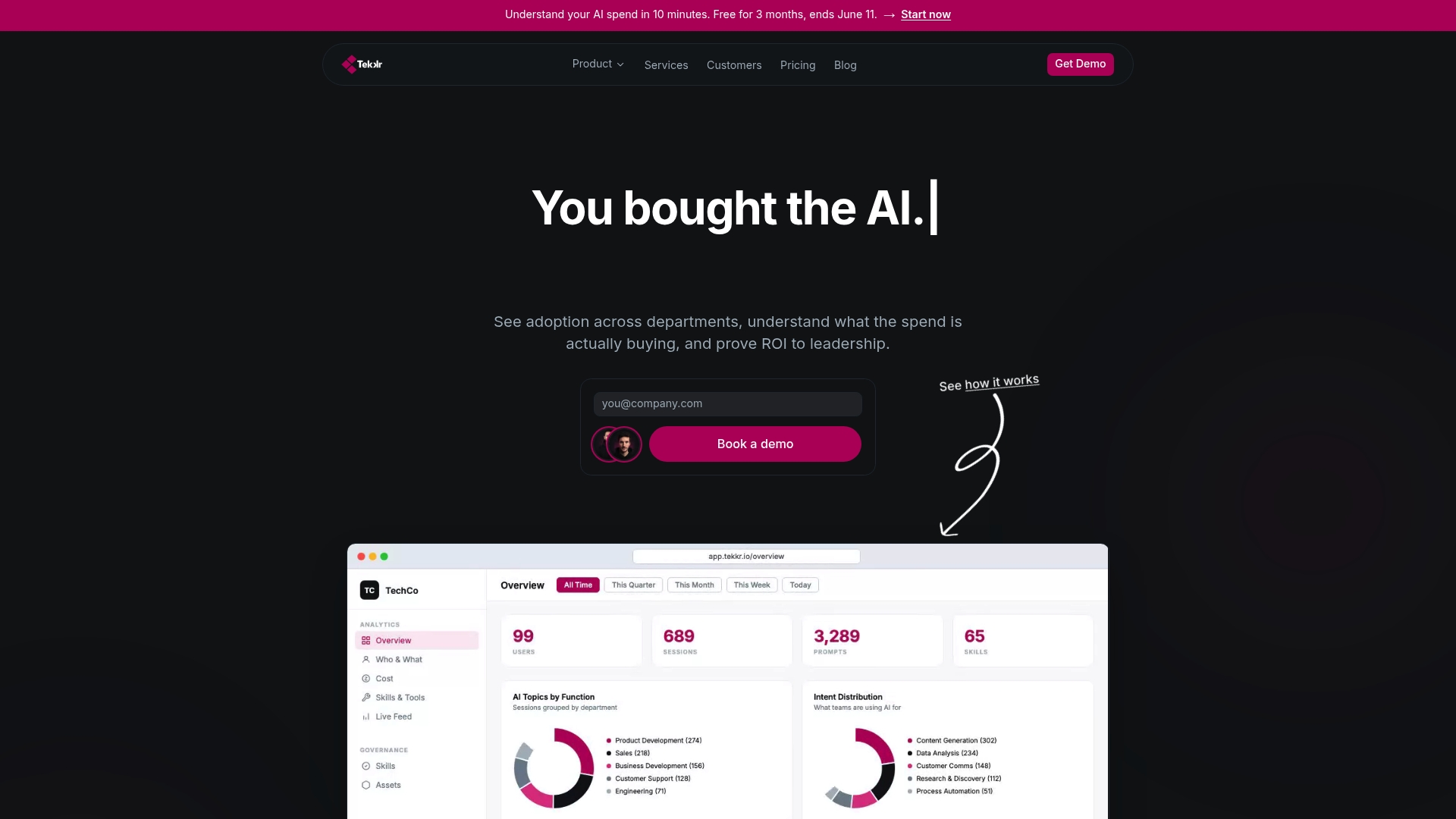
Configurato gives finance and transformation leaders the same visibility they’d otherwise have to build in-house: who’s using which AI tools, what it costs by team, and where the ROI actually shows up. Tekkr also offers an AI Readiness Assessment and hands-on transformation support for teams that want an operator alongside them rather than a dashboard alone.

You can start with the free tier of Configurato, no credit card required, or explore the full services overview if your pilot needs more than a measurement layer to reach production.
Sources
- Stanford HAI: AI Index 2025 — state of AI in 10 charts
- McKinsey: The state of AI — how organizations are rewiring to capture value
- NIST: AI Risk Management Framework (AI RMF)
FAQ
Is it hard to get a job at Scale AI?
This article covers scaling AI pilots inside an organization, not hiring practices at any specific AI company, so we can’t speak to that. If you’re researching a specific employer’s hiring process, their own careers page is the more reliable source.
Which three jobs will not survive AI?
There’s no verified, agreed-upon list of specific jobs that AI will eliminate, and any claim to name exactly three would be speculation. What’s better supported is that AI adoption is reshaping tasks within many roles rather than eliminating entire job categories overnight, as reflected in broader adoption trends from Stanford HAI’s AI Index.
Who owns Scale AI?
Scale AI’s ownership isn’t something this article’s sources cover, since it focuses on the process of scaling AI pilots within enterprises rather than any single company’s corporate structure. Check the company’s own investor or press materials for accurate, current ownership details.
How much does Scale AI pay?
Compensation at that specific company isn’t something this article addresses, as it’s focused on how enterprise leaders scale internal AI pilots into production. For accurate pay information, a source like the company’s own careers page or a salary aggregator would be more reliable.
How long does it typically take to see payback on a scaled AI pilot?
Payback periods can shrink to 6 to 12 months for programs that pair clear KPIs with a defined roadmap and a dedicated team, according to McKinsey’s research on AI value capture. Programs without those elements tend to take longer to show measurable business impact, if they show it at all.