
An AI champion team is a peer-led adoption layer that converts AI tools into repeatable, team-level workflows and measurable quality gains. That’s the whole idea. Not a committee, not a training program, not a mandate from the top floor. A small group of peers who sit inside the work, translate central AI objectives into daily practice, and close the gap between “we bought the licenses” and “we actually use this well.”
Your immediate action: pick one high-impact workflow this week and identify two peer colleagues who already use AI in that process. That’s your starting point.
BCG research shows that Peer-to-peer learning is one of the top ways many employees use to build AI skills. Champions are how that learning gets structured rather than left to chance. For enterprise and tech managers tracking AI adoption and productivity, the role of AI champions teams is the missing operational layer between tool access and measurable results.
Table of Contents
- What is the role of AI champions teams in an organization?
- What do AI champions actually do week to week?
- How should champions fit into your organization’s structure?
- Which KPIs prove that champions are delivering value?
- What do champions need to do their jobs well?
- What does a 90-day champion pilot look like?
- What causes AI champion programs to fail?
- Key Takeaways
- Why peer-led adoption scales faster than top-down mandates
- Tekkr Configurato gives your champion program real measurement
- Useful sources and further reading
What is the role of AI champions teams in an organization?
Champions are peer change operators, not managers and not evangelists. That distinction matters more than most program designs acknowledge.
| Role | Primary Function | Relationship to Team |
|---|---|---|
| AI champion | Translates objectives into team practice; coaches peers | Peer (same level) |
| Manager | Quality owner; provides mandate and sponsorship | Hierarchical |
| Evangelist / power user | Demonstrates features; shares enthusiasm | Peer, but no operational mandate |
The peer-based design is deliberate. When a manager runs the champion role, colleagues stop asking candid questions. Psychological safety collapses, and you get polished demos instead of honest adoption. Champions work because they sit inside the same pressures, deadlines, and frustrations as the people they’re helping.
Selection should weight social credibility and process knowledge over raw technical skill. A candidate who already has peer respect and understands the workflow end-to-end will outperform a technically brilliant colleague who nobody asks for help. Use this quick check before nominating anyone:
- Can they name a repeatable use case they’ve already run in the team’s actual work?
- Do peers come to them with process questions unprompted?
- Do they understand where quality review and human judgment are still required?
- Can they escalate a governance or compliance question to the right owner?
If the answer to all four is yes, you have a candidate. Two out of four, keep looking.
What do AI champions actually do week to week?
Champions are operational, not ceremonial. Their weekly work falls into four buckets: coaching, documentation, quality signaling, and escalation.
- Coaching and demos: Run short, real-work demos (not slide decks). Show a colleague how a specific document or report went from 45 minutes to 10 minutes using a validated prompt. Concrete beats theoretical every time.
- Prompt library maintenance: Keep a shared, team-specific prompt library current. Prune what stops working; add what colleagues discover.
- Office hours: Hold 30-minute weekly drop-ins for questions, blockers, and live troubleshooting.
- Quality signals: Track first-pass quality on champion-owned workflows. Flag regressions to the manager sponsor immediately.
- Escalation: Route access issues, compliance questions, and governance blockers to IT, legal, or risk. Champions are not IT support; they are the first filter.
Time commitment should be protected at 2–3 hours per week. Anything less and the role becomes symbolic. Anything more and you’re creating a full-time position without the title or the pay.
Pro Tip: Make the first champion output visible and concrete within the first two weeks. A real document reduced from 45 minutes to 10 minutes, shared in the team channel, does more for adoption than any kickoff presentation.

How should champions fit into your organization’s structure?
Champions are peer roles, but they need a line-manager sponsor to function. Without that co-ownership, the role drifts into volunteerism and burns out within 60 days.
The recommended model pairs each champion with a named manager sponsor who owns three things: protecting the champion’s 2–3 hours of weekly time, removing organizational blockers, and reviewing KPIs monthly. The champion does not report to the sponsor in a hierarchical sense. The sponsor creates the conditions; the champion does the work.
For scaling across functions, start in high-impact pockets where existing use-case evidence already exists. Champions reveal real starting points; building from those pockets is faster and more durable than forcing an org-wide rollout. A practical distribution for a pilot team of 20–30 people: two frontline champions, one enabling-function champion (ops, legal, or finance), and one manager sponsor.
Cadence matters. Weekly team clinic (15 minutes, champion-led). Monthly cross-champion calibration (compare quality signals across teams). Quarterly portfolio review with leadership to decide what scales and what retires.
Every champion needs a clear escalation map: who owns IT access, who owns legal review, who owns risk sign-off. Without that map, blockers pile up and champions become the person everyone blames for delays they can’t actually fix.
Which KPIs prove that champions are delivering value?
Activity metrics lie. Presentation counts, office-hour attendance, and “awareness survey” scores tell you the program is running. They don’t tell you it’s working. Tie every KPI to a workflow outcome.
| Metric | Definition | What “good” looks like |
|---|---|---|
| Workflow coverage | % of target processes with an active champion | most pilot workflows covered within the early weeks |
| First-pass quality delta | % of outputs accepted without revision vs. pre-champion baseline | Positive delta within 60 days |
| Rework reduction | Hours saved on revision cycles per workflow per week | Measurable drop by Month 2 |
| Time saved per workflow | Average task time before vs. after champion-led adoption | a significant reduction in task time on coached workflows |
| Barrier resolution speed | Days from blocker reported to blocker resolved | Under 5 business days |
| Safe deployment count | Validated, governance-approved workflows in production | Growing quarter over quarter |
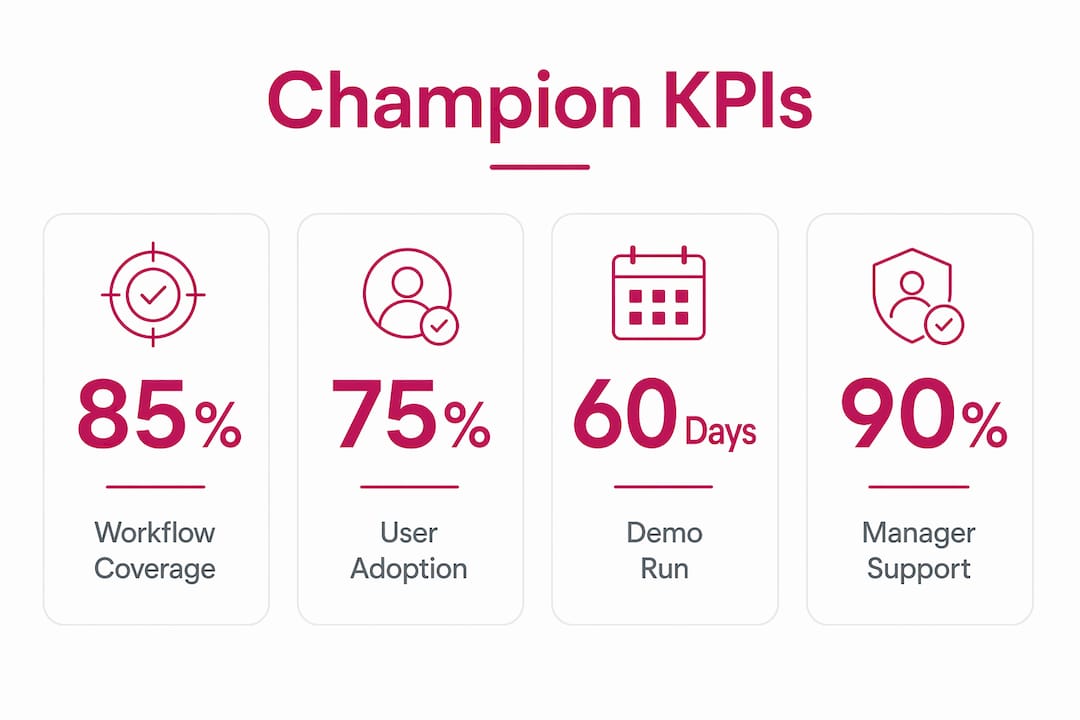
Benchmark against your own pre-champion baseline, not industry averages. The outcome-focused metric approach recommended by AI&Scale ties champion work directly to process KPIs rather than activity counts, which is the only framing that holds up in a quarterly leadership review.
What do champions need to do their jobs well?
Champions without assets are just enthusiastic colleagues. Within the first 30 days, provision these four things:
Playbook seed: A team-specific template covering the top three workflows the champion owns, with prompt standards, review checklists, and quality criteria already filled in. Don’t make champions build this from scratch.
Shared prompt library: A living document (or a dedicated channel) where validated prompts live. Champions own curation; the team owns contribution.
Usage dashboard: A lightweight view of which tools are being used, by whom, and at what frequency. Champions need this to spot adoption gaps before they become entrenched habits. Tekkr’s Configurato provides exactly this, with cost-by-team breakdowns and use-case intelligence that champions can act on without needing IT involvement.
Direct vendor support channel: Champions should have early access to new features and a direct line to vendor support. Routing everything through IT adds days to every blocker. Teams moving AI prototypes into repeatable workflows can also benefit from productization practices like those at VibeProd, which help champions package working examples into durable, reusable assets.
What does a 90-day champion pilot look like?
A well-structured 90-day program can become self-sustaining if champions are identified by behavior, not self-nomination, and given structured support from day one.
- Pre-launch (Days 1–7): Select two or three target workflows. Nominate 2–3 champions per pilot team based on the four-question checklist above. Align manager sponsors. Set success criteria against the KPI table.
- Month 1: Onboard champions with 6–8 hours of advanced training. Seed the playbook. Grant early tool access. Launch weekly office hours.
- Month 2: Run use-case clinics (30-minute live sessions on a single workflow). Collect first quality signals. Begin monthly manager cadence reviews. Iterate the playbook based on what’s actually working.
- Month 3: If the quality delta is positive, scale to adjacent teams. Present process KPIs to stakeholders. Decide: expand the portfolio, hold steady, or retire underperforming workflows.
| Milestone | Owner | Due |
|---|---|---|
| Champions nominated | Manager sponsor | Day 7 |
| Playbook seeded | Champion | — |
| First office hours held | Champion | — |
| First quality signal reported | Champion | Day 45 |
| Stakeholder KPI review | Manager sponsor | Day 90 |
What causes AI champion programs to fail?
Most programs fail for the same five reasons, and most of them are visible within the first 30 days.
- Appointing managers as champions. This is the single most common mistake. It kills psychological safety immediately. Peers stop asking questions they’d look foolish asking in front of their boss.
- No formal mandate. Without a written role definition and scope, programs drift into enthusiast clubs that generate activity but no process impact.
- No protected time. Champions who are expected to fit the role into their existing workload will deprioritize it the moment a deadline hits.
- Measuring activity instead of outcomes. Tracking presentation counts and survey scores creates the illusion of progress while real adoption stalls.
- Turning champions into IT support. Without clear escalation paths, every access issue and compliance question lands on the champion. Burnout follows within 60 days.
The 4M framework from AI&Scale gives you the recovery checklist: Mandate (written role definition), Minutes (protected weekly time), Metrics (outcome KPIs), and Manager sponsorship (named co-owner). If any of the four is missing, the program is at risk. If adoption stalls, audit all four before assuming the champion is the problem.
Red flags to watch for: a champion who hasn’t run a live demo by Day 30, a manager sponsor who hasn’t reviewed a quality signal by Day 45, or a playbook that hasn’t been updated since launch.
Key Takeaways
AI champion teams work when they are peer-led, formally mandated, and measured on workflow outcomes rather than activity counts.
| Point | Details |
|---|---|
| Peer design is non-negotiable | Appointing managers as champions breaks psychological safety and reduces candid adoption. |
| 4M framework prevents failure | Mandate, Minutes, Metrics, and Manager sponsorship must all be in place before launch. |
| Outcome KPIs only | Track first-pass quality delta, rework reduction, and time saved per workflow — not presentation counts. |
| 90-day pilot is enough | A behavior-identified champion with structured support can create a self-sustaining program within 90 days. |
| Tekkr Configurato maps to KPIs | Configurato tracks workflow coverage, cost by team, and usage gaps — the exact metrics a champion program needs to report to leadership. |
Why peer-led adoption scales faster than top-down mandates
The conventional wisdom on AI adoption is that leadership commitment drives results. It’s true but incomplete. Leadership commitment creates permission; peer champions create practice. Those are different things, and confusing them is why so many enterprise AI programs show high tool access and low actual use.
Peer advocacy works because it operates at the level where work actually happens. A colleague showing you how they cut a 45-minute task to 10 minutes in a tool you both use is more persuasive than any executive memo. Psychological safety amplifies this: people ask peers questions they’d never ask a manager, which means real blockers surface and get fixed instead of staying hidden.
Manager co-ownership multiplies champion effectiveness by removing the organizational friction that kills momentum. When a manager actively protects a champion’s time and reviews quality signals monthly, the program has institutional weight. Without that weight, champions are volunteers, and volunteers burn out.
The connection to governance is equally direct. Champions who have clear escalation paths to IT, legal, and risk don’t just drive adoption. They drive safe adoption, which is the only kind that survives a compliance audit.
Tekkr Configurato gives your champion program real measurement
Knowing your champions are active is not the same as knowing they’re working. Tekkr’s Configurato closes that gap by tracking who is actually using tools like Claude and Codex, breaking down costs by team, and surfacing use-case intelligence that champions can act on immediately.
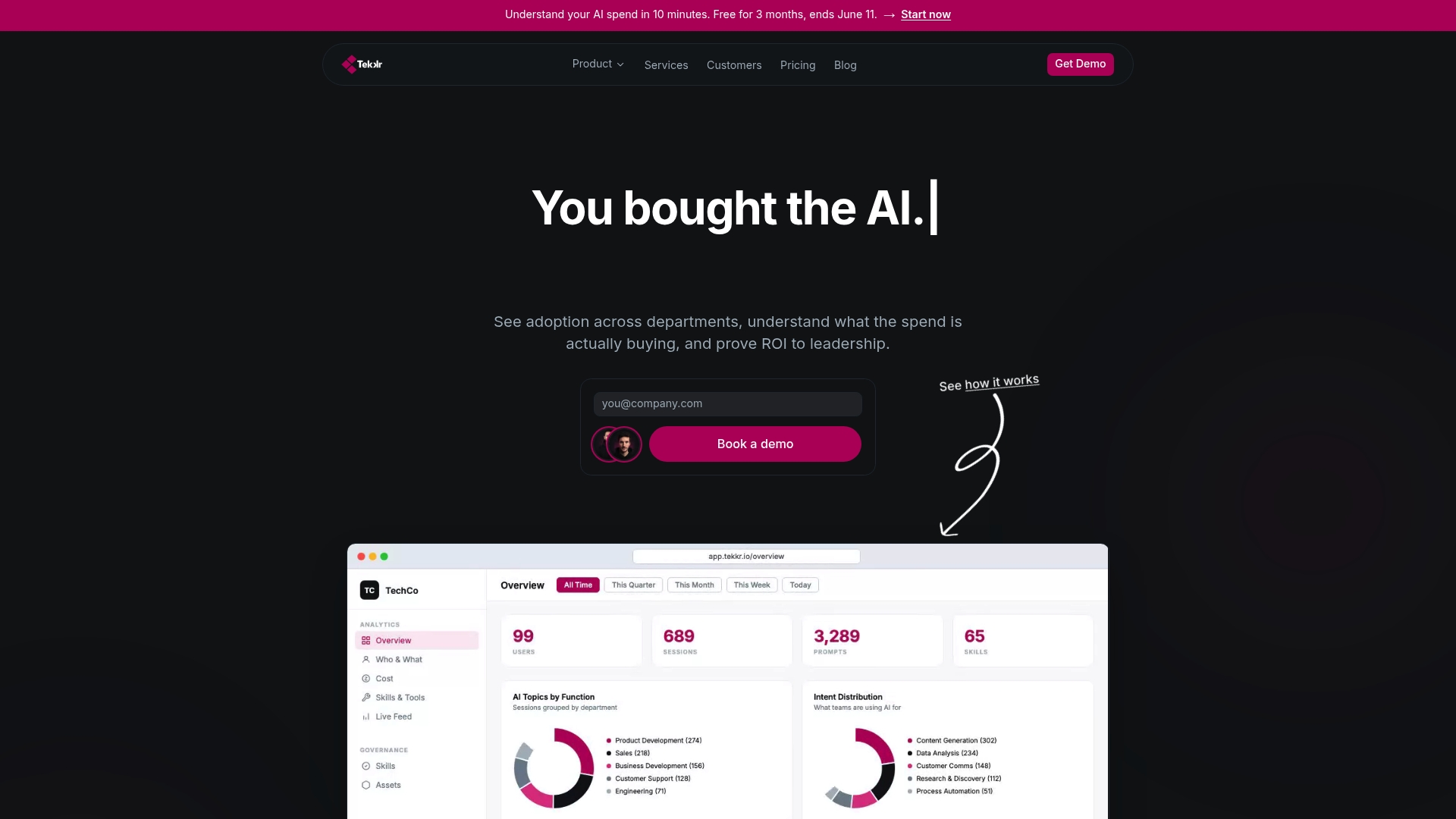
For champion programs specifically, Configurato maps directly to the KPIs that matter: workflow coverage, time saved, rework delta, and cost per team. The AI adoption platform also supports program mechanics that champions need: gamified rollouts, company-wide playbook templates, and automatic PII stripping so prompt data stays private and GDPR-compliant. Setup takes about 10 minutes, there’s a free tier, and no credit card is required. If you’re running a 90-day pilot, start Configurato in Month 1 so you have a real baseline before your first stakeholder review. Try it for one team at tekkr.io/product/adoption.
Useful sources and further reading
-
Setting Up an AI Champions Program — Rework. The operational playbook for peer-based champion design, psychological safety, and 90-day program structure. Use this for role definition and selection criteria.
-
AI Champions: Model, Mandate, and Metrics — AI&Scale. The source for the 4M framework and outcome-focused KPI design. Use this for program governance and metric templates.
-
AI Adoption Puzzle — BCG. Research on why usage is up but impact is not, including the peer-learning data. Use this to brief leadership on why champions matter.
-
How Internal AI Champions Shape Adoption — AI Beavers. Guidance on identifying starting points from existing adoption pockets. Use this for pilot team selection.
-
AI Champions: Beyond the Enthusiast Club — AI&Scale. Analysis of why programs without formal scope fail. Use this for pitfall prevention and program recovery.
-
Tekkr AI Adoption Resources — Implementation guides on leadership’s role in adoption, manager sponsorship, and cross-team scaling.