
Track five dimensions when you evaluate a prompt: clarity, specificity, structure, robustness, and the accuracy of the responses it produces. Score them with a mix of deterministic checks for anything structured, LLM-as-a-judge scoring for nuance and rationale, and a sampled human review layer to catch what automation misses. Skip the theory. Pick one production task, build 20 to 30 golden test cases, and run a single evaluation sprint this week before you touch a broader rollout.
TL;DR:
- Prompt quality should be evaluated by separately measuring prompt clarity, specificity, and structure, as well as response accuracy, relevance, and objectivity.
- Combining deterministic checks, LLM-based scoring, and human review ensures both automation efficiency and calibration for nuanced responses.
- Metrics like exact match, JSON schema validation, and operational costs are task-specific and help identify where prompts fail in real-world use cases.
- Building a small, diverse golden set and continuous monitoring in CI helps improve prompt robustness and prevent regressions.
- Broader enterprise evaluation requires tracking AI tool usage, cost attribution, and ROI to ensure AI investments deliver measurable value.
Table of Contents
- What Are Prompt Quality Metrics, Exactly?
- Deterministic Checks, LLM-as-a-Judge, or Human Review?
- Choosing the Right Metric for the Task
- Matching Metrics to Your Actual Use Case
- Tools That Actually Run These Evaluations
- A One-Sprint Workflow From Ad Hoc to Gated
- Measuring Diversity and Creativity, Not Just Correctness
- How Confident Should You Be in Your Evaluation Numbers?
- Where Bias and Ambiguity Creep Into Your Scores
- Which Benchmark Datasets Should You Actually Use?
- Case Studies: How This Plays Out in Practice
- Why Enterprises Need Measurement, Not Just Metrics
- Turn Prompt Metrics Into Organization-Wide ROI
- Sources
- FAQ
What Are Prompt Quality Metrics, Exactly?
Prompt quality metrics split into two families that most teams conflate: metrics about the prompt itself, and metrics about the response it generates. Conflating them is why so many prompt reviews go nowhere. A prompt can be perfectly clear and still produce a bad answer because the model hallucinated, and a messy prompt can occasionally produce a great answer by accident. You need both halves measured separately to know which one to fix.
Prompt-level metrics describe the instruction itself:
- Clarity: Can a model (or a new team member) parse the intent without guessing?
- Specificity: Does it name the format, scope, and constraints, or leave them implicit?
- Structure: Is there a logical order (context, task, format, examples) rather than a stream of consciousness?
- Constraint specification: Are output length, tone, and edge-case handling spelled out?
- Token efficiency: Does it get the job done without padding that adds cost and latency?
Response-level metrics describe what comes back:
- Accuracy and faithfulness: Does the output match ground truth or the source material it’s grounded in?
- Coherence: Does the response hold together logically from start to finish?
- Relevance: Does it answer what was asked, not a nearby question?
- Conciseness: Is it padded, or does it respect the length constraint?
- Objectivity: Does it avoid injecting unwarranted opinion into factual tasks?
The PEEM framework formalizes this into a joint rubric spanning up to nine axes, scoring the prompt and its response together rather than judging accuracy in isolation. That joint view matters because a rubric-based approach tells you why a response failed, not just whether it did. Single-shot accuracy scoring tells you a prompt is broken. A joint rubric tells you it’s broken because the constraint on output format was missing, which is a fix you can make in five minutes instead of a mystery you debug for a day.
Deterministic Checks, LLM-as-a-Judge, or Human Review?
Each evaluation method solves a different problem, and picking the wrong one for the job is the most common mistake teams make early on.
- Deterministic checks work best for anything with a defined correct answer: JSON schema validation, regex matching, exact match against a known label. They’re fast, cheap, and binary, which makes them ideal for CI gating on structured outputs like classification or extraction tasks.
- LLM-as-a-judge scoring fills the gap deterministic checks can’t touch: open-ended generation, tone, reasoning quality. A judge model returns a scalar score plus a written rationale, and that rationale is often more useful than the score itself because it tells you exactly what went wrong. Evaluation frameworks like NotDiamond’s implement this pattern with named metrics such as RAGAS_FAITHFULNESS and semantic similarity scores you can wire directly into a pipeline.
- Human review stays essential for fairness, cultural nuance, and calibrating the judge model itself. If your LLM judge and your human reviewers disagree consistently on the same class of prompts, that’s a signal your rubric or judge prompt needs revision, not that your humans are wrong.
Pro Tip: *Run your LLM judge against a small human-labeled sample before trusting it at scale.
The pattern that scales in production combines all three: automated gates catch the obvious failures, an LLM judge handles volume and nuance, and a human samples a slice of output weekly to keep the judge honest.
Choosing the Right Metric for the Task
Not every metric belongs on every task, and using the wrong one wastes engineering time on numbers that don’t move.
- Exact match and JSON match work for classification, slot-filling, and any task with one correct structured answer. Measure them with precision, recall, and F1, not just a pass rate, since F1 exposes whether failures cluster on rare classes.
- BLEU, ROUGE, and METEOR measure n-gram overlap against a reference text. They’re fine for translation-style tasks with a fixed correct phrasing, but they penalize legitimate paraphrasing and become misleading for anything creative or conversational.
- Semantic similarity and LLM-based relevance scoring handle open-ended generation and retrieval-augmented generation (RAG) faithfulness far better, since they judge meaning rather than surface word choice.
- Operational metrics, latency, token count, and cost per call, belong in every production dashboard regardless of task type. A prompt that scores well on quality but doubles your inference bill isn’t actually a win.
Matching Metrics to Your Actual Use Case
Different product types have different failure modes, so your metric priorities should shift with the task rather than applying one universal rubric everywhere.
- Classification and slot-filling: prioritize exact match, F1 by class, and strict JSON schema validation. These tasks have a right answer, so treat anything below near-perfect structured validity as a blocking bug.
- RAG systems: prioritize faithfulness to retrieved context, context relevance, and hallucination rate above general fluency. A RAG answer that reads beautifully but invents a fact is a worse failure than one that’s clumsy but grounded.
- Chat assistants: track turn-level relevance, multi-turn coherence, safety signals, and downstream user satisfaction rather than single-response scoring alone, since conversational quality compounds across turns.
- Code generation: functional tests and linting matter more than any text-similarity score. Pair those with token and cost tracking, since verbose code generation quietly inflates inference spend.
Tools That Actually Run These Evaluations
You don’t need to build a scoring pipeline from scratch to get started, and most teams overengineer this step.
- Prompt-Bench-style open-source scorers give you a zero-dependency way to score prompts across up to 12 dimensions locally, with built-in A/B testing and a CLI for batch runs, which makes it a solid starting point for a first evaluation sprint.
- PromptEval publishes a live benchmark tracking average scores across clarity, specificity, structure, and robustness, useful as a reference point for where your own prompts stand against a broader sample.
- PromptLayer-style orchestration tooling adds team-level dashboards, version history, and CI integration, better suited once you need reporting across multiple prompts and multiple contributors rather than a single local test run.
- Lightweight frameworks like prompteval offer built-in scorers for exact match, regex, and fluency with exportable reports, a fair middle ground between “build everything yourself” and a full hosted platform.
Building custom rules costs you upfront engineering time but gives full control over what “good” means for your domain. Adopting an LLM-judge config gets you running in a day but requires periodic recalibration against human review to stay trustworthy.
A One-Sprint Workflow From Ad Hoc to Gated
This is the workflow to actually run, not just read about.
- Define the objective and the bar. Decide what “production ready” means numerically. That might be 95% JSON validity or a judge score above 4 out of 5 on faithfulness.
- Assemble golden cases. Build 20 to 30 examples covering normal inputs, edge cases, and deliberately adversarial or malformed inputs.
- Run the automated layer. Fire deterministic checks first, then an LLM-judge pass on everything that isn’t a simple pass/fail, and pull a 10% sample for human review.
- Analyze the rationales, not just the scores. The judge’s written reasoning usually reveals a pattern, missing constraints, ambiguous scope, that a bare number hides.
- Gate and monitor. Wire the automated checks into CI so a regression blocks deployment, then keep sampling in production since real traffic always surfaces cases your golden set missed.
Pro Tip: Weight your golden case set toward adversarial and malformed inputs, not happy-path examples. PromptEval’s benchmark data shows robustness is the dimension most prompts fail first.
Measuring Diversity and Creativity, Not Just Correctness
Accuracy metrics tell you nothing about whether a prompt produces varied, interesting output, and for generative tasks like marketing copy, brainstorming, or creative writing assistants, that variance is the entire point.
Two quantitative approaches cover most of this ground. Lexical diversity measures how much vocabulary varies across multiple generations from the same prompt, often using type-token ratio or distinct n-gram counts across a batch of outputs. If ten runs of the same prompt return near-identical phrasing, the prompt (or the temperature setting behind it) is collapsing the model’s range. Semantic diversity goes a layer deeper, embedding each output and measuring pairwise distance in vector space, which catches cases where the wording changes but the underlying idea doesn’t.
Neither number tells you whether the output is good, only whether it’s varied, so pair diversity scoring with a relevance or quality check rather than treating it as a standalone success metric. A prompt that generates ten wildly different but off-topic responses hasn’t solved anything.
In practice, this matters most for brainstorming tools, ad copy generators, and any assistant meant to produce multiple options for a human to pick from. If your product’s entire value is “give me five different angles,” and your evaluation only checks whether each angle is grammatically correct, you’re measuring the wrong thing entirely.
How Confident Should You Be in Your Evaluation Numbers?
A single test run telling you Prompt A scores 4.2 and Prompt B scores 4.0 doesn’t mean Prompt A is actually better. That 0.2 gap could easily be noise from LLM-judge variance, a small sample, or a handful of edge cases that happened to land differently.
Run every comparison across a meaningful sample size, not five examples, and repeat the judge pass more than once when the model’s temperature isn’t pinned to zero, since judge models themselves carry sampling variance. If Prompt A win on 12 out of 20 test cases, that’s a coin flip dressed up as a finding, not a signal.
A simple, practical habit: bootstrap your test set. Resample your golden cases with replacement, rerun the comparison, and see whether Prompt A still wins the majority of the time across repeated resamples. If it flips depending on which subset you draw, you don’t have a reliable result yet, you have noise.
Reliability also means checking judge consistency over time. Run the same prompt against the same judge model on two separate days. If the score moves by more than a small margin with no changes on either side, your judge configuration needs tightening before you trust any comparison it produces. Treat that judge-to-judge consistency check as a recurring maintenance task, not a one-time setup step.
Where Bias and Ambiguity Creep Into Your Scores
Every evaluation method carries its own blind spot, and pretending otherwise leads teams to over-trust a single number.
LLM judges inherit the biases of the model doing the judging, including a well-documented tendency to favor longer, more verbose responses regardless of actual quality, and a preference for responses that resemble their own output style over genuinely different but equally valid phrasing. If you’re using the same model family to generate and to judge, that self-preference bias compounds.
Ambiguity in the prompt itself is often the real source of a low score, not a model failure. If three human reviewers score the same response differently, the problem usually traces back to a prompt that never specified what “good” means for that task. Before blaming the model, check whether your rubric and your prompt actually agree on the target.
Mitigate both problems the same way: anchor your rubric with concrete, worked examples of a 1 and a 5 score, not just adjective labels like “poor” and “excellent.” Rotate judge models occasionally rather than locking into one, and audit a sample of judge decisions against human review on a regular cadence, not just at launch. None of this eliminates bias entirely. It does keep it from silently skewing every score in one direction without anyone noticing.
Which Benchmark Datasets Should You Actually Use?
You don’t need to build every test set from scratch, and using an established benchmark gives you a comparison point against a wider population of prompts rather than just your own history.
PromptEval’s live benchmark tracks scores across clarity, specificity, structure, and robustness across a broad sample of real prompts, and it’s specifically useful because it shows where the average prompt fails, which turns out to be robustness far more often than clarity. That’s a useful sanity check before you assume your own weak spot is unique.
For task-specific benchmarking, build your own golden set modeled on your production traffic rather than relying solely on public datasets, since public benchmarks rarely match your domain’s actual vocabulary, edge cases, or user intent. A customer support prompt evaluated against a general-purpose benchmark will look fine and still fail in production because your customers ask questions the benchmark never covered.
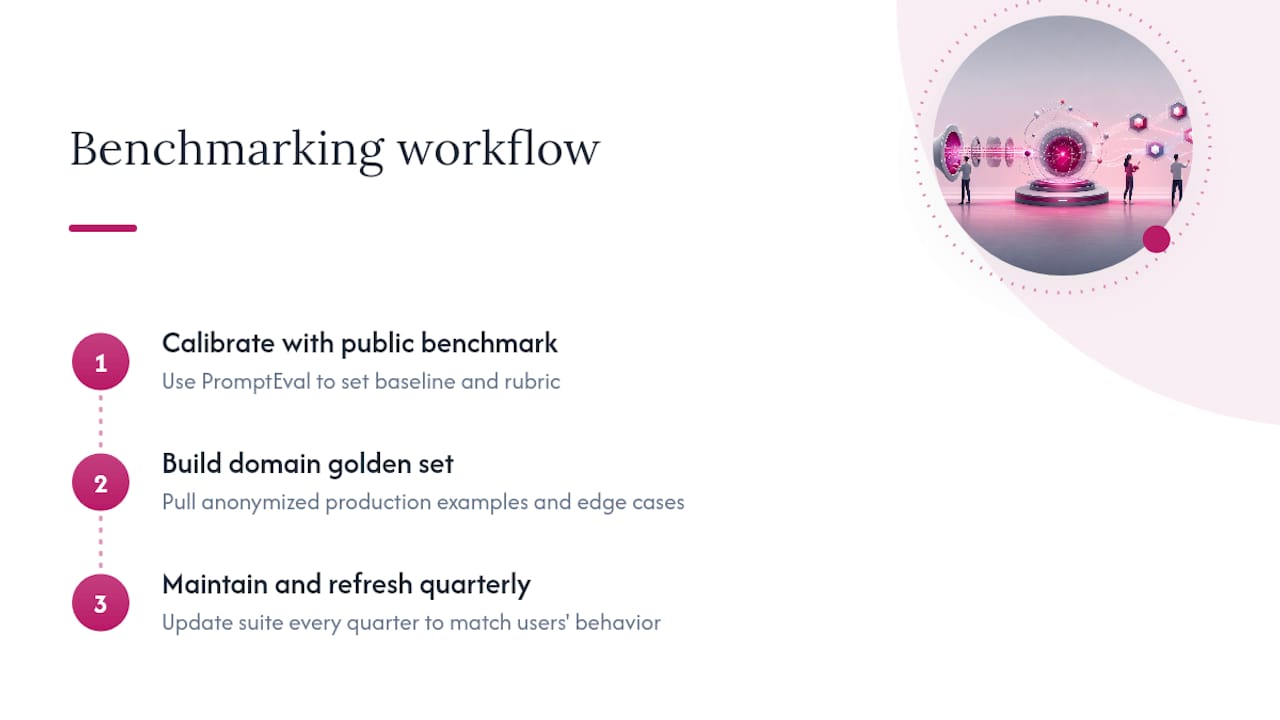
The practical approach: use a public benchmark like PromptEval’s to calibrate your judge and rubric against a known baseline, then invest your real effort in a domain-specific test suite pulled from actual logged interactions, anonymized and reviewed for edge cases. Refresh that internal suite quarterly, since user behavior and the questions people ask shift as your product evolves, and a golden set that’s a year old is testing against a version of your users that no longer exists.
Case Studies: How This Plays Out in Practice
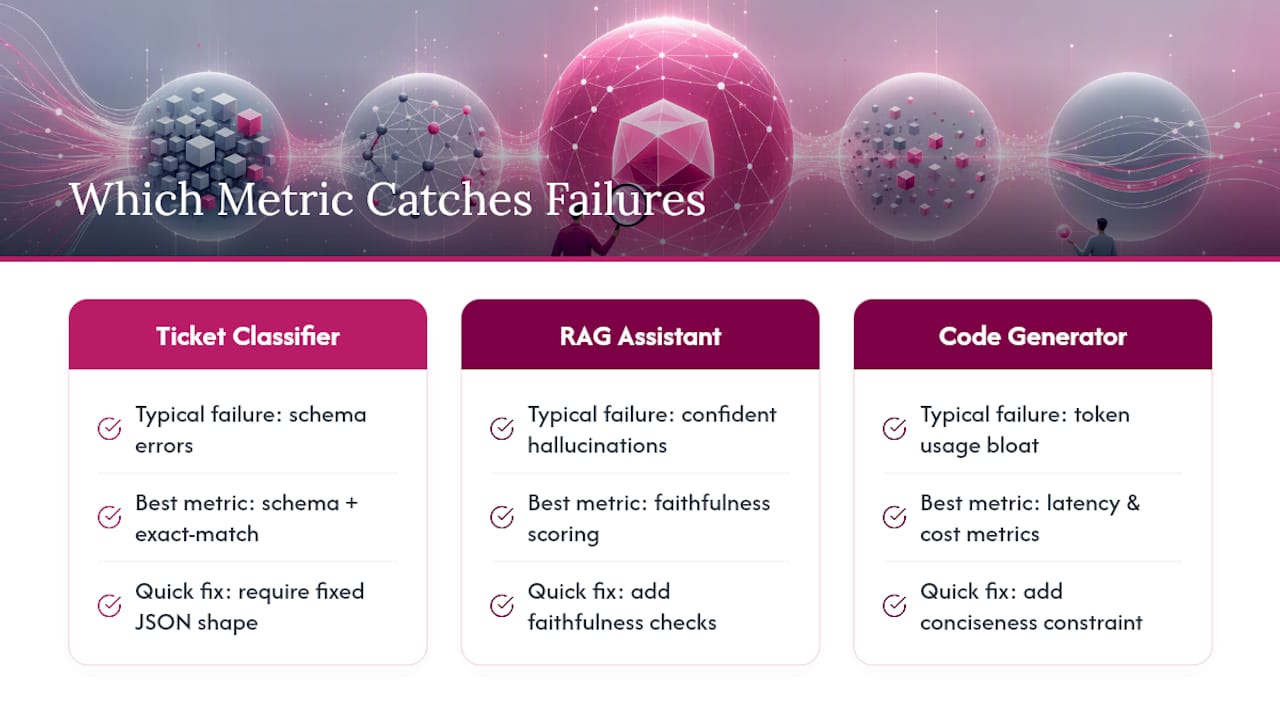
A support-ticket classification system illustrates the deterministic-checks case cleanly. When a team adds strict JSON schema validation and exact-match scoring against labeled ground truth, most classification failures surface immediately as schema violations, malformed category names, missing confidence fields, rather than as subtle semantic drift. Fixing the prompt to explicitly enumerate the valid category list and require a fixed JSON shape is a five-minute change that resolves the majority of failures, because the fix targets the structure of the instruction, not the model’s reasoning.
A RAG-based internal knowledge assistant shows the opposite pattern. Exact-match and BLEU-style scoring are close to useless here because there’s no single correct phrasing. Faithfulness scoring, checking whether the response’s claims are actually supported by the retrieved context, becomes the metric that catches the real failure mode: confident-sounding answers that quietly invent details not present in any retrieved document. Teams that skip faithfulness scoring in favor of a general “quality” score routinely miss this failure until a user reports it manually.
A code-generation assistant makes the case for operational metrics. A prompt that produces functionally correct code can still pass every test while quietly tripling token usage per request, an outcome that only shows up if latency and cost per call are tracked alongside functional test pass rates. The fix, in that case, is often adding an explicit conciseness constraint to the prompt rather than touching the underlying model at all. Across all three cases, the lesson holds: the right metric depends entirely on where that specific task actually breaks, not on a generic quality score applied uniformly.
Why Enterprises Need Measurement, Not Just Metrics
Individual prompt scores answer whether one prompt works. They don’t answer whether an entire organization’s AI spend is producing anything worth the invoice, and that gap is where most enterprise AI initiatives quietly stall.
Some organizational AI adoption platforms apply evaluation discipline at the organizational layer: tracking real usage of AI tools across teams, attributing spend by department, and surfacing which use cases earn their cost. That requires privacy-first telemetry, since prompt-level signal collection at scale needs anonymizing. A 30-day use-case playbook approach tends to work better than a company-wide mandate, as it gives teams a concrete, scoped win to point to before changing habits everywhere. When building internal training frameworks around prompt quality, the same rubric discipline that works for one prompt can scale to a portfolio if the reporting layer underneath is designed for that scale.
— TekkrTools
Turn Prompt Metrics Into Organization-Wide ROI
Scoring one prompt well is a good start. Knowing whether your entire company’s AI spend is paying off is a different, harder problem, and it’s the one Configurato was built to answer.
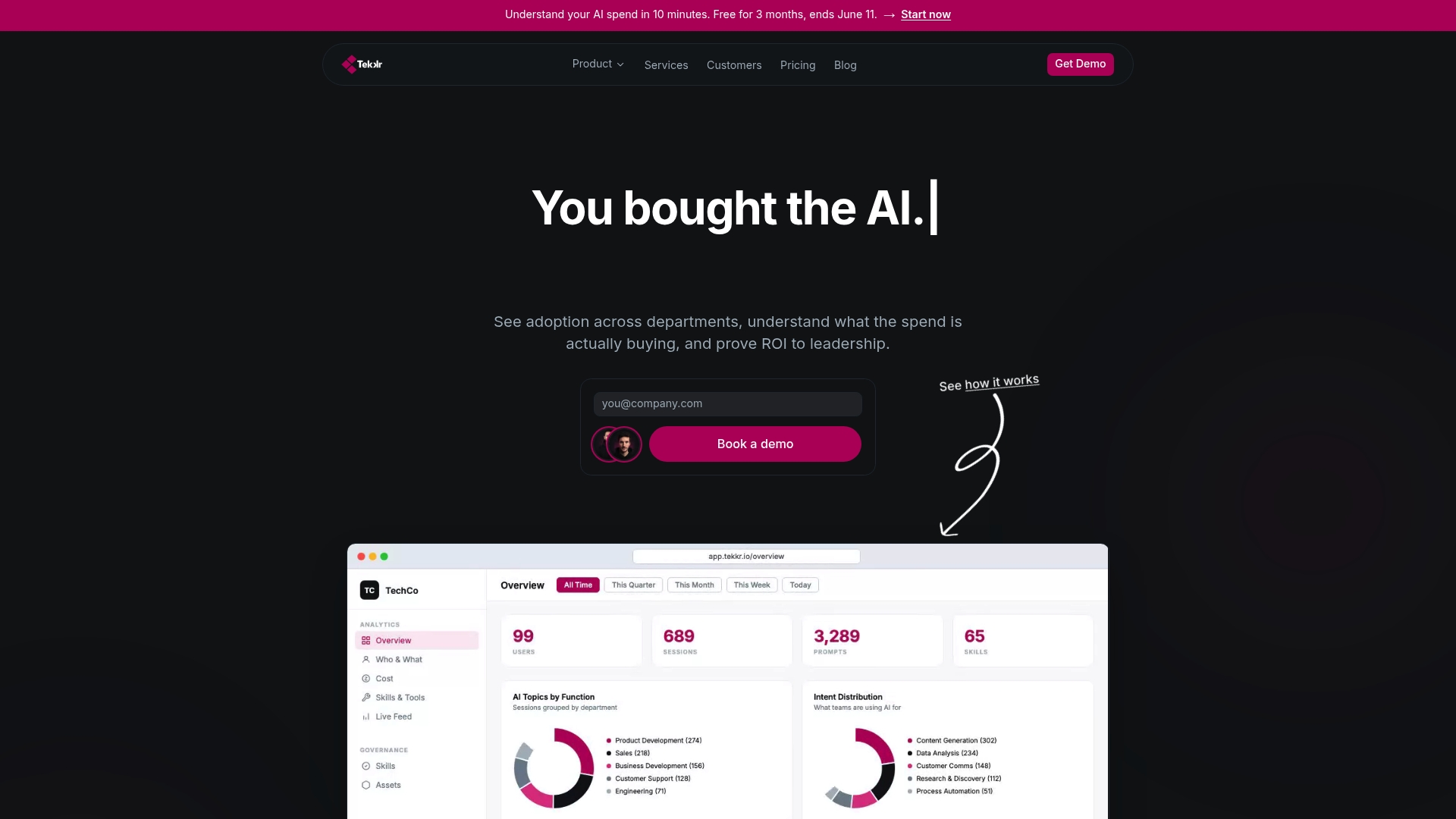
Tekkr tracks who’s actually using tools like Claude and Codex across your organization, breaks down cost by team, and surfaces which use cases are earning their budget and which aren’t. Everything runs through a privacy-first architecture: end-to-end encryption, GDPR compliance, and automatic PII stripping on every prompt, with no browser extensions required. Setup takes about 10 minutes. If you’ve already built solid prompt-level evaluations using the metrics above, Configurato is where that discipline turns into an executive-ready ROI report instead of a spreadsheet nobody outside engineering ever reads. Teams that want hands-on help wiring evaluation pipelines into a broader rollout can also look at Tekkr’s evaluation and testing services. Start with the free tier, no credit card required, and see what your organization’s AI adoption actually looks like once someone measures it.
Sources
- NotDiamond evaluation metrics documentation
- The State of Prompt Quality — Live Benchmark | PromptEval
- GitHub - nguyenminhduc9988/prompt-bench: Prompt quality scorer and A/B tester for LLM prompts
FAQ
How Do You Evaluate Prompt Quality?
Evaluate prompt quality by scoring both the prompt and its response across clarity, specificity, structure, and robustness, using a mix of deterministic checks, LLM-as-a-judge scoring, and sampled human review. The PEEM rubric formalizes this joint approach and shows it surfaces diagnostic failure reasons, not just pass/fail results.
How Do You Measure Prompt Efficiency?
Prompt efficiency is measured through token count per call, latency, and cost per request, tracked alongside quality scores so you can catch a prompt that scores well but quietly triples inference spend. Pair these operational numbers with accuracy metrics rather than tracking either alone.
What Are BLEU and ROUGE Metrics Used For?
BLEU and ROUGE measure n-gram overlap between a generated response and a reference text, originally built for tasks like translation and summarization with one correct phrasing. They become unreliable for paraphrase-heavy or open-ended outputs, where semantic similarity scoring works better.
Do I Need Human Review If I Already Use an LLM Judge?
Yes, human review stays necessary for calibrating the judge model and catching fairness or edge-case failures automation misses. A useful check is running your LLM judge against a small human-labeled sample regularly to confirm the two still agree.