
Prompt guardrails, in the enterprise sense, are the lifecycle rules, access controls, PII-stripping policies, and monitoring systems that turn ad-hoc prompt use into an auditable, cost-tracked business function. The single best starting move is a governed pilot: one versioned prompt repository, role-based approval, automatic PII stripping, and a dashboard tied to adoption and spend. Do that before writing another policy document, and every downstream metric, from compliance reporting to board-level ROI, gets easier to defend.
TL;DR:
- A focused pilot with a versioned prompt repository, role-based approval, and automatic PII removal can establish effective governance within a few weeks.
- Monitoring key signals such as prompt usage, response quality, and error rates helps detect behavioral drift and ensures consistent AI output.
- Metrics like adoption rate, cost per interaction, and revenue impact should be tracked to demonstrate ROI and align with business objectives.
- Ownership of prompt governance should be divided among a central standards team, business unit stewards, and legal reviewers to prevent sprawl and oversight gaps.
- Using infrastructure tools like Configurato accelerates deployment, offers built-in tracking, and reduces setup time to around 10 minutes with no credit card required.
Table of Contents
- Why Prompt Guardrails Matter for Enterprise Outcomes
- Core Components of Enterprise Prompt Guardrails
- How Do You Roll Out Prompt Guardrails Without Stalling Teams?
- Operational Patterns and Roles: Who Owns What
- Monitoring, Drift Detection, and the Metrics That Matter
- How Do You Measure the ROI of Prompt Guardrails?
- What We’ve Learned Rolling Out Governed Prompts
- Turning Prompt Governance Into a Working System
- Sources
- FAQ
Why Prompt Guardrails Matter for Enterprise Outcomes
Unmanaged prompts spread across teams the way shadow IT once did. One team’s customer-support prompt quietly drifts into new wording, a finance analyst’s prompt pulls sensitive figures into a shared thread, and nobody notices until legal asks who approved it. This pattern, often called prompt sprawl, creates reputational, legal, and operational risk precisely because nobody owns the artifact.
Governance fixes the ownership gap. It ties every prompt’s behavior back to brand standards, regulatory exposure, and a measurable business result, instead of leaving it as an unreviewed text string in someone’s browser tab.
Executives don’t fund AI programs on “hours saved” claims anymore. Gartner recommends picking two or three metrics tied directly to revenue growth, cost reduction, or retention, then validating them with pilots. That reframing matters:
- Revenue impact from AI-assisted sales or support workflows
- Cost per interaction, tracked by team and use case
- Retention or satisfaction shifts tied to consistent AI output quality
Statistic to note: IBM’s governance research found that 68% of AI-first organizations report more mature data and governance capabilities than their peers. Prompt governance is the operational layer of that broader maturity.
Core Components of Enterprise Prompt Guardrails
A working guardrail system has five moving parts, and skipping any one of them tends to surface as an incident report six months later.
- Lifecycle stages with metadata. Every prompt needs a draft, review, active, and archived state, plus an owner, stated purpose, expected behavior, and evaluation criteria attached at creation, following the four-stage lifecycle AWS recommends for agentic AI operations.
- Version control and rollback. Prompt history has to be retrievable for audits, and a bad update needs a rollback path measured in minutes, not a support ticket.
- Templates and parameterization. Standardized variable fields strip personally identifiable information before it reaches a model and block obviously unsafe inputs at the template level.
- RBAC and promotion workflow. Prompts move from personal, to team, to organization-wide only after passing review, mirroring the three-tier permission model that practitioner guides recommend for shared libraries.
- Logging. Prompts, parameters, and model responses get recorded for traceability, not just for compliance but for debugging when output quality slips.
Pro Tip: Reference prompts by stable IDs in your application code rather than hardcoding text, so a prompt update ships independently of a software release.
How Do You Roll Out Prompt Guardrails Without Stalling Teams?
Start small, prove the model works, then widen the net. This isn’t a big-bang policy rollout, it’s a staged build that earns trust one use case at a time.
- Pick one high-value use case. Choose something with clear cost or revenue exposure, like customer support drafting or contract summarization, and assemble a cross-functional team spanning the business unit, IT, and legal.
- Define success metrics up front. Decide what “working” looks like before you run anything, then validate it in shadow mode or an A/B test against the current process.
- Stand up a central prompt repository. Enforce templates, versioning, and automated PII checks at the point of entry, not as an afterthought.
- Roll out in stages. Set rollback gates and a fixed review cadence, expanding access only after each stage clears its metrics. This staged approach to expansion is also what Atlassian’s ROI framework recommends for AI programs generally.
- Scale governance by risk tier, not uniformly.
Practical checklist for the first 90 days:
- Repository live with version history
- One pilot use case in shadow mode
- RBAC roles assigned to at least three teams
- Rollback procedure tested at least once before go-live
Operational Patterns and Roles: Who Owns What
Ownership ambiguity kills more governance programs than bad tooling does. A workable model splits responsibility three ways: a central AI center of excellence sets standards, business unit stewards own their team’s prompts day to day, and legal or compliance reviewers sign off on anything customer-facing or regulated.
Promotion from personal to org-wide status should require documented approval, not a Slack thumbs-up. That approval sits inside a pipeline, ideally one where CI/CD-style gates run automated evaluations before a prompt reaches production status, catching regressions before they reach a customer.
When something does go wrong, the response has to be immediate and scripted:
- Freeze the offending prompt version and roll back to the last approved one
- Identify exposure scope: which teams, which outputs, how much data
- Notify the compliance owner within a defined window
- Log the incident against the prompt’s version history for the audit trail
Monitoring, Drift Detection, and the Metrics That Matter
A prompt that worked fine in March can quietly degrade by June, often because the underlying model updated or usage patterns shifted. Watching for that drift requires a specific set of signals, not a general sense that “things feel off.”
- Active prompt versions in production and their usage volume
- Response-quality scores against a golden test set
- Hallucination or error rates flagged by automated review
- Cost per call, broken out by team
- Adoption rate by department, tracked over time
Automated regression suites and golden test cases catch behavioral drift after a prompt change or a model version bump, and they should trigger an alert, not wait for a quarterly review. Map those operational signals to the metrics finance actually asks about: cost per interaction rolls into department budgets, quality scores tie to customer retention, and adoption rate becomes a leading indicator for the ROI story you’ll present next. Weekly dashboards for practitioners, monthly summaries for leadership.
How Do You Measure the ROI of Prompt Guardrails?
Pick two or three outcome metrics before you start, not after. Gartner’s guidance on AI value measurement points to cost reduction, revenue growth, or retention as the metrics that actually move budget conversations, and trying to track everything at once dilutes the story you’re building.
Run the pilot with a real control group. Compare a team using governed prompts against one that isn’t, and track leading indicators like adoption rate and straight-through processing rate as the pilot runs, not just the end result.
- Cost by team and cost per use, drawn from actual spend logs
- Forecasted savings once prompts are standardized versus ad-hoc
- Before and after snapshots of your chosen KPIs
- Annualized financial impact, not just the pilot-period number
| Metric type | What to track | Why it matters to executives |
|---|---|---|
| Cost visibility | Spend by team, cost per call | Turns AI spend from a line item into a controllable budget |
| Adoption | Active users, usage volume by department | Leading indicator that predicts ROI before revenue shows up |
| Quality | Error rate, regression test pass rate | Protects against the drift that erodes trust in AI outputs |
| Outcome | Revenue lift, retention change, cost saved | The number that actually gets a board’s attention |
A partner perspective from Baby Love Growth’s ROI research backs this up from the agency side: tying adoption data directly to productivity and revenue outcomes produces a stronger case than reporting engagement numbers alone.
What We’ve Learned Rolling Out Governed Prompts
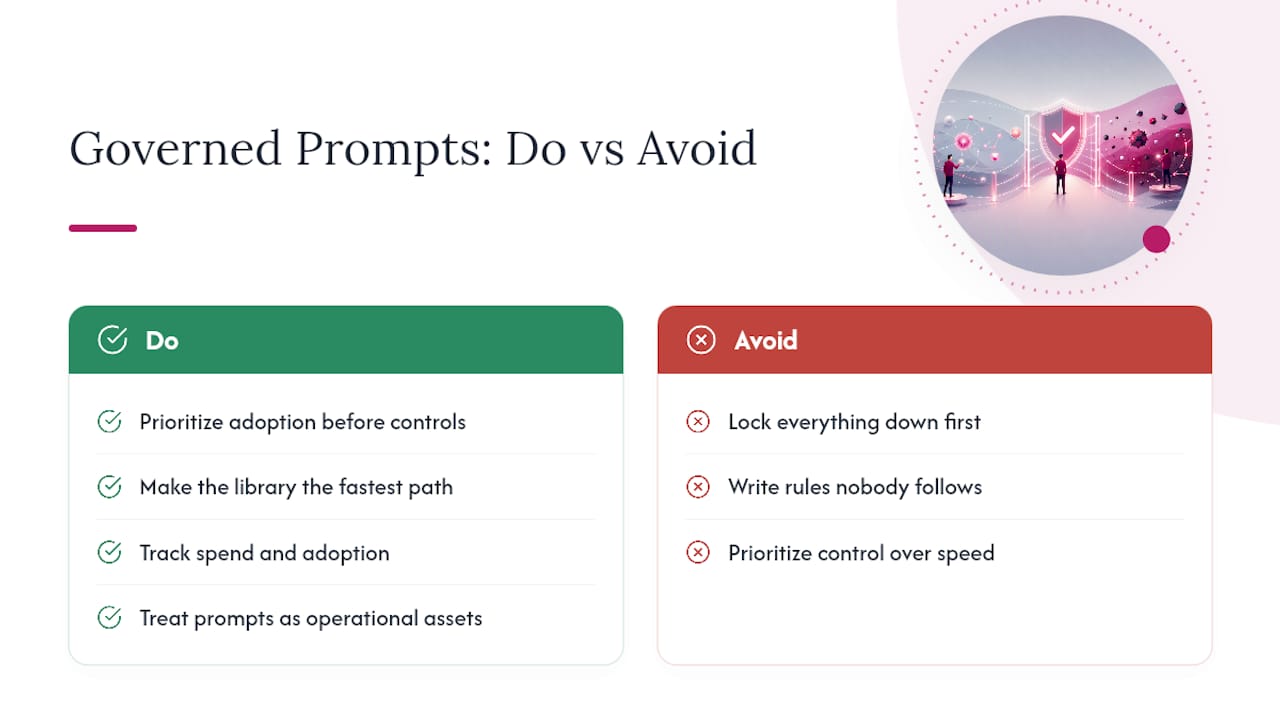
Prompts are operational assets, not scratch notes, and treating them that way changes how fast an organization can move. The instinct to lock everything down first is backwards. Adoption has to come before strict control, because a governed prompt library only works if it’s the fastest way to get a good result, not the slowest.
That’s also why spend visibility and adoption tracking matter as much as policy documents. A rulebook nobody follows protects nothing. A library people actually reach for, because it’s genuinely easier, is what makes governance stick.
— TekkrTools
Turning Prompt Governance Into a Working System
Building lifecycle stages, RBAC, PII stripping, and drift monitoring from scratch takes months most transformation teams don’t have. Configurato gives you that infrastructure already running: it tracks who’s actually using tools like Claude and Codex, breaks down spend by team, and surfaces which use cases are working, all inside a privacy-first, end-to-end encrypted architecture with automatic PII stripping and no browser extensions required.

If your teams have already bought AI tools but nobody can say who’s using them or what it’s costing, a build-in-house governance project will take quarters to catch up to where Configurato starts on day one. Setup runs about 10 minutes, there’s a free tier with no credit card required, and if you need hands-on help designing the rollout, Tekkr’s AI Adoption Programs pair the platform with operators who’ve run these transformations before. Check current plans and pricing or start with the free tier today.
Sources
- AGENTOPS02-BP01 Evolve agent prompts, tool calls, and configurations to reflect evolving business needs
- prompt-agent-and-model.html
- 5 AI Metrics That Actually Prove ROI to Your Board
- Enterprise Prompt Governance: An Operating Model for AI at Scale | Marshall Ridge Consulting
FAQ
What Are Prompt Guardrails in an Enterprise Context?
They’re the governance layer around how prompts get created, approved, and monitored across an organization: version control, RBAC, PII stripping, and usage tracking. This differs from technical model-safety filtering; it’s about organizational control, cost visibility, and audit readiness.
Who Should Own Prompt Governance Inside a Company?
A central AI center of excellence typically sets standards, while business unit stewards manage day-to-day prompt ownership and legal or compliance reviewers approve anything customer-facing or regulated. That split prevents both bottlenecks and unreviewed sprawl.
How Long Does It Take to Stand Up a Governed Prompt Pilot?
A focused pilot, covering one use case with a repository, RBAC, and shadow-mode testing, typically takes a few weeks to validate before wider rollout. Tools like Configurato shorten that timeline since the tracking and PII-stripping infrastructure is already built.
What Metrics Prove Prompt Governance Is Working?
Adoption rate by team, cost per call, response-quality scores, and error rates are the operational signals to watch, mapped up to revenue, cost savings, or retention for executive reporting. Gartner recommends limiting the headline metrics to two or three tied to a single business goal.
Does Tekkr Charge for Prompt Governance and Adoption Tracking?
Tekkr offers a free tier with no credit card required, and setup takes about 10 minutes. Current plan details for expanded features are available on Tekkr’s pricing page.