
Require an outcome-driven, workflow-embedded prompt engineering training program that pairs a versioned prompt registry and governance council with role-based curricula and measurable unit metrics. Assign an owner this week, write a one-page value hypothesis with a baseline and 90-day target, and give your platform team the technical checklist below.
What to demand from vendors and internal teams from day one:
- A prompt registry decoupled from application code, with versioning and metadata
- Role-based access control (RBAC), SSO, and audit trails
- Automated eval suites gating CI/CD pipelines before any prompt reaches production
- Integrations that embed approved templates directly into CRM, IDEs, and help desks
- Gamified adoption mechanics and role-based playbooks, not generic slide decks
- A unit metric per initiative (cost per ticket, cost per engineer-week) defined before launch
Pro Tip: Assign a single “prompt lead” who owns the registry and reports to both the platform team and the enablement lead. Without a named owner, the registry becomes a graveyard of untested templates within 60 days.
Key Takeaways
Enterprise prompt engineering training delivers measurable ROI only when prompts are treated as versioned production assets, embedded in workflows, and tied to a unit metric defined before launch.
| Point | Details |
|---|---|
| Define the unit metric first | Write a one-page value hypothesis with baseline and target date before any prompt reaches production. |
| Decouple prompts from code | Store prompts in a versioned registry with metadata; updates must not require full release cycles. |
| Gate with automated evals | Run representative and adversarial datasets in CI/CD; block any promotion that regresses performance. |
| Embed in existing workflows | Approved templates belong inside CRM, IDEs, and help desks, not in separate docs or wikis. |
| Use Tekkr / Configurato | Configurato tracks adoption and spend by team, drives enablement through gamified playbooks, and measures ROI with a privacy-first, PII-stripping architecture. |
Table of Contents
- What does enterprise prompt engineering training actually mean?
- Core components every enterprise program must include
- How to run a practical pilot-to-scale rollout
- KPIs and an ROI framework to mandate for every training initiative
- Technical and governance checklist for platform engineering and compliance
- Designing the training program: curriculum, gamification, and change management
- How to evaluate a prompt-management and training vendor
- A 90-day launch checklist with owners and deliverables
- What decision-makers consistently get wrong
- Tekkr and Configurato for enterprise prompt engineering training
- Primary sources and further reading
- Sources
What does enterprise prompt engineering training actually mean?
This is not about individual online courses or hobbyist prompt craft. Enterprise prompt engineering enablement means company-wide training, embedded playbooks, governed templates, and a technical control plane that scales across every department. The owner is a cross-functional team: platform engineering, enablement, and a governance council.
The program maps directly to the AI ROI maturity ladder that Atlassian frames as four stages:
- Exploring: Teams experiment with AI tools; no shared standards yet
- Optimizing: Approved prompt templates replace ad-hoc usage; adoption metrics tracked
- Enhancing: Prompts embedded in core workflows; unit economics measured per use case
- Transforming: Prompt management is a production discipline; ROI is auditable and repeatable
Most enterprises stall at Optimizing because they treat prompt engineering as a training event rather than an operational system. The fix is architectural, not pedagogical.
Core components every enterprise program must include
Enterprise prompt management is a distinct discipline, not an extension of general AI literacy. Once deployments exceed a handful of pilots, the absence of a registry and versioning creates prompt drift, compliance gaps, and unmeasurable ROI.
Technical architecture:
- Prompt registry/store: Decoupled from application code, with metadata fields for owner, model target, risk tier, and last review date. AWS GLOE explicitly recommends decoupling prompts into a prompt store so updates skip full release cycles.
- Version control and environment promotion: Dev → staging → prod, with PR-style reviews and CI/CD gating on every change.
- Automated eval suites: Representative and adversarial datasets, deterministic scorers for structure, and LLM-based evaluation for subjective quality. These checks block promotions that regress performance.
- RBAC and audit trails: Viewer, editor, and publisher roles with SSO integration and per-prompt ownership logs.
- Workflow embedding: Approved templates live inside the CRM, IDE, or help desk, not in a separate knowledge base. Templates in separate docs get ignored within weeks.
People and enablement:
- Role-based curricula (engineer, product manager, support agent, sales rep)
- Champion programs with internal certification
- Gamified adoption mechanics and leaderboards
Pro Tip: Build your eval suite before you write your first production prompt. A regression baseline on day one means you can prove improvement on day 90, not just assert it.
How to run a practical pilot-to-scale rollout

IBM’s research is direct: organizational constraints — culture, governance, workflow design — are the primary barriers to AI ROI, not model quality. Teams that follow disciplined best practices report materially higher returns. That means the rollout structure matters as much as the technology.
90-day pilot structure:
- Days 0–30: Discovery. Write a one-page value hypothesis per use case: unit metric, baseline, target date, owner. Select one high-volume workflow (support tickets, code review, document drafting).
- Days 31–60: Pilot engineering. Spin up the registry, write and version 10–20 prompt templates, wire eval suites into CI/CD, run the first adversarial tests.
- Days 61–90: Staging and measurement. Promote passing prompts to production, measure unit metric against baseline, run go/no-go decision against pre-set thresholds.
Staffing the squad: prompt lead, registry engineer, two to three domain SMEs, platform owner, enablement lead, and a legal/compliance reviewer for high-risk prompts.
Promotion rules: a prompt moves from staging to production only after passing eval gates, RBAC sign-off, and a security review for PII handling.
Scale cadence: monthly reviews for large bets, quarterly for the long tail. When a use case hits its ROI threshold, clone the playbook and apply it to the next workflow. Atlan notes that tooling-only centralization typically takes 3–6 weeks; extracting hardcoded business logic into governed context can add several more weeks. Budget accordingly.
Pro Tip: Run your pilot on a workflow where the baseline is already measured — support ticket volume, code review cycle time, document turnaround. A use case with no existing metric cannot prove ROI in 90 days.
KPIs and an ROI framework to mandate for every training initiative
EY analysts call this the “AI ROI trap”: organizations chase adoption metrics (daily active users, seats activated) instead of value metrics (cost-to-serve, cycle time). The fix is a one-page value hypothesis per initiative, written before launch.
CloudZero’s four-step framework is the clearest operational model available:
- See the investment: Allocate API, inference, and SaaS spend to specific teams and initiatives.
- Define the numerator before launch: Write the unit metric and baseline into the hypothesis document.
- Bridge with unit economics: Cost per ticket, cost per engineer-week, error rate delta.
- Review on cadence with kill/scale rules: Monthly for large bets, quarterly for the long tail.
| KPI Bucket | Example Metric | Kill Signal |
|---|---|---|
| Cost takeout | Cost per support ticket | No reduction after 60 days |
| Velocity | Features shipped per sprint | No delta vs. control team |
| Quality | Error rate or compliance flag rate | Regression vs. baseline |
| Revenue lift | Conversion rate on AI-assisted outreach | Flat or negative delta |
For AI ROI measurement to hold up to finance scrutiny, the spend allocation must be granular enough to produce a reliable denominator. Vague “productivity gains” do not survive a CFO review.
Technical and governance checklist for platform engineering and compliance
Hand this list to your platform team and require vendors to demonstrate each capability before signing.
Registry and versioning:
- Prompts stored in a versioned registry, decoupled from application code
- Diffable format with metadata: owner, model target, risk tier, last review, environment
- Searchable taxonomy for discovery across teams
CI/CD and testing: 4. Eval gating on every PR: representative dataset, adversarial dataset, deterministic scorers 5. LLM-based evaluation for subjective quality (tone, completeness, safety) 6. Staging environment that mirrors production; no direct dev-to-prod promotion
Identity and access: 7. RBAC with viewer, editor, and publisher roles 8. SSO integration and per-prompt ownership assignment 9. Immutable audit log for every change and promotion event
Monitoring and observability: 10. Cost per call, latency, output-quality drift, refusal rates, and error rates tracked in a live dashboard 11. Alert rules for drift beyond defined thresholds
Data handling: 12. Automatic PII stripping at ingestion 13. End-to-end encryption in transit and at rest 14. Documented data retention and prompt deprecation policies
Governance council: 15. Cross-functional membership: platform, legal, security, product, enablement 16. Monthly cadence for active use cases; quarterly for the long tail 17. Defined approval authority for high-risk prompts and agentic workflows
Treating prompts as production code with git-based version control and CI/CD checks is what separates teams that can audit and roll back from teams that are guessing.
Key governance signal: Organizations that embed governance into the prompt lifecycle, rather than bolting it on after deployment, are the ones that can demonstrate ROI to a board. The audit trail is the proof.
Designing the training program: curriculum, gamification, and change management
Role-based curricula beat generic AI literacy programs because the unit metric differs by role. An engineer cares about code review cycle time; a support agent cares about first-contact resolution. Build the curriculum around the metric, not the technology.
Sample time budgets by role:
- Engineers: 4 hours (prompt versioning, eval writing, IDE integration)
- Product managers: 3 hours (hypothesis writing, registry governance, KPI review)
- Support agents: 2 hours (approved template usage, escalation rules, PII awareness)
- Sales reps: 2 hours (CRM-embedded templates, personalization guardrails)
Gamified adoption mechanics that work:
- Leaderboards tracking prompt usage and quality scores, visible to the team
- Internal certification for “prompt champions” who pass an eval-based assessment
- Monthly hackathons where teams submit new prompt templates for registry inclusion
- Adoption vs. value dashboards that separate who is using AI from who is generating measurable output
Change management requirements:
- Executive sponsor who reviews the unit metric monthly and visibly champions the program
- Feedback loops: a Slack channel or ticketing queue where employees flag broken templates
- Playbooks embedded in the tools employees already use, not in a separate wiki
Pro Tip: Measure adoption and value separately from week one. The diagnosis is different and so is the fix.
How to evaluate a prompt-management and training vendor
Use these dimensions in your RFP. A vendor that cannot demonstrate all must-have capabilities in a sandbox within two weeks is not production-ready.
Must-have technical capabilities:
- Prompt registry with versioning, metadata, and searchable taxonomy
- CI/CD hooks and automated eval suites (not just manual testing)
- RBAC, SSO, audit logs, and a runtime context API for workflow embedding
- Observability dashboards: cost per call, latency, quality drift, refusal rates
Compliance and security:
- Automatic PII stripping at ingestion
- SOC 2 Type II certification or equivalent; GDPR alignment for any EU data
- Encryption in transit and at rest; documented data residency controls
Commercial model questions to ask:
- Is pricing per-seat, per-call, or subscription? How does it scale with prompt volume?
- What does the professional services engagement cover for rollout support?
- What are the SLAs for uptime and incident response?
Pro Tip: Ask every vendor for a live demo of their eval suite running against an adversarial dataset. If they cannot show you a failed eval blocking a promotion, their CI/CD gating is theoretical.
| Scorecard Dimension | Pass Threshold |
|---|---|
| Registry and versioning | Live demo with metadata and rollback |
| Eval automation | Adversarial test blocking a staging promotion |
| RBAC and audit log | Role assignment and immutable log visible in UI |
| Observability | Cost per call and drift alert in live dashboard |
| PII handling | Automatic stripping demonstrated on test data |
| Pricing transparency | Written per-unit cost model provided |
A 90-day launch checklist with owners and deliverables
Days 0–30: Discovery and hypothesis
- Appoint prompt lead and enablement lead (Platform + HR/Enablement)
- Identify one high-volume workflow with a measurable baseline (Product + Domain SME)
- Write the one-page value hypothesis: unit metric, baseline, target, owner, date (Finance + Product)
- Map integration requirements for CRM, IDE, or help desk embedding (Platform)
- Complete legal and compliance review of data handling requirements (Legal)
Days 31–60: Pilot engineering
- Spin up the prompt registry and configure RBAC roles (Platform)
- Write and version 10–20 prompt templates for the target workflow (Domain SME + Prompt Lead)
- Build eval suite: representative dataset, adversarial cases, deterministic scorers (Platform)
- Wire eval suite into CI/CD; confirm staging environment mirrors production (Platform)
- Run first adversarial tests; document failures and iterate (Prompt Lead)
Days 61–90: Staging, measurement, and go/no-go
- Promote passing prompts to production after RBAC sign-off and security review (Platform + Legal)
- Measure unit metric against baseline at day 75 (Finance + Product)
- Run go/no-go decision at day 90 against pre-set kill/scale thresholds (Executive Sponsor)
- If go: clone playbook for next workflow; if no-go: document failure mode and pivot (Prompt Lead)
Pilot acceptance criteria: the unit metric must show a directional improvement against baseline by day 75, with at least one adversarial eval suite passing in CI/CD and RBAC roles assigned to all active contributors.
What decision-makers consistently get wrong
The most common failure pattern is treating prompt engineering training as a one-time event: a workshop, a Confluence page of templates, a lunch-and-learn. Six weeks later, the templates are stale, nobody knows who owns them, and the unit metric was never defined in the first place.
The corrective pattern that works is straightforward: a governance council that meets monthly, a prompt registry that every approved template must pass through, and a unit metric written into the initiative before the first prompt is written. One enterprise support team that followed this pattern, moving from ad-hoc ChatGPT usage to a governed registry with 40 versioned templates embedded in their help desk, reduced their average handle time measurably within a single quarter. The difference was not the model. It was the registry, the eval suite, and the metric.
Tekkr and Configurato for enterprise prompt engineering training
Configurato is built for exactly the gap this guide describes: you have AI tools deployed, but you cannot prove they are working. It tracks who is actually using tools like Claude and Codex, breaks down costs by team, surfaces use-case intelligence, and drives adoption through gamified rollouts and company-wide AI playbooks.
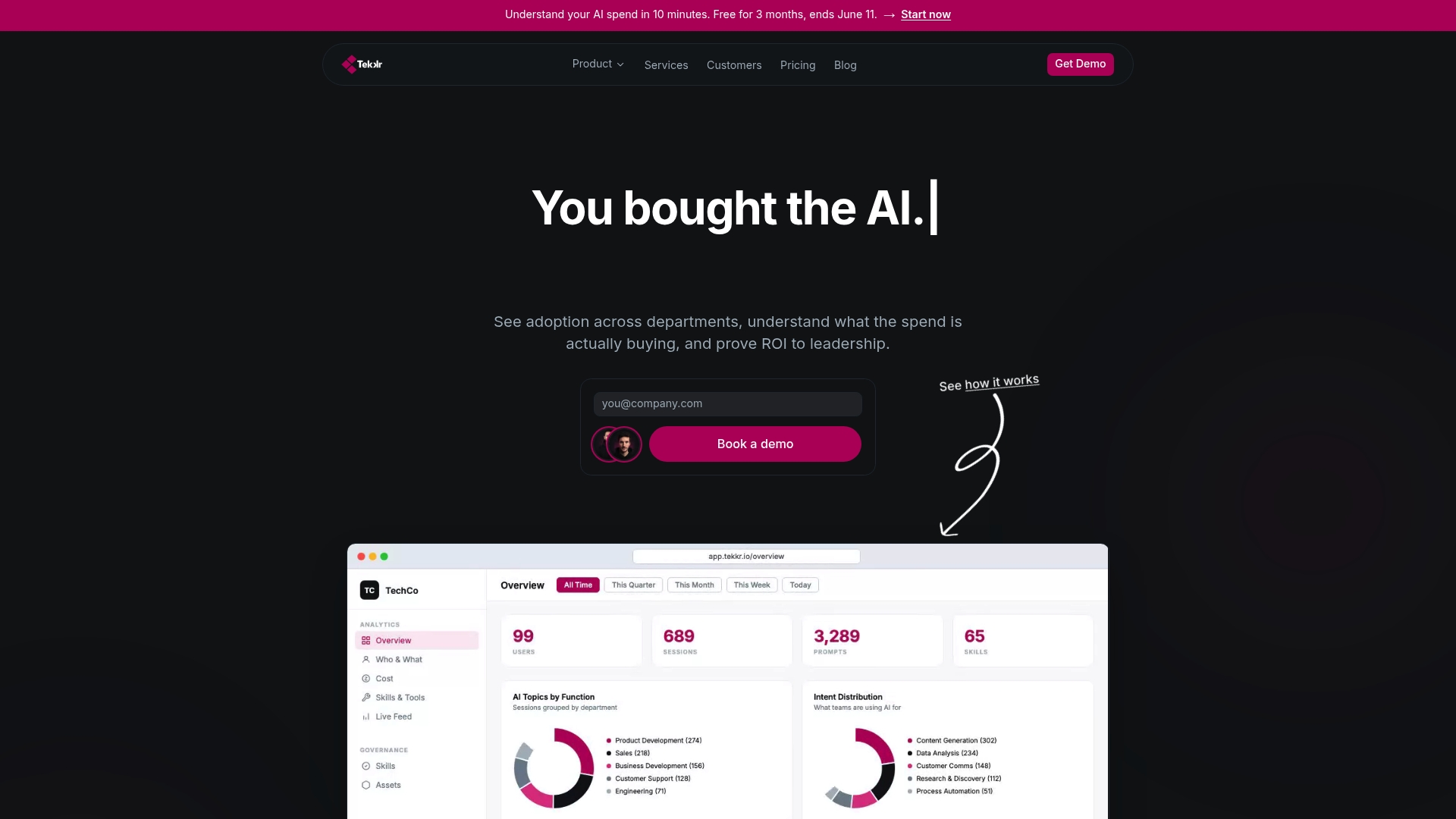
For prompt engineering training specifically, Configurato maps to the must-have features in this guide: adoption and spend tracking by initiative (your numerator), gamified leaderboards and playbooks (your enablement layer), and a privacy-first architecture with automatic PII stripping and end-to-end encryption. Setup takes about 10 minutes, with a free tier and no credit card required.
The AI adoption solutions page covers the full consulting and platform engagement model, including pilot timelines and measurement support. If you want to see Configurato against your own use case, request a demo and bring your one-page value hypothesis to the call.
Primary sources and further reading
- How can you break out of the AI ROI trap — EY
- Enterprise prompt management guide — LyZR
- How to maximize AI ROI — IBM
- How to measure AI ROI: metrics and a framework — CloudZero
- Generative AI Lifecycle Operational Excellence (GLOE) — AWS
- Centralized Prompt Management for Enterprise — Atlan
- Enterprise AI ROI Framework — Atlassian
- Operationalizing prompt engineering for enterprise — Promptly
- AI productivity ROI executive guide — Tekkr
- Metrics for AI success — Tekkr
Sources
- How can you break out of the AI ROI trap
- Enterprise prompt management guide
- How to maximize AI ROI in 2026 | IBM
- How to measure AI ROI: metrics and a framework
- Generative AI Lifecycle Operational Excellence (GLOE)
- Centralized Prompt Management for Enterprise: 2026 Framework