
Prompt anonymization is the practice of masking personal data before it leaves your environment and reaches a language model. The most practical pattern is pre-egress masking: detect sensitive fields locally or at a proxy, swap them for stable, reversible placeholders, then run adversarial re-identification tests to confirm the masking holds. If you haven’t done this yet, enable a local PII scan or add a pre-commit hook today.
TL;DR:
- Simple regex masking effectively covers structured PII but cannot detect unstructured identifiers like names or addresses.
- Context-aware NER models improve coverage but may require more computational resources and risk exposing raw data if hosted externally.
- Reversible pseudonymization maintains conversational context while enabling identity restoration and reduces re-identification risks.
- Anonymization tools must be integrated at multiple points—local, proxy, or CI pipelines—and tested regularly against adversarial re-identification efforts.
- Reducing collected data and actively testing protections, rather than relying solely on redaction, significantly mitigates the risks of linking and inference attacks.
Table of Contents
- Which anonymization techniques actually protect prompts?
- How do you build the tooling and deployment architecture?
- What are the real limits of anonymization?
- What’s the implementation checklist for a prompt anonymization pipeline?
- How does Tekkr approach prompt privacy in practice?
- What do engineering teams underestimate about this?
- How Tekkr turns prompt anonymization into a rollout advantage
- Where to verify these standards and tools yourself
- Sources
- FAQ
Which anonymization techniques actually protect prompts?
Not every masking technique protects a prompt the same way, and the right choice depends on what you’re hiding and what the model still needs to do its job.
Regex and pattern redaction catch structured data fast: email addresses, phone numbers, card numbers, and government ID formats all follow predictable shapes. The weakness is coverage. A name like “Jordan” or a street address with no obvious pattern slips through a regex filter entirely, so pattern matching alone leaves gaps an attacker can exploit.
Named entity recognition (NER) models close some of that gap by flagging names, locations, and organizations based on context rather than format. Offline NER models run entirely on-device, which keeps raw text from touching a third-party service; transformer-based NER models tend to catch more edge cases but may need more compute or a hosted endpoint, which reopens the exposure you were trying to close.
Pseudonymization is where privacy and utility meet. Instead of deleting “Jordan Reyes” outright, you replace it with a consistent placeholder like [[Person-1]] everywhere it appears in the prompt. The model keeps enough structure to reason about the conversation, and you keep a mapping that lets you restore the real value once the response comes back. The prompt-anonymizer project documents exactly this kind of on-device, reversible anonymization with consistent labeling and mapping IDs.
Query-relevant masking refines this further by masking only the PII that isn’t actually needed to answer the question, which PII-Bench shows preserves task performance better than blanket redaction.
- Regex catches structured formats fast but misses unstructured identifiers.
- NER-based masking understands context but costs more compute.
- Pseudonymization with stable placeholders preserves conversational coherence.
- Query-relevant masking keeps only the PII the model’s task actually requires hidden.
An adversarial loop, where an attacker model tries to re-identify your masked output and the anonymizer adjusts in response, is becoming a standard way to measure whether your masking actually holds under pressure.
Pro Tip: Label placeholders by entity type and index ([[Email-1]], [[Person-2]]) rather than generic tags, so restoration logic never has to guess which value goes where.
How do you build the tooling and deployment architecture?
Anonymization has to live somewhere in your pipeline, and where you put it determines how much protection you actually get.
- On-device libraries run masking inside the browser, desktop app, or local script before anything touches the network, which is the strongest guarantee against leakage but requires shipping detection models to every endpoint.
- A local egress proxy intercepts requests between your application and the model provider, masking PII on the way out and restoring placeholders in the response on the way back. This pattern also works for streaming responses, but only when the proxy is built to handle them correctly.
- Pre-commit and CI scanning blocks PII from ever reaching a prompt template or log file stored in a repository, catching mistakes before they ship.
- SDK streaming pitfalls deserve specific attention. CVE-2026-41182 documented a real case where streaming token events in an older LangSmith SDK bypassed the standard redaction pipeline entirely, leaking raw tokens that the normal input and output redaction never touched. Patched SDK versions fixed the gap, which means teams running older client libraries should verify their SDK routes streaming events through the same redaction logic as regular inputs and outputs, not around it.
- Mapping stores need to live in a secured vault with access controls and retention limits, and plaintext mappings should never appear in application logs, error traces, or debugging output.
Our prompt PII detection architecture piece walks through how these layers combine in a working pipeline.
What are the real limits of anonymization?
Masking a name doesn’t erase a person’s identity from the conversation. Models can still infer who someone is from contextual clues: a job title, a city, a rare medical condition, and a start date together can re-identify a person even when every obvious PII field was stripped.
NIST’s generative AI risk profile flags data memorization and inferential risk as core concerns, recommending that teams minimize what they collect, de-identify what they send, and actively test their protections rather than assume redaction worked.
Linking attacks compound this problem. An attacker with auxiliary data (a leaked customer list, a public LinkedIn profile) can match masked fragments back to real identities even when no single field in the prompt counts as PII on its own. NIST SP 800-226 notes that this kind of re-identification from combined, seemingly harmless features is a known failure mode of ad-hoc redaction, and that differential privacy offers stronger guarantees where the risk is high.

Over-masking has its own cost: strip too much context and the model’s answers get vaguer or wrong. That’s why testing matters. PII-Bench and adversarial re-identification loops give you a repeatable way to measure whether your masking survives contact with a motivated attacker, instead of trusting that it does.
What’s the implementation checklist for a prompt anonymization pipeline?
Building this correctly comes down to five stages, each with its own verification step.
- Detect: choose regex, NER, or a hybrid approach, and configure patterns for the locales and ID formats your users actually produce.
- Mask: apply reversible placeholders with consistent labeling, and maintain allow and deny lists for terms that should or should never be masked.
- Store: keep the placeholder-to-value mapping in a secured vault with access controls and a defined retention window, never in application logs.
- Integrate: attach the anonymizer to your proxy, SDK, or CI pipeline, and confirm streaming events pass through the same redaction logic as standard requests.
- Test: run adversarial re-identification checks and PII-Bench-style evaluations on a schedule, not just once at launch.
Pro Tip: Run your re-identification tests against auxiliary data from your own domain (HR exports, CRM records), not just generic benchmarks, since real attackers use whatever data they already have.
Our data minimization guide covers retention policy details compliance teams tend to miss during this step.
How does Tekkr approach prompt privacy in practice?
The platform is built on a privacy-first architecture that is end-to-end encrypted, GDPR-compliant, and anonymizes prompts with automatic PII stripping before any observability data is processed. This approach maps directly onto the detect-and-mask stages of the checklist above: the stripping happens automatically, without a browser extension, as part of how AI tool usage is tracked across an organization.
The security and privacy architecture behind Configurato is what lets Tekkr report on who’s using tools like Claude and Codex, and at what cost, without storing raw prompt content. Observability and privacy aren’t separate concerns in that design; the stripping has to happen before the usage data is ever visible on a dashboard.

What do engineering teams underestimate about this?
Most teams treat anonymization as a one-time regex pass and move on. The real work is adversarial: assume someone will try to re-identify your masked prompts using data you don’t control, and test against that assumption on a schedule, not once at launch.
Start with reversible placeholders and a basic scan before reaching for differential privacy or on-premises models. Those heavier options earn their cost only once you’ve confirmed simple masking isn’t holding, which takes monitoring, not guesswork.
— TekkrTools
How Tekkr turns prompt anonymization into a rollout advantage
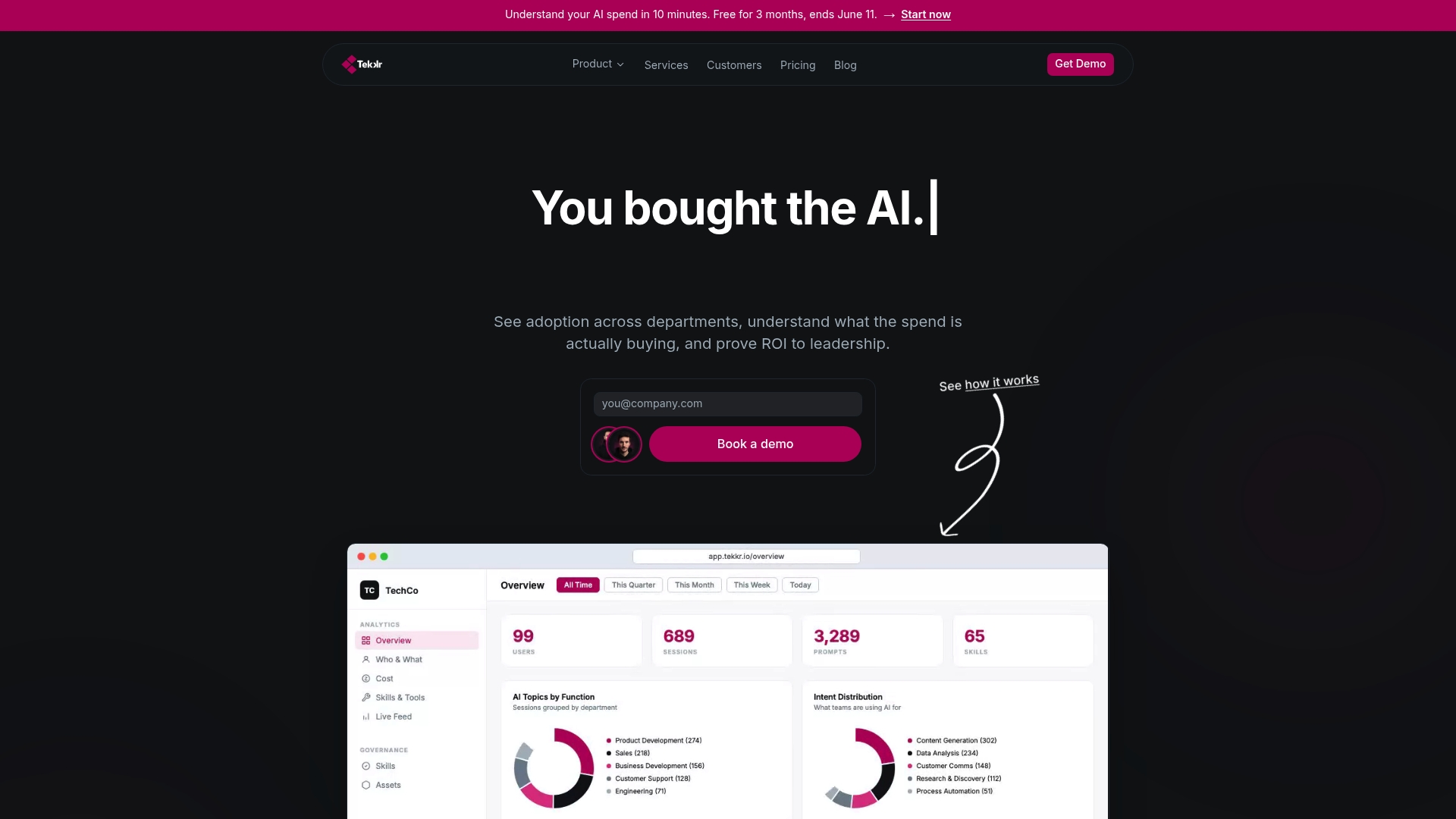
Most teams building their own masking pipeline end up solving the same problems: automatic PII stripping, a secure mapping layer, and a way to prove to a compliance team that none of it leaked. This platform ships that architecture already built, end-to-end encrypted and GDPR-compliant, alongside adoption and spend reporting that shows which teams are actually using AI tools and what it’s costing per department.
- Automatic PII stripping runs before any usage data reaches a dashboard.
- Setup is typically quick and does not require a browser extension.
- A free tier is available without requiring a credit card.
Check the Configurato observability and ROI tools or see current pricing for the full enterprise rollout.
Where to verify these standards and tools yourself
- NIST’s generative AI risk profile covers memorization and inferential risk safeguards.
- CVE-2026-41182 documents the LangSmith SDK streaming redaction bypass and its fix.
- PII-Bench and the related adversarial re-identification research benchmark masking approaches.
- PromptAnonymizer is an open-source reference implementation for reversible masking.
- For a red-team view of prompt-layer attacks, see NullVector’s prompt injection defense research.
Sources
- Adaptive text anonymization and adversarial re-identification (ACL findings 2026)
- PII-Bench and query-unrelated PII masking (ACL long 2026)
- AI Risk Management Framework: Generative AI Profile (NIST)
- CVE-2026-41182 (LangSmith SDK streaming redaction bypass)
- prompt-anonymizer (PyPI project page)
FAQ
What does anonymization mean in an AI context?
Anonymization means removing or masking information that could identify a specific person before that data is processed or stored. In prompt anonymization specifically, it means stripping or replacing personal details before a prompt reaches a language model.
What are examples of anonymization in prompts?
Common examples include replacing an email address with a placeholder like [[Email-1]], swapping a person’s name for [[Person-1]] consistently throughout a conversation, and masking phone numbers or ID numbers with regex patterns. PromptAnonymizer documents this placeholder pattern directly.
How do you anonymize data before sending it to an AI model?
The most reliable approach is masking data locally or through a proxy before it leaves your environment, using reversible placeholders so you can restore real values once the model responds. NIST’s generative AI guidance recommends pairing this with ongoing testing rather than treating one redaction pass as sufficient.
What tools help anonymize data for AI prompts?
Open-source options like PromptAnonymizer offer on-device masking with proxy and CI tooling for engineers who want to build their own pipeline. For organizations that need this built into a broader adoption and observability platform, Configurato applies automatic PII stripping as part of its privacy-first, end-to-end encrypted architecture.
Is regex enough to anonymize prompts safely?
Regex alone catches structured data like emails and card numbers but misses unstructured identifiers such as names or addresses that don’t follow a fixed format. A hybrid approach combining regex with NER-based masking, tested against adversarial re-identification, gives more reliable coverage.