
Treat AI as a portfolio, not a shopping list: measure who actually uses each tool, price it against full lifecycle cost, and fund what proves out. The fastest path to optimize AI usage across a company runs through four levers working together: visibility into adoption and spend, a defensible measurement and attribution method, governance gates that scale with risk, and enablement that turns access into habit. Platforms like Tekkr’s Configurato exist specifically to give leaders that visibility and drive the enablement side without months of custom tooling.
TL;DR:
- Conduct a comprehensive inventory of all AI tools, users, use cases, and spending across departments to ensure accurate tracking and ownership.
- Build a full total cost of ownership model that includes license fees, inference costs, integration, governance, training, change management, and support for realistic ROI calculations.
- Implement governance with risk-tiered workflows and deployment gates, tying reviews to impact levels and model changes to prevent risks from silent updates.
- Foster AI adoption through role-specific playbooks, early support from super-users, and peer influence strategies to maximize workflow integration.
- Approach AI funding with a portfolio strategy, assigning different criteria for broad access, function-level projects, and strategic investments, with clear kill criteria before scaling.
Table of Contents
- The Six-Lever Checklist for Optimizing AI Usage
- How Do You Measure AI ROI That Survives a CFO’s Scrutiny?
- What Governance Controls Are Required Before Scaling AI?
- How Do You Actually Get Employees to Use AI Tools?
- How Should You Fund and Prioritize AI Investments?
- A 90-Day Plan to Put This Into Action
- Why Most Executives Get AI Optimization Backward
- How Tekkr Fits Into This Playbook
- Sources
The Six-Lever Checklist for Optimizing AI Usage
Before you touch a dashboard or a budget line, get six things assigned to named owners with dates attached. Skip one and the whole program tends to stall on the one nobody claimed.
- Inventory: catalog every tool, user, use case, and dollar of spend across departments, not just what IT approved.
- Measurement: set a baseline, pick KPIs, and define an attribution method for each use case before rollout, not after.
- Governance: assign risk tiers to workflows and build deployment gates that match the stakes.
- Funding: adopt a portfolio model with pre-committed kill criteria, so money follows evidence instead of enthusiasm.
- Enablement: build role-specific playbooks, name champions, and consider gamified rollouts to accelerate peer learning.
- Operations: schedule monitoring, a re-measure cadence, and a standing report to finance.
Each lever depends on the others. Governance without measurement just slows things down. Enablement without inventory means you’re training people on tools nobody tracks.
How Do You Measure AI ROI That Survives a CFO’s Scrutiny?
Most AI business cases fail scrutiny because they undercount cost and overcount benefit. A defensible ROI model needs a full total cost of ownership, not just the software invoice, and it needs a value side that maps cleanly to the P&L.
Build your TCO from seven categories:
- Tool license fees, including seat-based and usage-based pricing tiers.
- Inference cost, which fluctuates with usage volume and model choice.
- Integration work to connect the tool to existing systems.
- Governance overhead, including review cycles and compliance tooling.
- Adoption cost, covering training time and lost productivity during ramp-up.
- Change management, the org-design and communication work most teams forget to budget.
- Ongoing support and maintenance, since AI systems shift as models and data change.
That last point matters more than most finance teams expect. AI pricing is consumption-based and evolves as workloads and model versions change, which means a TCO built once at launch goes stale fast, and ongoing cost governance has to be a standing process, not a one-time exercise.
On the value side, sort benefits into four buckets: time saved (converted to fully loaded FTE cost), quality improvement (fewer errors, faster cycle times), revenue lift (deals closed faster, higher conversion), and risk reduction (avoided compliance failures or rework). Attribution should come from pre-registered hypotheses tested through A/B comparisons, control groups, or matched-market pilots, run over a fixed window rather than left open-ended.
Pro Tip: *Report cost per accepted outcome, not cost per query.
Most business cases undercount total cost by omitting exactly these integration, governance, and change management lines, which is why the same pilot can look wildly profitable in a slide deck and break even in reality. Realistic payback windows for enterprise AI typically fall between 12 and 36 months depending on how mature the use case is, and modeling that range with sensitivity scenarios, rather than a single optimistic number, keeps the case honest. For a deeper walkthrough of these calculations, see Tekkr’s guide to measuring AI ROI.
What Governance Controls Are Required Before Scaling AI?
Governance isn’t a brake pedal. It’s what lets you say yes faster to low-risk work while keeping a tight leash on the workflows that could actually hurt you.
Start by tiering workflows by risk: low-risk internal drafting needs light review, while anything touching customer data, financial reporting, or regulated decisions needs a validation step before it ships. Attach deployment gates to those tiers, so a workflow can’t go from pilot to company-wide rollout without an approval tied to its cost and potential impact.
- Define PII handling rules and vendor data controls before any tool touches customer or employee data.
- Require observability into which tools are used, by whom, and for what, so risk isn’t discovered after the fact.
- Route governance reviews through the same forum that reviews budget, not a separate committee that never talks to finance.
- Set a recheck trigger tied to model or data changes, not just a calendar date.
Enterprises where senior leadership actively shapes AI governance extract measurably more value from their AI investment than those that leave it to a technical team in isolation, according to Deloitte’s research on enterprise AI. Governance embedded in the same conversation as budget tends to catch problems before they become expensive.
Pro Tip: Set a governance recheck for every workflow whenever the underlying model or its training data changes, not just once a year. A vendor’s silent model update can shift outputs enough to break a workflow that passed review six months earlier.
How Do You Actually Get Employees to Use AI Tools?
Buying licenses is the easy part. Getting a workflow adopted by the people who’d benefit from it is where most AI programs quietly fail.
Role-specific playbooks beat generic training every time. A sales rep needs a script for using AI in call prep; a finance analyst needs one for variance analysis. Build playbooks around actual job tasks, not tool features, and pair them with gamified rollouts that surface early super-users. Those super-users become informal trainers faster than any top-down program, and peer credibility moves adoption in a way a mandate from leadership rarely does.
- Build playbooks around specific job tasks, not generic tool tutorials.
- Identify and support super-users early; peer influence outperforms formal training.
- Embed micro-learning directly into the workflow instead of scheduling separate training sessions.
- Use adoption data to prioritize enablement toward the highest-value workflows first.
Role-based playbooks, super-user networks, and structured incentives substantially lift usage, and observability into who’s actually using which tools is what makes targeted enablement possible in the first place.
That’s the exact gap Configurato was built to close: it tracks who’s really using tools like Claude and Codex, breaks spend down by team, and pairs that visibility with gamified rollouts and ready-made playbooks, all inside a privacy-first setup that strips PII automatically and takes about ten minutes to configure. For a fuller look at why tools sit unused despite heavy investment, Tekkr’s executive guide walks through the pattern in detail.
How Should You Fund and Prioritize AI Investments?
Not every AI initiative deserves the same funding logic. Treat your portfolio as three distinct bands, each with a different bar for evidence.
- Broad access funding covers low-cost, low-risk productivity tools rolled out company-wide, evaluated mainly on adoption rate.
- Function-level funded workflows get budget once a specific team shows a validated use case with measured time or cost savings.
- Strategic bets are the smaller number of higher-investment initiatives tied to competitive advantage, evaluated over a longer horizon with closer executive oversight.
Tie every band to maturity gates: a workflow doesn’t move from pilot to function-level funding without hitting its acceptance criteria first. Set kill criteria before launch, not after a disappointing quarter, and revisit every funded initiative on a quarterly cadence. Recommendations for this kind of maturity-matched funding echo across OpenAI’s guidance on managing AI investments, which stresses matching capacity to proven demand rather than funding speculative scale upfront. Shared capabilities, like a common data pipeline multiple teams draw on, deserve centralized funding since no single team will build them alone.
A 90-Day Plan to Put This Into Action
You don’t need a year-long transformation program to start seeing signal. Ninety days is enough to inventory, pilot, and make a real funding decision.
- Days 0 to 30: inventory every tool, user, and dollar of spend; set baseline metrics; pick two or three priority workflows and write down testable hypotheses for each.
- Days 31 to 60: run pilots with control groups or A/B structures; instrument the metrics defined in step one so results are measurable, not anecdotal.
- Days 61 to 90: apply kill or scale decisions based on pre-committed criteria, fund shared capabilities centrally, and roll out enablement playbooks to the workflows that proved out.
Ship four deliverables from this cycle: a baseline report, documented pilot results, an adoption playbook for the winning use cases, and a one-page executive summary that finance can act on without a follow-up meeting. Tekkr’s guide to tracing AI impact covers the attribution designs referenced here in more depth if your pilots need a tighter measurement setup.
Why Most Executives Get AI Optimization Backward
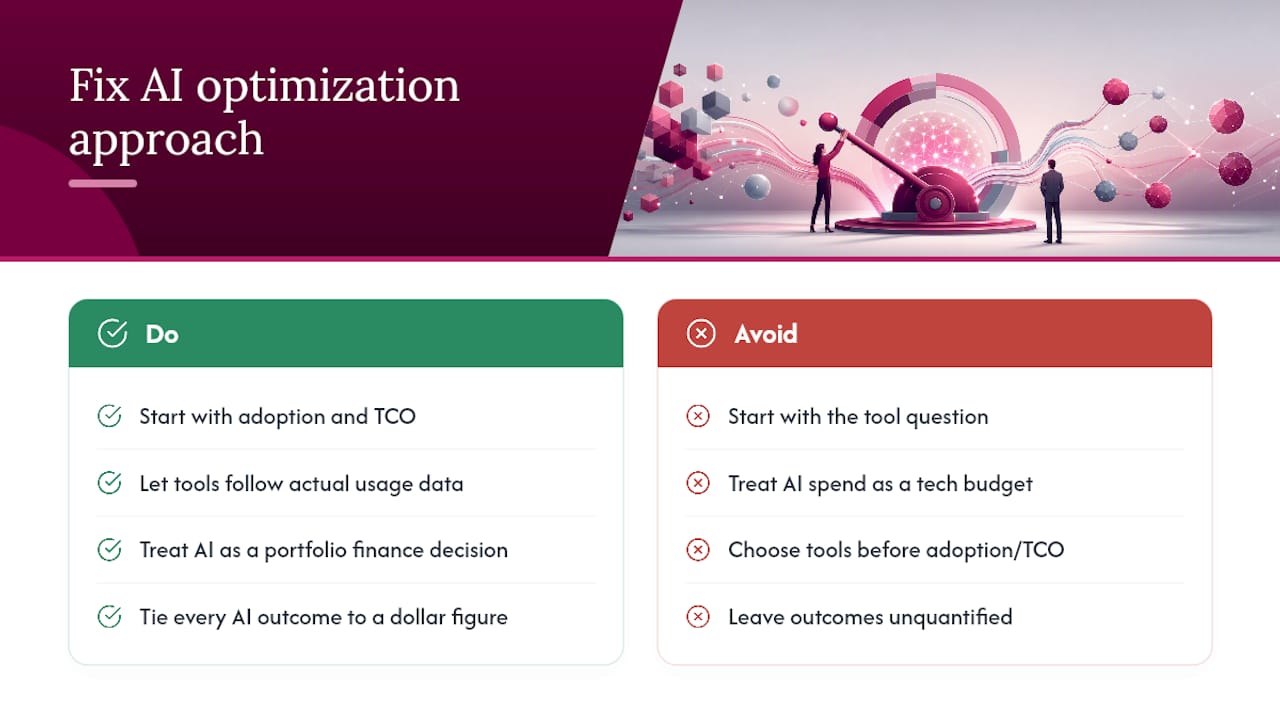
Most leadership teams start with the tool question: which model, which vendor, which feature set. That’s backward. The companies getting real value start with adoption and total cost of ownership, then let tool selection follow from what the data says people actually use.
The other habit worth breaking: treating AI spend like a technology budget instead of a portfolio finance decision. Tie every AI outcome to a dollar figure finance recognizes, or the program dies at the next budget cycle regardless of how well it worked operationally.
— TekkrTools
How Tekkr Fits Into This Playbook
Everything in this playbook, from inventory to attribution to enablement, is what Configurato was built to run. It tracks who’s using tools like Claude and Codex across every team, breaks spend down by department, and surfaces which use cases are actually delivering value instead of sitting idle.
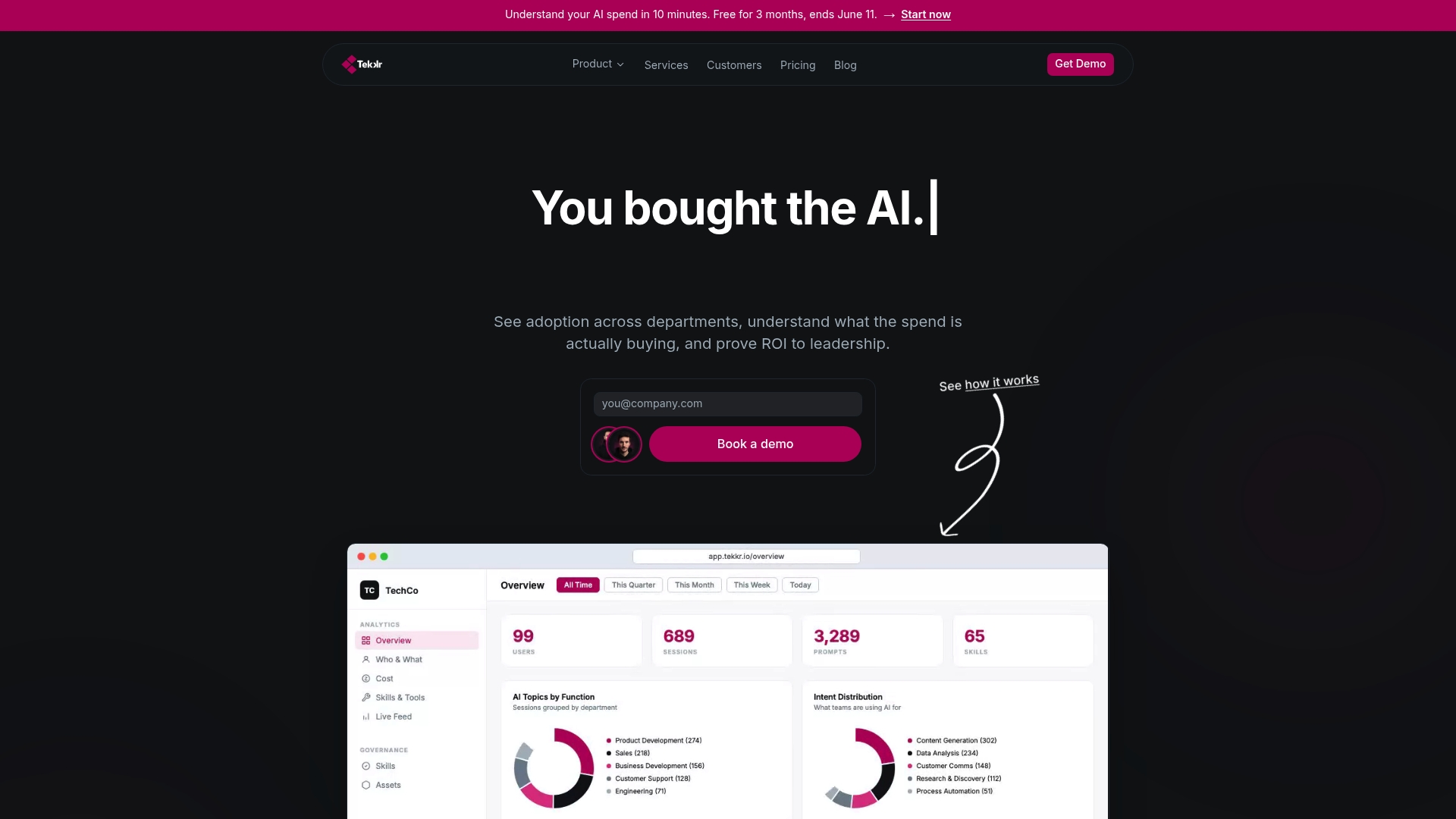
Setup takes about ten minutes, with a free tier and no credit card required, so you can see your own adoption and spend picture before committing to anything larger. Configurato’s adoption and enablement features handle the playbooks and gamified rollouts described above, while the platform’s privacy-first architecture strips PII automatically and runs end-to-end encrypted, which matters if your governance team is going to sign off on it. For enterprises ready to move past a single tool and rebuild the whole measurement and adoption process, Tekkr’s AI adoption consulting pairs the software with hands-on rollout strategy. Start with the free tier and see what your own usage data says before your next budget review.
Sources
For deeper context on the frameworks referenced here, EY’s seven-layer blueprint for AI ROI covers data foundations and workforce design, while Seattle Software Developers’ analysis offers an outside view on AI’s operational impact.
- Cloud cost optimization: how to maximize ROI from AI (Azure blog)
- State of AI in the enterprise (Deloitte)
- Calculating AI ROI in the Enterprise (AI Advisory Practice)