
Measuring Slack means building three things at once: instrumentation that captures Slack and Slack AI activity, outcome metrics tied to finance, and an attribution method that survives an audit. Pull the raw signal from the Slack AI dashboard and the Audit Logs API. Then run a baseline before you claim a single dollar of savings.
The single next move: start a 3 to 6 week baseline capture now, before any new AI feature rollout, and store the results alongside general ledger evidence so finance can trace every number back to a source.
- Instrument Slack activity and AI feature usage at the event level, not just seat counts.
- Convert activity into outcome metrics finance actually recognizes: time saved, cycle time, cost per unit.
- Build attribution with a documented baseline, not a post hoc estimate.
Pro Tip: Deloitte’s research found AI now captures roughly 36% of digital initiative budgets at surveyed enterprises, and firms that measure broadly report higher realized value. That is the number that gets a CFO’s attention before you’ve shown a single savings figure.
Key Takeaways
CFO-ready Slack measurement requires pre-deployment baselining, clear activity-to-outcome mapping, and properly documented confidence-tiered attribution to pass audit scrutiny.
| Point | Details |
|---|---|
| Capture a baseline first | Run 3 to 6 weeks of pre-deployment measurement before claiming any savings figure. |
| Separate activity from outcomes | Track Slack AI feature invocations, then map them to time saved, cycle time, and error rates. |
| Use the Audit Logs API | Extract event-level Slack data for team and use-case breakdowns beyond the standard dashboard. |
| Tier every ROI claim | Label savings as bookable, modeled, or optionality, with a documented haircut for each. |
| Automate the pipeline | Configurato instruments Slack usage, allocates cost by team, and generates board-ready reports with PII stripped automatically. |
Table of Contents
- Which Slack and Slack AI metrics actually matter
- How do you collect Slack signals without breaking privacy rules?
- How do you turn Slack activity into board-ready ROI?
- Who reviews these metrics, and how often?
- How Configurato turns this playbook into a working system
- Frequently asked questions
- Sources
Which Slack and Slack AI metrics actually matter
Activity metrics tell you whether people opened the tool. Outcome metrics tell you whether it did anything. You need both, but they answer different questions, and conflating them is the most common mistake in Slack measurement.
Start with activity. Daily and monthly active users, active channels, huddle minutes, and messages that touch AI features all establish reach. Slack AI feature invocations, summaries, thread recaps, and channel explainers, show which capabilities people actually reach for versus which ones sit unused after launch.
Outcome metrics are the harder half, and the half finance cares about:
- Time saved per task, measured against a pre-AI baseline for comparable work.
- Cycle time reduction on workflows that route through Slack (approvals, incident response, handoffs).
- Tickets or requests resolved per period, especially where Slack AI triages or drafts responses.
- Quality and error rate changes, since faster is not automatically better.
- Cost per unit of output, once you have a denominator worth trusting.
The mapping between the two sets is where most programs fail. Activity metrics feed the ROI math only when you can tie a specific behavior (say, a spike in Slack AI recap usage in a support channel) to a downstream outcome (ticket resolution time dropping). Atlassian’s Enterprise AI ROI Value Framework recommends weighting metrics by program maturity: early rollouts should lean on adoption signals because outcome data is still noisy, while mature programs shift almost entirely to throughput, error rates, and net-new revenue. Trying to report Tier 1 dollar savings in month one, before you have a maturity curve, is how measurement programs lose credibility with finance before they get started.
How do you collect Slack signals without breaking privacy rules?
Two extraction points cover almost everything an enterprise program needs. The Slack AI dashboard gives Enterprise Grid admins org-wide usage summaries: feature adoption, active user counts, and rollout trends without any custom engineering. The Audit Logs API goes deeper, streaming individual events (message sends, huddle starts, AI feature invocations) that you can pipe into your own analytics warehouse for team-level or use-case-level breakdowns.
Build the event stream with a schema that survives scrutiny:
- Timestamp and anonymized user or team identifier, never a raw name or email.
- Feature invoked (summary, recap, explainer, standard message) and the task type it supports.
- Success or failure flag, so you can separate genuine usage from abandoned attempts.
- Ingestion into a central store, refreshed on a schedule your team actually reviews.
Privacy has to be designed in, not bolted on afterward. Strip personally identifiable information automatically before storage, avoid browser extensions that widen your data surface unnecessarily, and log the minimum content needed to answer the metric question, not full message text. This is also where a lot of homegrown instrumentation efforts stall: they either grab too much (raising legal and employee-trust problems) or too little (leaving finance with numbers nobody trusts).
Pro Tip: Treat your event schema like a contract with legal, not just an engineering spec. Get sign off on what counts as “anonymized” before you ship a single dashboard, not after an audit asks.
How do you turn Slack activity into board-ready ROI?
Activity data becomes financial evidence only through a deliberate conversion process, and the process starts before deployment, not after.
Run a pre-deployment baseline of 3 to 6 weeks. Capture current cycle times, ticket volumes, and time-on-task for the workflows you expect AI to touch, and where possible, ground those baselines in general ledger data so finance can independently verify the starting point.
From there, build a driver-tree: decompose any claimed savings into gross measurable savings, an attribution percentage (how much of the change is actually attributable to the AI feature versus other factors), and a recurring versus one-time split. The Enterprise AI ROI Assessment methodology treats this decomposition as the core defense against audit risk, because every node in the tree has to carry its own evidence file rather than resting on a single top-line number.
Not every claim deserves the same confidence. Use tiers:
- Tier 1, bookable direct savings: hours eliminated from a documented workflow, verified against payroll or GL data, little or no haircut applied.
- Tier 2, modeled indirect savings: productivity gains inferred from activity metrics and comparable-team analysis, typically haircut 30 to 50%.
- Tier 3, optionality value: capacity freed up for work that has not yet been assigned a dollar figure, reported as a range, not a point estimate.
Most enterprise AI ROI failures trace back to a measurement problem, not a technology problem: instrumentation and baselines that should have existed before launch get bolted on months later, once someone in finance asks for proof.
Where a clean baseline isn’t available, matched-market comparisons, time-series analysis with control groups, or structured time-tracking studies fill the gap. Any of the three beats a single before/after anecdote from one enthusiastic team lead.
Who reviews these metrics, and how often?
Measurement that only happens once a year produces a snapshot, not a trend, and boards trust trends. Continuous tracking at three cadences keeps the program honest.
- Monthly, team leads and AI operations staff review activity metrics and troubleshoot adoption gaps before they compound.
- Quarterly, the AI program lead presents trend analysis and a confidence-tier narrative to program stakeholders, updating the driver-tree as new evidence arrives.
- Annually, the board packet includes GL-linked evidence, the full driver-tree, and a clean split between recurring savings and one-time or NPV-style gains.
Keep an audit folder running year round: baseline capture files, the attribution memo explaining each driver-tree node, and a short prep document for external auditors who will ask where every number originated.
Why measurement designed after deployment usually fails
Most teams instrument Slack and Slack AI usage only after finance asks for proof, and by then the baseline window has closed for good. You cannot retroactively measure a “before” state, which means every subsequent ROI claim rests on assumption rather than evidence. Change management budgets get treated as optional, and adoption stalls exactly where measurement should have caught it early. Build the instrumentation and the enablement plan together, from day one, or expect the finance conversation to stall at “we think it’s working.”
How Configurato turns this playbook into a working system
Building the pipeline described above from scratch, event schema, PII stripping, driver-tree templates, and a board-reporting cadence, takes most internal teams months, and most never finish the attribution layer. Configurato does the instrumentation, the cost allocation, and the reporting in one system built specifically for this problem.
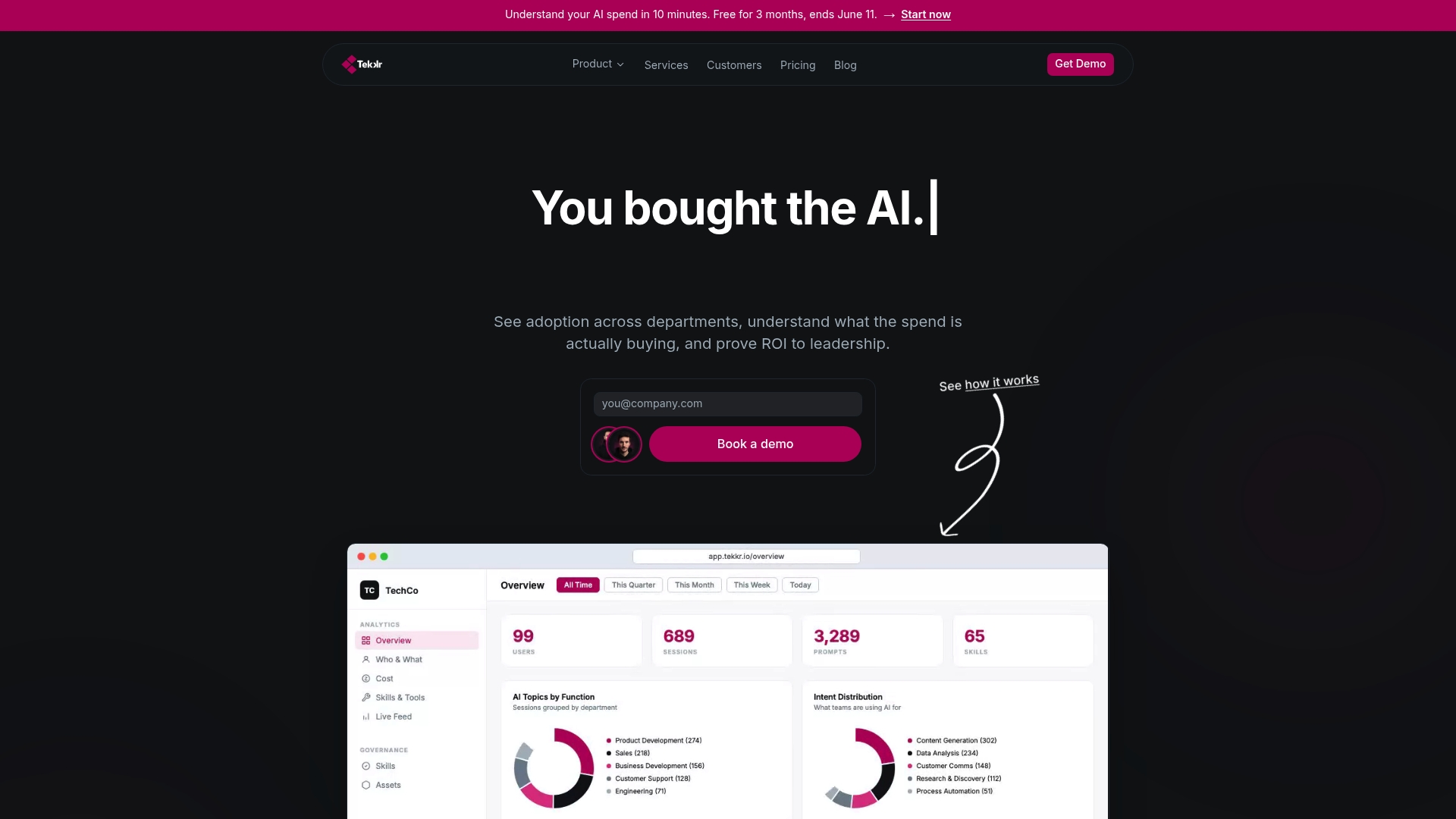
It tracks Slack and Slack AI usage by team, breaks down feature invocations and cost per department, and rolls the numbers into driver-tree-style ROI reports finance can actually sign off on. The privacy architecture strips PII automatically, requires no browser extensions, and stays end-to-end encrypted and GDPR-compliant, so legal never has to negotiate the data model after the fact. Setup runs about 10 minutes, there’s a free tier with no credit card required, and gamified rollout tools push adoption up instead of just measuring it after the fact. Check the AI Adoption solution page to start a baseline capture this month.
Frequently asked questions
What’s the fastest way to start measuring Slack AI usage? Pull org-wide adoption data from the Slack AI dashboard immediately, then start a parallel Audit Logs API integration for team-level detail. Begin the baseline clock the same week.
How long should a baseline period run before I trust the numbers? Three to six weeks generally captures enough variation in normal workflow to separate a real signal from noise, though workflows with heavy weekly or monthly cycles may need the longer end of that range.
What costs belong in an enterprise AI cost model beyond licenses? Include inference costs, integration and engineering time, governance overhead, and change management. These commonly multiply visible license spend by 2 to 5 times, and skipping them is the fastest way to present an ROI number that collapses under finance review.

How do I know if a savings claim is credible enough for the board? Check whether it sits on a driver-tree with a documented attribution percentage, a stated confidence tier, and evidence tied back to general ledger data. If a number can’t answer “where did this come from,” it isn’t ready for the board packet.
Sources
- View your Slack analytics dashboard
- AI and tech investment ROI | Deloitte Insights
- AI ROI Measurement: How to Track, Prove, and Report AI Investment Returns (2026) | Moweb