
Marketing AI adoption has crossed into the mainstream, but proving what that AI actually returns is now the real work. Survey data puts overall usage at 91%, while only about 41% of teams say they can confidently prove AI ROI to leadership. That gap, not access to tools, is the defining marketing AI use case challenge of 2026.
Most organizations have moved past the question of whether to adopt AI. The open question is whether anyone can show what it’s worth in dollars, hours, or conversions.
- Adoption: widespread across enterprises and mid-market teams alike
- ROI confidence: a minority can defend the number to a CFO
- Priority move: assign ownership, set KPIs before scaling further, and put governance in place now, not after the next tool purchase
Key Takeaways
Marketing AI adoption succeeds when organizations pair widespread tool usage with disciplined ROI measurement, governance ownership, and a phased rollout from pilot to standardized practice.
| Point | Details |
|---|---|
| Adoption outpaces proof | Usage sits at 91%, but only about 41% of teams can confidently prove ROI to leadership. |
| Fastest ROI use cases | Personalization and predictive segmentation prove value faster than creative generation because outcomes are easier to isolate. |
| Governance closes incident gaps | Human-in-the-loop review and documented approval workflows reduce hallucination and brand-safety risk before launch. |
| Ownership must be named | A single accountable owner, not a committee, keeps AI governance and playbooks from stalling at the pilot stage. |
| Measurement tools close the gap | Platforms like Tekkr’s Configurato track usage, spend, and ROI by team with a privacy-first, GDPR-aligned setup in about 10 minutes. |
Table of Contents
- Where Marketing AI Adoption Stands in 2026
- What Are the Top Marketing AI Use Cases That Deliver Real Value?
- What Risks Come With Scaling AI in Marketing?
- How Do You Measure ROI on Marketing AI Investments?
- How Do You Operationalize AI Adoption Across a Marketing Team?
- What Tech and Architecture Choices Support Scaled AI Marketing?
- What Does a Mature Marketing AI Organization Look Like?
- How Configurato Puts the ROI Framework Into Practice
- What’s Blocking Wider Marketing AI Adoption Beyond Data and Skills?
- What Strategies Actually Work for Successful AI Adoption?
- What Do Real Marketing AI Adoption Success Stories Look Like?
- What’s Next for AI in Marketing?
- A Marketing Leader’s Take on What Matters in 2026
- See Your Own AI Adoption Numbers Before You Buy the Next Tool
- Sources
Where Marketing AI Adoption Stands in 2026
Marketing AI adoption stopped being a pilot conversation somewhere in the last two years. It’s now closer to infrastructure. Organizations that once ran a single generative writing tool for social captions now run stacks that touch copy, segmentation, forecasting, and campaign optimization at the same time.
Growth in AI marketing spend has tracked with that shift. Statista’s market analysis on AI use in marketing shows the category reaching multi-billion-dollar revenue levels, with continued growth projected as more budget shifts from experimental line items into core martech spend. Larger enterprises adopted first and fastest, largely because they had the headcount to run pilots without disrupting core campaigns. Mid-market teams have caught up quickly, often skipping the pilot phase entirely and buying platforms that bundle AI features by default.
The use cases dominating budget allocation right now break down fairly consistently across sectors:
- Content and copy generation, still the highest-volume use case by raw output
- Personalization and audience segmentation, growing fastest in retail and e-commerce
- Predictive analytics for campaign forecasting and budget allocation
- Campaign automation, including bid management and send-time optimization
An academic review of AI marketing adoption found the technology genuinely improves personalization and forecasting accuracy, but flagged data privacy, ethics, and organizational readiness as persistent friction points. That friction is exactly why the conversation has moved from “are we using AI” to “can we prove it’s working.” Budget owners who once measured success by tool count are now being asked for attribution models, and most don’t have one ready.
What Are the Top Marketing AI Use Cases That Deliver Real Value?
Not every use case returns value at the same speed. Some show measurable lift within a quarter; others take a year of tuning before the numbers move.
- Copy and creative generation. Early use was single-asset drafting, a headline here, a product description there. Mature teams now run multi-asset workflows that generate a full campaign’s variations for testing, cutting creative production time from weeks to days.
- Personalization and predictive segmentation. Predictive models identify high-intent segments before a human analyst would notice the pattern, and personalized email or on-site content built on those segments consistently outperforms static campaigns on click-through and conversion.
- Analytics, forecasting, and attribution. AI-driven forecasting tightens budget planning by flagging underperforming channels earlier in the cycle, before spend is fully committed.
- Automation and campaign optimization. Real-time bid adjustment and send-time optimization run continuously, something no human team could do at the same frequency.
Personalization and predictive segmentation tend to show the fastest measurable ROI, mostly because the output (a conversion rate, an open rate) is easy to isolate and test against a control group. Copy generation delivers speed gains immediately but takes longer to prove revenue impact, since creative quality still needs human judgment layered on top.
What Risks Come With Scaling AI in Marketing?
Hallucinated statistics in a blog post. A generated ad that references a discontinued product. A chatbot that answers a customer complaint with the wrong tone entirely. These aren’t hypothetical. The IAB’s research on responsible AI in advertising points to incidents like these happening at meaningful scale already, and the industry’s tooling for catching them hasn’t kept pace with adoption speed.
Data quality is the underlying gating factor behind most of these failures. A model trained or prompted against inconsistent customer data will produce inconsistent personalization, sometimes recommending a product a customer already returned or targeting a segment that no longer exists. Bias creeps in the same way: if historical campaign data skewed toward one demographic, predictive tools will keep optimizing toward that same demographic unless someone corrects for it.
Governance controls that actually work tend to share a few traits:
- A human-in-the-loop checkpoint before any AI-generated asset goes to a paid channel
- Model selection criteria that account for hallucination rates, not just output quality
- A documented review workflow for anything customer-facing, with a named approver
- Regular audits of training data and prompt inputs for demographic skew
On privacy, treat it as a design requirement, not a compliance checkbox. Build in data minimization and PII handling from the first pilot, not after a legal review flags it.
Pro Tip: Run a “red team” pass on your top three AI-generated campaign assets each month, where someone actively tries to find factual errors or brand-safety issues before launch, not after a customer flags one publicly.
The ethics research from IAPP makes a similar point: standards and transparency requirements are rising because the industry’s incident rate hasn’t left much choice.
How Do You Measure ROI on Marketing AI Investments?
Time saved isn’t the same as value created, and this is where most ROI conversations run aground.
A workable ROI framework maps AI activity in three stages:
- Input tracking. What’s actually being used, by whom, on what task, and at what cost per seat or per API call.
- Output tracking. Assets produced, campaigns launched, segments built, and the time each took compared to a pre-AI baseline.
- Outcome tracking. Revenue, cost per lead, conversion rate, and retention, measured against a control group or a pre-adoption baseline.
The metrics worth watching closely: campaign lift, cost per lead (CPL), conversion rate by channel, time-to-market for new creative, and cost per finished asset. None of these mean much in isolation. They mean something when tracked over time against a baseline that predates the AI rollout.
Testing methodology matters as much as the metric itself. A/B tests against a non-AI control group, holdout audiences excluded from AI-personalized campaigns, and incremental lift measurement all give a cleaner read than simply comparing this quarter to last quarter, where a dozen other variables changed too. Enterprise benchmark data shows this is exactly where most teams stall: tracking ROI and governance closely is the trait that separates advanced adopters from teams stuck reporting activity metrics. A detailed measurement framework built around these stages gives leadership something more durable than a productivity anecdote.
How Do You Operationalize AI Adoption Across a Marketing Team?
Someone has to own this, and “everyone” is not an answer that survives a budget review. Most marketing organizations land on one of two models: a central AI center of excellence that sets standards and approves major rollouts, or a distributed model where each team adopts independently under shared governance rules. Centralized ownership scales faster and stays consistent; distributed ownership scales AI literacy faster because more people are hands-on with the tools daily. Many organizations end up running a hybrid, central governance with distributed execution, once the initial pilot phase proves out.
Whichever model you pick, an AI playbook makes the rollout repeatable instead of ad hoc. A useful playbook documents which tools are approved for which task, what the review workflow looks like before anything ships, and how a new pilot graduates into standard practice. Pair that with a rollout cadence: pilot a use case with one team, set success metrics up front, expand once those metrics clear a threshold, then formalize what worked into the shared playbook. Gamified incentives, leaderboards for tool adoption, recognition for teams that hit AI-driven KPIs, tend to accelerate this far more than a mandate from leadership ever does.
Training is the piece most rollouts underfund. AI literacy isn’t binary; it ranges from “knows how to write a decent prompt” to “understands what to do when a model’s output looks wrong.” Measuring that range, through skills assessments or usage audits, tells you where training dollars actually need to go.
- Assign a named owner for AI governance, not a committee
- Document an approval workflow before scaling past pilot
- Track AI literacy the same way you’d track any other skill gap
- Reward measurable adoption, not just tool access
Pro Tip: If leadership and middle managers disagree about how mature your AI rollout is, that gap is itself useful data. It usually means the metrics leadership sees don’t match what’s happening on the ground.
That perception gap is well documented. Benchmark research on marketing’s AI inflection point found leadership consistently rates organizational maturity higher than the managers actually running campaigns day to day. Closing that gap starts with shared dashboards, not another all-hands presentation. A practical adoption playbook and a mid-market focused AI marketing plan can both shortcut the trial-and-error most teams go through building this from scratch.
What Tech and Architecture Choices Support Scaled AI Marketing?
Out-of-the-box tools win on speed of deployment. Domain-specific tools win on relevance to your exact workflow. Custom models win on control, at the cost of engineering time most marketing teams don’t have. Research on agentic AI adoption found most marketers still default to out-of-the-box tools, largely because agentic systems still carry trust and integration friction that slows enterprise rollout.
Orchestration matters more as the tool count grows. A single AI writing assistant doesn’t need an orchestration layer. Ten AI tools spread across five teams, each with its own login, cost center, and output format, absolutely does.
What to evaluate before scaling further:
- Data hygiene: is customer data clean and consistent enough to feed reliable personalization?
- Identity resolution: can you tell if the same customer is being targeted by three different AI-driven campaigns at once?
- Telemetry and cost tracking: do you know what each tool costs per team, per month, per outcome?
- Monitoring and observability: is there a dashboard that flags anomalous output before a customer sees it?
Skipping the observability question is the single most common mistake teams make once they scale past a pilot.
What Does a Mature Marketing AI Organization Look Like?
Maturity shows up in three places: governance that’s documented rather than assumed, ROI tracking that’s continuous rather than a one-time pilot report, and workflows where AI is embedded in the process rather than bolted on as an extra step. Teams stuck at the pilot stage tend to share the same blockers, disconnected data, no named governance owner, and metrics that measure activity instead of outcome.
A workable ramp plan runs in three stages:
- Pilot. Pick one use case, one team, and a clear success metric before you start. Resist the urge to pilot five things at once.
- Standardize. Once a pilot clears its threshold, document what worked into a playbook and expand it to a second team, adjusting for what didn’t transfer cleanly.
- Govern and optimize. Formalize review workflows, assign ongoing ownership, and shift reporting from “look what we built” to “here’s what it returned this quarter.”
Most organizations get stuck between stage one and two, running parallel pilots that never consolidate into a shared standard. A clear enterprise adoption strategy at the standardize stage is usually what separates teams that scale from teams that stay stuck running the same five pilots a year later.
How Configurato Puts the ROI Framework Into Practice
Tekkr built Configurato around the exact gap most marketing organizations hit: widespread AI usage with no reliable way to show what it returns. It tracks who’s actually using tools like Claude and Codex across departments, breaks down spend by team, and surfaces which use cases are driving real output versus which ones sit unused after the initial rollout excitement fades.
The privacy posture matters as much as the measurement itself. Configurato runs end-to-end encrypted, strips PII from prompts automatically, aligns with GDPR, and needs no browser extension installed on every employee’s machine, a real barrier for IT teams evaluating usage-tracking tools.
Setup takes about 10 minutes, and a free tier means a pilot doesn’t require a procurement cycle to start. In a typical 90-day pilot, teams aim to establish:
- A baseline of tool usage and spend by department
- At least one use case with a measured before/after outcome
- A monthly executive report that ties usage to a business metric, not just adoption percentage
That checklist alone gives leadership something more concrete than a rollout announcement.
What’s Blocking Wider Marketing AI Adoption Beyond Data and Skills?
Data quality and skills gaps get most of the attention, but they’re not the only friction. Budget ownership is a quieter blocker: when AI spend is scattered across a dozen team credit cards instead of a tracked line item, nobody can tell you the actual cost of the rollout, let alone its return. Vendor sprawl compounds it. Five teams independently subscribing to five overlapping tools creates redundant spend and makes any unified ROI story nearly impossible to assemble.

Trust is its own barrier, separate from skill. A marketer who knows how to use a tool well may still not trust its output enough to ship it unreviewed, and that hesitation, reasonable as it is, slows throughput more than a training gap would. Legal and brand teams often add friction here too, requiring review cycles that weren’t built with AI-speed output in mind, which stalls campaigns even after the creative itself is ready.
Internal politics play a role that rarely makes it into a boardroom slide. Teams that built early AI wins sometimes resist standardizing on a shared playbook, worried that centralizing governance will slow down what’s already working for them. And incentive misalignment, rewarding campaign output volume rather than measured lift, quietly pushes teams toward using AI to produce more assets rather than better ones. None of these barriers show up on a data quality audit, but each one slows adoption as much as a messy CRM does.
What Strategies Actually Work for Successful AI Adoption?
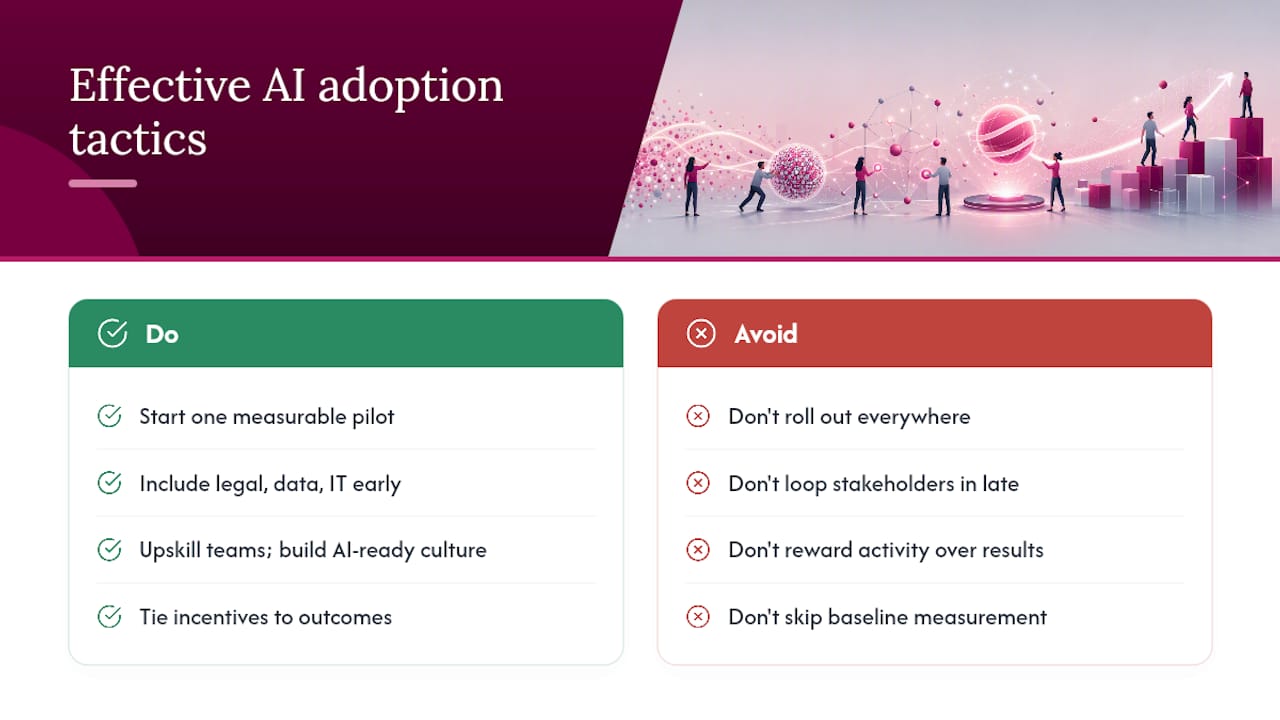
Start with one measurable use case instead of a department-wide mandate. Teams that pick a single, well-scoped pilot, personalized email subject lines, say, or predictive lead scoring, and measure it against a clear baseline tend to build the internal case for expansion faster than teams that roll AI out everywhere at once and hope the numbers sort themselves out later.
Cross-functional buy-in beats a marketing-only initiative. Legal, data, and IT all touch AI adoption eventually, whether through a review workflow, a data pipeline, or a security review. Looping them in during the pilot phase, rather than after a rollout hits a wall, saves months.
Cultivating what one academic review calls an “AI-ready culture” turns out to matter as much as the technical stack itself. That review on AI adoption in marketing strategies found organizational readiness and upskilling shape outcomes just as much as which tools get purchased. A team that trusts the tooling and understands its limits will ship AI-assisted work faster and with fewer costly corrections than a team handed the same tools with no context.
Tie incentives to outcomes, not activity. Reward the campaign that converted better because of AI-driven segmentation, not the team that generated the most assets this quarter. That single shift in what gets measured tends to reshape behavior faster than any policy memo.
What Do Real Marketing AI Adoption Success Stories Look Like?
The clearest signal of successful adoption isn’t a flashy campaign; it’s a team that can show a number and defend it. A retail marketing team running predictive segmentation against a genuine holdout group, one that received the standard campaign while a matched audience got the AI-personalized version, can point to a measurable lift in conversion rate that survives scrutiny. That kind of clean comparison is rarer than it should be, precisely because most teams skip the holdout step.
Content teams that moved from single-asset generation to full multi-variant campaign workflows report the most visible before-and-after: a process that used to take a creative team two weeks now produces test-ready variations in days, freeing that team to spend more time on strategy and less on production. The ROI story there isn’t just speed. It’s the ability to test more variations against real audience data instead of shipping a single creative and hoping.
The pattern across teams that get real traction isn’t the tool they picked. It’s that they measured a baseline before rollout, isolated one use case, and reported the outcome in a metric that meant something outside the marketing department, revenue, cost per lead, retention, rather than an internal productivity score nobody else in the company could interpret.
What’s Next for AI in Marketing?
Agentic AI, systems that don’t just generate content but take multi-step actions across a campaign, is the clearest trend on the horizon, though adoption is still held back by trust and integration complexity. Research on the marketer’s guide to AI found most marketers still prefer out-of-the-box tools over agentic systems, largely because handing a model autonomy over budget or send decisions raises the stakes of a bad output considerably.
Expect governance frameworks to formalize further as incident rates climb. Standards bodies and industry groups are already pushing for clearer accountability structures, and marketing leaders who build governance now will have a real head start once those standards become closer to mandatory than optional.
The metrics conversation will keep shifting from productivity to outcome. As adoption accelerates, expectations for return rise right alongside it, and teams still reporting “hours saved” to a CFO in 2027 will look increasingly behind the curve compared to teams reporting lift, retention, and cost per acquisition.
Search and discovery are changing the game too, generative search and AI answer engines are reshaping how customers find brands in the first place, which means marketing AI adoption increasingly has to account for optimizing content for AI-driven discovery, not just human readers.
A Marketing Leader’s Take on What Matters in 2026
The teams winning this year aren’t the ones with the most tools. They’re the ones who can tell you, in one sentence, what their AI spend returned last quarter. Chasing the next model release feels productive; it usually isn’t the fastest path to credibility with your CFO.
The quickest win with leadership comes from measurement, not experimentation. Pick one use case, track it against a real baseline, and report the number before you add a sixth tool to the stack.
Run one measurement-first pilot this quarter. Prove the model works before you scale it.
— TekkrTools
See Your Own AI Adoption Numbers Before You Buy the Next Tool
Most teams find out their AI spend is scattered across a dozen expense lines only when finance asks for a report. Tekkr’s Configurato gives marketing leaders one place to see who’s actually using AI tools, what each team spends, and which use cases are earning their budget, without asking IT to install a browser extension on every laptop.

The setup runs in about 10 minutes, starts on a free tier with no credit card, and strips PII automatically so privacy and legal don’t become a second approval cycle. If the ROI framework in this article sounds like the report you wish you already had, start a pilot with Configurato and have a real usage baseline before your next budget review.
Sources
- Artificial Intelligence (AI) adoption in marketing strategies: Navigating the present and shaping the future business landscape
- Artificial intelligence (AI) use in marketing - statistics & facts
- 2026 benchmark study: Marketing’s AI inflection point