
Large language models can leak memorized training data, expose personal information through inference-time attacks, and let retrieval-augmented systems surface documents users were never meant to see. The EDPB’s 2025 guidance and Stanford HAI’s research both treat this as a lifecycle problem, not a one-time fix. Currently, four priorities matter: restrict what goes into prompts, harden retrieval stores, enforce access controls with real monitoring, and adopt privacy-engineering techniques like differential privacy and systematic sanitization.
TL;DR:
- Fine-tuning attacks can extract training data from production models at significant rates, with actual leakage risk potentially over twice the estimated averages.
- Prompt injection, especially through indirect or tool-mediated methods, can hijack models to exfiltrate sensitive information without adversarial prompts or regular use.
- Effective risk mitigation requires combining input filtering, differential privacy during training, output monitoring, and strict access controls for retrieval and agent systems.
- Conducting regular red-team extraction tests and ongoing monitoring is essential to identify and address evolving privacy vulnerabilities over time.
- Building privacy into the lifecycle involves detailed data flow mapping, comprehensive logging, and implementing governance and incident response practices from the start.
Table of Contents
- What Are the Main LLM Privacy Risks?
- How Does Leakage Actually Happen?
- What Does the Research Actually Show?
- Which Technical Controls Actually Reduce Risk?
- How Do You Build Privacy Into the LLM Lifecycle?
- What Risks Are Coming Next?
- TekkrTools’ 30/60/90-Day Privacy Checklist
- Where Privacy-First Observability Fits Into This
- Sources
- FAQ
What Are the Main LLM Privacy Risks?
Every LLM deployment carries a specific set of technical exposure points, and mapping them to your architecture is the first real step toward controlling them. These are not theoretical categories. Each one has been demonstrated against production systems.
- Training memorization and extraction. Models sometimes reproduce verbatim sequences from training data, including names, addresses, or proprietary text, when prompted the right way.
- Membership inference. An attacker determines whether a specific record was part of the training set, which alone can expose sensitive affiliations (a person’s presence in a medical dataset, for instance).
- Model inversion. Adversaries reconstruct approximations of training inputs from model outputs or gradients.
- Prompt injection. Malicious instructions hidden in user input or in retrieved documents hijack the model’s behavior, often to exfiltrate data.
- RAG leakage. Retrieval-augmented generation pulls from a knowledge base that may include documents the current user has no permission to see.
- Agentic persistence. Long-running agents retain memory across sessions, so a leak in one task can resurface in an unrelated one week later.
- Side channels. Timing, token probabilities, or API response patterns can leak information indirectly, without any explicit disclosure in the output text.
How Does Leakage Actually Happen?
Two distinct failure modes get lumped together constantly, and the distinction matters for defense planning. Capability is whether a model can be made to reveal something under a crafted attack. Propensity is whether it does so under ordinary, non-adversarial use. A model can score low on adversarial extraction tests yet still leak sensitive details when a regular user just asks an innocent question the wrong way. Effective risk assessment tests both.
Adversarial elicitation uses prefix attacks, carefully chosen phrasing, or repeated querying to coax memorized sequences out of a model. Fine-tuning introduces its own baggage: custom training runs on internal data can implant backdoors that force the model to emit specific memorized outputs when triggered by a pattern the attacker controls.
Prompt injection comes in two flavors. Direct injection is a user typing malicious instructions straight into a chat window. Indirect injection hides instructions inside a webpage, PDF, or email that an agent later ingests. Tool-mediated exfiltration takes it further: a compromised agent with access to a code interpreter or web browser can smuggle data out through an API call disguised as routine tool use. Split-LLM architectures, where computation is divided between client and server, add another vector: intermediate activations sent across that boundary can be inverted to recover input content.
What Does the Research Actually Show?
The numbers here are more alarming than most security teams assume. A 2025 study presented at ICLR found that fine-tuning attacks extracted training examples from production models in a significant portion of attempts. That is not a lab curiosity involving toy models. It is a documented rate against systems built the way most enterprises build them.
By the numbers: Standard extraction-rate metrics, averaged across a dataset, can underestimate actual leakage risk by up to 2.14x compared to sequence-level analysis. Averages hide the sequences that are catastrophically over-exposed.
A 2026 USENIX study found that even highly capable, widely deployed models can reveal private information in contexts most users would never expect, without any adversarial prompting at all.
A working leakage audit needs four components:
- Adversarial extraction attempts using known prefix and elicitation techniques.
- Propensity testing under realistic, non-adversarial usage patterns.
- Direct probing of RAG document stores for cross-tenant or cross-permission leakage.
- Memory persistence checks across agent sessions and multi-turn conversations.
Which Technical Controls Actually Reduce Risk?
Input controls come first. Client-side PII detection and redaction, paired with a formal input policy that blocks sensitive categories before they ever reach the model, catches the majority of accidental exposure. A tool like prompt-level PII detection applied before a query leaves the client stops the leak at the source rather than after the fact.
Training-side defenses matter just as much. Differential privacy adds calibrated noise during training to limit memorization, though it trades off some model accuracy, and teams need to test whether that trade-off is acceptable for their use case. Data minimization and scrubbed pretraining corpora reduce the raw material available to memorize in the first place.
Inference-time defenses include output filtering, rate limiting to blunt repeated extraction attempts, anomaly detection on query patterns, and planted canary strings that flag when memorized content resurfaces. RAG systems need provenance tagging so every retrieved chunk carries its access-control metadata into the generation step.
For retrieval and agent systems specifically:
- Per-document access controls that respect the original document’s permissions, not a flattened index.
- Scoped vector databases segmented by tenant or user group.
- Memory expiration policies so agent context does not accumulate indefinitely.
- Tool sandboxing that limits what an agent can actually reach, even if it is compromised.
Pro Tip: Run a scheduled extraction red-team exercise quarterly, not once at launch. Models get fine-tuned, RAG indexes get updated, and a control that worked in January can be stale by June.
Operationalizing all of this means continuous monitoring and a written incident playbook, because a control that only exists on a slide deck stops nothing.
How Do You Build Privacy Into the LLM Lifecycle?
Governance starts with documentation. Map every data flow into and out of the model, then run a Data Protection Impact Assessment at each lifecycle stage, not just once at deployment. The EDPB’s methodology treats training, inference, RAG, and feedback loops as separate risk surfaces, each needing its own mitigation plan, and residual-risk decisions should be written down, not assumed.
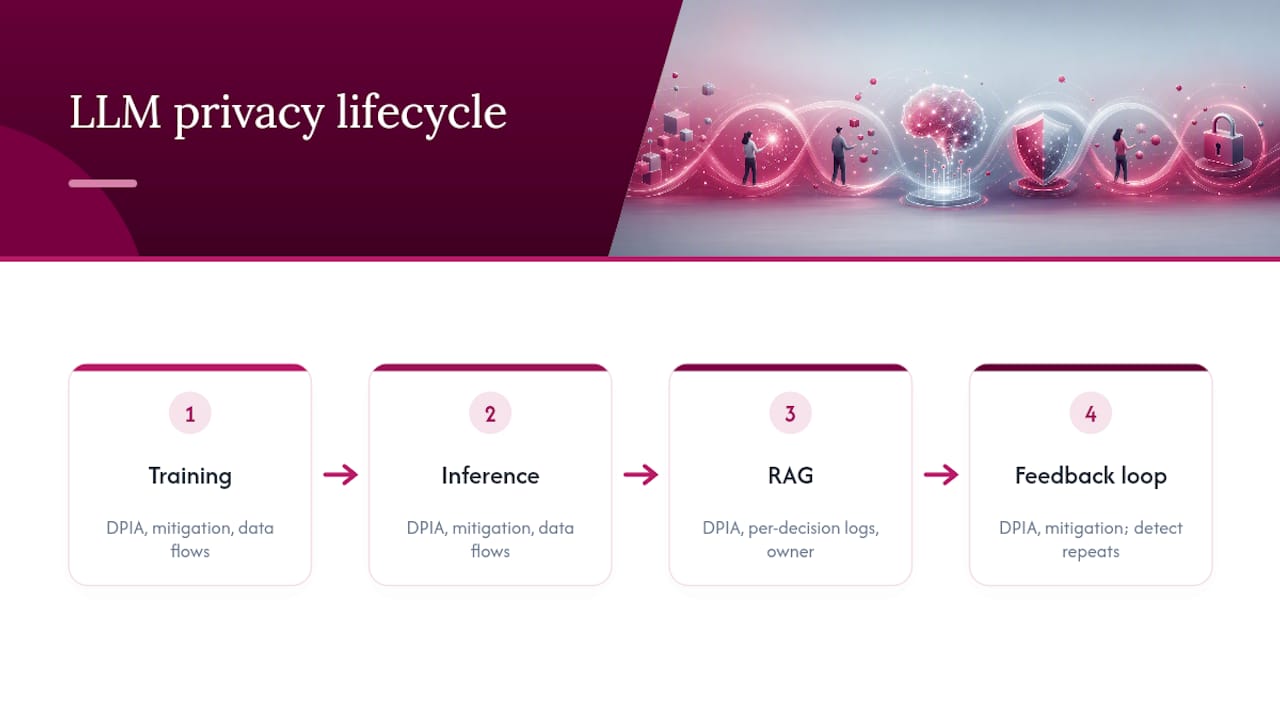
Per-decision audit logs, especially for RAG outputs, let you trace exactly which documents fed which answer after an incident occurs. Building this kind of DPIA-ready logging into the system from day one saves weeks during a compliance review. Watch for repeat elicitation attempts, unusually high-entropy outputs, and abnormal retrieval patterns, and route anything suspicious to a named escalation owner. None of this works as a security-team-only exercise. Product, security, privacy, and legal need a standing cadence, not an annual meeting, and NIST’s AI Risk Management Framework offers a useful structural reference for that coordination.
What Risks Are Coming Next?
Agentic systems change the threat model entirely. A 2026 Frontiers survey documents how persistent memory and multi-agent collaboration let leaks compound across sessions instead of staying isolated to a single query. An agent that remembers a mistake from last week can leak it into a completely different task today. The fix is memory minimization, scoped tool access per agent, and threat models built specifically for agentic behavior rather than borrowed from single-turn chat.
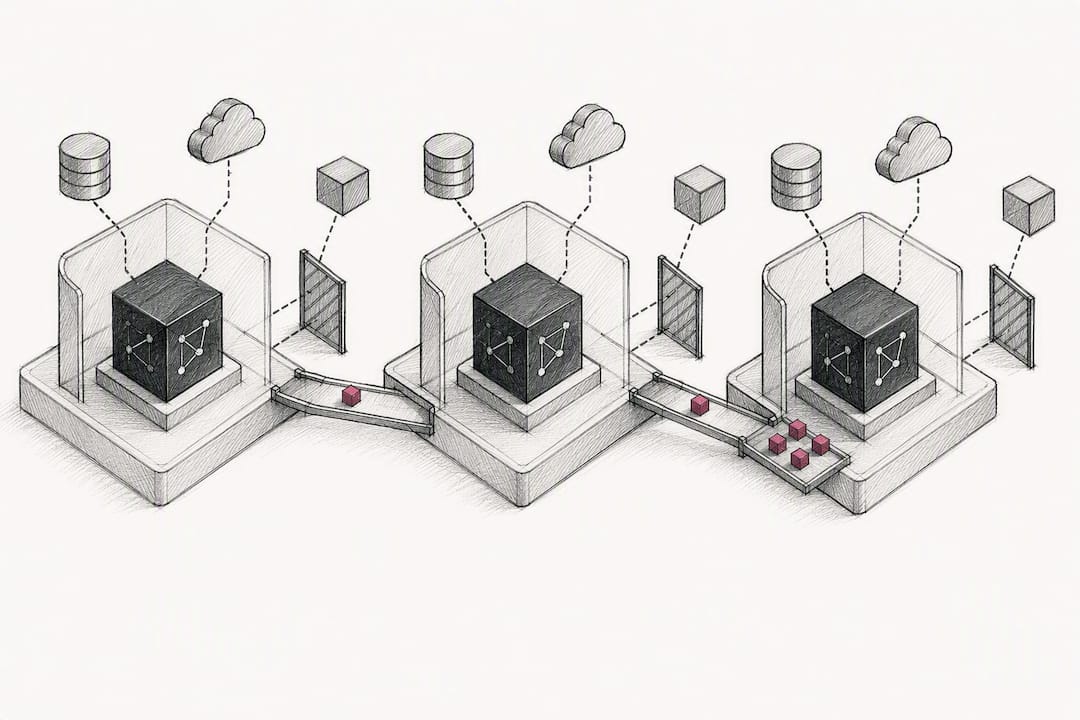
Split and distributed LLM architectures need defenses at both ends: the input side and the output side, plus protection for whatever intermediate activations travel between them. The research community still lacks standardized, agent-specific benchmarks for propensity testing. Until those exist, teams should run both capability and propensity tests themselves rather than waiting for an industry standard to catch up.
TekkrTools’ 30/60/90-Day Privacy Checklist
In the first 30 days, map your data flows, add prompt-level PII detection, and turn on per-decision logging. By day 60, run an extraction red-team, harden RAG access controls, and apply basic differential privacy or sanitization to any fine-tuning pipeline. By day 90, have continuous monitoring feeding your incident response process, and revisit vendor contracts for how they use your data in training.
— TekkrTools
Where Privacy-First Observability Fits Into This
Most of the controls above depend on one thing: knowing what is actually happening inside your organization’s AI usage, not what the vendor’s dashboard claims. A privacy-first observability platform can track who is using AI tools, break down spending by team, and run on an architecture with end-to-end encryption and automatic PII stripping from prompts, designed to satisfy lifecycle scrutiny similar to the EDPB guidance.
For teams that need per-decision logging and use-case intelligence without standing up that infrastructure themselves, Configurato gives you visibility into adoption and cost in about 10 minutes of setup, no browser extensions required. If your privacy review needs a governance partner rather than just software, Tekkr’s AI Adoption Programs pair the platform with hands-on consulting for DPIA support and rollout strategy. Check current pricing and plans to see which option fits your organization’s stage.
Sources
- Study: LLMs can reveal private information (USENIX SOUPS 2026)
- Sequence-Level Leakage Risk of Training Data in Large Language Models
- AI Privacy Risks & Mitigations for Large Language Models (EDPB, 2025)
For a quick third-party sanity check across multiple models, BabyLoveGrowth’s multi-LLM audit tool offers a free lightweight starting point.
FAQ
Will ChatGPT Leak My Data?
Any large language model, ChatGPT included, can potentially expose sensitive information through memorization or inference-time attacks, though the likelihood depends heavily on how the model was trained and deployed. A 2026 USENIX study found that even highly capable production models can reveal private information in contexts users wouldn’t expect. Treat any input to a general-purpose chat interface as potentially retained.
What Shouldn’t You Share With an LLM?
Avoid entering personally identifiable information, financial account details, health records, credentials, or proprietary business data into any LLM interface that lacks documented data handling guarantees. Northeastern’s 2025 review of LLM privacy failure modes catalogs these as common categories of accidental exposure.
How Should You Protect Privacy When Using LLMs?
Restrict sensitive inputs at the source, use tools with per-decision logging and PII stripping, and review vendor policies on whether your prompts are used for training. Organizations can implement prompt-level PII detection to catch sensitive data before it reaches a model.
How Is AI a Risk to Privacy?
AI systems create privacy risk through training-data memorization, inference-time disclosure, and retrieval systems that surface documents beyond a user’s permissions. The EDPB’s guidance frames this as a risk that spans the entire model lifecycle, not a single point of failure.
Does Tekkr Store or Train on My Organization’s Prompts?
Tekkr’s platform is built as end-to-end encrypted and GDPR-compliant, with automatic PII stripping applied to prompts before analysis. Full technical details are available on the Configurato security page.