
Hygiene data refers to the policies, processes, and controls that keep an organization’s datasets accurate, complete, deduplicated, and fit for decision-making. The desired state is a dataset a finance lead, analyst, or AI system can trust without double-checking it first.
If you’re triaging right now, assign these five things this week:
- Audit your top three revenue-critical datasets (CRM, billing, product usage) for completeness and duplicates.
- Assign an owner for each dataset, not a committee.
- Set field-level standards (date formats, required fields, naming conventions) and document them.
- Run a high-priority dedupe and validation pass on customer and account records.
- Schedule a recurring cadence for review, not a one-time cleanup.
If the audit turns up isolated problems, a two-week remediation sprint fixes it. If duplicates and inconsistencies show up across every system you check, you need a full program, not a patch.
Key Takeaways
Clean hygiene data requires clear ownership, documented standards, prioritized deduplication, and continuous monitoring to stay reliable over time.
| Point | Details |
|---|---|
| Assign a single owner | Give each priority dataset a named owner and steward, not a shared committee. |
| Audit before automating | Sample 5 to 10 percent of records to find real problems before buying any tool. |
| Track four core KPIs | Monitor completeness, duplicate rate, validation errors, and freshness weekly. |
| Match timeline to scope | Budget 4 to 12 weeks for a pilot, 3 to 12 months for a full enterprise rollout. |
| Fix quick wins fast | Bulk-correct formatting and stale records first; they resolve a large share of visible issues. |
Table of Contents
- What Counts as Hygiene Data (and What “Dirty” Looks Like)
- How Dirty Data Actually Gets Into Your Systems
- The Business Case for Clean Hygiene Data
- Building a Data Hygiene Plan: Roles, Cadence, and KPIs
- Data Hygiene Best Practices: The Prioritized Playbook
- KPIs and a Minimal Monitoring Toolkit
- How Long It Takes and What Drives the Cost
- What Most Teams Get Wrong First
- Get Visibility Into How Your Organization Actually Uses AI
- Frequently Asked Questions
- Sources
What Counts as Hygiene Data (and What “Dirty” Looks Like)
Data hygiene is continuous maintenance, not a spring-cleaning event. A dataset that’s clean today drifts within weeks as people, systems, and integrations touch it. Recognizing the common failure types is the first diagnostic skill worth building.
- Missing values: A CRM contact record with no phone number or industry tag, breaking segmentation.
- Duplicates: The same account entered twice in an ERP after a merger, doubling revenue in a report.
- Inconsistent formats: One system stores dates as MM/DD/YYYY, another as DD/MM/YYYY, and a join silently misaligns records.
- Stale records: A customer who churned eight months ago still counted as “active” in analytics dashboards.
- Erroneous values: A negative age, a $0 invoice that should read $4,500, or a country code that doesn’t exist.
- Versioning errors: Two teams update the same product catalog independently, and neither version wins cleanly.
- Incorrect mappings: A Salesforce field mapped to the wrong warehouse column during an integration, quietly corrupting downstream reports.
Each of these looks small in isolation. Stacked across a few hundred thousand records, they’re the reason your executive dashboard and your finance team’s spreadsheet never agree.
How Dirty Data Actually Gets Into Your Systems
Dirty data comes from four sources: people, systems, integrations, and process gaps. It’s rarely one dramatic failure. It’s usually a slow accumulation of small shortcuts nobody flagged.
Root causes worth naming directly:
- Manual entry errors from reps or ops staff working fast under deadline pressure.
- Poor integration mapping between tools that were never designed to talk to each other.
- Stale imports and enrichments where third-party data providers update on a different schedule than your team checks.
- Disjointed master data, meaning no single system is treated as the source of truth.
- Lack of validation rules at the point of entry, so bad data enters clean and stays that way.
- Differing definitions across teams, where “active customer” means something different to sales than it does to finance.
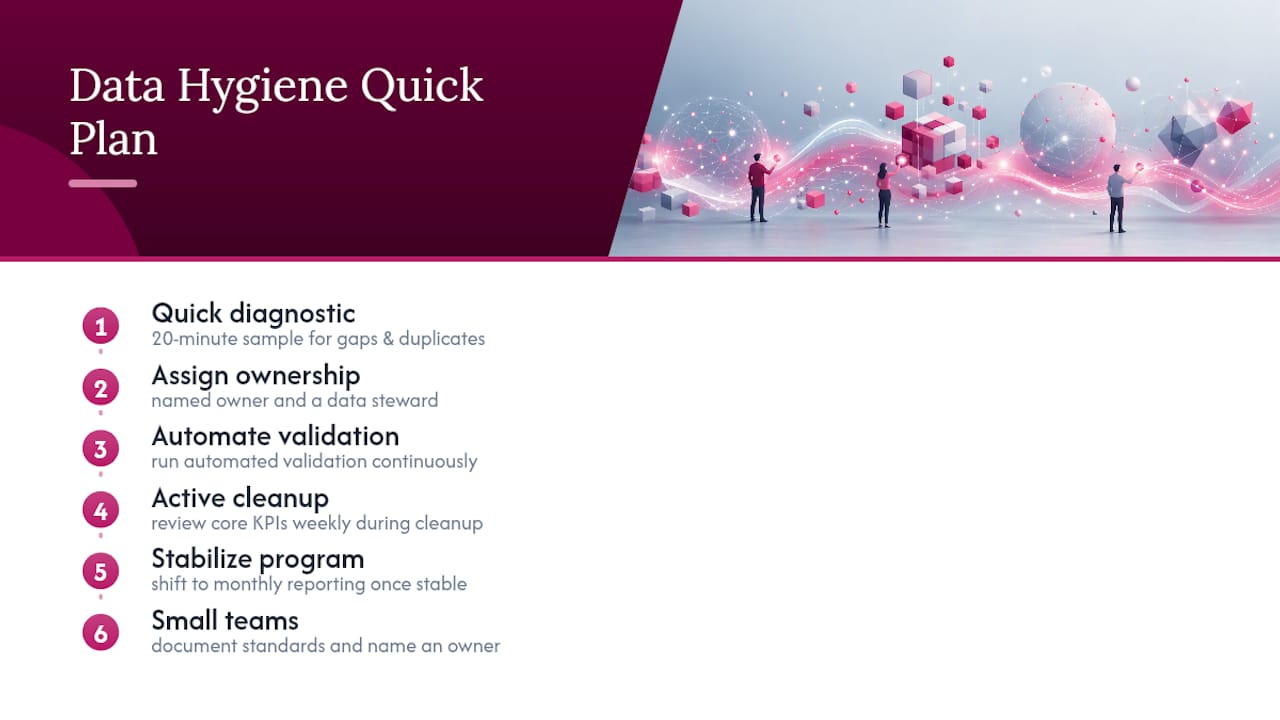
A 20-minute diagnostic works well here. Ask product: “What’s the last field you changed the meaning of without telling anyone?” Ask ops: “Where do you manually copy data between tools?” Ask analytics: “Which report do you no longer fully trust?” Ask IT: “Which integration breaks silently?”
The Business Case for Clean Hygiene Data
Clean data drives better decisions, lower operating costs, more accurate models, stronger customer experience, and easier compliance audits. Executives fund what they can measure, so the case has to be concrete, not aspirational.
The health sector offers a useful proxy for scale. Handwashing with soap reduces diarrheal illness by roughly 23 to 40 percent and respiratory infections by 16 to 21 percent, according to the CDC. That’s a small, consistent intervention producing outsized downstream effects. Data hygiene works the same way: a small standardization fix at the point of entry prevents a much larger reconciliation problem three systems downstream.
Statistic Callout: The WHO reports that multimodal hand hygiene improvement strategies can generate economic savings averaging 16 times the cost of implementation. Data hygiene programs follow a comparable logic: the cost of governance and validation is small next to the cost of decisions made on bad numbers.
Beyond the ROI argument, clean data materially improves the accuracy of AI and analytics models. A model trained on duplicated or mislabeled records inherits those errors at scale, quietly, and usually without anyone noticing until output looks wrong.
Building a Data Hygiene Plan: Roles, Cadence, and KPIs
A one-quarter pilot should cover one or two priority datasets end to end: audit, standards, cleanup, monitoring, and a first KPI report. An enterprise program extends that same sequence across every system that touches customer, financial, or operational data.
Core activities to sequence:
- Run an initial audit against your priority datasets.
- Document data standards (formats, required fields, naming conventions).
- Write normalization rules for the fields that vary most.
- Deduplicate using clear matching keys.
- Build validation rules at data entry points.
- Layer in enrichment where gaps exist (firmographic, contact, product usage).
- Stand up a monitoring pipeline with alerts.
- Train the teams who enter and touch the data daily.
Roles matter more than tooling here. A workable structure:
- Data owner (usually a department head): accountable for the dataset’s overall quality.
- Data steward (an analyst or ops lead): responsible for day-to-day rule enforcement and cleanup.
- Data engineers: build and maintain the validation and pipeline infrastructure.
- Analysts: consume the data and flag anomalies back to the steward.
- Executive sponsor: unblocks budget and cross-team priority conflicts.
Track completeness percentage, duplicate rate, validation error rate, and freshness (average record age since last verified update). Report these weekly during a pilot and monthly once the program stabilizes.
Data Hygiene Best Practices: The Prioritized Playbook
Sequence matters more than most teams assume. Buying a tool before you’ve defined standards just automates chaos faster.
- Audit first. Sample 5 to 10 percent of records across your priority datasets and manually score them against basic completeness and accuracy criteria before touching a single tool.
- Write standards second. Field formats, naming conventions, and required-field rules need to exist on paper before anyone builds automation around them.
- Fix the quick wins. Bulk-correct obvious formatting inconsistencies and remove clearly stale records. This alone often resolves 30 to 40 percent of visible issues.
- Deduplicate deliberately. Use a matching key (email plus company domain, or a normalized phone number) rather than exact-string matching, and set a fuzzy-matching threshold around 85 to 90 percent similarity. Route anything below that threshold to manual review rather than auto-merging, since aggressive auto-merge is how you accidentally combine two different customers into one account.
- Automate the repeatable parts. Validation rules at entry, scheduled enrichment refreshes, and scheduled deduplication jobs.
- Monitor continuously. A dashboard that tracks the KPIs above, not a quarterly spreadsheet review.
- Train and assign ownership. The team entering data daily needs to understand why the standards exist, not just what they are.
On tooling categories, without naming specific vendors: a data catalog helps you inventory what exists and where; validation libraries enforce rules at the schema level; ETL rule engines handle transformation logic during data movement; master data management (MDM) platforms consolidate a single source of truth across systems; and observability platforms alert you when data drifts or pipelines fail silently. Smaller organizations often start with validation rules and a shared standards document before investing in MDM.
Pro Tip: Build your deduplication matching key from a field customers can’t easily change, like a normalized phone number or tax ID, rather than email. People change email addresses constantly; they rarely change a business registration number.

KPIs and a Minimal Monitoring Toolkit
Track these metrics on a recurring basis rather than checking data quality only when a report looks suspicious:
- Completeness rate: percentage of required fields populated. Target above 90% for customer-facing data.
- Duplicate rate: percentage of records flagged as likely duplicates. Under 2% is a reasonable target for a mature system.
- Schema drift incidents: how often field structures change unexpectedly.
- Validation failure rate: percentage of new records failing entry-point rules.
- Freshness: average time since a record was last verified or updated.
- Enrichment coverage: percentage of records with third-party data appended successfully.
- Downstream error rate: how often bad data surfaces in a report or model output after the fact.
Review completeness and duplicate rate weekly during active cleanup; monthly once stable. A minimal toolkit needs three things: a dashboard surfacing these metrics, alerting rules for threshold breaches, and an automated monthly audit that samples records rather than relying on manual spot checks alone.
How Long It Takes and What Drives the Cost
A focused pilot on one or two datasets takes 4 to 12 weeks. A full enterprise rollout across every core system typically runs 3 to 12 months, depending on how many disconnected systems you’re reconciling.
Pilot timeline: weeks 1 to 2 for audit, weeks 3 to 6 for standards and quick fixes, weeks 7 to 12 for automation and first monitoring report.
Enterprise rollout: phase by department or system, starting with whichever dataset carries the highest financial risk.
Cost scales with data maturity, the number of disconnected systems, integration complexity, licensing for validation or MDM tools, staff time diverted from other projects, and whether you bring in outside consulting for the initial audit and governance design.
What Most Teams Get Wrong First
The biggest mistake is shopping for tools before assigning an owner. I’ve watched teams license a data-quality platform, then spend six months arguing about whose job it is to act on the alerts it generates. Fix ownership first. Fix the highest-impact datasets first. Everything else follows from those two decisions.
Get Visibility Into How Your Organization Actually Uses AI
Clean hygiene data matters most when it’s feeding a decision, and increasingly, that decision runs through an AI tool. If your organization has rolled out Claude, Codex, or other AI assistants without knowing who’s actually using them, what they cost by department, or where adoption is stalling, you’re facing the same visibility problem this article just walked through, applied to your AI spend instead of your CRM.
Tekkr’s AI adoption solution tracks real usage, breaks down cost by team, and surfaces which use cases are actually driving value, all inside a privacy-first, GDPR-compliant setup that anonymizes prompts and strips PII automatically. No browser extensions, no lengthy rollout. Setup takes about 10 minutes, and there’s a free tier with no credit card required.
Frequently Asked Questions
What is hygiene data in simple terms? Hygiene data is the practice of keeping your organization’s datasets accurate, complete, deduplicated, and current, so decisions and analytics built on that data can be trusted.
How often should we clean our data? Run automated validation continuously, review core KPIs weekly during active cleanup, and shift to monthly reporting once your program stabilizes. Data hygiene is ongoing maintenance, not a one-time project.
Who should own data hygiene in an organization? Each priority dataset needs a named data owner (typically a department head) and a data steward who handles day-to-day enforcement. Shared ownership without a single accountable person is the most common reason hygiene programs stall.
What’s the fastest way to see if we have a data hygiene problem? Run a 20-minute diagnostic: sample records for missing fields and duplicates, and ask your product, ops, analytics, and IT teams where they’ve stopped trusting a report. Consistent answers across systems signal a program-level problem, not an isolated fix.
Do small companies need a formal data hygiene program? Not necessarily a formal program, but even small teams benefit from documented standards and a named owner. The cost of untangling bad data grows with every system it touches, so starting early is cheaper than fixing it later.
Sources
For teams building reproducible audits, JMP/UNICEF offers global hygiene coverage estimates and monitoring methodology, while Our World in Data provides accessible country-level breakdowns. The CDC and WHO document the health and economic impact of hygiene interventions at scale.