
Gamified AI adoption applies game design mechanics and behavioral science to get employees actively using AI tools, not just accessing them. The results from recent enterprise programs are hard to ignore: structured gamified programs achieve very high adoption rates within months, compared to the lower average for standard engagement tools. Insight’s Flight Academy hit 91% adoption across 14,000 employees in nine months. Microsoft’s internal Copilot Expo drove companywide adoption spikes that persisted months after the event ended.
What separates these programs from failed rollouts comes down to three things: the right game mechanics, behavioral design that builds habits rather than novelty, and a compliance architecture employees actually trust. The sections below break down each element, with a step-by-step rollout plan at the end.
- Core game mechanics: Points, badges, leaderboards, challenges, and immediate feedback
- Behavioral design: Daily micro-interactions over one-off training events
- Privacy and compliance: GDPR-compliant, anonymized architectures that build trust
- Measurement: KPIs tied to usage frequency, skill milestones, and prompt activity
- Key platforms: Tekkr’s Configurato for tracking and driving adoption at scale
What game mechanics actually drive a gamified AI adoption employee rollout?
Five core mechanics consistently appear in the highest-performing AI adoption programs: point systems, badges, leaderboards, time-bound challenges, and immediate explanatory feedback. Each one targets a different motivational lever.
1. Point systems
Points give employees a visible, real-time signal that their effort counts. At Microsoft’s Copilot Expo, attendees earned points for every Copilot-related task they completed during the event. The leaderboard stayed active for months afterward, with participants still logging points long after the formal program ended. Points work because they make invisible progress visible.
2. Badges
Badges function as social proof. Insight’s Flight Academy employees displayed their level badges in email signatures, on social profiles, and pinned to office walls. That visibility created peer pressure in the best sense: colleagues noticed who had advanced and wanted to catch up. Badges also serve as skill credentials, signaling to managers which employees have reached specific AI competency levels.
3. Leaderboards
Leaderboards activate social motivation by combining competition with transparency. Microsoft’s engineers turned their Copilot Expo leaderboard into a reusable template for internal teams. The key design choice: leaderboards should show team standings alongside individual ones, so employees who are not naturally competitive still feel the pull of collective progress.
4. Time-bound challenges
Challenges with deadlines create urgency without pressure. Insight’s Flight Academy required teammates to maintain monthly prompt usage thresholds to advance levels, which meant engagement had to be consistent, not just a one-time burst. Microsoft’s Camp Copilot used a scavenger hunt format with prizes, turning skill-building into something people actually looked forward to.
5. Immediate explanatory feedback
Feedback that explains why an answer was right or wrong accelerates learning far faster than a simple score. For AI tools specifically, this matters because employees are often uncertain about what “good” prompt usage looks like. Immediate feedback closes that loop before confusion hardens into avoidance.
How do you turn early excitement into lasting AI habits?
75% of HR technology tools are underutilized or abandoned entirely, according to Sapient Insights Group’s 2024 HR Systems Survey. The reason is almost always the same: the tool was designed around compliance, not habit. Behavioral design gamification takes the opposite approach.
Daily micro-interactions beat periodic training events
The most effective gamified engagement platforms use daily interactions that take roughly three minutes, not monthly surveys or quarterly workshops. Habit research shows that daily behaviors become automatic within 2–3 weeks, while weekly or monthly ones rarely stick. Insight’s Flight Academy required teammates to maintain ongoing monthly prompt usage, not just complete a one-time course.
The Fogg Behavior Model as a design framework
The Fogg Behavior Model frames every interaction around three elements: motivation, ability, and a prompt. Most engagement tools fail because they assume motivation (participation is optional), demand too much ability (lengthy interfaces), or deliver prompts too infrequently. A well-designed gamified AI rollout lowers the ability threshold through short, role-specific tasks, delivers daily prompts, and builds motivation through social reward loops.
Framing AI as a superpower, not a threat
Framing AI as a superpower reduces the psychological friction that keeps hesitant employees from experimenting. Insight explicitly told teammates that AI was designed to make them more effective, not replace them. Once employees stopped fearing the technology and started engaging with it, adoption accelerated on its own. Microsoft used a “superhero prompt” activity at Camp Copilot for exactly the same reason.
Social reward loops and peer recognition
Peer recognition is one of the strongest drivers of sustained participation. When employees see colleagues celebrated for AI use cases in team meetings or on dashboards, it normalizes experimentation and creates a feedback loop that management alone cannot generate. Insight designated AI Champions to mentor peers and embed AI into team culture, which distributed the adoption effort across the organization rather than concentrating it in IT.
Pro Tip: Schedule gamified challenges before training sessions, not after. Microsoft’s Copilot Expo data showed that games scheduled prior to learning sessions built the engagement needed to make the training itself land harder.
Privacy, compliance, and measurement in your gamified rollout
Privacy concerns are a real adoption barrier, not just a legal checkbox. When employees worry their AI prompts are being monitored or stored with identifying information, they self-censor or avoid the tools entirely. Transparent data practices directly increase voluntary participation.
Tekkr’s Configurato addresses this with a privacy-first architecture that is end-to-end encrypted, GDPR-compliant, and strips PII automatically before any prompt data is processed. No browser extensions are required, which removes a common IT security objection. For organizations operating under the EU AI Act, Article 4 requires demonstrable AI literacy across the workforce, and a gamified platform with built-in compliance reporting satisfies that requirement far more credibly than a one-time training log.
Measurement is where most rollouts lose momentum. Tracking completion rates alone tells you nothing about whether employees are actually using AI tools in their daily work. Configurato tracks the KPIs that reflect real adoption: engagement frequency, prompt volume, skill badge attainment, and leaderboard activity, broken down by team and tool.
| KPI | What it measures | Why it matters |
|---|---|---|
| Engagement frequency | How often employees interact with AI tools | Distinguishes active users from one-time completers |
| Prompt volume | Number of prompts executed per user per month | Insight tracked nearly 1 million prompts at peak adoption |
| Skill badge attainment | Completion of role-specific competency milestones | Signals genuine capability growth, not just participation |
| Leaderboard standing | Relative progress across teams and individuals | Sustains competitive motivation after formal programs end |
| AI use case logs | Real-world applications documented by employees | Insight logged 25,000 “AI celebrations” as proof of productivity impact |
Transparency with employees about what data is collected, how it is anonymized, and who can see it is not optional. Organizations that communicate this clearly before launch see higher voluntary participation from day one.
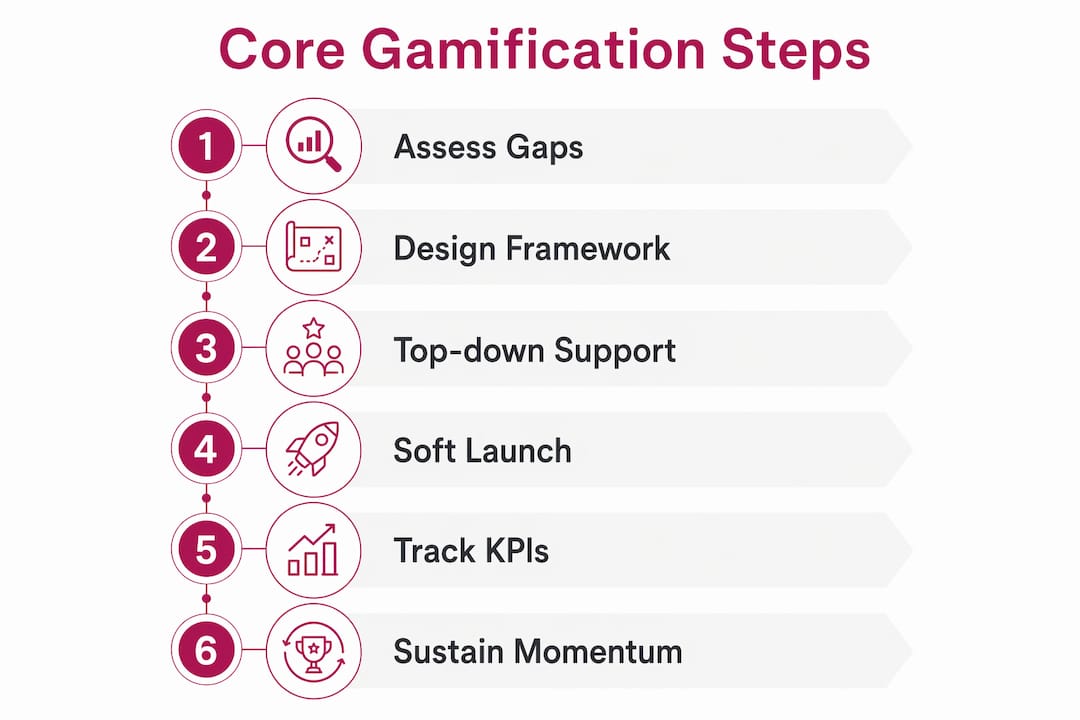
How to run a successful gamified AI adoption rollout
A gamified AI adoption employee rollout works best when it follows a structured sequence rather than launching all mechanics at once.
Step 1: Assess current AI literacy and adoption gaps

Before designing anything, map where your workforce actually stands. Survey employees by department and role to identify who the early adopters are, who the skeptics are, and who genuinely wants to learn but lacks a starting point. Insight found exactly these three groups when they first rolled out their internal AI tools, and that segmentation shaped every design decision in Flight Academy. Tekkr’s Configurato can surface this baseline by tracking existing tool usage across teams before a formal program begins.
Step 2: Design the gamified framework
Choose mechanics that match your culture. Leaderboards work well in sales-oriented organizations; badge systems tend to land better in technical or creative teams. Build role-specific learning paths so a finance analyst and a software engineer are not completing identical challenges. Microsoft’s Copilot Expo capped sessions at 30 minutes and scheduled them at accessible times, targeted to specific roles. That personalization made the learning more effective and reduced drop-off.
Step 3: Apply change management from the top down
Leadership visibility accelerates adoption faster than any game mechanic. When executives participate in challenges, share their own AI use cases, and spotlight employee wins in meetings, it signals that AI adoption is a company priority, not an IT project. Designate AI Champions early: peer advocates who mentor colleagues, surface use cases, and embed AI into team rhythms. Insight’s AI Champions were a core reason Flight Academy reached 90%+ adoption in five months.
Step 4: Launch with a soft rollout, then scale
Test the program with a small group first. A buggy or confusing first experience destroys trust before the program gains momentum. Once stability is confirmed, expand companywide with a launch event that generates excitement: a competition, a live leaderboard reveal, or a team challenge with visible prizes. For enterprise AI rollouts, this soft-launch approach consistently reduces the skeptic population before full deployment.
Step 5: Track KPIs and iterate monthly
Use Configurato to monitor engagement frequency, prompt volume, and skill milestones by team. If a department’s numbers plateau, investigate whether the challenges are too generic, the prompts too infrequent, or the feedback too slow. Adjust the mechanics before disengagement becomes a pattern. Real-world AI adoption incentives tied to measurable milestones keep the program from fading into background noise after the launch event.
Step 6: Sustain momentum with ongoing challenges and recognition
The programs that maintain high adoption long after launch share one design principle: they never stop. Microsoft’s leaderboard stayed active months after Copilot Expo. Insight’s Flight Academy continued expanding levels and requirements as employees advanced. Build a calendar of monthly challenges, quarterly team competitions, and regular AI use case spotlights to keep the program alive. For more on onboarding teams quickly, Tekkr’s resources cover the full transition from initial rollout to sustained daily use.
See how Tekkr’s Configurato drives your AI rollout
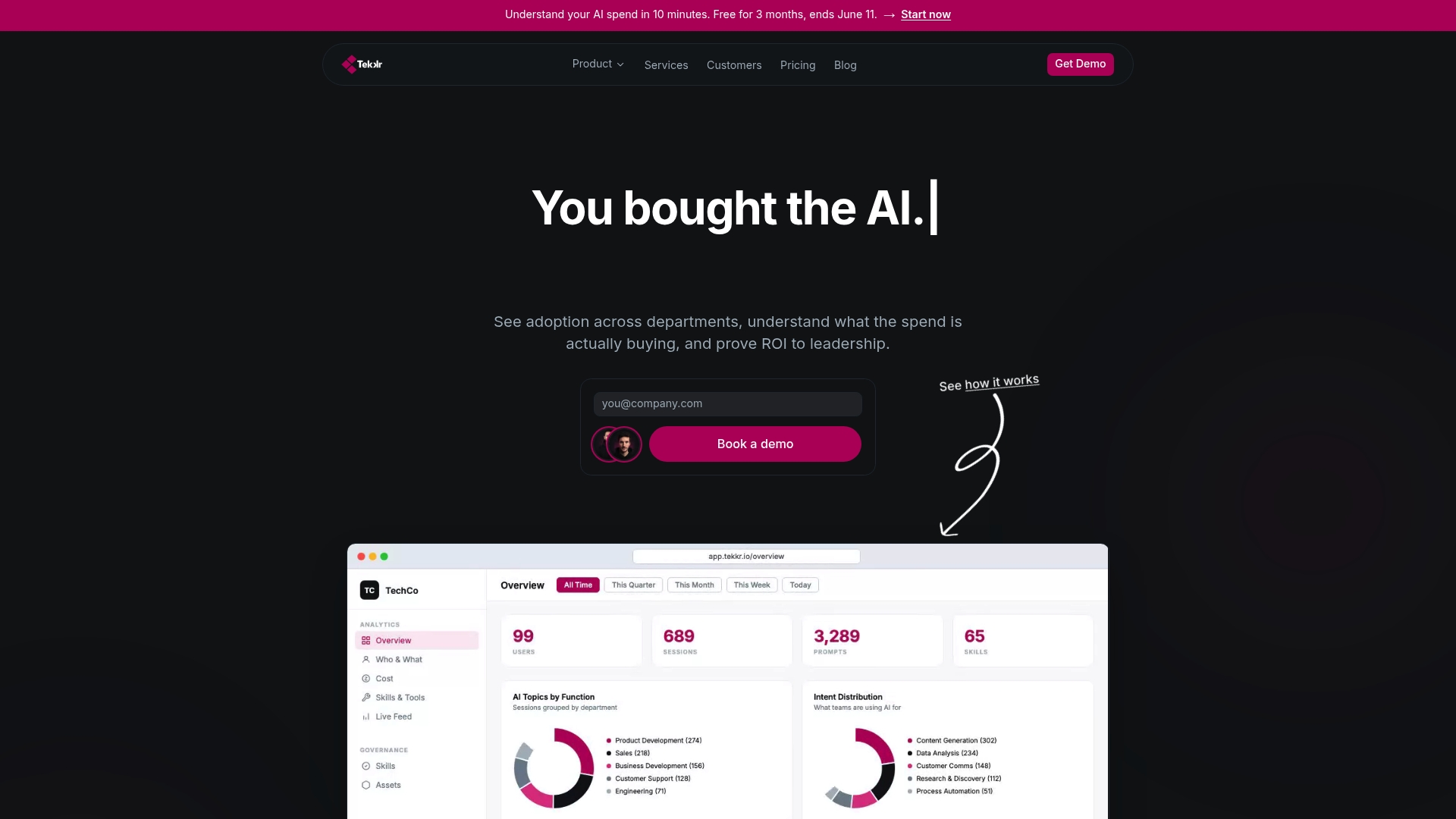
Tekkr built Configurato specifically for the problem most enterprises hit after buying AI tools: nobody can tell who is actually using them, or why adoption stalled. Configurato tracks usage across tools like Claude and Codex, breaks down costs and engagement by team, and runs gamified rollouts with company-wide AI playbooks. Setup takes about 10 minutes. There is a free tier, and no credit card is required.
If your organization has bought the AI and now needs to prove it is working, Tekkr’s AI adoption solution is where that proof starts.
Key Takeaways
Gamified AI adoption programs that combine core game mechanics with behavioral design consistently outperform traditional training, achieving adoption rates of 90–91% within 5–9 months.
| Point | Details |
|---|---|
| Game mechanics drive engagement | Points, badges, leaderboards, challenges, and immediate feedback each target a distinct motivational lever. |
| Daily habits beat one-off training | Three-minute daily interactions build sustainable AI use faster than periodic workshops or quarterly events. |
| Privacy architecture increases participation | GDPR-compliant, PII-stripped platforms like Configurato raise voluntary participation by removing employee data concerns. |
| Leadership and AI Champions accelerate scale | Peer advocates and visible executive participation are why programs like Insight’s Flight Academy hit 90%+ adoption in five months. |
| Measure prompt volume, not just completion | KPIs like monthly prompt counts and skill badge attainment reveal real adoption; completion rates alone do not. |