
Five enterprise AI playbooks consistently deliver measurable results: Agentic Escalation, AI Factory, Self-Service Copilot Rollout, Revenue-Oriented Personalization, and Back-Office Automation. The measurement approach that ties them together is a single executive dashboard tracking adoption rate, usage frequency, and a business outcome metric (cost or revenue) in one view.
- Agentic Escalation — AI handles the majority of work; humans review exceptions only
- AI Factory — a shared infrastructure that ships agents repeatedly, each one cheaper than the last
- Self-Service Copilot Rollout — structured enablement so employees actually use tools like Claude and OpenAI Codex
- Revenue-Oriented Personalization — AI applied to purchase intent and contract velocity, not just cost reduction
- Back-Office Automation — reconciliation, data entry, and reporting handed to agents with human sign-off on exceptions
BCG research shows that leading firms have a substantially higher proportion of employees with AI-related skills than laggards. That gap is the real competitive moat, and these playbooks are how you close it. Bain recommends concentrating capital on a few multi-year bets rather than scattering small pilots. Tekkr’s Configurato platform instruments all five playbooks, tracking tool usage, cost allocation, and outcome mapping from a single dashboard.
Pro Tip: Pick two of these five playbooks for your first cohort. Running all five at once fragments sponsorship and makes attribution nearly impossible.
Table of Contents
- What every enterprise AI playbook must include
- Five detailed playbook examples you can run now
- How to measure adoption, AI fluency, and ROI
- Tactics that lift adoption: the 90–180 day roadmap
- Privacy-first playbook controls every enterprise needs
- Copy-and-paste playbook template and 90-day checklist
- Key Takeaways
- Why measurable playbooks — not pilots — win
- Tekkr makes these playbooks measurable from day one
- Authoritative sources and further reading
What every enterprise AI playbook must include
A playbook without a defined success criterion is just a project plan. Every enterprise-grade playbook needs these components:
- Goal and success criteria — one measurable outcome, not a capability description
- Business owner — the executive who owns the P&L impact
- RACI — who is Responsible, Accountable, Consulted, Informed for each step
- Triggers — what event starts the workflow (a form submission, a file upload, a schedule)
- Inputs and outputs — data in, artifact out, with typed schemas
- SLOs — latency, accuracy, and error-rate thresholds the system must meet
- Fallback behavior — what happens when the AI fails or falls below threshold
- Monitoring and dashboards — which signals are tracked and at what cadence
- Data governance — retention, access controls, PII handling
- Rollout plan — pilot cohort size, expansion gates, and timeline
- Training and incentives — how employees learn and why they keep using it
| Function | Accountability |
|---|---|
| Product | Use-case definition, acceptance criteria |
| Data / ML | Model selection, evaluation, SLO design |
| Engineering | Integration, monitoring, fallback logic |
| Compliance | Data governance, audit trail, risk sign-off |
| Business owner | Outcome tracking, budget, escalation decisions |
Governance standards like typed schemas, monitored outputs, and defined fallback behavior are what allow subsequent agents to ship faster and cheaper. Build them once; reuse them across every playbook.
Pro Tip: Design SLOs around your oversight model. Escalation models (AI acts, humans review exceptions) require tighter accuracy SLOs because errors surface later. Approval models (humans review all outputs) can tolerate looser thresholds but add latency.
Five detailed playbook examples you can run now
1. Agentic escalation for customer support
Goal: Resolve 70%+ of tier-1 tickets autonomously; route exceptions to humans.
- Classify incoming ticket by intent and urgency
- Retrieve relevant knowledge base articles via semantic search
- Draft response using Claude
- Score confidence; if above threshold, send automatically
- If below threshold, route to human queue with draft attached
- Human reviews, edits, and resolves
- Log outcome and update knowledge base
- Report resolution rate and CSAT weekly
KPIs: Autonomous resolution rate, time-to-resolution (TTR), CSAT score
Tech stack: Claude (response generation), ticketing system integration, Configurato (usage and cost tracking)

Sample outcome: Escalation-based models produce a median 71% productivity gain versus approval-only models. A team resolving 500 tickets/week could handle 850 with the same headcount.
Timeline to first production value: 6–10 weeks
2. AI Factory for internal developer productivity
Goal: Ship reusable AI agents at decreasing marginal cost using shared infrastructure.
- Define a semantic layer and shared memory store
- Build orchestration layer (routing, retry, cost envelope)
- Deploy first agent (e.g., code review via OpenAI Codex)
- Establish typed schemas and deployment standards
- Run shadow mode for two weeks; compare outputs to human baseline
- Promote to production with monitoring in place
- Reuse infrastructure for agent #2, #3, and beyond
- Track cost-per-agent and time-to-ship as factory matures
KPIs: Time-to-ship per new agent, cost per agent, developer hours saved
Tech stack: OpenAI Codex (code generation and review), shared orchestration layer, Configurato (spend tracking by team)
Sample outcome: One AI Factory deployment reached 55+ agents in production, delivering 300% ROI and a 35% reduction in operational costs over four years. By agent #20, a single engineer can ship new agents rapidly, reducing time per agent significantly.
Timeline to first production value: 8–12 weeks for first agent; compounding returns from week 20 onward
3. Self-service copilot rollout for knowledge workers
Goal: Reach substantial active adoption of Claude or Codex across a target department within a few months.
- Identify a 20–30 person pilot cohort with a willing manager
- Run a two-day prompt engineering workshop
- Assign AI champions (one per 10 employees)
- Publish a shared prompt library in the team’s documentation system
- Track weekly active users and sessions via Configurato
- Run a leaderboard showing top use cases (anonymized)
- Host bi-weekly office hours for troubleshooting
- Gate expansion to the next department on hitting 50% adoption in the pilot
KPIs: Adoption rate (active users / eligible users), sessions per user per week, tasks completed per session
Tech stack: Claude (writing, summarization, analysis), Configurato (adoption tracking, leaderboards, playbook delivery)
Sample outcome: One marketing organization increased AI usage 20x in the first six weeks after launching a structured mandate and shared use-case library.
Timeline to first production value: 4–6 weeks to hit pilot adoption targets
4. Revenue-oriented personalization
Goal: Lift purchase conversion or reduce contract cycle time using AI-generated personalization.
- Identify the highest-volume customer touchpoint (email, proposal, landing page)
- Pull historical conversion data to establish baseline
- Build a personalization agent that segments by intent signal
- Generate variant content using Claude; A/B test against control
- Route high-value leads to a human for final review (approval model)
- Measure conversion lift weekly
- Expand to additional touchpoints after first positive signal
- Map revenue lift back to AI cost in Configurato’s ROI dashboard
KPIs: Conversion rate lift, contract cycle time reduction, revenue attributed to AI-assisted touches
Tech stack: Claude (content generation), CRM integration, Configurato (cost-to-revenue mapping)
Sample outcome: Stanford case studies show AI-assisted contract drafting can reduce cycle time from weeks to hours. For AI-driven sales conversations, structured playbooks also improve multi-stakeholder alignment and close rates.
Timeline to first production value: 6–8 weeks to first statistically meaningful A/B result
5. Back-office automation for finance reconciliation
Goal: Automate 80%+ of routine reconciliation tasks; flag exceptions for human review.
- Map current reconciliation workflow and identify rule-based steps
- Build an extraction agent to pull data from source systems
- Run matching logic; flag discrepancies above a defined threshold
- Route flagged items to finance team with context attached
- Human reviews and resolves flagged items only
- Log all decisions for audit trail
- Report exception rate and processing time weekly
- Expand to adjacent workflows (invoice matching, expense categorization)
KPIs: Exception rate, processing time per batch, cost per reconciliation cycle
Tech stack: Data extraction agent, ERP integration, Configurato (cost allocation by department)
Sample outcome: Teams typically cut processing time by 60–80% on rule-based reconciliation tasks once the exception rate stabilizes below 15%.
Timeline to first production value: 8–12 weeks
Pro Tip: Instrument every playbook in Configurato before you launch it. You cannot prove ROI on data you did not collect from day one.
How to measure adoption, AI fluency, and ROI
The metrics that matter are simpler than most dashboards suggest. Track these six:
| Metric | Definition | Target threshold |
|---|---|---|
| Adoption rate | Active users / eligible users | 50%+ at 90 days; 70%+ at 180 days |
| Usage frequency | Sessions per active user per week | 3+ sessions/week signals habit formation |
| Task depth | Tasks completed per session | Rising trend week-over-week |
| AI fluency | % of employees with demonstrated AI skills | Benchmark against BCG’s 13% leader standard |
| Cost per outcome | AI spend / units of output produced | Declining quarter-over-quarter |
| Outcome lift | Revenue gain or process time reduction | Positive vs. pre-playbook baseline |
BCG’s research on AI fluency makes the case for tracking it as a lagging indicator of competitive position, not just a training metric. The gap between 13% and 1% does not close with a single workshop. It closes with a sustained measurement program.
Stat to watch: Leading firms have 13x the AI-skilled workforce of laggards — and that gap compounds every quarter you delay measurement.
For the executive dashboard, map these six metrics to three decision triggers: expand the playbook, hold and optimize, or escalate to the sponsor. A weekly automated report from Configurato covers all three. For deeper guidance on AI adoption best practices and KPI design, Tekkr’s resource library has templates you can adapt directly.
Tactics that lift adoption: the 90–180 day roadmap
Adoption does not happen because you bought a license. It happens because someone made it easy, visible, and worth doing.
Days 1–30: Pilot cohort
- Select 20–30 employees in one function with a motivated manager
- Run a two-day enablement sprint (not a lecture — hands-on prompt building)
- Assign one AI champion per 10 employees
- Publish a shared prompt library and use-case catalog
- Launch a leaderboard in Configurato showing weekly active users by team
Days 31–60: First expansion gate
- Review adoption rate at day 30; expand only if above 40%
- Add a second cohort (50–100 employees) with a new champion cohort
- Host bi-weekly office hours; record and publish the sessions
- Share three success stories in the company all-hands
Days 61–180: Sustained adoption
- Tie AI usage milestones to recognition (not compensation — recognition scales)
- Run a quarterly AI showcase where teams present their best workflows
- Require an executive dashboard review every 30 days
Common pitfalls: launching to the whole organization at once, skipping the prompt library, and measuring logins instead of tasks completed. Why AI tools go unused almost always traces back to one of these three.
Pro Tip: Gamification works best when the leaderboard shows use-case diversity, not just session count. Teams compete to find new workflows, not just log in more.
Privacy-first playbook controls every enterprise needs
Speed without governance creates liability. These controls are non-negotiable:
- PII stripping — automatic before any prompt reaches a model; no employee or customer data in plain text
- Model allow-lists — only approved models (e.g., Claude, Codex) can be used in production playbooks
- Encryption at rest and in transit — end-to-end, no exceptions
- Access logging — every prompt, every output, every user, timestamped
- Cost envelopes — per-team spending caps enforced at the API layer
- Incident runbooks — documented response for model failure, data exposure, and SLO breach
| Control | Framework alignment | Tekkr/Configurato coverage |
|---|---|---|
| PII stripping | NIST AI RMF (GOVERN) | Automatic, no browser extension needed |
| Audit logging | NIST AI RMF (MANAGE) | Full prompt and output logging |
| Encryption | SOC 2, GDPR | End-to-end encryption, GDPR-compliant |
| Model allow-lists | NIST AI RMF (MAP) | Configurable per team |
| Cost envelopes | Internal governance | Per-department spend tracking |
Tekkr’s security and privacy architecture covers all five controls out of the box. For oversight model selection: use escalation (AI acts, humans review exceptions) when error tolerance is moderate and volume is high. Use approval (humans review all outputs) only when errors carry regulatory or financial risk. The Stanford finding of a median substantial productivity gain for escalation models clarifies the default choice for most enterprise workflows.
Pro Tip: Document your oversight model selection in the playbook itself. Auditors and regulators will ask why you chose escalation over approval — have the answer written down before they ask.
Copy-and-paste playbook template and 90-day checklist
One-page playbook template (copy into Notion, Confluence, or any doc system):
- Playbook name:
- Goal: [one measurable outcome]
- Business owner: [name and title]
- RACI: [table with four roles]
- Trigger: [event that starts the workflow]
- Inputs: [data sources, formats]
- Outputs: [artifact type, destination]
- SLOs: [latency target, accuracy threshold, error rate cap]
- Fallback behavior: [what happens on failure]
- Rollout plan: [pilot size, expansion gate, timeline]
- KPIs: [three metrics with targets]
- Monitoring dashboard: [link to Configurato or equivalent]
- Training plan: [workshop, prompt library, office hours schedule]
90-day milestone checklist:
| Milestone | Week | Sample KPI target |
|---|---|---|
| Pilot cohort launched | Week 1 | 20–30 employees enrolled |
| First adoption check | Week 4 | 40%+ active adoption in pilot |
| Expansion gate decision | Week 6 | Expand if 40%+ hit; hold if below |
| Second cohort live | Week 8 | 50–100 employees in cohort 2 |
| Executive dashboard review | Week 12 | 50%+ adoption, cost per outcome trending down |
Key Takeaways
Measurable AI playbooks — not scattered pilots — are what convert AI spend into compounding business advantage.
| Point | Details |
|---|---|
| Pick 3–5 concentrated bets | Fund multi-year playbooks; scattered pilots rarely reach production. |
| Instrument before you launch | Collect adoption rate, frequency, and cost-per-outcome from day one. |
| AI fluency is a competitive metric | Leading firms have 13% of employees with AI skills; laggards have 1%. |
| Escalation models outperform approval | Median 71% productivity gain when AI acts and humans review exceptions. |
| Tekkr/Configurato tracks it all | Configurato instruments Claude and Codex usage, maps costs to teams, and delivers the executive dashboard in about 10 minutes of setup. |
Why measurable playbooks — not pilots — win
The conventional wisdom is that you should run pilots to “learn before you scale.” That framing is wrong, and it costs organizations years. A pilot is designed to end. A playbook is designed to compound.
Stanford’s research across 51 enterprise AI deployments found that the same use case can take weeks in one organization and years in another. The difference is never the model. It is executive sponsorship, platform readiness, and a culture that tolerates iteration. Pilots rarely survive the transition to production because they were never built with production governance in mind.
Bain’s recommendation to concentrate on a small number of multi-year bets is the right antidote. A playbook funded for 18 months, with a named executive owner and a dashboard reviewed every 30 days, behaves like a factory. Each iteration makes the next one cheaper. The shared infrastructure built for playbook one accelerates playbook two.
The prescription for CEOs is simple: commit calendar time to a monthly AI review, fund at least two playbooks for a full fiscal year, and require outcome reporting — not project status updates. Status updates tell you what happened. Outcome reporting tells you whether it was worth it. For a deeper look at cross-team AI adoption strategy, Tekkr’s executive guide covers the operating rhythms that sustain adoption past the 90-day mark.
Tekkr makes these playbooks measurable from day one
Most organizations buy AI tools and then spend six months arguing about whether they are working. Tekkr’s Configurato ends that argument before it starts.
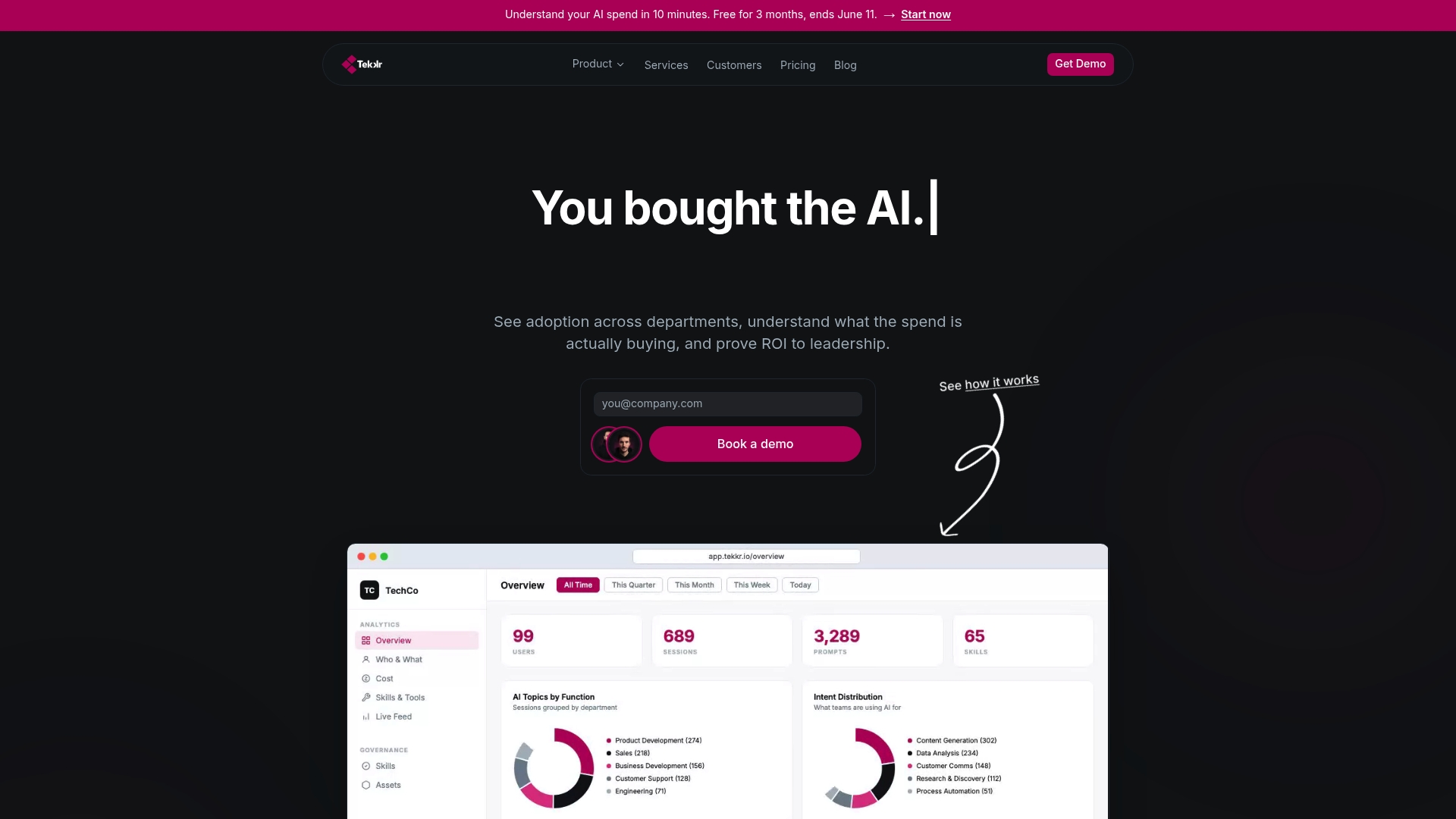
Configurato tracks Claude and OpenAI Codex usage across every team, breaks down costs by department, and maps activity to business outcomes in a single executive dashboard. Gamified leaderboards and company-wide playbook delivery drive adoption without requiring IT involvement. Setup takes about 10 minutes. There is a free tier and no credit card required.
For enterprises that want hands-on help, Tekkr’s consulting team can run the first cohort, design the playbooks, and deliver the first executive dashboard within 30 days. The starting point is the AI adoption solutions page, where you can explore Configurato’s full feature set or request a demo. If you want to go straight to the product, the Configurato adoption page has everything you need to get started today.
Authoritative sources and further reading
The research and case studies behind this article are worth reading in full, especially if you are adapting these playbooks to a specific industry context:
- The Enterprise AI Playbook: Lessons from 51 Successful Developments — Stanford Digital Economy Lab. The most rigorous empirical study of enterprise AI deployments available. Essential reading for anyone designing oversight models or rollout timelines.
- Proprietary Intelligence: How to Win with AI — Bain & Company. The source for the concentrated-bets recommendation and shared infrastructure strategy.
- How AI Leaders Create Competitive Advantage — BCG. The AI fluency data (13% vs. 1%) and the case for treating fluency as a strategic metric.
- 55 AI Agents in Production: The Full Playbook — Amjid Ali. The most detailed operator-level account of building an AI Factory, including the 300% ROI figure and the per-agent cost curve.
- Tekkr Resource Library — Step-by-step templates for building a company AI playbook, including role assignments, SLO design, and adoption tracking. Use these to adapt the templates in this article to your organization’s specific context.