
AI-enabled lean teams are small, cross-functional groups that apply lean value-stream discipline first, then embed AI agents or delivery-intelligence to automate repetitive work, monitor flow, and surface risks before they become blockers. The highest-value patterns that enterprise leaders are deploying right now:
- Product squad with embedded copilots — AI assists spec writing, acceptance criteria, and test scaffolding
- Delivery-intelligence pod — persistent monitoring of velocity, WIP, and cross-team dependencies
- MLOps and observability team — model lifecycle governance, drift detection, rollout safety
- Autonomous delivery engine (AI-Scrum pattern) — full sprint automation with enforced quality gates
- AI-mentored Kaizen squad — democratizes value-stream mapping and Pareto analysis at the team level
- Embedded domain copilots — handles routine execution in sales, support, and pricing operations
C.H. Robinson’s lean AI program illustrates what this looks like at scale: 40% productivity gains with 30+ AI agents processing over 3 million tasks, and quote generation dropping from hours to 32 seconds. That is the benchmark. The patterns below show how to get there.
Table of Contents
- What do AI-enabled lean teams actually look like?
- What lean prerequisites must you satisfy before adding AI?
- Which tools map to which problems in lean AI teams?
- How do you measure success in AI-enabled lean teams?
- What pitfalls should you watch for when scaling?
- How do you stand up an AI-enabled lean team in 8 steps?
- How does Tekkr’s Configurato give you visibility and drive adoption?
- How do you manage organizational change when rolling out AI in lean teams?
- What roles and skills does an AI-enabled lean team need?
- How does AI enable cross-functional collaboration in lean teams?
- Case studies that show AI’s impact on team agility and innovation
- Key Takeaways
- The real commitment AI-enabled lean teams require
- Tekkr helps you prove your AI investment is working
What do AI-enabled lean teams actually look like?
Product squad with embedded copilots
A product squad of 6–8 people embeds copilots like GitHub Copilot or Claude directly into the workflow for product managers, business analysts, and engineers. The AI drafts specs, generates acceptance criteria, and scaffolds test cases. Engineers spend less time in refinement and more time shipping. Expected outcomes: shorter PR cycle times and fewer back-and-forth clarification loops. AI in product management covers the decision-making layer in more depth.

Delivery-intelligence pod
This pod acts as a persistent system-of-record between ceremonies. Rather than waiting for a retrospective to discover a blocked dependency, the pod’s delivery-intelligence platform monitors velocity, WIP limits, and cross-team risks in real time. Delivery-intelligence platforms move teams from reactive guesses to proactive decisions — a shift that changes what gets discussed in standups and what gets escalated to leadership.
MLOps and observability team
This team owns the model lifecycle: training pipelines, data drift monitoring, rollout safety gates, and incident response when a model degrades in production. They hand off validated models to stream-aligned product teams and own the observability stack (logs, metrics, traces). Without this team, AI agents drift silently and nobody notices until a customer does.
Autonomous delivery engine (AI-Scrum)
AiScrum Pro enforces seven quality gates — tests, lint, types, build, scope, diff size, and review — and uses parallel workers via git worktrees to control drift. Humans set the sprint boundaries and escalation rules; the engine executes within them. This pattern suits teams with well-defined, repeatable delivery work where the cost of human review per task is high.
AI-mentored Kaizen squad
Sogeti’s work with Fortive shows what happens when AI mentors accelerate Kaizen: subject-matter experts stop being bottlenecks, and frontline teams carry out continuous improvement without waiting for a specialist. The AI mentor guides teams through value-stream mapping and Pareto analysis in real time.
Embedded domain copilots for customer operations
In sales, support, and pricing, AI handles routine execution — drafting quotes, summarizing tickets, flagging pricing anomalies — while humans handle exceptions. Outcome metrics to track: time-to-quote, average handle time, and escalation rate. Lemvigh-Müller’s procurement team achieved over 90% touchless processing of supplier confirmations with matching accuracy near 98% after deploying a multi-agent workflow.
What lean prerequisites must you satisfy before adding AI?
Skipping this step is the single most common reason AI pilots fail. Lean AI strategy treats AI as the how, not the why — lean principles come first or AI scales inefficiency.
- Value-stream mapping first. Define customer value and map the current state before any AI engagement. If you cannot draw the value stream, you cannot tell the AI what to optimize.
- Eliminate waste and stabilize flow. Reduce handoffs, kill manual reporting, and lower WIP before automation. A mid-sized manufacturer cut unplanned downtime by 65% and defect rates from 2.4% to 0.6% by stabilizing processes before layering AI.
- Small, empowered teams with decision rights. Team Topologies heuristics apply: stream-aligned teams with clear ownership outperform large, centralized groups. REA Group’s Financial Services unit doubled flow efficiency and saved 75+ hours per person per quarter by restructuring around this principle.
- Data readiness. Instrument real-time telemetry — velocity, WIP, queue times — before AI agents arrive. REA Group canceled nonessential meetings and enforced a single source of truth in live JIRA data; that discipline is what made AI-assisted decisions trustworthy.
Pro Tip: Run a focused value-stream pilot for 4–8 weeks before any AI investment. If you cannot measure a delta in cycle time or WIP during that window, the process is not ready for automation.
Which tools map to which problems in lean AI teams?
| Problem | Tooling Pattern | When to adopt |
|---|---|---|
| Velocity/WIP blind spots | Delivery-intelligence platform | Before scaling AI agents |
| Spec and test overhead | Embedded copilots (GitHub Copilot, Claude, Codex) | Once flow is stable |
| Model governance and drift | MLOps platform (MLflow, Kubeflow) | When models go to production |
| System observability | Observability stack (logs, metrics, traces) | Alongside MLOps |
| Agent execution safety | Sandboxed boards, git worktrees | Before autonomous delivery |
| Adoption and spend visibility | Configurato (Tekkr) | At pilot launch |
Paca illustrates the agent-as-teammate pattern: AI agents sit inside the same project board as humans, pick tasks, co-author specs, and act in sprints via an MCP server. That first-class integration matters. A peripheral chatbot bolted onto the side of a workflow does not change flow; an agent embedded in the board does.
Security non-negotiables: data minimization, automatic PII stripping, end-to-end encryption, and tenant isolation for every agent execution context. These are not optional compliance checkboxes — they are what lets you run AI agents on real customer data without legal exposure.
Pro Tip: For pilots, pick lightweight and composable tools. Prioritize delivery-intelligence or adoption-visibility tooling first so you can measure what the AI is actually doing before you scale it.
How do you measure success in AI-enabled lean teams?
| Metric | Definition | How to measure | Pilot target signal |
|---|---|---|---|
| Cycle time | Time from work start to delivery | Board timestamps | Decreasing trend vs. baseline |
| Lead time | Time from request to delivery | Ticket creation to close | — |
| Deployment frequency | Deploys per team per week | CI/CD pipeline logs | Increasing without quality drop |
| MTTR | Time to restore after incident | Incident tracking tool | Declining over pilot period |
| AI adoption rate | % of tasks completed with AI assist | Usage logs per tool | Rising week-over-week |
| Cost per automated task | Spend divided by AI-completed tasks | Spend dashboard (e.g., Configurato) | Declining as volume scales |
| Time-to-quote / handle time | Domain-specific throughput metric | CRM or support platform | Measurable reduction vs. control |
Tie every metric to a business outcome. Prompts-per-user is a vanity metric unless it connects to cycle time or cost avoided. C.H. Robinson’s 40% productivity figure is credible precisely because it maps to operational scale — 3 million tasks processed, quote time from hours to 32 seconds — not just usage counts.
What pitfalls should you watch for when scaling?
- Automating broken processes. Require value-stream sign-off before any automation ticket is opened. No exceptions.
- Governance gaps and shadow AI. Without centralized visibility, teams spin up their own tools and PII leaks into model prompts. Automated PII stripping and a usage policy enforced at the platform level close this gap.
- Vendor sprawl. Every point tool that does not integrate with your delivery board adds cognitive load and creates data silos. Prefer composable, open-integration tools and consolidate early.
- Expert-dependence bottlenecks. If only two people in the org know how to run a value-stream mapping session, AI mentors solve this — Inspiro’s Agent X achieved a 75% reduction in analytical effort by democratizing Lean Six Sigma methods across knowledge workers at every skill level.
- Measurement blindness. Tracking AI usage without tying it to cycle time or customer impact is how programs lose funding. Build the outcome link from day one.
How do you stand up an AI-enabled lean team in 8 steps?
- Select a high-value value stream and executive sponsor. Pick a stream where waste is visible and the sponsor has budget authority.
- Map current state and define success metrics. Document the value stream, set baseline KPIs (cycle time, lead time, WIP).
- Instrument flow telemetry and a single source of truth. Live boards, real-time dashboards — no PowerPoint standups.
- Run a focused pilot with a small cross-functional team. 4–6 people, one value stream, 6–12 weeks.
- Add delivery-intelligence and AI agents with explicit boundaries. Define what the agent can do autonomously and what requires human escalation.
- Enforce quality gates and escalation rules. Tests, lint, build checks, and peer review before any agent output ships.
- Measure outcomes against KPIs and compute FTE-equivalent ROI. Hours saved × loaded cost rate = cost avoided. Compare to AI spend.
- Scale via a playbook and governance model. Document what worked, bake in privacy safeguards, and run quarterly governance reviews at each scale gate.
Timeline: pilot in 6–12 weeks, validated rollouts by quarter, governance review at every scale decision. Cross-team AI adoption requires this kind of structured sequencing — pilots that skip steps 2 and 3 almost always stall at step 7.
How does Tekkr’s Configurato give you visibility and drive adoption?
Configurato answers the question every enterprise leader hits six months into an AI rollout: who is actually using this, and is it working?
- Adoption dashboards show utilization by team, role, and tool — so you know whether Claude is being used by engineers or sitting idle.
- Spend-by-team breakdowns map AI cost to value streams, making ROI conversations concrete rather than theoretical.
- Use-case intelligence and playbooks surface what is working across the org and push those patterns to teams that have not adopted them yet, via gamified rollouts.
- Privacy-first architecture: end-to-end encryption, automatic PII stripping, GDPR compliance, no browser extensions required.
Setup takes about 10 minutes. There is a free tier and no credit card required.
Pro Tip: Deploy Configurato at pilot launch, not after. The adoption and cost data it captures during the pilot is exactly what you need to make the scale decision at week 12.
How do you manage organizational change when rolling out AI in lean teams?
The technology is rarely the hard part. Resistance, fear of job displacement, and unclear ownership kill more AI programs than bad tooling does. A few patterns that work:
Start with transparency. Tell teams what the AI will do, what it will not do, and how its output will be reviewed. Ambiguity breeds resistance. Pair that with visible early wins — a product squad that ships a feature 30% faster, a support team that cuts handle time measurably — and skeptics start paying attention.
Leadership involvement is non-negotiable. Leaders who delegate AI rollouts entirely to IT send a signal that the program is low priority. Showing up in pilot reviews, asking about cycle time data, and celebrating team wins publicly changes the cultural calculus.
Gamified adoption programs — like the playbooks Configurato enables — reduce the “I don’t know where to start” barrier that stalls individual adoption even when team-level buy-in exists.
What roles and skills does an AI-enabled lean team need?
A functional AI-enabled lean team typically needs these roles covered, though one person can cover more than one:
- Lean/flow owner — owns the value stream, defines waste, sets WIP limits
- AI product manager — translates business problems into agent use cases and owns outcome metrics
- ML/AI engineer — builds, deploys, and monitors models and agents
- Platform/DevOps engineer — owns CI/CD, quality gates, observability, and agent execution environments
- Data engineer — instruments telemetry, maintains data pipelines, ensures data readiness
- Change champion — drives adoption, runs playbooks, surfaces blockers to leadership
The skill gaps that matter most: prompt engineering literacy across the whole team (not just engineers), lean methodology fluency (value-stream mapping, Kaizen basics), and data interpretation skills so non-technical members can read dashboards and act on them.
How does AI enable cross-functional collaboration in lean teams?
AI breaks down the handoff friction that kills flow between functions. A few concrete patterns:
A product manager, BA, and engineer working in the same board with a shared copilot means spec ambiguity gets resolved in the tool, not in a meeting. The AI drafts, all three review, and the output is a shared artifact — not a document one person owns.
In procurement, Lemvigh-Müller’s multi-agent workflow routes supplier confirmation exceptions directly to the buyer who needs to act, with context already assembled. Buyers stop reviewing every document and start handling only the cases that need judgment. That is a structural change in how functions collaborate, not just a speed improvement.
Sinopec Maoming’s citizen-developer model shows a different angle: when no-code tools let frontline teams build their own data applications, the gap between operations and IT closes. Over 70 citizen developers built more than 1,000 custom applications, creating a shared data layer that connected functions that had previously operated in silos.
Case studies that show AI’s impact on team agility and innovation
C.H. Robinson applied lean principles before deploying AI, then scaled to 30+ agents processing over 3 million tasks. Quote generation dropped from hours to 32 seconds. The sequencing — lean discipline first, AI second — is what made the productivity gains durable rather than a one-quarter spike.
REA Group restructured around Team Topologies, enforced a single source of truth, and canceled nonessential meetings. Flow efficiency doubled. Teams saved 75+ hours per person per quarter. Team engagement hit 94% in the Financial Services unit. AI tooling amplified a foundation that was already solid.
Inspiro’s Agent X achieved a 75% reduction in analytical effort for Lean Six Sigma practitioners by automating DMAIC-phase data work — VOC text analysis, statistical testing, before-and-after validation. The result was not just faster projects; it was a democratization of LSS expertise across skill levels, from beginners to advanced practitioners.
A mid-sized manufacturer piloted lean AI on a targeted production process and measured a 65% reduction in unplanned downtime, defect rates falling from 2.4% to 0.6%, and a 28% inventory reduction — before scaling the approach org-wide.
Key Takeaways
AI-enabled lean teams deliver measurable results only when lean discipline precedes automation, adoption is tracked at the team level, and governance is built in from the pilot.
| Point | Details |
|---|---|
| Lean before AI | Map the value stream and eliminate waste before any automation; AI scales what already works. |
| Six repeatable patterns | Product squads, delivery-intelligence pods, MLOps teams, autonomous delivery engines, Kaizen squads, and domain copilots cover most enterprise use cases. |
| Measure cycle time and WIP | Tie AI usage to cycle time, lead time, and WIP — not just utilization counts — to make ROI defensible. |
| Pilot 6–12 weeks, then scale | Run a focused pilot on one value stream, enforce quality gates, compute FTE-equivalent ROI, then scale with a governance model. |
| Tekkr’s Configurato | Tracks AI adoption and spend by team, surfaces use-case playbooks, and runs privacy-first with automatic PII stripping — deploy it at pilot launch. |
The real commitment AI-enabled lean teams require
Most organizations treat AI adoption as a technology decision. The teams that actually see results treat it as a leadership commitment. Lean discipline, clear ownership, and hands-on involvement from leaders are what separate the programs that scale from the ones that stall after the pilot.
The leaders I respect most in this space do three things consistently: they celebrate early wins loudly and publicly, they make adoption visible so teams can see their own progress, and they stay close enough to the work to know when a quality gate is being bypassed or a metric is being gamed. That visibility is not micromanagement — it is the signal that the program matters.
AI does not reduce the need for lean thinking. It raises the stakes for it.
Tekkr helps you prove your AI investment is working
Most AI programs stall not because the tools are wrong, but because nobody can see what is actually happening. Tekkr’s Configurato gives enterprise and tech teams the visibility layer that pilots almost always lack: real adoption data by team, cost broken down by value stream, and use-case playbooks that move adoption from the early adopters to the rest of the org.
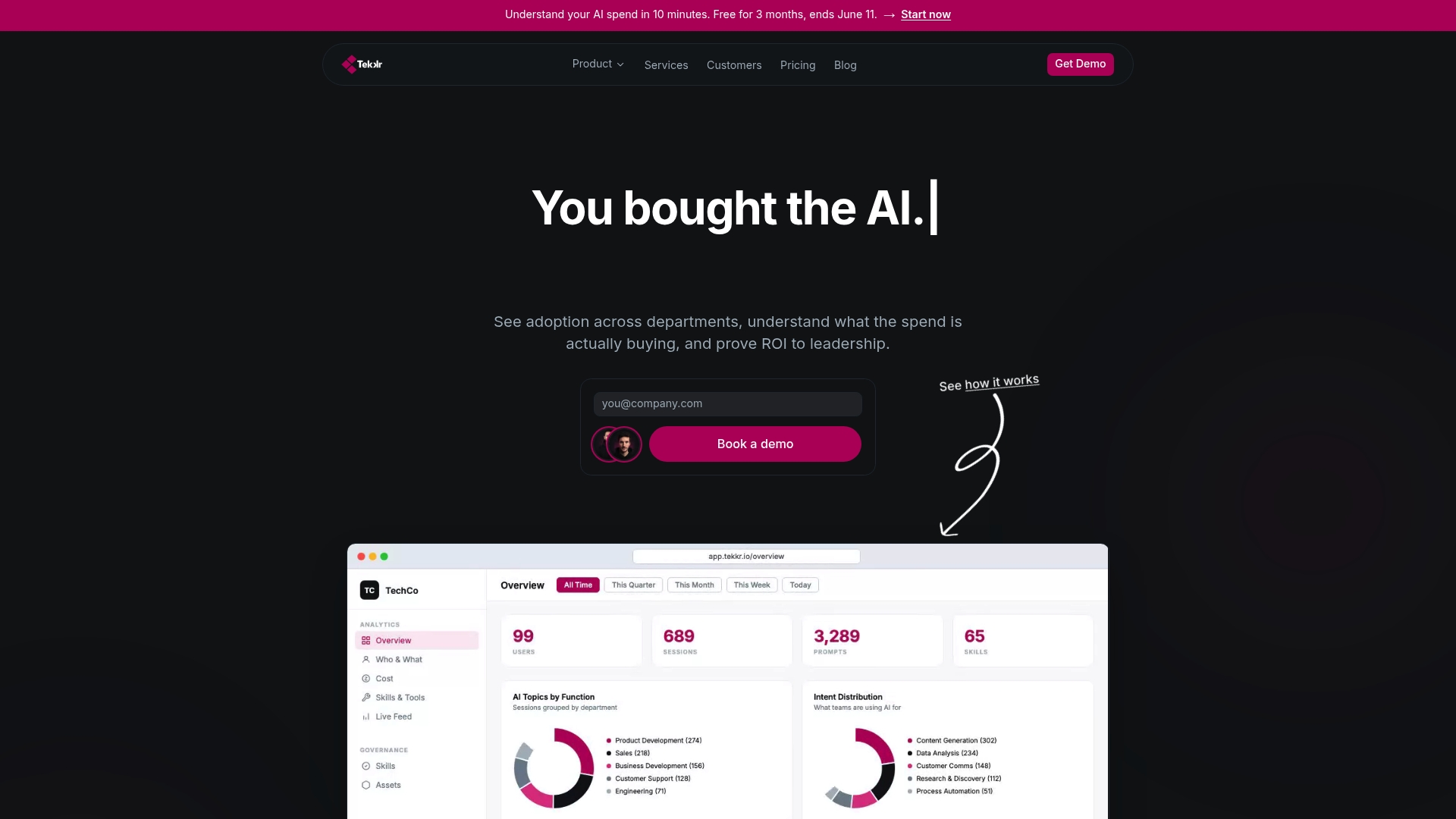
Privacy-first by design — end-to-end encrypted, automatic PII stripping, no browser extensions, GDPR-compliant. Setup takes 10 minutes. Start with a single value stream pilot and you will have the data you need to make the scale decision before the quarter ends. See how Configurato works and start your free pilot today.