
Agentic AI, AI-native development platforms, and data readiness dominate the 2026 landscape, but the single priority every leader needs to act on now is operational governance paired with measurable ROI reporting. Gartner and Stanford HAI both point to the same gap: enterprises are deploying agents faster than they can fully control or measure them. Tekkr’s own work with enterprise AI adoption confirms that managing that gap, rather than solely chasing new models, is critical for success this year.
TL;DR:
- Enterprises must prioritize operational governance by implementing agent registries, verifiable identities, and runtime circuit breakers to prevent autonomous errors.
- Shifting to AI-native development platforms and reusable infrastructure is crucial for reducing technical debt and increasing engineering productivity.
- Data readiness, including golden datasets and shared metadata, is the main barrier to scaling AI across functions like software engineering and customer support.
- Outcomes-based vendor contracts, tracking costs per agent action, and reporting value in dollars are necessary to manage the financial risks associated with agentic AI.
- Scaling AI deployment requires staged rollouts, thorough integration with legacy systems, and continuous monitoring of adoption, cost, and incident metrics.
Table of Contents
- The top enterprise AI trends for 2026 at a glance
- Agentic AI and multiagent systems: the technical and operational shift
- AI-native platforms and the new engineering productivity math
- Data, metadata and observability as the practical gating factor
- Governance and runtime controls: operationalizing safety and compliance
- Economics and pricing: agentic arbitrage, FinOps and vendor strategy
- People and operating model: reskilling and human-agent collaboration
- Leader playbook: six priorities and the metrics to bring to the board
- Practical implementation examples: measuring adoption and accelerating ROI
- Domain-specific models and the rise of physical AI
- Security, confidential computing and building enterprise trust
- AI ethics and responsible adoption inside the enterprise
- Integration challenges of AI with legacy systems
- Regulatory landscape and compliance for enterprise AI
- AI scalability and deployment strategies
- Emerging AI hardware and processing technologies
- What to watch heading into 2027
- A practical next step for measuring what you already bought
- Sources
- FAQ
The top enterprise AI trends for 2026 at a glance
Enterprise technology leaders are tracking a cluster of shifts that reinforce each other. Each trend below carries a distinct operational demand.
- Agentic AI and multiagent systems move work from single prompts to coordinated task execution, raising new orchestration and identity questions.
- AI-native development platforms compress build cycles and shift capital toward reusable platform infrastructure, a pattern McKinsey ties to reduced technical debt.
- Data and metadata readiness now gates scaling, with Stanford HAI’s AI Index showing productivity gains concentrated where data foundations are strong.
- Governance and runtime controls replace static policy documents, a shift Gartner frames as mandatory once agents act autonomously.
- Agentic economics are rewriting SaaS pricing, with Gartner warning that $234 billion in enterprise software spend is exposed to disruption.
- Confidential computing and provenance address trust as agents touch more sensitive systems.
Agentic AI and multiagent systems: the technical and operational shift
An assistant waits for instructions. An agent plans, calls tools, and takes multistep action without a human approving each step. That distinction matters because Gartner projects that 40% of enterprise applications will feature task-specific AI agents by 2026, up from under 5% the year before. Orchestrating dozens of agents across departments requires an agent registry, a way to assign each agent a verifiable identity, and coordination logic that prevents agents from stepping on each other’s actions.
Gartner’s guidance on agentic infrastructure governance is blunt: written policy cannot stop an agent mid-action, only runtime enforcement can.
- Build an agent registry that logs every agent’s purpose, owner, and permissions.
- Assign agent identity separate from the human who deployed it, so actions are traceable.
- Install circuit breakers that halt an agent automatically when it exceeds defined thresholds.
Pro Tip: Treat every new agent like a new employee: define its scope, its manager, and what it is never allowed to touch before it goes live.
AI-native platforms and the new engineering productivity math
AI-native development platforms, tools built around code generation, automated testing, and agent-assisted review, are changing how fast engineering teams ship and how much technical debt they accumulate along the way. Gartner’s 2026 strategic technology trends list AI-native development alongside multiagent systems as top priorities, and McKinsey’s research on enterprise tech returns finds that companies reallocating capital toward platform infrastructure, rather than one-off tools, extract more value per dollar spent.
The practical implication is that platform investment now competes directly with feature work for budget, and the leaders who win treat reusable components as infrastructure rather than side projects.
- Fund shared toolchains instead of letting every team build its own AI pipeline.
- Track unit economics per feature, not just velocity, to see where AI actually lowers cost.
- Invest in reuse primitives, like shared prompt libraries and evaluation harnesses, before scaling agent use cases.
Data, metadata and observability as the practical gating factor
Most enterprise AI stalls not because the models are weak but because the data underneath them is not ready. Stanford HAI’s 2026 AI Index shows that generative AI’s productivity gains concentrate in functions like software engineering and customer support, precisely where structured, well-labeled data already exists. McKinsey’s research on workplace transformation makes a similar point: value requires embedding use cases into redesigned workflows, not bolting AI onto messy pipelines.
Agent observability adds a second layer: you need to see not just outputs but the reasoning chain that produced them, captured in immutable logs auditors can trust.
- Build golden datasets for the two or three use cases carrying the most business risk.
- Write a shared metadata glossary so agents and humans interpret fields the same way.
- Stand up evaluation suites that score agent output before it reaches production.
- Log reasoning chains immutably, not just final answers, for every agent action.
Governance and runtime controls: operationalizing safety and compliance
Policy documents describe what agents should do. Runtime controls stop them the moment they do something else. Gartner’s guidance on agentic infrastructure governance argues that separating reasoning from execution is the only reliable way to prevent an autonomous error from becoming a costly incident, because a policy written in a wiki page has no power over a live process.
- Enforce least privilege so agents can only touch the systems their task requires.
- Tier human approval by risk, letting low-stakes actions run freely while high-stakes ones wait for sign-off.
- Stage every agent rollout in a sandboxed environment before granting production access.
Pro Tip: Test governance the way you test code: write failure scenarios first, then confirm the circuit breaker actually trips before the agent ever sees real data.
Economics and pricing: agentic arbitrage, FinOps and vendor strategy
Agentic AI is unsettling how software gets priced. Gartner estimates that $234 billion in enterprise application software spend is at risk as agents substitute for seat-based tools, a shift that pressures vendors to move away from per-seat pricing toward outcome-based models. Finance and procurement teams need an agentic FinOps practice now, one that tracks cost per completed task rather than cost per license.
- Negotiate outcome-based clauses that tie vendor payment to measured results, not seats.
- Track cost per agent action, not per user, to see where automation actually saves money.
- Report AI value in dollars saved or generated, replacing adoption percentages as the primary board metric.
People and operating model: reskilling and human-agent collaboration
McKinsey’s analysis of workplace transformation frames the shift as moving from deployment to transformation: rolling out a tool changes little until roles and workflows are redesigned around it. New roles worth staffing include agent orchestration leads and AI evaluation specialists, while existing teams need structured apprenticeship rather than one-off training sessions.
- Redesign workflows, not just job titles, around where agents now handle the first pass.
- Pair junior staff with agent output as an apprenticeship model, reviewing rather than starting from scratch.
- Watch for adoption fatigue by rotating pilot ownership so the same team is not absorbing every new tool.
Leader playbook: six priorities and the metrics to bring to the board
Board conversations about AI are shifting from “are we using it” to “what is it worth.” Six priorities cover most of that ground.
- Governance: confirm every production agent has an identity, a registry entry, and a circuit breaker.
- Data readiness: fund golden datasets and metadata glossaries for your top use cases.
- Platform investment: consolidate toolchains instead of letting teams duplicate AI infrastructure.
- FinOps: renegotiate vendor contracts toward outcome-based pricing where volume justifies it.
- People: assign clear ownership for agent oversight and redesign at least one core workflow.
- Security: extend confidential computing and access controls to every system an agent can touch.
Up to $234 billion in enterprise application software spend is at risk from agentic AI disruption, according to Gartner, which is reason enough to put pricing strategy on the same agenda as governance.
Report adoption rate, value generated per use case, cost per completed agent action, and incidents per thousand agent actions on a monthly cadence, with the AI transformation lead owning the dashboard and finance validating the dollar figures. For deeper templates, see this breakdown of AI ROI measurement and these board-level reporting examples.
Practical implementation examples: measuring adoption and accelerating ROI
Most enterprises cannot answer a basic question: who is actually using the AI tools they bought, and what is it costing per team. Instrumenting active users, spend by department, and use-case-level ROI turns that guesswork into a dashboard.
- Track active usage of tools like Claude or Codex, not just license counts.
- Break down spend by team to find where cost outpaces value.
- Run gamified rollouts with playbooks and leaderboards to lift adoption without mandates.
Pro Tip: Start a two-week pilot on one department before rolling adoption tracking company-wide, so you can fix reporting gaps while the stakes are still small.
Domain-specific models and the rise of physical AI
General-purpose models are giving ground to smaller, domain-specific systems trained on a company’s own regulatory, clinical, or engineering data, because narrow accuracy matters more than broad fluency in regulated work. This pairs with growing interest in physical AI, models that control or predict outcomes in robotics, manufacturing lines, and logistics networks rather than generating text. Gartner’s 2026 strategic technology trends list multiagent systems alongside these more specialized deployments, reflecting a broader move away from one model handling every task.
For enterprise leaders, the implication is procurement diversity. Instead of standardizing on a single foundation model, technology teams are increasingly expected to evaluate domain-specific options for high-stakes functions such as claims processing, quality inspection, or predictive maintenance, while keeping general models for broad productivity tasks. Physical AI adds a layer of operational risk that software-only deployments do not carry: a misjudged output on a factory floor has physical consequences, not just a bad chatbot response.

That raises the bar for testing and evaluation before any physical AI system reaches production. Evaluation and testing budgets should scale with the stakes of the deployment, not just its novelty.
Security, confidential computing and building enterprise trust
Confidential computing, which keeps data encrypted even while it is being processed, has moved from a niche security feature to a baseline expectation as agents gain access to more sensitive systems. Gartner names it among the top strategic technology trends for 2026, alongside digital provenance and preemptive cybersecurity, because agents that can read and act on data need stronger guarantees than a login screen.
Trust in enterprise AI now depends on three things working together: encrypted processing so sensitive data is never exposed in plain form, verifiable provenance so leaders can trace where an output came from, and preemptive monitoring that catches unusual agent behavior before it causes damage. Any platform that touches employee prompts or company data should be evaluated against all three, not just the first one.
AI ethics and responsible adoption inside the enterprise
Responsible AI adoption is less about drafting an ethics charter and more about building the habits that keep agents accountable day to day. That means documenting why an agent made a decision, giving employees a clear path to flag bad outputs, and reviewing high-risk use cases on a fixed schedule rather than only after something goes wrong.
McKinsey’s research on workplace transformation frames responsible adoption as inseparable from the broader shift to transformation: ethics reviews work best when they are built into the workflow redesign, not layered on afterward as a compliance checkbox.
Integration challenges of AI with legacy systems
Enterprise AI rarely fails because the model underperforms. It fails because the surrounding systems, decades-old databases, brittle APIs, and inconsistent data formats, cannot feed it reliably. Agents that need to call multiple internal systems in sequence expose these gaps faster than a single chatbot ever did, since one broken integration can stall an entire multistep task.
Practical integration work starts with mapping which legacy systems an agent actually needs to touch, then building a thin, well-tested API layer between the agent and that system rather than letting the agent call fragile legacy interfaces directly. Teams that skip this step tend to see agents fail silently or, worse, act on stale data without anyone noticing until a report looks wrong.
Regulatory landscape and compliance for enterprise AI
Enterprise AI regulation continues to develop across regions and industries, and the practical response for most technology leaders is the same regardless of jurisdiction: document what each system does, keep audit trails, and involve legal review before deploying agents into regulated workflows like hiring, lending, or health data handling. Rules and enforcement priorities differ by market and sector, so compliance decisions should rest on guidance from a qualified legal advisor or the relevant regulator rather than general industry commentary.
What holds steady across markets is the expectation that enterprises can explain an AI system’s decisions and show who is accountable for them. Building that documentation habit now, before it is legally required, costs far less than retrofitting it after a regulator asks for it.
AI scalability and deployment strategies
Scaling an agent from a single team’s pilot to company-wide use exposes problems that never showed up in the pilot: inconsistent data formats across departments, uneven governance maturity, and cost structures that were fine for ten users but not for ten thousand agent actions a day. IDC’s FutureScape research describes this as the defining shift of the year, agentic AI moving from isolated pilots to genuine enterprise orchestration, which changes what “deployment” even means.

A staged rollout, sandbox first, then a single business unit, then company-wide, catches most of these problems before they become expensive. Leaders who skip stages tend to discover their governance model or their data pipeline was never built for the volume they eventually reach.
Emerging AI hardware and processing technologies
The compute layer underneath enterprise AI is shifting too. Demand for specialized AI processing hardware, chips optimized for inference rather than general computing, continues to grow as agentic workloads run constantly instead of responding to occasional prompts. Gartner’s strategic technology trends for 2026 situate this hardware shift alongside confidential computing, since processing sensitive data efficiently and securely increasingly depends on the chip layer, not just the software stack.
For enterprise buyers, the practical question is less about chip specifications and more about vendor lock-in: hardware choices made for one agent framework may not transfer cleanly if orchestration standards shift again next year.
What to watch heading into 2027
Watch pricing renegotiations, emerging agent orchestration standards, and new regulatory guidance through late 2026. Prioritize governance and measurability over adding the newest agent feature: the leaders who can prove value will outlast the ones who only shipped it.
— TekkrTools
A practical next step for measuring what you already bought
Everything in this playbook depends on one capability most enterprises lack: visibility into who is actually using the AI tools they pay for and what it is returning. Configurato tracks active usage of tools, breaks down spend by team, and surfaces use-case-level ROI, all inside an end-to-end encrypted, GDPR-compliant setup that strips personal data from prompts automatically.
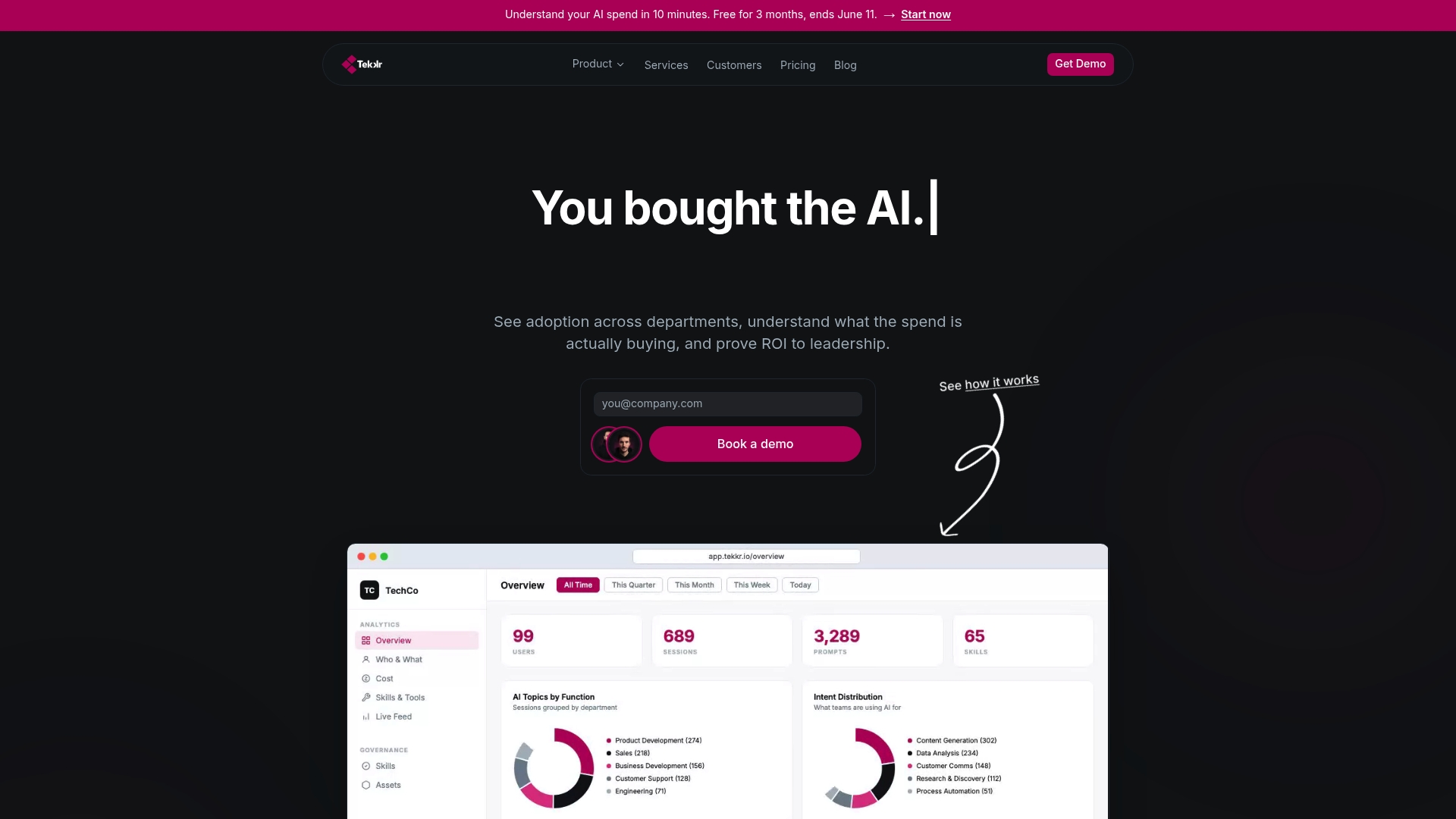
Setup takes about 10 minutes with no browser extensions and offers a free tier to start. If your board is asking what your AI spend is actually returning, start with Tekkr’s pricing and plans or explore Configurato directly.
Sources
- Gartner Says $234 Billion in Enterprise Application Software Spend Is at Risk from Agentic AI
- Gartner Predicts 40% of Enterprise Apps Will Feature Task-Specific AI Agents by 2026
- Inside the AI Index — 12 takeaways from the 2026 report
- Agentic AI fails where governance stops
FAQ
What is agentic AI and how is it different from AI assistants?
Agentic AI refers to systems that plan and execute multistep tasks autonomously, calling tools and taking action without approval at each step, unlike assistants that respond only when prompted. Gartner projects that 40% of enterprise apps will feature task-specific agents by 2026.
How should enterprises measure AI ROI in 2026?
Measure ROI through value generated per use case and cost per completed agent action, not adoption percentages or license counts alone. Platforms like Configurato track spend by team and use-case-level returns to make this concrete for board reporting.
When will agentic AI have the biggest impact on enterprises?
Impact is already visible in 2026, with Gartner warning that $234 billion in enterprise software spend is at risk from agentic disruption this year. The shift accelerates through 2027 as orchestration standards mature.
What governance controls do enterprises need before deploying AI agents?
Enterprises need an agent registry, verifiable agent identity, and runtime circuit breakers that can halt an agent mid-action, since written policy alone cannot stop live processes according to Gartner’s guidance. Tiered human approval for higher-risk actions rounds out a practical control set.