
What enterprise AI adoption actually means for your business
Enterprise AI adoption is the systematic process of embedding AI technologies into organizational workflows, decision-making, and business models to generate measurable value at scale. It goes well beyond deploying a chatbot or automating a single process. The real work is organizational: redesigning how people work, how decisions get made, and how performance gets measured.

The distinction from standard automation or digital transformation matters. Automation replaces a defined, repetitive task. Digital transformation modernizes infrastructure and processes. AI adoption does something harder: it changes the nature of work itself, requiring humans and AI systems to operate as a single unit across functions. The Stanford Digital Economy Lab’s Enterprise AI Playbook, drawn from 51 real enterprise deployments, found that across identical use cases, outcomes varied from weeks to years. The difference was never the AI model. It was always the organization.
Why it matters right now:
- AI adoption creates competitive advantage through faster decision cycles, personalized customer experiences, and new revenue streams that weren’t operationally feasible before.
- Efficiency gains are real but unevenly distributed. Escalation-based AI operating models, where AI handles the majority of tasks autonomously and humans review only exceptions, delivered substantial productivity gains in the Stanford study.
- The business case extends beyond cost reduction. The highest returns came from companies pointing AI at revenue generation: personalizing offers at the individual level, closing deals faster, and packaging internal tools as products sold to clients.
- AI adoption is a prerequisite for competing in markets where AI-native players are setting new speed and cost benchmarks.
The core components of a mature AI adoption program include use-case prioritization, data infrastructure readiness, workforce upskilling, governance frameworks, and a measurement system that tracks actual workflow impact rather than license counts.
Table of Contents
- The real obstacles to scaling AI across a large organization
- How leading enterprises structure their AI adoption strategy
- What leadership actually needs to do to make AI adoption work
- How to evaluate and select AI tools that actually fit your enterprise
- Why AI governance can’t be an afterthought
- What enterprise AI adoption will look like in the next two years
- Organizational change is what separates AI leaders from everyone else
- Tekkr gives you visibility into whether your AI investment is actually working
- Key Takeaways
The real obstacles to scaling AI across a large organization
Most enterprises underestimate where the friction actually lives. Technology is consistently the easiest part. 77% of the hardest challenges practitioners faced were invisible costs: change management, data quality, and process redesign, not technical issues.
The primary barriers enterprises face:
- Workforce skill gaps. Insufficient worker skills are the primary barrier to AI integration, pushing firms to create entirely new roles like “human-AI interaction specialists” and to redesign workflows so humans focus on strategic oversight rather than task execution.
- Data quality and integration. AI output is only as reliable as the data feeding it. Fragmented data across legacy systems, inconsistent labeling, and poor data governance create compounding errors at scale.
- Staff function resistance. Legal, HR, and Risk departments account for 35% of AI adoption resistance, more than frontline user pushback. Their concerns center on liability, regulatory exposure, and loss of oversight authority.
- Governance gaps. Most enterprises deploy AI before establishing clear accountability structures, creating compliance risk and slowing future scaling.
- Measurement failures. Organizations that track only seat counts or token usage get a false picture of adoption health. What actually matters is how deeply AI is embedded in workflows and whether it’s reducing the unit cost of output.
- Organizational resistance to failure. AI projects require iteration. Cultures that punish failed experiments kill adoption before it scales.
Statistic: Almost eight in ten businesses acknowledge that upskilling isn’t keeping pace with AI evolution, making workforce development the most persistent structural challenge in enterprise AI programs.
Research shows that 79% of enterprises say their workforce upskilling is falling behind the pace of AI evolution, underlining the urgent need for targeted development strategies. The pattern is consistent: enterprises that treat AI adoption as a technology project rather than an organizational change program spend more, move slower, and capture less value.

How leading enterprises structure their AI adoption strategy
No single framework fits every industry, but the most effective enterprise AI adoption strategies share a common architecture: they measure both breadth (how many workflows touch AI) and depth (how fundamentally AI changes those workflows), and they scale iteratively rather than all at once.
Core framework elements:
- Use-case tiering. Prioritize high-volume, recoverable tasks for early agentic deployment. Reserve collaborative or approval-based AI models for regulated, high-stakes decisions.
- Iterative scaling. Successful AI scalers set 1–2-year timelines to move from pilot to production. The “move fast” ethos consistently produces failed pilots and organizational fatigue.
- OKR alignment. The seven enterprise cases in the Stanford study that achieved organization-wide transformation all shared one trait: the executive sponsor tied AI adoption to corporate Objectives and Key Results, including bonus structures.
- Process depth measurement. Tracking process depth and unit cost of output gives a far more accurate picture of AI’s business impact than usage metrics alone.
Industry approaches diverge significantly from that shared foundation. In financial services, AI adoption concentrates on fraud detection, credit underwriting, and personalized client advisory, all areas where model explainability and regulatory compliance are non-negotiable design constraints. Manufacturing enterprises focus on predictive maintenance and quality control, where AI operates in escalation mode: the system flags anomalies, humans review exceptions. Retail and e-commerce push AI deepest into personalization and demand forecasting, where the feedback loops are fast and the tolerance for experimentation is higher.
The common thread across sectors is that the most effective programs don’t ask “what can AI do?” They ask “which specific workflows, if redesigned around AI, would generate the most measurable business value?” That question forces prioritization and keeps adoption grounded in outcomes rather than technology enthusiasm.
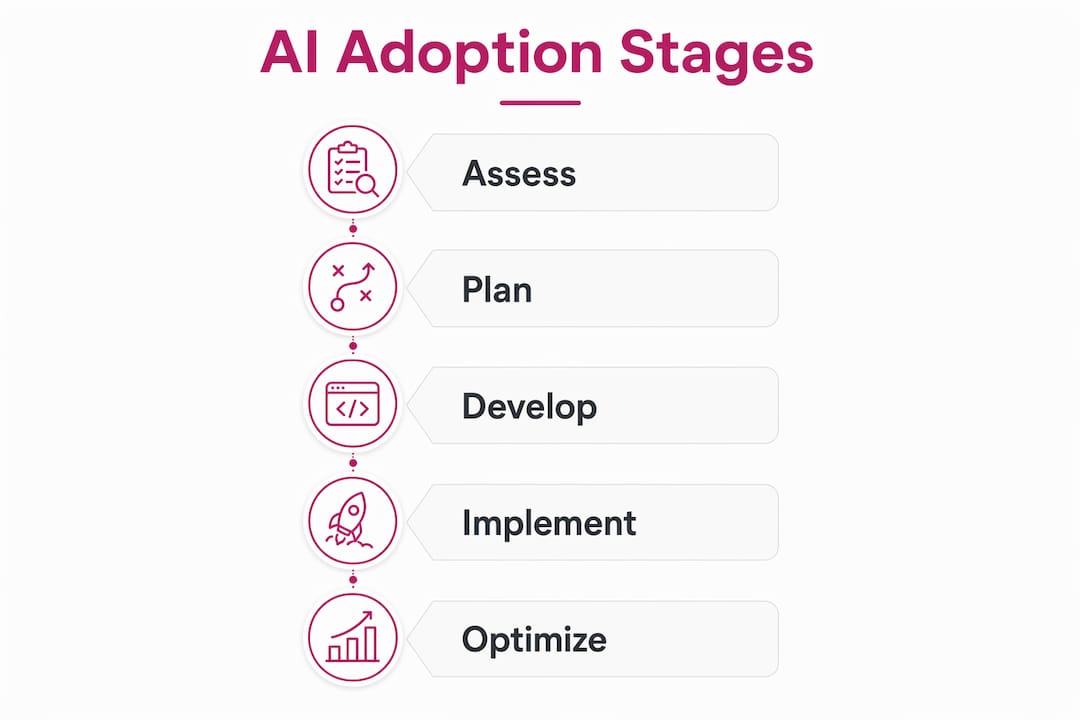
Pro Tip: Map your highest-volume, lowest-error-tolerance workflows first. These are your best candidates for agentic AI deployment, and they’ll generate the productivity data you need to build internal support for broader rollout.
What leadership actually needs to do to make AI adoption work
Executive sponsorship is the single most reliable predictor of AI adoption success. But the Stanford research is specific about what effective sponsorship looks like: it’s not signing off on a budget. It’s creating conditions where teams can fail, learn, and try again without career consequences.
Leadership practices that consistently accelerate AI adoption:
- Tie AI adoption to corporate OKRs and individual performance metrics, not just project milestones.
- Run weekly check-ins with active blocker removal, not monthly status reports.
- Create new roles explicitly designed for human-AI collaboration, including workflow redesign specialists and AI output reviewers.
- Invest in structured upskilling before deployment, not after resistance surfaces.
- Treat Legal, HR, and Risk as design partners rather than approval gates. Their concerns about liability and oversight are legitimate and solvable with the right process design.
Cultural factors matter as much as structural ones. The organizations that scaled AI fastest weren’t the ones with the most sophisticated models. They were the ones where experimentation was expected, collaboration was designed in, and accountability was clear without being punitive.
Change management for AI differs from standard technology rollouts in one critical way: the scope of role redesign requires holistic AI automation for business operations that transforms workflows end to end. AI doesn’t just change how a task gets done; it often changes who does it, what judgment is required, and what the human’s value-add actually is. That requires honest conversations about role evolution, not just training on new tools. For a deeper look at how executives can structure this process, AI integration strategies for executives covers the organizational design questions in detail.
How to evaluate and select AI tools that actually fit your enterprise
The tool selection mistake most enterprises make is evaluating AI products in isolation from the workflows they’re meant to change. A tool that scores well in a vendor demo can fail completely in production if it doesn’t integrate with existing systems, comply with data residency requirements, or match the actual skill level of the people using it.
Key evaluation criteria for enterprise AI tools:
- Integration depth. Does the tool connect natively with your existing data infrastructure, or does it require a parallel data pipeline? The latter adds cost and latency.
- Compliance and data governance. For regulated industries, model explainability, audit trails, and data residency controls are requirements, not features.
- Human-in-the-loop design. The best enterprise AI tools are built around escalation, not full automation. Evaluate how the tool handles edge cases and low-confidence outputs.
- Vendor maturity. Enterprise AI vendors vary enormously in their ability to support large-scale deployments. Check for SLAs, dedicated support, and a track record of enterprise implementations.
- Adoption potential. A tool that 20% of your workforce uses deeply outperforms one that 80% opens once. Evaluate the user experience and the vendor’s approach to driving actual usage.
- Measurement capability. Can the tool report on workflow impact, not just activity? If your only visibility is login counts, you can’t manage adoption.
The deeper issue is that measuring adoption by seat counts and token usage doesn’t tell you whether AI is actually changing how work gets done. Before selecting any tool, define what “deep adoption” looks like in your specific workflows and confirm the tool can be measured against that standard. For practical guidance on getting AI assistants configured for real productivity gains, configuring AI assistants for enterprise productivity is worth reviewing.
Why AI governance can’t be an afterthought
Governance is the part of AI adoption that most enterprises delay until something goes wrong. That’s expensive. Only 12% of businesses feel fully ready to govern AI effectively, and delaying governance leads to higher remediation costs post-deployment.
Governance principles that belong in your AI adoption program from day one:
- Data privacy and PII controls. Every AI system that processes employee or customer data needs clear policies on data retention, access, and anonymization.
- Model bias auditing. AI models trained on historical data can encode historical biases. Regular audits are necessary, not optional.
- Accountability structures. For every AI-assisted decision, there should be a named human accountable for the outcome. Diffuse accountability is a governance failure waiting to happen.
- Security protocols. AI systems introduce new attack surfaces, including prompt injection and model extraction. Security reviews need to be part of the deployment process.
- Regulatory compliance mapping. In the US, sector-specific regulations (HIPAA, FCRA, EEOC guidance on algorithmic hiring) apply to AI systems. Map your use cases to applicable regulations before deployment.
- Ongoing monitoring. Model performance drifts over time as data distributions shift. Governance requires continuous monitoring, not a one-time review.
Statistic: With only 12% of enterprises feeling fully prepared to govern AI, the majority are deploying systems they cannot yet adequately oversee. The cost of fixing governance gaps after deployment consistently exceeds the cost of building them in from the start.
Proactive AI governance isn’t just risk management. It’s what allows you to scale confidently. Organizations that establish clear governance frameworks early move faster in later deployment phases because they’re not stopping to resolve compliance questions that should have been answered at the design stage. For a practical framework, AI governance strategies for innovation covers the key structural decisions.
What enterprise AI adoption will look like in the next two years
The trajectory is clear: AI is moving from tool to agent. Agentic AI systems, where AI operates autonomously across multi-step workflows and coordinates with other AI systems, currently represent about 20% of enterprise deployments. That share will grow fast, and the productivity gap between organizations that adopt agentic AI and those that don’t will widen accordingly.
Key trends shaping enterprise AI adoption through 2026 and beyond:
- Agentic AI at scale. Even in its current early form, agentic AI delivers higher median productivity gains than high-automation models. As enterprise agent frameworks mature, the use cases will expand well beyond high-volume, low-stakes tasks.
- ROI expectations are rising sharply. Global businesses expect AI ROI to grow from 21% to 38% over the next two years, with agentic AI expected to deliver quadruple the ROI of last year’s figures.
- The Autonomous Enterprise model. Moving to what SAP describes as the “Autonomous Enterprise” is a human change, not just a technical one. It requires redesigning processes so agents, workflows, and people function as a single integrated unit.
- Continuous upskilling as a permanent function. Upskilling is no longer a one-time training event. It’s an ongoing organizational capability that needs dedicated resources and measurement.
- Governance infrastructure catching up. Regulatory pressure and enterprise risk appetite are forcing governance frameworks to mature. Organizations that built governance early will have a structural advantage.
- Human-centric AI design. The enterprises generating the most value from AI are designing systems that augment human judgment rather than replace it, particularly in high-stakes, regulated, or relationship-intensive work.
The organizations best positioned for this shift are already treating AI adoption as a core business capability rather than an IT initiative. That mindset difference compounds over time.
Organizational change is what separates AI leaders from everyone else
The empirical evidence on this is unambiguous. Organizational readiness, specifically leadership sponsorship, clear process definition, and end-user willingness, is more decisive than technical maturity for both the duration and success of AI projects.
The revenue data reinforces this. Only 18% of firms are seeing actual revenue growth from AI. What distinguishes them is not their technology stack. Among these “AI Leaders,” 93% run structured upskilling programs, compared to 20% of firms that are lagging. That 73-percentage-point gap in human capital investment is the actual driver of the revenue gap.
Workforce transformation for AI adoption requires more than training. It requires role redesign. When AI takes over the execution layer of a job, the human role shifts toward judgment, exception handling, and oversight. That’s a fundamentally different job description, and it requires deliberate redesign rather than incremental skill-building. Organizations that recognize this early create new roles explicitly built around human-AI collaboration, rather than retrofitting old roles with AI tools.
The resistance patterns are also worth understanding clearly. C-suite leaders demand measurable ROI proof before committing. Staff functions worry about process risk and accountability. End users distrust system inconsistency. Frontline workers fear replacement. Each group requires a different response, and conflating them into a single “change management” effort is why so many programs stall. For a detailed look at how to structure the human side of AI transformation, AI transformation strategy for executives addresses each stakeholder group specifically.
Tekkr gives you visibility into whether your AI investment is actually working
Most enterprises buying AI tools face the same problem six months in: they can’t tell who’s using what, which teams are getting value, or whether the spend is justified. That’s the gap Tekkr was built to close.
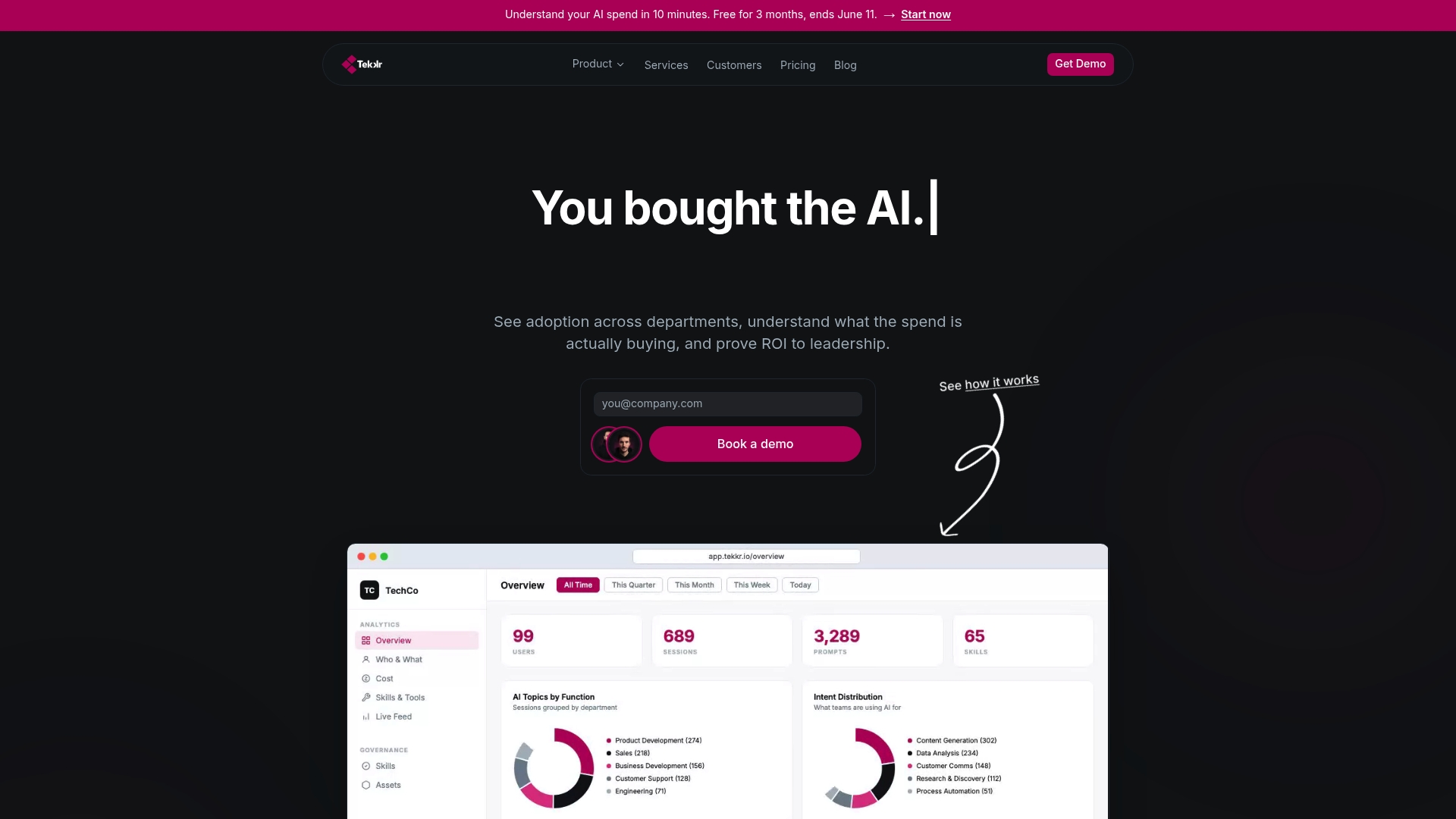
Tekkr’s flagship product, Configurato, measures AI adoption, spending, and return across your entire organization, then actively works to drive adoption higher. It tracks real usage of tools like Claude and Codex, breaks down costs by team, surfaces which use cases are generating value, and enables employees through gamified rollouts and company-wide AI playbooks. The result is that teams don’t just have access to AI. They actually use it well. Everything runs in a privacy-first architecture: end-to-end encrypted, GDPR-compliant, with automatic PII stripping and no browser extensions required. Setup takes about 10 minutes, with a free tier and no credit card needed.
If you’re an executive who has already bought the AI and now needs to prove it’s working, Tekkr’s AI adoption platform is the practical next step. You get the measurement infrastructure and the adoption engine in one place, without a lengthy implementation project.
Key Takeaways
Enterprise AI adoption succeeds when organizational readiness, leadership commitment, and structured human capital investment drive the program, not technology selection alone.
| Point | Details |
|---|---|
| Organizational factors beat technology | Leadership sponsorship, process clarity, and end-user willingness determine AI project success more than the model chosen. |
| Invisible costs dominate | 77% of the hardest challenges in AI deployments are change management, data quality, and process redesign, not technical issues. |
| Human capital separates leaders | 93% of AI Leaders run structured upskilling programs, versus 20% of lagging firms, driving the revenue gap between them. |
| Governance must be built in early | Only 12% of businesses feel fully ready to govern AI; delaying governance raises remediation costs significantly post-deployment. |
| Tekkr measures and drives adoption | Configurato tracks real AI usage by team, surfaces ROI by use case, and actively lifts adoption through playbooks and gamified rollouts. |