
Yes, most LLM deployments that process personal data require a DPIA under GDPR Article 35, and where the AI Act’s high-risk provisions apply, you will likely need to pair it with a Fundamental Rights Impact Assessment (FRIA) too. The EDPB’s guidance on large language models treats a DPIA as necessary for nearly any non-trivial deployment, and the signals that trigger it (systematic profiling, large-scale processing, sensitive data) show up constantly in real-world LLM use cases like support chatbots and screening tools.
TL;DR:
- Conduct a DPIA whenever a large language model regularly processes personal, sensitive, or vulnerable data for substantial groups, especially with automated decision-making or high volume.
- The DPIA must detail the specific model, data flow, necessity reasons, risks like memorization or re-identification, and concrete mitigation actions supported by evidence logs.
- Include a broader AI Act-focused assessment, the FRIA, to evaluate societal impacts, misuse scenarios, and human oversight, especially when deploying in high-risk contexts.
- Operational tools should automate continuous evidence collection, maintain an immutable audit trail, and simplify updates; treating DPIA as a living document is essential.
- In high-risk deployments, involve data protection officers and compliance teams early, document all sign-offs, and prepare for regulator reviews with clear, evidence-backed controls.
Table of Contents
- When Is a DPIA Required for LLMs?
- What Must a DPIA for an LLM Actually Contain?
- Pairing the DPIA With an AI Act FRIA
- How Do You Conduct a DPIA for an LLM Step by Step?
- What Operational Evidence Makes a DPIA Defensible?
- How Tooling Supports DPIA Evidence Collection
- Three Priorities for Running an LLM DPIA
- Turn DPIA Evidence Into an Ongoing Practice, Not a One-Time Filing
- Sources
When Is a DPIA Required for LLMs?
Article 35 sets the bar at processing “likely to result in a high risk” to individuals’ rights and freedoms. That phrase sounds abstract until you map it against how LLMs actually get deployed inside organizations, at which point it stops being abstract fast.
The EDPB’s guidance and related supervisory commentary point to a specific set of risk indicators. When two or more show up in the same processing operation, you’ve crossed into DPIA territory. According to analysis of Article 35 triggers for AI systems, this two-or-more threshold is the practical heuristic supervisory authorities use when they assess whether a controller should have run an assessment.
The signals to check for:
- Systematic evaluation or scoring. Any LLM that ranks, rates, or profiles people, including resume screening or customer risk tiers, counts.
- Automated decisions with legal or similarly significant effects. A chatbot that recommends loan denial or determines eligibility for a service crosses this line even with a human “reviewing” the output, if that review is largely rubber-stamped.
- Large-scale processing. Volume matters. A model handling thousands of customer conversations a day operates at a different risk tier than an internal tool used by twelve people.
- Special category or highly personal data. Health questions in a support chatbot, financial details in an advisory tool, or immigration status in an HR system all qualify.
- Matching or combining datasets. LLMs that pull from CRM records, support tickets, and behavioral data simultaneously create re-identification risk that didn’t exist when those datasets sat separately.
- Data concerning vulnerable people. Children, patients, or job applicants get heightened scrutiny regardless of scale.
- Novel technology used in a new way. LLMs generally qualify here by default, since the EDPB treats generative AI as new enough that its risk profile isn’t fully settled.
Put these against common deployments and the pattern is obvious. A customer support chatbot that logs full conversation transcripts and occasionally handles account or health information hits three or four signals at once: large-scale processing, sensitive data, and arguably automated decision-making if it triggers account actions. A recruitment screening tool hits systematic evaluation and vulnerable-population concerns simultaneously. An internal coding assistant with no customer data and no profiling function might not need a full DPIA at all, though a screening exercise to document that conclusion is still good practice.
The practical heuristic: if your LLM touches personal data of a considerable number of people regularly, makes or heavily informs decisions about them, or processes anything in the special categories under Article 9, run the DPIA. Don’t wait for a supervisory authority to tell you it was necessary after the fact.
What Must a DPIA for an LLM Actually Contain?
Article 35(7) sets four mandatory components: a description of the processing, an assessment of necessity and proportionality, a risk analysis, and the measures taken to address those risks. That structure hasn’t changed for AI. What changes is the evidence you need to fill each section credibly, and regulatory guidance increasingly expects that evidence to be operational, not just narrative.
Processing description
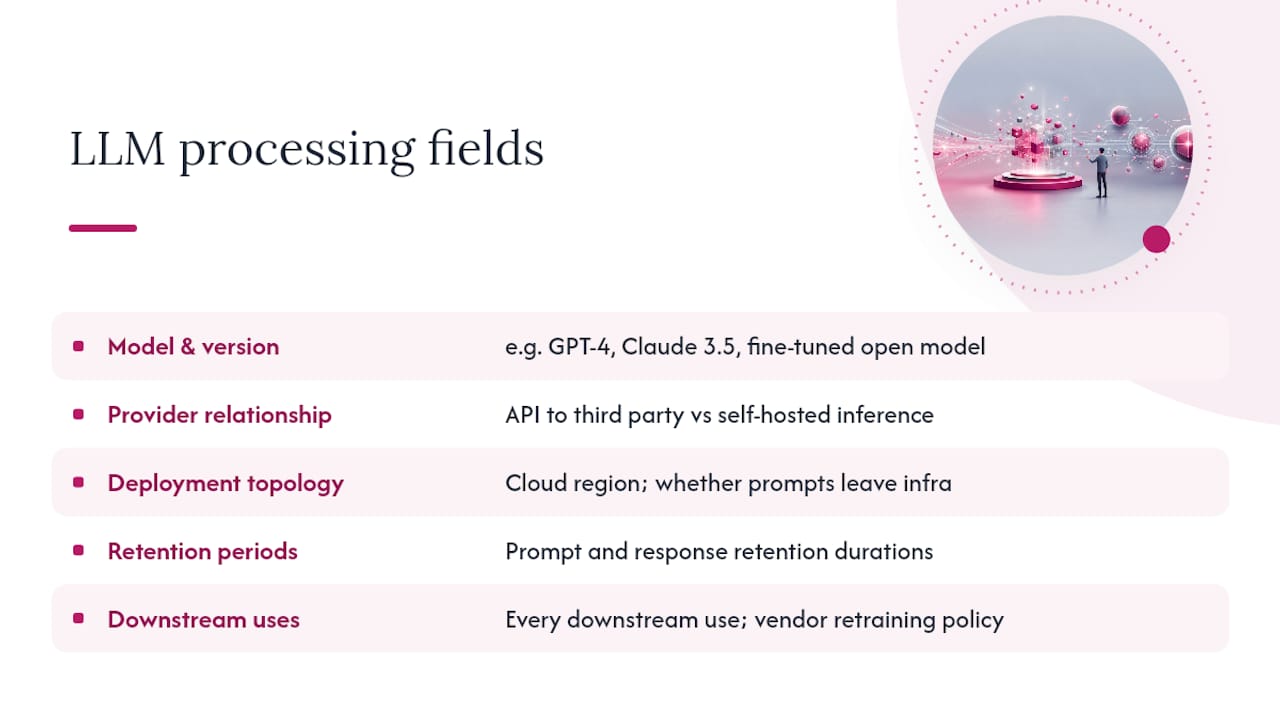
This section needs specifics a generic privacy policy won’t give you: the model name and version (GPT-4, Claude 3.5, a fine-tuned open-weight model), the provider relationship (API call to a third party versus self-hosted inference), deployment topology (cloud region, whether prompts leave your infrastructure), prompt and response retention periods, and every downstream use of the outputs. If your vendor retrains on customer prompts by default, that belongs here explicitly, not buried in a footnote.
Necessity and proportionality
Explain why an LLM specifically, not a rules-based system or a simpler classifier, is necessary for the task. Document the alternatives you considered and why they fell short. Then show data minimization at the prompt layer: are you sending full customer records to the model when a truncated context would work? Data minimization checks at this stage often reveal that teams are passing far more personal data into prompts than the use case actually requires.
Risk analysis
This is where generic DPIA templates fail LLMs specifically. You need to catalog risks that don’t apply to traditional processing:
- Memorization. Models can reproduce training data verbatim, including personal details, if prompted the right way.
- Re-identification. Combining model outputs with other data sources can de-anonymize people who were supposedly protected by aggregation.
- Discriminatory outputs. Bias baked into training data surfaces in scoring, recommendations, or generated text.
- Unintended profiling. A model built for one purpose (summarizing tickets) can be repurposed to infer sensitive attributes (health status, sexual orientation) it was never authorized to process.
- Sensitive category exposure. Free-text prompts routinely contain special category data even when the system wasn’t designed to collect it.
Mitigations and their evidence
Every mitigation needs proof, not intent. “We minimize data” isn’t a mitigation until you can point to a redaction log. “We monitor for bias” isn’t credible until a test result exists. The measures that hold up under scrutiny include pre-prompt redaction with logged before/after samples, contractual retention limits with the model provider, red-team test results, and human oversight records showing actual review, not just a checkbox.
Pro Tip: Write your mitigations section as a table with three columns: control, owner, and evidence artifact. If you can’t fill the third column with something a regulator could inspect, the control isn’t documented, it’s aspirational.
Sign-offs and DPA consultation
The DPO should review and sign every LLM DPIA before deployment. If the residual risk after mitigations remains high, Article 36 requires prior consultation with your supervisory authority before processing starts. That threshold gets crossed more often with LLMs than with legacy systems, largely because the risk analysis surfaces memorization and profiling risks that are genuinely hard to fully mitigate with current tooling.
Pairing the DPIA With an AI Act FRIA
If your LLM deployment falls under a high-risk category in the AI Act, you’ll also need a Fundamental Rights Impact Assessment under Article 27. The FRIA and the DPIA overlap substantially, but they’re not the same document, and treating them as one saves real time.
The DPIA asks whether processing personal data creates high risk to privacy rights. The FRIA asks a broader question: does deploying this system create risk to fundamental rights generally, including non-discrimination, freedom of expression, and access to essential services, regardless of whether personal data is even involved. Practitioner templates for combining the two show that a shared core document with a FRIA-specific addendum is the most workable approach for teams that don’t want to maintain two parallel compliance artifacts.
The overlapping sections cover processing description, risk identification, and mitigation measures. What the FRIA adds on top:
- Foreseeable misuse scenarios. How could this system be used outside its intended purpose, and by whom?
- Broader societal harms. Effects on groups, not just identifiable individuals, such as systemic bias against a demographic even when no single person can point to concrete harm.
- Demonstrable human oversight. The AI Act wants proof that a human can meaningfully intervene, not just a theoretical override button nobody uses.
A combined artifact structured this way gives regulators one document to review instead of two that might contradict each other on scope or risk rating. Label the FRIA-only sections clearly so an auditor can see exactly where GDPR obligations end and AI Act obligations begin.
How Do You Conduct a DPIA for an LLM Step by Step?
Running the assessment is less about legal theory and more about sequencing the right work in the right order, so nothing gets signed off before it’s actually tested.
- Scope the system. Classify what the LLM does, who it affects, and which data categories it touches. Be specific: “customer support chatbot handling account questions and occasional billing disputes” scopes very differently than “general-purpose assistant.”
- Map the data. Build or update a model catalog listing every LLM in use, the provider’s data processing agreement terms, and the lineage of prompts and responses, where they originate, where they’re stored, and who can access them.
- Run risk tests. Execute bias tests against protected characteristics, memorization checks using known training data patterns, and red-team prompts designed to extract sensitive information the system shouldn’t reveal. Document false-positive and false-negative rates for any decision-support function.
- Implement mitigations. Deploy pre-prompt redaction, set rate limits on sensitive query types, build in human-in-the-loop review for high-stakes outputs, and enforce retention rules that actually delete data on schedule rather than defaulting to indefinite storage.
- Get sign-offs and set review triggers. Route the completed DPIA through the DPO, compliance, and relevant engineering leads. Consult your Data Protection Authority under Article 36 if residual risk remains high after mitigation. Set a review cadence tied to concrete triggers: model version changes, new data source integrations, or any incident involving the system.
Pro Tip: Treat step 3 as non-negotiable even under deadline pressure. Teams that skip risk testing to hit a launch date almost always end up rewriting the entire risk analysis section after the first real incident, which costs far more time than testing up front would have.
Timelines vary by organization size, but a first-time LLM DPIA for a moderately complex deployment typically takes several weeks once data mapping is underway, longer if the model catalog itself doesn’t exist yet and has to be built from scratch.
What Operational Evidence Makes a DPIA Defensible?
A DPIA that reads well but has no supporting evidence is the single most common weakness auditors and DPAs flag. Guidance on adapting Article 35 assessments for LLM processing points specifically to per-decision audit logs as the evidence that connects what a DPIA claims to what the system actually does.
A useful audit log schema captures, at minimum: timestamp, model name and version, requester identity or role, a hash or redacted version of the input, the policy state in effect at the time (which redaction rules were active), the output classification, and whether a human reviewed the decision. Without these fields, you can’t reconstruct what happened when something goes wrong, and you can’t prove your mitigations were actually running rather than just documented.
Beyond logging, the controls that matter most:
- Automated PII detection and pre-prompt redaction. Catching names, account numbers, and health terms before they reach the model, not after.
- Prompt anonymization. Stripping identifying details while preserving enough context for the model to remain useful.
- Model cataloging and version control. Knowing exactly which model version processed which requests, since providers update models without always notifying customers of behavioral changes.
- Incident-linked review triggers. Any privacy incident involving the LLM should automatically trigger a DPIA re-review, not wait for the next scheduled cycle.
Regulators reviewing AI systems increasingly ask for exactly this kind of artifact. Multiple 2026 practitioner templates now build the audit log schema directly into the DPIA document itself, rather than treating it as a separate appendix, because reviewers expect to see the evidence sitting next to the claim it supports.
How Tooling Supports DPIA Evidence Collection
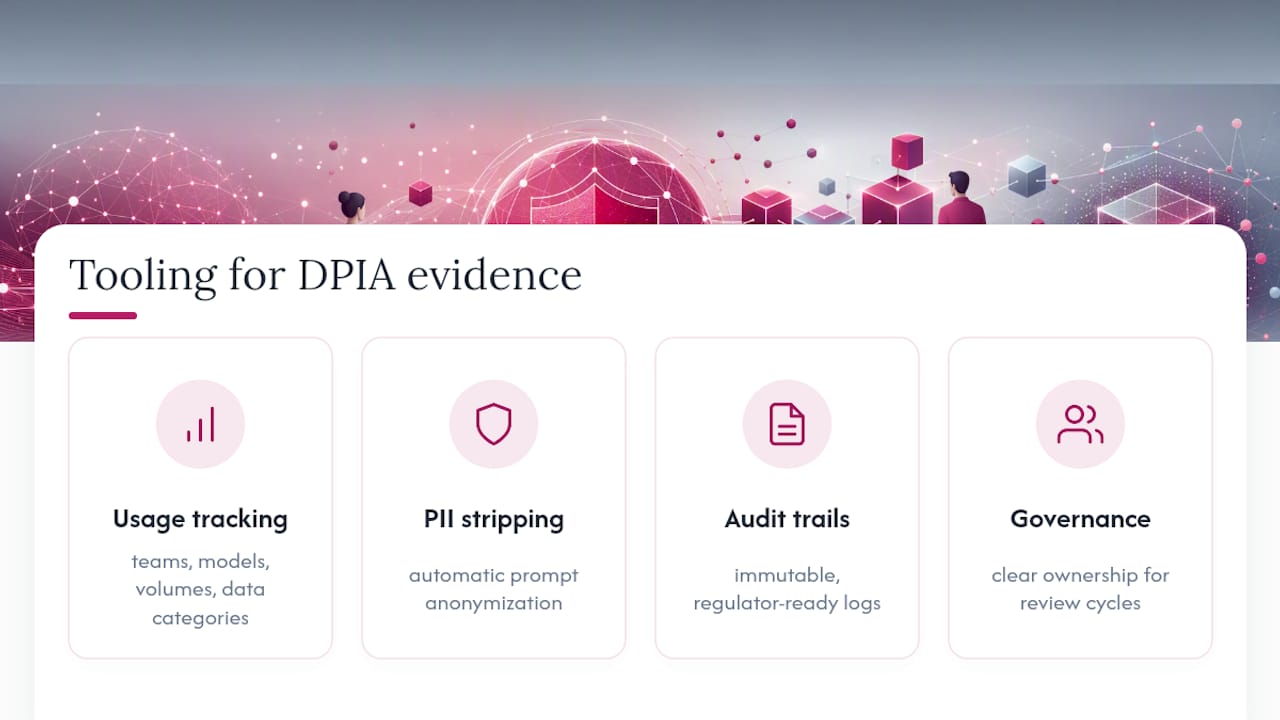
Usage tracking that shows which teams run which models, at what volume, and against what data categories gives you the scale estimates a DPIA’s risk analysis actually needs, instead of guesswork.
Look for tooling that handles automatic PII stripping and prompt anonymization by default, keeps immutable audit trails you can hand to a regulator without reconstruction work, and maintains a live model catalog as your organization adds or swaps providers, such as the Multi-LLM Audit - Check All AI Models at Once tool designed to support risk-testing and bias checking across model variants. Configurato’s privacy architecture is built around exactly this combination: encrypted end to end, GDPR compliant, with PII stripped from prompts automatically. Paired with a governance process that assigns clear ownership for review cycles, this kind of tooling turns evidence collection from a quarterly scramble into a continuous byproduct of normal operations.
Three Priorities for Running an LLM DPIA
Prioritize operational evidence over aspirational controls. Treat the DPIA and any FRIA as living documents tied to model version changes, not one-time filings. Bring in your DPO, compliance team, and engineering leads early, and document every sign-off, because a verbal agreement doesn’t survive an Article 36 consultation.
— TekkrTools
Turn DPIA Evidence Into an Ongoing Practice, Not a One-Time Filing
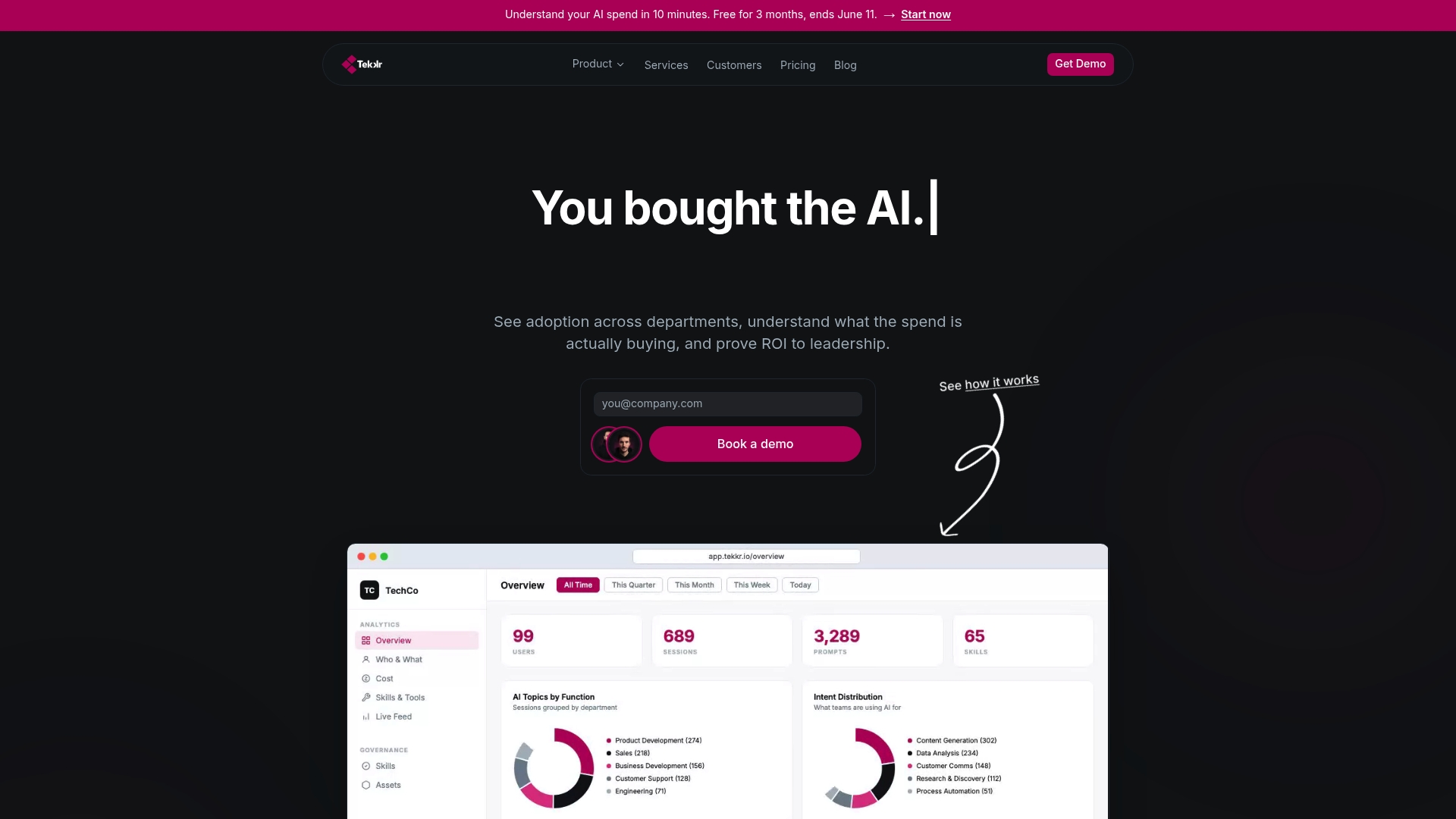
Most teams treat the DPIA as a document to finish and file away. The harder problem is keeping the evidence current when models change monthly and new use cases pop up faster than compliance can track them. Tekkr’s Configurato was built for that gap: it tracks which LLMs your teams actually use, strips PII from prompts automatically, and keeps an immutable audit trail you can hand a regulator without weeks of reconstruction work.
That combination, adoption visibility plus privacy-first architecture, is what turns a DPIA from a compliance formality into something you can defend under Article 36 scrutiny with actual artifacts instead of promises. The security and privacy features cover prompt anonymization, per-call audit logging, and model cataloging out of the box, and setup runs about ten minutes with a free tier and no credit card required. If your organization is rolling out LLMs faster than your governance process can document them, start with Configurato’s AI adoption tooling and see what evidence you’re already missing.
Sources
- Large Language Models (LLMs) — EDPB guidance (2025)
- GDPR AI DPIA: When Article 35 Requires a Data Protection Impact Assessment for an AI System | DeepInspect
- DPIA for AI Systems (2026): Template, Walkthrough, and AI Act FRIA Pairing — Knowlee
This article is general information, not a substitute for advice from a qualified lawyer. Consult a qualified legal professional about your own circumstances before acting on anything here.