
A data lake stores raw data in its native format using schema-on-read; a data warehouse stores cleaned, structured data using schema-on-write. That single distinction drives almost every downstream decision about cost, governance, and who gets to use the data.
Pick a warehouse when the workload is repeatable BI, financial reporting, or executive dashboards. Pick a lake when you’re feeding machine learning models, running exploratory analytics, or ingesting large volumes of unstructured files. Pick a lakehouse when you’re tired of running both and paying for the integration glue between them.
A few terms you’ll see throughout this comparison:
- Schema-on-read vs schema-on-write: whether structure gets applied at query time or at load time
- ELT vs ETL: whether transformation happens after loading (lake pattern) or before (warehouse pattern)
- Object storage (like AWS S3): the cheap, durable storage layer most modern lakes are built on
Key Takeaways
The difference between a data lake and a data warehouse comes down to when structure gets applied, at query time for lakes, at load time for warehouses, and that timing decision drives every downstream tradeoff in cost, governance, and performance.
| Point | Details |
|---|---|
| Core distinction | Lakes use schema-on-read for raw data; warehouses use schema-on-write for curated, structured data. |
| Match workload to platform | Use warehouses for repeatable BI and reporting, lakes for ML training and exploratory analytics. |
| Budget for hidden costs | Lake storage is cheap, but cataloging, indexing, and variable query compute add up fast. |
| Governance can’t wait | Deploy metadata catalogs and access controls before data lands, not after it becomes a swamp. |
| Lakehouse is often the pragmatic default | Combining ACID transactions with object storage cuts system count for mixed BI and ML workloads. |
| Measure adoption after architecture | Tekkr’s Configurato tracks AI usage, spend, and ROI once your data foundation is in place. |
Table of Contents
- Difference Between Data Lake and Data Warehouse: The Core Definitions
- What Technical Differences Actually Matter Here
- BI Reporting or ML Training: Matching Workload to Architecture
- Cost, Performance, and Scalability Trade-offs
- Governance, Metadata, and Security Implications
- The Lakehouse: Where the Line Is Disappearing
- Data Lake vs Data Warehouse: Side-by-Side Comparison
- How to Choose: A Decision Checklist
- What This Means for Enterprise AI Adoption
- How Tekkr Helps After You Pick an Architecture
- Frequently Asked Questions
- Sources
Difference Between Data Lake and Data Warehouse: The Core Definitions
A data lake is a repository for raw and semi-processed data, kept in its native format, structured, semi-structured, or unstructured, on inexpensive object storage. It’s not an ETL tool and it’s not a database; think of it as a holding tank that accepts anything you throw at it, from JSON logs to video files to CSV exports, and figures out structure only when someone queries it.
A data warehouse is a curated, structured store built specifically for fast SQL queries and business intelligence. Data gets cleaned, modeled, and validated before it ever lands in a table, which is why warehouse queries tend to run fast and predictably.
The engines differ accordingly:
- Lakes typically run on object storage like AWS S3 or Azure Data Lake Storage, paired with query engines that read files directly.
- Warehouses run on columnar, massively parallel processing (MPP) systems, think Amazon Redshift, Google BigQuery, or Snowflake, purpose-built to scan billions of rows fast.
- Both increasingly separate storage from compute, but warehouses have historically bundled the two more tightly than lakes do.
What Technical Differences Actually Matter Here
The schema question is the one that ripples through everything else. In a warehouse, you define the schema before data lands, which means every downstream query trusts that the columns mean what they say. In a lake, you apply structure at query time, which gives you flexibility to ingest first and figure out the analysis later. The tradeoff: a warehouse’s schema-on-write model requires cleaning and structuring data upfront, which slows ingestion but speeds every query that follows.
Storage architecture follows the same logic. Lakes favor cheap, flat object storage that scales to petabytes without much thought. Warehouses use optimized columnar storage designed for compression and fast aggregation, usually at a higher per-terabyte cost.
Processing models diverge too. Lakes generally use ELT (extract, load, transform), pushing computation to query time. Warehouses lean on ETL (extract, transform, load), doing the heavy lifting before storage. That choice shifts where you pay for compute and how predictable your costs are: ETL locks in quality and cost upfront, ELT defers both to whenever someone runs a query.
Format and transaction support round out the list:
- Open formats like Parquet and Delta Lake now let lakes support columnar compression once exclusive to warehouses.
- Traditional lakes lack built-in ACID transaction support, which warehouses have had for decades, unless a lakehouse layer is added on top.
Pro Tip: Before committing to ELT, model out what a worst-case query month looks like on variable compute pricing. Teams that skip this step are often surprised when a single analyst’s exploratory query racks up more compute cost than a month of scheduled warehouse jobs.
BI Reporting or ML Training: Matching Workload to Architecture
Executive dashboards, regulatory filings, and monthly board reports belong in a warehouse. These workloads run the same query shape over and over, and they need a single, trusted source of truth that finance and compliance teams can stand behind. Warehouses are built for exactly this kind of repeatable business intelligence.
Data science and ML training pull the opposite direction. Feature engineering wants raw, granular data, including images, logs, and semi-structured event streams that a warehouse schema would flatten or reject outright. Lakes give data scientists the freedom to reshape data however a given model needs it.

Streaming and near-real-time analytics sit in the overlap zone. Modern lakehouse platforms and streaming-native warehouse features have narrowed the gap here, letting teams run near-real-time dashboards off the same pipeline that feeds ML feature stores.
Most enterprises don’t pick one architecture exclusively:
- Raw event data lands in the lake first.
- A curation layer cleans and models a subset of that data into the warehouse for BI.
- This lake-to-warehouse pipeline is one of the most common enterprise patterns, and it’s often why teams end up running both systems rather than choosing one.
For a deeper look at architecting the lake side of this pipeline for AI workloads, see Tekkr’s guide to data lake solutions for enterprise AI.
Cost, Performance, and Scalability Trade-offs
Object storage costs a fraction of optimized warehouse storage per terabyte, which is why lakes win on raw storage economics. But that’s only half the bill. Warehouse compute is often reserved and predictable; lake compute, especially under ELT, gets charged at query time, so a single poorly written join can spike your monthly cloud bill without warning.
Query latency and concurrency favor warehouses for structured SQL workloads. They’re tuned for dozens or hundreds of concurrent BI users hitting the same tables. Lakes can match that performance with the right query engine, but it takes tuning that warehouses give you out of the box.
- Storage: lakes cheaper per terabyte, warehouses more expensive but faster for structured queries
- Compute: warehouses predictable with reserved capacity, lakes variable with on-demand pricing
- Hidden costs: cataloging, indexing, and query optimization on a lake can rival the operational overhead of managing a warehouse
The real cost story isn’t storage, it’s the engineering hours spent making a lake queryable at warehouse speed. Teams that budget only for storage and skip the cataloging and indexing work almost always end up paying for it later, just in a different line item.
Governance, Metadata, and Security Implications
Schema timing determines how much you can trust a single source of truth. Because warehouses enforce structure before ingestion, bad data mostly gets rejected before it reaches a report. Lakes accept everything, which means quality checks have to happen downstream or not at all.
Without strong metadata management, a lake can devolve into what practitioners call a “data swamp”, unsearchable, untrusted, and effectively write-only. Metadata catalogs, lineage tracking, and access-control policies aren’t optional extras for a lake; they’re the difference between an asset and a liability.
- Apply role-based access control and encryption at rest and in transit on both architectures, not just the warehouse.
- Deploy a metadata catalog and a policy engine on the lake before teams start writing to it, not after.
Pro Tip: Assign data classification tags at ingestion time, not retroactively. Retroactive tagging on a multi-petabyte lake is a project that never quite finishes.
The Lakehouse: Where the Line Is Disappearing
The distinction between lakes and warehouses has been blurring for a few years now, and many teams treat the lakehouse as the default architecture rather than a compromise. A lakehouse combines open object storage with the transaction support and schema enforcement that used to require a separate warehouse.
Lakehouse designs deliver ACID semantics and schema enforcement on top of formats like Delta and Parquet, which means one system can serve both BI dashboards and ML feature stores without a separate curation pipeline between them.
Analysts increasingly frame this not as lake versus warehouse but as governance versus speed: warehouses give you consistent, trusted reports; lakes give you ingestion flexibility for use cases you haven’t invented yet. The lakehouse is the attempt to get both without maintaining two systems.
It’s not free of trade-offs. Lakehouse platforms can add complexity for teams that only need simple, stable BI reporting, and single-purpose warehouses still edge out lakehouses on raw query performance for narrow, well-defined workloads.
- Lakehouses reduce system count and integration overhead for mixed BI/ML workloads
- Single-purpose warehouses still win when the workload never touches unstructured data
Data Lake vs Data Warehouse: Side-by-Side Comparison
| Dimension | Data Lake | Data Warehouse |
|---|---|---|
| Schema model | Schema-on-read | Schema-on-write |
| Data types supported | Structured, semi-structured, unstructured | Structured, pre-modeled |
| Primary workloads | ML training, exploratory analytics, large files | BI, regulatory reporting, dashboards |
| Query performance/latency | Variable, engine-dependent | Fast and predictable for SQL |
| Cost model | Cheap storage, variable compute | Higher storage cost, reserved compute |
| Governance & lineage | Requires added catalog/policy layer | Built-in structure aids trust |
| Scalability & concurrency | High storage scale, concurrency needs tuning | High concurrency for structured queries |
| Skills/ops complexity | Higher without lakehouse tooling | Lower for standard SQL workloads |
Vendors like Databricks and Snowflake illustrate the convergence directly: Databricks built its platform around the lakehouse pattern, while Snowflake, historically a pure warehouse, has added native support for semi-structured data and external tables to close the gap from the other direction.
How to Choose: A Decision Checklist
Run through these questions before committing budget to either architecture:
- What’s the dominant workload, repeatable BI or exploratory ML?
- What latency SLA do your stakeholders actually need, not just want?
- How many concurrent users will hit the system, and in what query patterns?
- What proportion of your data is unstructured or semi-structured today?
- Does your team have the skills to manage lake cataloging and indexing, or only SQL?
- How mature is your governance function, do you already have a data catalog?
- What’s your tolerance for variable, query-time compute costs?
Watch for these red flags before you commit:
- No metadata catalog or discovery tooling planned before data starts flowing in
- Governance owned by no one, or owned by everyone, which is the same problem
- A pilot scoped around a single easy workload instead of your actual mixed reality
Start with a representative pilot, not your easiest use case. A lake pilot that only tests clean CSV files tells you nothing about how it handles the messy log data you’ll actually load six months in.
What This Means for Enterprise AI Adoption
Platform choice shapes AI ROI measurement more than most teams expect. If model training data lives in a lake with no lineage tracking, nobody can answer a basic question: which dataset actually produced the model in production right now. Tekkr sees this gap constantly across enterprise AI rollouts, teams that instrumented spend and usage but never connected it back to data lineage or quality.
The fix isn’t complicated, but it does require discipline:
- Prioritize metadata and lineage capture before scaling any pipeline, lake or warehouse.
- Instrument ML pipelines for usage and cost from day one, not after the first budget overrun.
- Align governance maturity with your adoption KPIs, not just your storage architecture.
Get this right and adoption metrics become trustworthy. Get it wrong and you’re reporting AI ROI numbers nobody can actually trace back to source data. Tekkr’s guide on enterprise AI adoption covers instrumentation patterns that pair well with either a lake or warehouse foundation.
A Pragmatic Take on Lake vs Warehouse
For most enterprise AI programs, a hybrid or lakehouse approach beats picking a side. You need the lake’s flexibility to capture whatever a future model might need, and the warehouse’s discipline to keep finance and compliance confident in the numbers.
A single-purpose warehouse still makes sense when your entire data estate is structured and your only real workload is reporting. Don’t build lakehouse complexity you don’t need.
How Tekkr Helps After You Pick an Architecture
Choosing between a lake, a warehouse, or a lakehouse solves the storage question. It doesn’t solve the harder problem: knowing whether the AI tools running on top of that data are actually being used, by whom, and at what cost.
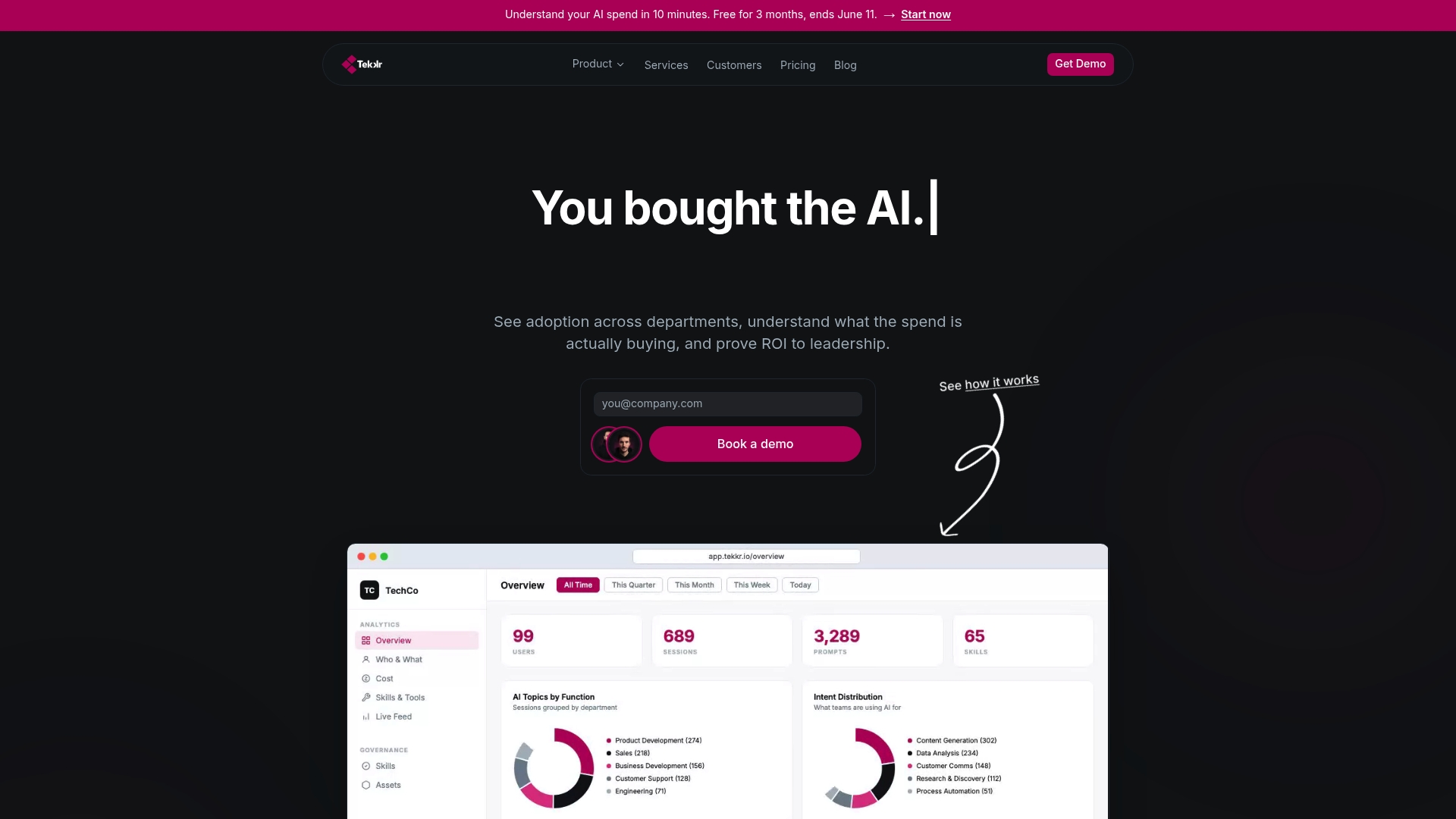
Tekkr’s Configurato platform tracks AI adoption, spend, and ROI across your organization once your data architecture is in place, breaking down usage of tools like Claude and Codex by team, surfacing where spend isn’t translating into adoption, and flagging gaps before they show up in a board report. Setup takes about 10 minutes, runs on a privacy-first architecture with automatic PII stripping, and starts with a free tier, no credit card required. If your next step is proving the AI investment sitting on top of your new data platform is actually paying off, start with Tekkr’s AI adoption product or explore advisory support for the rollout.
Frequently Asked Questions
Is Snowflake a data lake or a data warehouse? Snowflake is primarily a cloud data warehouse, though it now supports semi-structured data and external tables that give it some lake-like flexibility.
Is Databricks a data lake or a lakehouse? Databricks positions itself as a lakehouse platform, combining lake-scale object storage with warehouse-style performance and governance features.
Can a data lake replace a data warehouse entirely? Rarely for BI-heavy organizations. Most enterprises run a lake for raw and exploratory data alongside a curated warehouse layer for reporting, or consolidate both into a lakehouse.
Do I need both Amazon Redshift and AWS S3, or can I pick one? Many AWS architectures use S3 as the lake layer and Redshift as the warehouse layer, with data flowing from one into the other rather than choosing exclusively.
What is the simplest way to explain schema-on-read vs schema-on-write? Schema-on-write means you decide the structure before you save the data. Schema-on-read means you decide the structure when you read it back out.
Sources
- Data Lakes vs Data Warehouses Explained | Databricks Blog
- The difference between a data warehouse, data lake and data mart | AWS
- Data lake vs data warehouse: Key differences explained | TechTarget