
Department AI spend is the portion of an enterprise’s AI investment attributed to a specific business function, such as engineering, marketing, or customer support, tracked through usage, licensing, and infrastructure costs tied to that team. The single most urgent move for finance and department leaders right now is to enable per-department attribution and reporting. Most organizations can reach real departmental visibility within 90 days, which is fast enough to stop runaway bills before the next budget cycle.
TL;DR:
- Enabling per-department AI spend attribution within 90 days helps identify runaway bills and prevent overspending before the next budget cycle.
- Tagging API calls and usage logs by team and use case is essential to accurately measure and attribute costs across departments.
- Transitioning to a visibility-first approach allows organizations to detect shadow subscriptions, optimize spend, and strengthen procurement leverage.
- A 90-day implementation plan includes inventorying vendors, instrumenting high-volume flows, and publishing departmental spend reports to ensure ongoing oversight.
- Using a hybrid budgeting model and linking spend to actual outcomes enhances accountability, supports forecasting, and improves governance of AI investments.
Table of Contents
- Where Departmental AI Spend Sits in Enterprise Budgets Today
- Why Department-Level Visibility Matters for Finance and Department Heads
- How to Measure and Attribute AI Spend by Department
- Practical Models to Budget and Allocate AI Spend
- Allocating Governance Resources by Risk, Not by Department Size
- A 90-Day Plan to Gain Visibility and Stop Runaway Spending
- What KPIs Should You Show the CFO and CTO?
- How Department AI Spend Reshapes Budgeting and Forecasting
- Common Challenges and Pitfalls in Tracking Department AI Spend
- Best Practices for Integrating AI Spend Visibility With Financial Systems
- What Successful Department-Level AI Spend Management Looks Like
- Why Visibility-First Beats Governance-First Every Time
- See Departmental AI Spend Clearly With Configurato
- Sources
- FAQ
Where Departmental AI Spend Sits in Enterprise Budgets Today
AI spend has stopped behaving like a pilot expense. Menlo Ventures’ 2025 State of Generative AI in the Enterprise found that generative AI investment moved into recurring budget lines during 2025. Product and engineering teams absorbed the majority of enterprise spend on coding tools, copilots, and industry-specific models. That shift matters because recurring costs get finance scrutiny that one-time pilot budgets never did.
Deloitte’s 2025 tech value survey backs this up: organizations now dedicate between 21% and 50% of digital initiative budgets to AI, averaging around 36%. Meanwhile, enterprise CIOs surveyed by a16z describe AI budgets graduating from experimentation funds to permanent line items, with many expecting sharp year-over-year growth.
The catch: spend concentrates in visible front-office functions, while back-office automation, the kind that quietly eliminates BPO contracts or agency retainers, often delivers better payback and gets less attention. If your organization can’t say which department drove last quarter’s AI bill increase, you’re not alone. But you’re also not ready for the next budget cycle.
Why Department-Level Visibility Matters for Finance and Department Heads
Without departmental attribution, finance teams face what amounts to a black box every renewal cycle. A single vendor invoice arrives as one lump number, no breakdown by team, feature, or use case. This is sometimes called the Lump Sum Problem, and it has real consequences of bookkeeping annoyance.
Visibility solves several problems at once:
- Shadow AI stops hiding. Unattributed subscriptions and rogue API keys surface once every dollar maps to an owner.
- Back-office wins become visible. Automation that displaces an agency retainer or a BPO seat often has a stronger payback than flashy front-office tools, but it never gets funded if nobody can prove it.
- Procurement gets leverage. Knowing exact per-department usage lets finance negotiate renewals from data instead of vendor talking points.
- Budget reallocation becomes defensible. You can move money from underused licenses to high-demand teams with evidence, not guesswork.
Pro Tip: Tie each department’s AI budget renewal to a one-page usage and outcome summary. Finance teams that require this before approving a renewal tend to catch overspend and underuse in the same document.
How to Measure and Attribute AI Spend by Department
Attribution starts with instrumentation, not spreadsheets. You need three data streams talking to each other: vendor billing, usage logs, and team metadata. Without that connective tissue, you’re stuck reading invoice totals and guessing.
The core technique is tagging. Every API call, seat assignment, or model request gets tied to a team, a use case, and ideally a cost center. Vendor billing exports then get reconciled against those tags. This is exactly the kind of correlation Menlo Ventures flags when it notes that product-led adoption and shadow AI usage make up a growing, often invisible, share of enterprise spend, precisely because nobody tagged it at the source.
Once tagging exists, unit economics follow naturally:
- Cost per query or request — the raw usage-level cost, useful for high-volume flows like support chatbots or code generation.
- Cost per feature — spend attributed to a specific product capability, useful when engineering ships AI-powered features.
- Cost per outcome — cost divided by a business result, like tickets resolved or leads qualified, the metric CFOs actually care about.
Prioritize instrumentation on your highest-volume flows first. A support desk running thousands of AI-assisted tickets a day will surface far more signal, and far more savings, than a niche internal tool used by five people.
| Metric | Data source | Owner |
|---|---|---|
| Cost per department | Vendor billing + tags | Finance |
| Cost per use case | Usage logs + metadata | Engineering |
| Adoption rate | Login/usage telemetry | Department head |
| Cost per outcome | Business KPIs + spend | Finance + department head |
Finance and engineering need to run this jointly. Finance alone can’t tag usage data, and engineering alone won’t prioritize cost reporting without a mandate.
Practical Models to Budget and Allocate AI Spend
Three allocation models dominate enterprise practice, and each fits a different maturity stage.
Centralized budgets put one team, usually IT or a central AI function, in control of all AI spend. This works early on, when usage is low and you need consistent vendor negotiation. It breaks down once departments start adopting tools independently, because the central team can’t see what it doesn’t own.
Distributed budgets hand each department its own AI line item. This scales adoption fast and puts accountability where usage happens, but it invites duplicate tooling and inconsistent governance across departments.
Hybrid models centralize platform-level contracts (the core LLM providers, security tooling, observability) while letting departments own their application-layer spend and use-case decisions. Most mature organizations converge here.
Whichever model you choose, guardrails matter:
- Set renewal thresholds that trigger a usage review before any contract over a certain size auto-renews.
- Require minimum utilization for platform-level investments before expanding seats.
- Choose between cross-charge (departments pay directly) and showback (departments see costs but don’t pay directly) based on how much autonomy you want to grant.
A simple scoring rubric, rating funding requests on value, risk, and feasibility on a one-to-five scale, gives you a defensible way to rank competing department requests when budget is tight. Tekkr’s guide on optimizing AI usage walks through similar prioritization levers CFOs can apply directly.
Allocating Governance Resources by Risk, Not by Department Size
Governance spend should scale with risk, not with how loud a department is. The NIST AI Risk Management Framework organizes this into four functions: Govern (set policy and accountability), Map (identify context and risk), Measure (quantify performance and risk indicators), and Manage (respond and allocate resources).
The framework’s practical value is that it ties oversight spending directly to assessed risk level, not to department popularity or spend volume.
- Red-flagged systems (customer-facing decisions, regulated data, financial outputs) receive dedicated review cycles and named owners.
- Amber systems (internal tools touching sensitive data) receive periodic audits.
- Green systems (low-stakes internal productivity tools) receive lightweight, automated monitoring.
Document every system’s risk tier and assign a named accountable owner, not just a team. A rubric with no owner behind it becomes shelf-ware within two quarters. NIST’s framework doesn’t prescribe exact dollar amounts, but it does make one thing clear: governance budgets should track risk exposure, not headcount or spend size.
A 90-Day Plan to Gain Visibility and Stop Runaway Spending
You don’t need a year-long transformation program to get control of departmental AI spend. A focused 90-day sprint gets most organizations from zero visibility to auditable reporting.
- Weeks 0 to 2: Inventory every AI vendor and tool in use, assign an owner per contract, and centralize billing intake so invoices stop landing in five different inboxes.
- Weeks 3 to 6: Instrument your highest-volume usage flows first, tag requests by team and use case, and stand up a basic dashboard showing spend by department.
- Weeks 7 to 10: Run anomaly detection against usage patterns to catch shadow subscriptions and unexpected spikes, then publish the first departmental spend report to finance and department heads.
- Weeks 11 to 12: Lock in governance checkpoints tied to risk tier, and set a recurring executive reporting cadence so this doesn’t become a one-time exercise.
Pro Tip: Don’t wait for perfect data before publishing your first report. A rough departmental breakdown in week six, even with gaps, creates pressure to fill those gaps faster than any internal memo will.
Enterprises that lead with visibility rather than model tuning have reported cutting AI spend by 40 to 60 percent within a similar window, largely by finding unattributed and duplicate spend that nobody was tracking. Tekkr’s governance playbook covers this same 90-day arc in more operational detail for CTOs and CFOs working through it together.
What KPIs Should You Show the CFO and CTO?
Executive reporting works best when it answers one question per metric, cleanly, without forcing a CFO to interpret a dashboard.
- Departmental AI spend — absolute dollars per department, per month.
- Spend growth rate — how fast each department’s AI costs are rising, flagged against budget.
- Cost per outcome — spend divided by a business result, the number that actually justifies renewal.
- Adoption rate — percentage of licensed seats actively used, which exposes waste fast.
- ROI per use case — value generated against cost, ideally tied to avoided external spend.
Frame these in language finance already uses. A department that replaced part of an agency retainer with an internal AI workflow should get credited as avoided external spend, not just “AI savings,” because that maps directly to an EBITDA conversation CFOs already understand. Deloitte’s research on leadership alignment shows that how you frame these numbers depends on who’s receiving them: CTOs respond to adoption and technical performance, CFOs respond to cost avoidance and margin impact. Report monthly to department heads, quarterly to the executive team.
How Department AI Spend Reshapes Budgeting and Forecasting
Once departmental AI costs are visible, they stop being a rounding error in the annual plan and start behaving like a real budget category, one with its own growth curve, renewal cycles, and seasonality. That changes how finance teams forecast.
Traditional software budgeting assumes fairly flat, predictable license costs. AI spend doesn’t behave that way. Usage-based pricing means a department’s bill can double in a quarter simply because adoption increased, with no new contract signed. Forecasting models built for flat SaaS costs will consistently underestimate AI line items unless they incorporate usage trend data, not just headcount or seat counts.
This has a knock-on effect on capital planning too. Departments that show strong cost-per-outcome numbers become easier to fund aggressively in the next cycle, while departments burning budget with low adoption become candidates for reallocation. Finance teams that build department-level AI visibility into their quarterly forecasting process report catching budget overruns a full cycle earlier than teams relying on annual vendor reconciliation.
The broader organizational budget also needs a new line: governance and oversight cost, separate from tool licensing. As AI systems scale, the NIST-aligned review and monitoring work described earlier carries its own cost, and it needs its own forecast line rather than getting buried inside a general IT operations budget. Organizations that skip this step tend to discover governance costs retroactively, usually right when a risk incident forces the conversation.

Common Challenges and Pitfalls in Tracking Department AI Spend
The most common failure mode isn’t a lack of tools. It’s organizational: nobody owns the reconciliation between vendor invoices and internal usage data, so the work never happens consistently.
A few specific pitfalls show up repeatedly across enterprises trying to build this visibility:
Fragmented vendor billing. Large enterprises often run five, ten, or more AI vendor relationships simultaneously, each with its own billing format, none of which map cleanly to internal cost centers. Reconciling this manually every month is unsustainable past a handful of vendors.
Shadow subscriptions. Individual employees or small teams sign up for tools using personal or departmental credit cards, bypassing procurement entirely. These costs often go untracked until a finance audit stumbles onto them, sometimes months later.
Metadata gaps. Tagging requests by team and use case sounds simple until you realize most legacy logging systems weren’t built to capture that context. Retrofitting tagging into existing pipelines takes real engineering time, which competes with feature work for priority.
Attribution disputes. When two departments share a platform, like a company-wide chatbot serving both sales and support, allocating shared infrastructure cost fairly becomes a political exercise as much as a technical one.
Static reporting. Some organizations build a one-time spend report, present it once, and never repeat the exercise. Visibility only has value as an ongoing habit, not a quarterly fire drill.
Each of these pitfalls has the same root cause: treating AI spend attribution as a project instead of an operating discipline.

Best Practices for Integrating AI Spend Visibility With Financial Systems
The organizations that get this right treat AI spend data as another feed into existing financial infrastructure, not a parallel system running alongside it. Bolting on a standalone AI cost dashboard that finance never opens defeats the purpose.
Start by mapping AI vendor cost centers to the same chart of accounts structure finance already uses for software spend generally. This sounds mundane, but it’s what makes an AI spend report legible to a CFO in thirty seconds rather than requiring a meeting to explain a new taxonomy.
Push usage and billing data into the same systems finance already trusts for reconciliation, rather than asking finance teams to check a second dashboard. If your organization runs a general ledger and an expense management system, AI spend data needs an automated feed into both, not a manual export someone remembers to run monthly.
Align reporting cadence with existing budget cycles. If finance reviews departmental budgets monthly, AI spend reporting should hit that same cadence, not an arbitrary weekly or quarterly schedule that creates extra reconciliation work.
Finally, assign a single owner for the AI spend data pipeline, someone accountable when a number looks wrong, the same way a controller owns general ledger accuracy. Tekkr’s guide to AI spend analysis for finance leaders covers the reconciliation mechanics in more depth for teams building this integration from scratch.
What Successful Department-Level AI Spend Management Looks Like
The pattern across organizations that get departmental AI spend under control looks less like a single dramatic fix and more like compounding discipline.
Engineering-heavy organizations that instrumented coding assistant usage early tend to catch a specific problem fast: seat sprawl, where licenses get assigned during onboarding and never get revoked when someone changes roles or leaves a team. Tracking adoption rate alongside spend, not spend alone, is what surfaces this. A department paying for 200 seats with 60 active users is an obvious reallocation candidate once adoption data exists, but invisible without it.
Customer support functions that tagged AI-assisted ticket resolution by cost center have been able to build a direct case for budget increases, because cost-per-outcome data ties resolution time improvements to headcount avoidance, a number CFOs can act on immediately. This is the back-office pattern research consistently points to: less visible than front-office AI investment, but often carrying a stronger, more defensible ROI story once it’s measured.
Marketing organizations offer a useful contrast. Front-office AI adoption, covered in third-party analysis on AI’s impact on client acquisition and agency productivity gains, tends to get funded quickly because results are visible and easy to narrate. The lesson for finance leaders isn’t to defund front-office AI. It’s to make sure back-office use cases get measured with the same rigor so they compete fairly for the next budget cycle instead of losing by default.
Why Visibility-First Beats Governance-First Every Time
Most enterprises build AI governance before they build AI visibility, and it backfires. You can’t govern what you can’t see, and a governance framework layered on top of an unmeasured spend base just creates paperwork without changing behavior.
The organizations getting real results flip that order: measure and attribute spend first, then apply risk-based governance to what the data actually shows. That sequencing is why a 90-day visibility sprint tends to outperform a six-month governance rollout. The visibility work also happens to be exactly what department heads need to defend their own budgets in the next planning cycle, which makes adoption a lot less of a fight.
— TekkrTools
See Departmental AI Spend Clearly With Configurato
A platform offering department-level breakdowns enables finance leaders to obtain detailed spend visibility without months of manual reconciliation work. It tracks tool usage, attributes costs by team and use case, and identifies which departments are achieving returns versus paying for underused licenses.
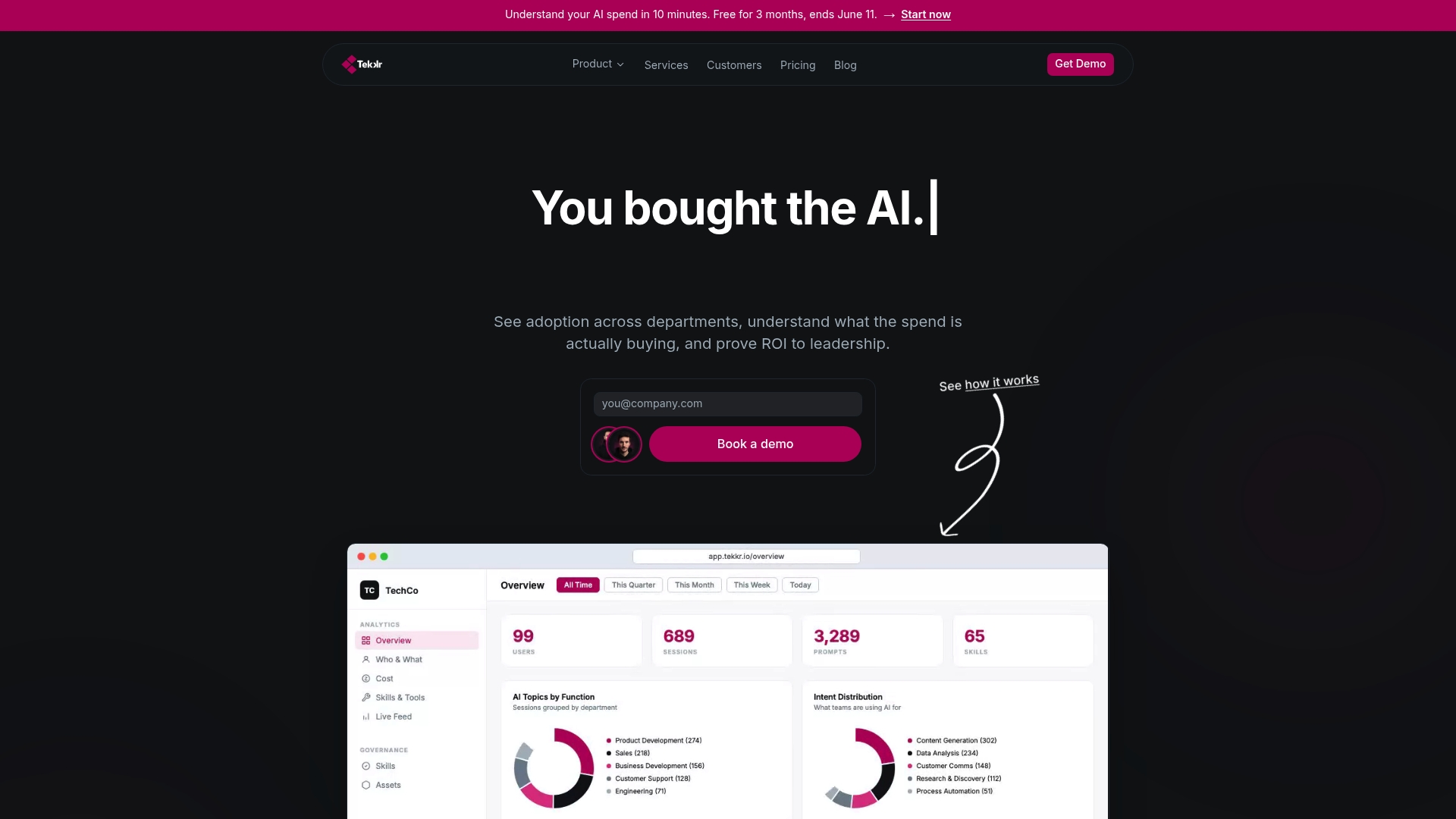
Setup can be completed quickly without browser extensions or credit card requirements to start on a free tier. That matters if you’ve been putting off spend visibility because every other option on the market demands a lengthy implementation project before you see a single number. Configurato also runs on a privacy-first, end-to-end encrypted architecture that’s GDPR-compliant and strips personal information from prompts automatically, so finance and security teams don’t have to negotiate a separate data-handling exception to get the reporting they need.
Beyond tracking, Configurato drives adoption higher through gamified rollouts and company-wide AI playbooks, so the tools you’re already paying for actually get used. Check the Configurato product page to see what department-level reporting looks like, or review Tekkr’s pricing if you’re ready to move past guesswork on where your AI budget is actually going.
Sources
- Menlo Ventures’ 2025 State of Generative AI in the Enterprise
- AI and tech investment ROI | Deloitte Insights
- AI RMF playbook (NIST)
- How 100 Enterprise CIOs Are Building and Buying Gen AI in 2025 | Andreessen Horowitz
FAQ
What Is Department AI Spend?
Department AI spend refers to the AI-related costs attributed to a specific business function, such as engineering, sales, or support, based on usage, licensing, and infrastructure tied to that team. Measuring it requires tagging usage data and reconciling it against vendor billing rather than relying on a single lump invoice.
How Long Does It Take to Get Departmental AI Spend Visibility?
Most organizations can reach basic departmental visibility within 90 days by inventorying vendors, instrumenting high-volume usage flows, and publishing an initial spend report. Full integration with existing financial systems and governance checkpoints typically follows in the same window if the effort is treated as a focused sprint rather than an open-ended project.
How Does Tekkr Help With Departmental AI Spend Tracking?
Tekkr’s Configurato platform tracks AI tool usage and attributes cost by department and use case, giving finance and department heads a clear view of spend and adoption without a lengthy setup process. Setup takes about 10 minutes, and a free tier is available with no credit card required, detailed on the Configurato product page.
What’s the Biggest Mistake Companies Make With AI Budgets?
The most common mistake is building AI governance before establishing spend visibility, which creates process overhead without actually revealing where money goes. Measuring and attributing spend first, then applying risk-based oversight to what that data shows, tends to produce faster, more defensible results.
Should AI Budgets Be Centralized or Distributed by Department?
Neither extreme works well at scale: fully centralized budgets lose visibility into department-specific usage, while fully distributed budgets invite duplicate tools and inconsistent governance. Most mature organizations use a hybrid model, centralizing platform-level contracts while letting departments own application-layer spend decisions.