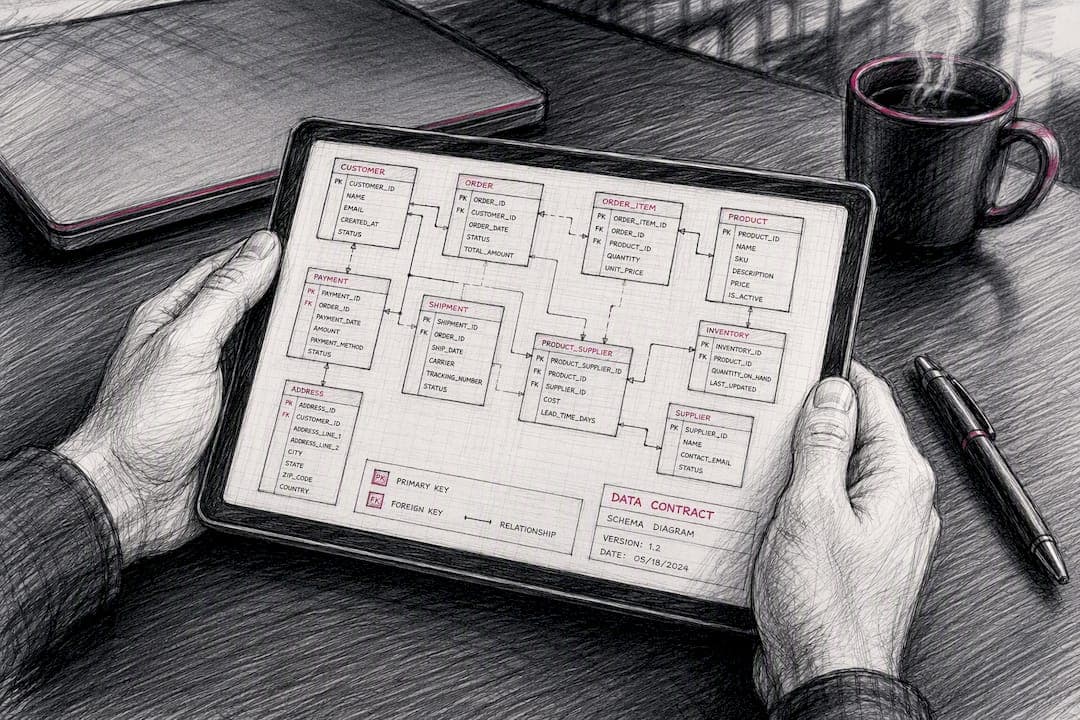
“Database contracts” means one of two very different things, and confusing them wastes time. If you’re an engineer, it usually means data contracts: machine-readable agreements that lock down schema, quality, and availability between the teams producing data and the teams consuming it. If you work in legal or operations, it means a contract database, a centralized, searchable repository for the agreements your company signs.
Choose your path based on your goal:
- Want pipelines that stop breaking when someone renames a column? Go to the data contract sections below, where tools like dbt and Prisma enforce schema at build time.
- Want to stop losing renewal dates in a shared drive? Skip to the contract database sections, where contract lifecycle management (CLM) software turns static PDFs into searchable, trackable records.
Both problems are solvable. Both get worse the longer you ignore them.
Key Takeaways
Database contracts split into two disciplines that solve different problems, and treating either one as mere documentation instead of an enforced system is the single most common failure mode in both.
| Point | Details |
|---|---|
| Clarify which meaning applies | Engineering data contracts govern schema and pipelines; contract databases govern legal agreements. |
| Enforce, don’t just define | Use tools like dbt or Prisma to fail builds on schema mismatches instead of relying on documentation. |
| Start with minimum viable fields | Build contract databases around a core metadata set before chasing a perfect taxonomy. |
| Name real owners | Every data contract and every contract record needs a named accountable person, not a team name. |
| Sequence by acute pain | Onboard whichever team, engineering or legal, is feeling the most operational pain first. |
This article is general information, not a substitute for advice from a qualified lawyer. Consult a qualified legal professional about your own circumstances before acting on anything here.
Table of Contents
- What Is a Data Contract in Database Engineering?
- What Should Every Data Contract Include?
- Why Do Data Contracts Matter for Data Quality?
- How Do You Implement and Enforce Data Contracts?
- What Do Deterministic Contract Guarantees Look Like in Practice?
- What Is a Contract Database, and Why Do Legal Teams Need One?
- What Are the Best Ways to Build a Contract Database?
- How Do You Build a Functioning Contract Database From Scratch?
- What Are the Most Common Pitfalls in Both Systems?
- Data Contracts or Contract Database: Which Do You Need First?
- What’s the Right Order to Roll Out Database Contracts?
- Turn Contract Discipline Into Organization-Wide AI Governance
- Sources
What Is a Data Contract in Database Engineering?
A data contract is a formal, machine-readable agreement that specifies a dataset’s shape, data types, semantic meaning, service-level guarantees, and ownership. IBM defines it as the formal link between the team producing data and every team downstream that depends on it. It’s the difference between “I hope that table doesn’t change” and “the build fails if it does.”
Picture a simple example: a customer_orders table with an order_id (integer, non-null), an order_date (timestamp), a total_amount (decimal, two-digit precision), and a status field constrained to five specific string values. The contract also states a freshness SLA, say, data lands within 15 minutes of the transaction, and names the owning team’s Slack channel for incident response. That’s the whole idea. Nothing exotic, just precision written down somewhere a machine can check it.
Where this actually gets used:
- Public or shared data models that multiple teams query, where nobody wants a silent schema change to break five downstream jobs at once.
- Cross-team data products, where a data platform team promises a stable interface to product teams that don’t want to read pipeline code to understand what changed.
- Downstream analytics, where a dashboard breaking at 6 a.m. is a lot cheaper to prevent than to debug.
- ML training datasets, where a quietly shifted feature distribution can degrade a model for weeks before anyone notices.
- Integration points between internal systems and third-party APIs, where a mismatched field type can cascade into a production incident.
What Should Every Data Contract Include?
A data contract that only describes structure and skips everything else is half a contract. The strong ones cover eight areas:
- Canonical schema: every column, its data type, and whether it’s nullable.
- Validation rules and tests: range checks, uniqueness constraints, referential integrity, anything you’d write as a unit test for data.
- SLAs and availability guarantees: how fresh the data must be, and what uptime the pipeline promises.
- Ownership and contact points: a named team or person, not “the data platform” in the abstract.
- Versioning and change policy: how breaking changes get proposed, reviewed, and rolled out.
- Semantics and field dictionaries: what “active_user” actually means, because every team has a different definition until someone writes it down.
- Access controls: who can read, write, or modify the underlying tables.
- Observability hooks: alerts and logging tied to contract violations, not just to infrastructure failures.
There’s a real gap between metadata that’s merely definable and metadata that’s enforced. You can write a beautiful schema document in a wiki, and it will do nothing to stop a runtime failure. Enforcement means the system actively checks: a build fails, a deploy is blocked, or a pipeline halts before bad data spreads. dbt’s model contracts are a clean example. When contract enforcement is turned on, dbt fails the model build if the returned columns or data types don’t match what’s declared, which requires the contract to name columns and data types explicitly upfront.
Pro Tip: Version your contracts the way you version an API. Treat any column rename, type change, or removed field as a breaking change requiring a new major version and a deprecation window, not a silent patch.
Why Do Data Contracts Matter for Data Quality?
Contracts prevent a specific, recurring failure: a producer changes something upstream, and five things break downstream before anyone notices. That’s not hypothetical. It’s the most common root cause of “why did the dashboard go blank overnight” incidents at any company running more than a handful of pipelines.
Concretely, contracts:
- Prevent pipeline failures triggered by unannounced schema changes.
- Reduce the blast radius of an incident, since enforcement catches the mismatch at the source instead of three hops downstream.
- Improve trust in analytics and ML outputs, because consumers know the input has guarantees.
- Speed up onboarding for new data consumers, who get documentation instead of a Slack thread archive.
- Enable safer automation, since a system can act on data it doesn’t have to manually double check.
Here’s the failure pattern in practice: a producer team renames user_id to customer_id without telling anyone. Three downstream jobs that reference the old column name fail overnight. Analysts spend the morning debugging, not analyzing. With an enforced contract, that rename fails the build the moment it’s proposed, and the fix happens in code review, not in a war room. Worth tracking over time: incidents avoided, and time-to-resolution when something does slip through.
How Do You Implement and Enforce Data Contracts?
Four approaches dominate in practice, and most mature teams end up combining more than one:
- Schema-as-code: contracts live in version control alongside the pipeline code that produces the data, reviewed in the same pull requests.
- Schema registries: a centralized service (common in streaming architectures) that validates every message against a registered schema before it’s accepted.
- Tests-as-contracts: existing data testing frameworks double as enforcement, checking null rates, uniqueness, and ranges on every run.
- Platform-assisted enforcement: the platform itself, not a bolt-on tool, blocks builds or deploys that violate the contract.
A basic implementation checklist looks like this: author the contract with the consuming team’s input, add preflight checks that run before any build, wire enforcement into CI/CD so violations block merges, set up monitoring and alerting for runtime drift, and document the change policy so nobody is guessing how to propose an update.
Responsibility usually breaks down like this:
| Role | Author Contract | Approve Changes | Enforce in CI/CD | Monitor Violations |
|---|---|---|---|---|
| Data producer team | Responsible | Consulted | Accountable | Informed |
| Data consumer team | Consulted | Responsible | Informed | Accountable |
| Platform engineering | Informed | Consulted | Responsible | Responsible |
| Data governance lead | Consulted | Accountable | Informed | Consulted |
Enforcement points each carry trade-offs: preflight build checks catch problems early but need CI access; runtime checks catch what preflight misses but let bad data through before flagging it; DDL verification against the live database catches drift at the source but requires database-level tooling most teams haven’t set up yet. Enforcing standards consistently across teams is exactly the kind of policy work that AI-assisted governance tooling can help operationalize at scale.
What Do Deterministic Contract Guarantees Look Like in Practice?
The most rigorous engineering approach treats the contract as a compiled artifact, not a document. Prisma 8 is the clearest current example: it treats the contract as the single source of truth, compiles it into deterministic artifacts like contract.json and contract.d.ts, computes a content hash, and checks that hash against the live database before running queries. If the database doesn’t match what the contract expects, Prisma blocks the deploy instead of letting a mismatch slip into production.
Think of it as a build pipeline: you write the contract, a compiler generates the machine-readable artifact and its hash, and a verification step at deploy time compares that hash against the actual database state. Mismatch means stop, not warn.
Deterministic contract artifacts and cryptographic hashing exist precisely so misalignment gets caught before a single query runs against production data, not after.
Best practices worth adopting regardless of your specific stack: commit the contract source to version control, run preflight verification in CI, verify at compile time or deploy time rather than relying on runtime alerts alone, and make contract violations observable, not silent log lines nobody reads.
Pro Tip: When migrating a database that has partial constraint support, don’t assume the platform enforces everything your contract declares. Test each constraint type against your actual database engine before trusting it in production.
What Is a Contract Database, and Why Do Legal Teams Need One?
A contract database is a centralized, searchable repository of executed agreements, with metadata extracted from each document so lifecycle events, like renewals, obligations, and expirations, trigger action instead of getting missed. LexisNexis frames it well: the goal is turning contracts into operational business intelligence rather than static files sitting in a folder.
The benefits over a shared drive or an inbox full of signed PDFs are concrete:
- Discoverability: search by counterparty, clause type, or expiration date instead of scrolling through folder names.
- Obligation tracking: know who owes what, and by when, without re-reading every document.
- Automated reminders: renewal and termination dates trigger alerts instead of surprises.
- Analytics: spend visibility, contract volume by vendor, risk exposure by clause type.
- Auditability: a defensible trail of who changed what, and when, for compliance and litigation readiness.
A shared drive fails at enterprise scale for a simple reason: it has no memory. Nobody gets alerted when a renewal window opens, nobody can search by clause language, and version history is whatever naming convention someone happened to use in 2022. A contract database with real metadata extraction solves all three problems by design, not by discipline.
What Are the Best Ways to Build a Contract Database?
Three paths exist, and the right one depends entirely on your contract volume and how much manual work you’re willing to tolerate.
- Manual or Excel-based repository. Fast to start, costs nothing beyond time, and works fine for a small portfolio, maybe under 100 active agreements. The limitation shows up fast: no automated alerts, no real search beyond filename, and metadata quality depends entirely on someone’s discipline in keeping the spreadsheet current.
- Homegrown contract database. Building your own repository on top of a general database or document management system gives you full control over fields and integrations, but it means someone owns the ongoing engineering work: metadata schema design, search indexing, and alert logic all have to be built and maintained in-house.
- Commercial CLM software. Platforms in this category, DocuSign CLM among them, automate metadata extraction with AI, run built-in renewal workflows, and integrate with e-signature and procurement systems out of the box. The investment pays off once manual tracking starts causing missed renewals or eating meaningful staff time.
Decide based on four factors: contract volume, how much automation you actually need versus want, integration requirements with existing legal and finance systems, and how complex your regulatory obligations are.
Pro Tip: A useful upgrade trigger: once you’re managing more than a few hundred active contracts, or you’ve missed even one renewal deadline that cost real money, the spreadsheet has already stopped paying for itself.
How Do You Build a Functioning Contract Database From Scratch?
Start with a minimum field template. Every record needs, at minimum: contract title, parties involved, effective date, expiry or renewal trigger, key obligations, monetary value, contract owner, current status, tags or category, and linked attachments. Skip any of these and you’ll be back to manually opening PDFs within a month.
Indexing comes next. OCR extracts text from scanned documents, clause extraction pulls out specific provisions like termination rights or liability caps, and both feed the searchable fields that make the whole system worth using. Automate metadata extraction first. It’s the highest-leverage step, since manual tagging is exactly the bottleneck a contract database exists to remove.

Lifecycle tracking is what separates a database from a filing cabinet: renewal alerts fire ahead of deadlines, obligation owners are named individuals (not “legal team”), version history captures every amendment, and an audit trail records who touched what.
Integrations matter more as volume grows. E-signature platforms feed newly executed contracts directly into the repository. ERP and finance systems reconcile contract values against actual spend. Procurement systems flag new vendor agreements automatically. Legal matter management systems link contracts to active disputes or negotiations, which CLM vendors like Jaggaer build into procurement-focused platforms with clause libraries and full-text search.
A practical build sequence:
- Gather the existing contract corpus, wherever it currently lives.
- Choose your storage approach based on the three options above.
- Define your metadata schema using the minimum field template as a starting point.
- Run an initial ingestion pass with automated extraction where possible.
- Validate the extracted data against a sample of source documents and refine.
| Field | Purpose | Automation Potential |
|---|---|---|
| Parties and effective date | Basic identification and timeline | High (OCR extraction) |
| Key obligations | Compliance and risk tracking | Medium (clause extraction) |
| Renewal trigger | Prevents missed deadlines | High (automated alerts) |
| Contract owner | Accountability | Low (manual assignment) |
What Are the Most Common Pitfalls in Both Systems?
On the engineering side, the recurring mistake is treating a data contract as documentation instead of enforcement. A schema written in a wiki page stops nothing; only an enforced check in CI or at deploy time actually prevents bad data from spreading. Close behind: no versioning policy, so breaking changes ship silently, and unclear ownership, so nobody responds when a contract violation fires an alert.
On the legal and operations side, the equivalent mistake is treating the contract database as a storage locker rather than a working system. Missing metadata means the search function is useless. No integrations means someone re-enters the same data three times across three systems. Poor lifecycle alerting means renewal dates get missed regardless of how nicely organized the repository looks.
Mitigations map directly to each problem:
- Mandate enforcement, not just definition, for any contract governing shared infrastructure.
- Name a real owner for every contract and every dataset, with no exceptions.
- Start metadata extraction with a minimum viable field set rather than waiting for a perfect taxonomy.
- Test platform constraint support before assuming your database engine enforces what your contract declares.
Data Contracts or Contract Database: Which Do You Need First?
These two systems solve different problems for different owners, and treating them as interchangeable is where cross-functional teams get stuck.
- Data contracts: owned by data engineering and platform teams, goal is pipeline reliability, consumers are analysts and ML engineers, typical tooling includes dbt, schema registries, and CI enforcement.
- Contract database: owned by legal and operations, goal is lifecycle visibility and risk management, consumers are legal, finance, and procurement, typical tooling includes CLM platforms and metadata extraction engines.
They intersect more than people expect. A vendor’s contractual data retention clause, sitting in your contract database, should map directly to the retention and access policy encoded in your data contracts for any dataset sourced from that vendor. Miss that link, and you can end up enforcing a technical retention window that contradicts what legal actually signed.
| Dimension | Data Contracts | Contract Database |
|---|---|---|
| Primary owner | Data engineering | Legal and operations |
| Primary goal | Pipeline reliability | Lifecycle and risk visibility |
| Typical consumer | Analysts, ML engineers | Legal, finance, procurement |
| Typical tooling | dbt, schema registries, CI | CLM platforms, e-signature systems |
If you’re sequencing adoption, onboard the team with the more acute pain first. A company drowning in missed renewals should build the contract database before touching schema enforcement. A company shipping broken dashboards weekly should enforce data contracts first. Either way, put a combined governance checkpoint on the calendar quarterly, so the two systems don’t drift apart.
What’s the Right Order to Roll Out Database Contracts?
Start small and enforced, not broad and theoretical. Pick one public-facing data model, write a real contract for it, turn on enforcement, and let the team feel what it’s like when a build actually fails instead of a dashboard silently breaking three weeks later. On the legal side, don’t try to digitize every contract you’ve ever signed. Ingest your highest-value, highest-risk agreements first, get metadata extraction working on that smaller set, then expand.
The next 90 days should include a defined pilot scope, a measurement plan (incidents avoided, renewals caught), and explicit sign-off from both the engineering owner and the legal or ops owner before either system goes company-wide. Cross-team review of contract changes matters more than any tool choice. Without a single, named source of truth for ownership, both systems degrade back into the mess they were built to replace. Governance frameworks that pair automated enforcement with human accountability, the kind Tekkr builds for AI adoption governance, work on exactly this principle: automation catches the violation, but a person still owns the response.
Turn Contract Discipline Into Organization-Wide AI Governance
Data contracts and contract databases solve a narrower version of a problem enterprises now face with every AI tool they roll out: nobody knows who’s using what, at what cost, or with what guarantees around data handling. Tekkr’s Configurato applies the same enforcement instinct, tracking who’s actually using tools like Claude and Codex, breaking down spend by team, and surfacing use-case intelligence so AI adoption doesn’t drift the way ungoverned data pipelines and unindexed contract folders do.
The privacy architecture matters here too. Configurato runs end-to-end encrypted, strips PII from prompts automatically, and stays GDPR-compliant, which means the same governance instinct that goes into a well-built data contract gets applied to how your organization tracks its own AI usage. Setup takes about 10 minutes, there’s a free tier with no credit card required, and gamified rollout playbooks help teams actually adopt the standards you set instead of ignoring them. If you’re already thinking in terms of enforcement and ownership for your data infrastructure, Tekkr’s AI adoption platform extends that same discipline to your AI stack.
Sources
- Model contracts | dbt Developer Hub
- The Prisma 8 data contract | Prisma Documentation
- What Is a Data Contract? | IBM
- How To Create A Functioning Contract Database