
The right answer for most enterprise AI programs right now: adopt a governance-first data lake solution that attributes token spend to the P&L, tracks real adoption by team, and produces board-ready ROI reporting. Then run a 30–90 day pilot on one to three high-value workflows with finance in the room from day one. Token-cost visibility and pre-deployment baselines are not optional extras. Without them, you cannot scale AI investments credibly, and your board will eventually ask questions you cannot answer.
Table of Contents
- Why do most AI programs fail to show measurable ROI?
- What does a data lake solution actually need to do for AI ROI?
- Which metrics and reporting cadences actually link AI work to the P&L?
- How do you run a 90-day AI rollout that produces defensible results?
- What security and privacy controls must you validate before signing?
- How do you evaluate vendors with a scoring template?
- What outcomes can you realistically expect, and when?
- Key Takeaways
- The measurement discipline most programs skip
- Tekkr Configurato: the fastest path to finance-backed AI ROI
- Sources and further reading
Why do most AI programs fail to show measurable ROI?
The failure mode is almost always the same. Teams move fast, deploy tools, and measure the wrong things. Prompts written. Licenses activated. Demos given. None of that connects to the P&L.
EY identifies this as the governance and measurement trap: organizations prioritize speed and isolated point solutions rather than end-to-end transformation, then find themselves unable to justify continued investment at the board level. The recommended exit is a recurring monthly operational review cadence plus annual board-level reporting — not a one-time ROI slide.
“Vanity metrics — tools adopted, prompts written — lead to misalignment. Organizations need to shift from measuring experiments to measuring business outcomes such as revenue influenced and time-to-value.” — Barry O’Reilly, Metrics for AI Transformation
The numbers behind this are stark. According to Moweb’s synthesis, only 29% of executives say they can reliably measure AI ROI. Meanwhile, Solutions Review reports that Many executives claim AI delivers value, but fewer see a great deal of it. That gap between perceived and provable value is exactly where programs stall, budgets get cut, and AI transformation leaders lose credibility with finance.
The practical consequences for boards and CFOs:
- Overstated benefits built on activity counts rather than outcome deltas
- Hidden infrastructure costs (vector databases, cloud compute, security tooling, integration) that inflate the true denominator and deflate real ROI
- Audit risk when savings claims cannot be traced to GL-grounded evidence
- No baseline to compare against, making it impossible to prove causation
What does a data lake solution actually need to do for AI ROI?
For this article, “data lake solution” means the enterprise-grade AI adoption and productivity analytics platform that makes AI investments measurable and governable. The category is distinct from raw data storage infrastructure. The capabilities that matter:
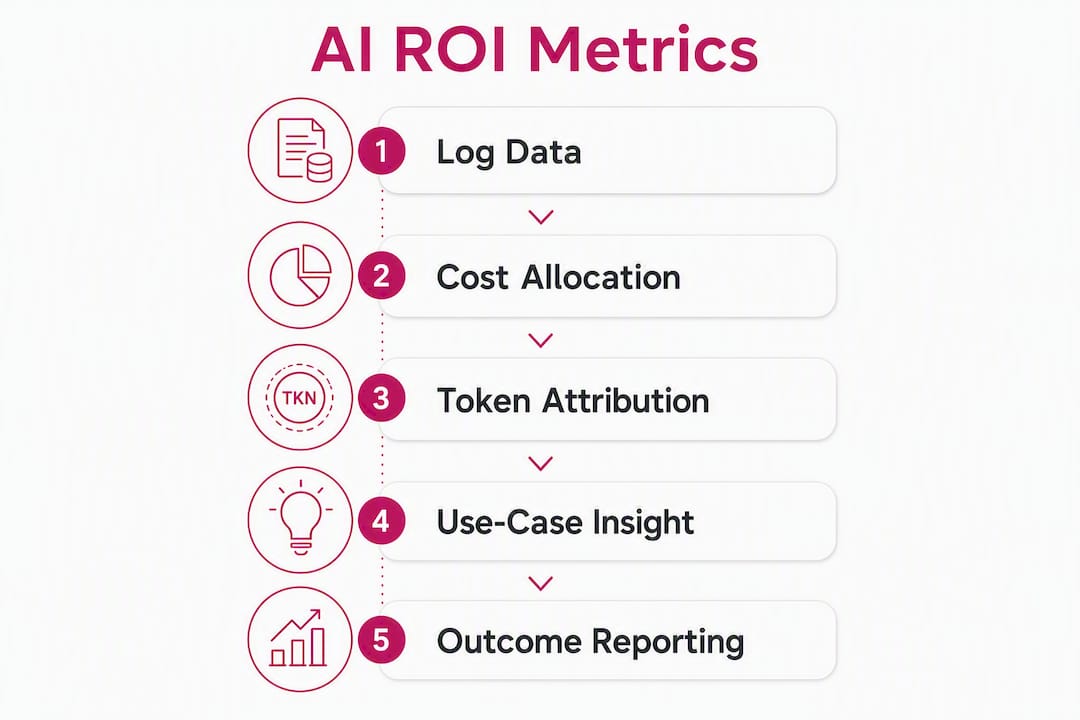
Usage tracking logs every AI interaction at the tool, team, and workflow level. Finance needs to know which departments are actually using Claude or Codex, not just who has a license.

Token attribution connects consumption directly to the P&L line generating value. Accenture’s work on AI tokenomics is clear: token spend pooled into IT overhead obscures accountability. It must be attributed to the department or use case creating the return.
Cost allocation by team lets finance run a real cost-per-outcome calculation. Engineering copilots, customer care automation, and finance document review all have different cost structures and different value drivers.
Use-case intelligence surfaces which workflows are generating measurable outcomes and which are burning tokens on low-value tasks. This is where AI team analytics becomes a strategic tool rather than a reporting afterthought.
Enablement features — playbooks, gamified rollouts, leaderboards — drive adoption past the early-adopter cohort into the broader organization. Measurement without adoption is just expensive dashboarding.
Privacy-first architecture with end-to-end encryption, automatic PII stripping, and GDPR-compliant data handling is a prerequisite for legal and security sign-off, not a differentiator.
Pro Tip: Require that any platform you evaluate can produce a single report showing cost-per-outcome by workflow, not just aggregate token spend. That one report separates governance-ready platforms from activity trackers.
Which metrics and reporting cadences actually link AI work to the P&L?
The metrics that survive a CFO review are outcome-focused, not output-focused. Build your measurement framework around these:
| Metric | What It Measures | Reporting Cadence |
|---|---|---|
| Cost-per-outcome | Token + infra cost divided by verified business outputs | Monthly |
| Token attribution to P&L | Spend mapped to the department or workflow generating value | Monthly |
| Time-to-value | Days from deployment to first verified outcome delta | Quarterly |
| Revenue influenced | Pipeline or revenue decisions touched by AI-assisted work | Quarterly |
| Error-rate delta | Quality improvement vs. pre-deployment baseline | Monthly |
| FTE time redeployed | Hours shifted from manual tasks to revenue-generating work | Quarterly |
Instrumentation must log every AI interaction with a timestamp, anonymized user ID, task type, and completion status. Quality sampling should be built in from day one. Without that log structure, you cannot reconstruct causation when the board asks.
The cadence that wins board support: monthly operational reviews for program leads and finance, quarterly program reviews that assess use-case portfolio performance, and an annual board report that presents finance-certified savings with conservative haircuts applied. Moweb’s measurement framework recommends exactly this three-tier cadence. The metrics catalog at Tekkr maps these to dashboard elements you can deploy immediately.
How do you run a 90-day AI rollout that produces defensible results?
-
Phase 0 (pre-deployment, weeks 1–2): Capture three to six months of historical baseline data for the workflows you plan to automate. Align with finance on the outcome metrics that will count as savings. Agree on the haircut methodology before deployment, not after.
-
Phase 1, days 1–30: Deploy on one to three workflows only. Instrument every interaction. Set up attribution rules that tie token consumption to the specific P&L line. Run a control group where feasible. The goal is not scale; it is a clean, auditable data set.
-
Phase 2, days 30–60: Expand to additional teams. Automate cost attribution reporting. Add enablement: scalable AI enablement approaches like playbooks and leaderboards move adoption from early-stage levels to well above half of the cohort in this window. Begin monthly outcome reviews with finance present. Start outcome reviews monthly with finance for the pilot cohort, then continue on a monthly operational review cadence as recommended by Moweb and EY.
-
Phase 3, days 60–90+: Operationalize governance. Establish a standing review for high-token workflows. Implement token-discipline controls — prompt caching, model routing, concise default outputs — that BCG identifies as material levers for reducing cost-per-outcome. Prepare the first board-level report with CFO attestation.
Pro Tip: The single biggest predictor of a pilot that scales is whether finance signed off on the baseline methodology before deployment. If they did not, the savings number will be contested at the board level regardless of how good the outcome data is.
What security and privacy controls must you validate before signing?
Non-negotiable architecture requirements:
- End-to-end encryption for all telemetry and interaction logs
- Automatic PII stripping before any data is stored or analyzed
- Anonymized instrumentation so individual prompt content is never exposed
- GDPR-compliant data handling with a signed data processing addendum
Operationally, require audited logging, role-based access controls, and documented key management. The contract must include breach notification SLAs and clear responsibility for retained telemetry. When integrating with existing cloud providers, verify that the platform’s data flows have been reviewed against your cloud security posture — not just checked against a generic compliance checklist.
How do you evaluate vendors with a scoring template?
Eight criteria, weighted for enterprise AI programs:
| Criterion | Weight | Sample Procurement Question |
|---|---|---|
| Attribution fidelity | 20% | Show a board-ready report tracing token spend to a specific P&L line. |
| Cost allocation model | — | How is cost broken down by team, workflow, and use case? |
| Integration breadth | 15% | Which AI assistants and cloud platforms are natively supported? |
| Security posture | 15% | Provide your last third-party security audit and DPA template. |
| Scalability | 10% | What is the per-seat or per-token cost at 500 and 5,000 users? |
| Enablement features | 10% | Describe your gamification and playbook capabilities. |
| Measurement governance support | — | Do you provide templates for monthly ops reviews and board reporting? |
| Finance-friendly reporting | 5% | Can a CFO export a GL-grounded savings report without engineering support? |
Score each vendor 1–5 per criterion, multiply by weight, and sum. Any vendor scoring below 3.0 on attribution fidelity or security posture should be disqualified regardless of total score.
- Ask for a live demo of the cost-per-outcome report, not a slide.
- Request a reference from a finance team that has used the platform for board reporting.
- Confirm the onboarding timeline — platforms claiming under 15 minutes for initial setup should demonstrate it.
What outcomes can you realistically expect, and when?
Near-term wins tend to cluster around structured automation: document review, data extraction, and templated reporting. These workflows show measurable cycle-time reduction within the first quarter because the baseline is easy to capture and the output is countable.
Productivity copilots for engineering and customer care typically take three to six months to show finance-certifiable savings. The delay is not technical; it is measurement discipline. Teams that skip baseline capture in Phase 0 spend months arguing about what the number should have been.
Complex agentic systems — multi-step reasoning, autonomous decision support — carry a six to eighteen month timeline to defensible ROI. The full cost denominator matters here: LLM consumption, vector database costs, cloud compute, security tooling, integration, and change management all belong in the denominator. Undercounting any of them inflates the ROI figure and creates audit exposure later.
Early signals that a program is on track: verified cost-per-outcome improvement in the first 30 days, token cost-per-successful-outcome trending down by week six, and FTE time visibly shifting into revenue work rather than manual processing. Finance-certified savings with a conservative haircut (typically between 40% and 70%) carry far more board credibility than engineering estimates at face value.
Key Takeaways
Governance-first AI programs that attribute token spend to the P&L and run monthly outcome reviews are the only ones that survive board scrutiny at scale.
| Point | Details |
|---|---|
| Governance before scale | Establish attribution rules and baselines before expanding beyond the pilot cohort. |
| Outcome metrics only | Replace activity counts with cost-per-outcome, time-to-value, and FTE redeployment. |
| Finance in from day one | CFO attestation on the baseline methodology makes savings defensible at the board level. |
| 90-day pilot structure | Four phases: baseline capture, focused deployment, scale with enablement, governance operationalized. |
| Tekkr Configurato | Tracks usage, attributes token costs by team, and produces board-ready reporting with a free tier and roughly 10-minute setup. |
The measurement discipline most programs skip
The pilots that scale share one trait that has nothing to do with the AI model or the vendor: finance was involved before the first prompt was written. Not consulted after the fact. Present at baseline design, agreeing on what counts as a verified outcome and what haircut applies to projected savings.
Most programs get this backwards. They deploy, generate impressive-looking usage data, and then bring finance in to validate a number that was never designed to be auditable. The CFO applies a 70% haircut to everything, the ROI case collapses, and the program gets reclassified as a cost center.
The practical tip from TekkrTools: require a two-tier measurement sign-off before any pilot result goes to the board. First, AI ops certifies the outcome data against the instrumentation logs. Second, the CFO attests that the savings methodology is GL-grounded and the haircut is defensible. That two-signature rule changes the conversation from “we think AI is working” to “here is the auditable evidence.”
Tekkr Configurato: the fastest path to finance-backed AI ROI
Most AI programs need the same thing: visibility into what is actually being used, what it costs by team, and whether it is moving the metrics that matter to finance. Tekkr’s Configurato delivers exactly that, without a six-month implementation or a browser extension requirement.
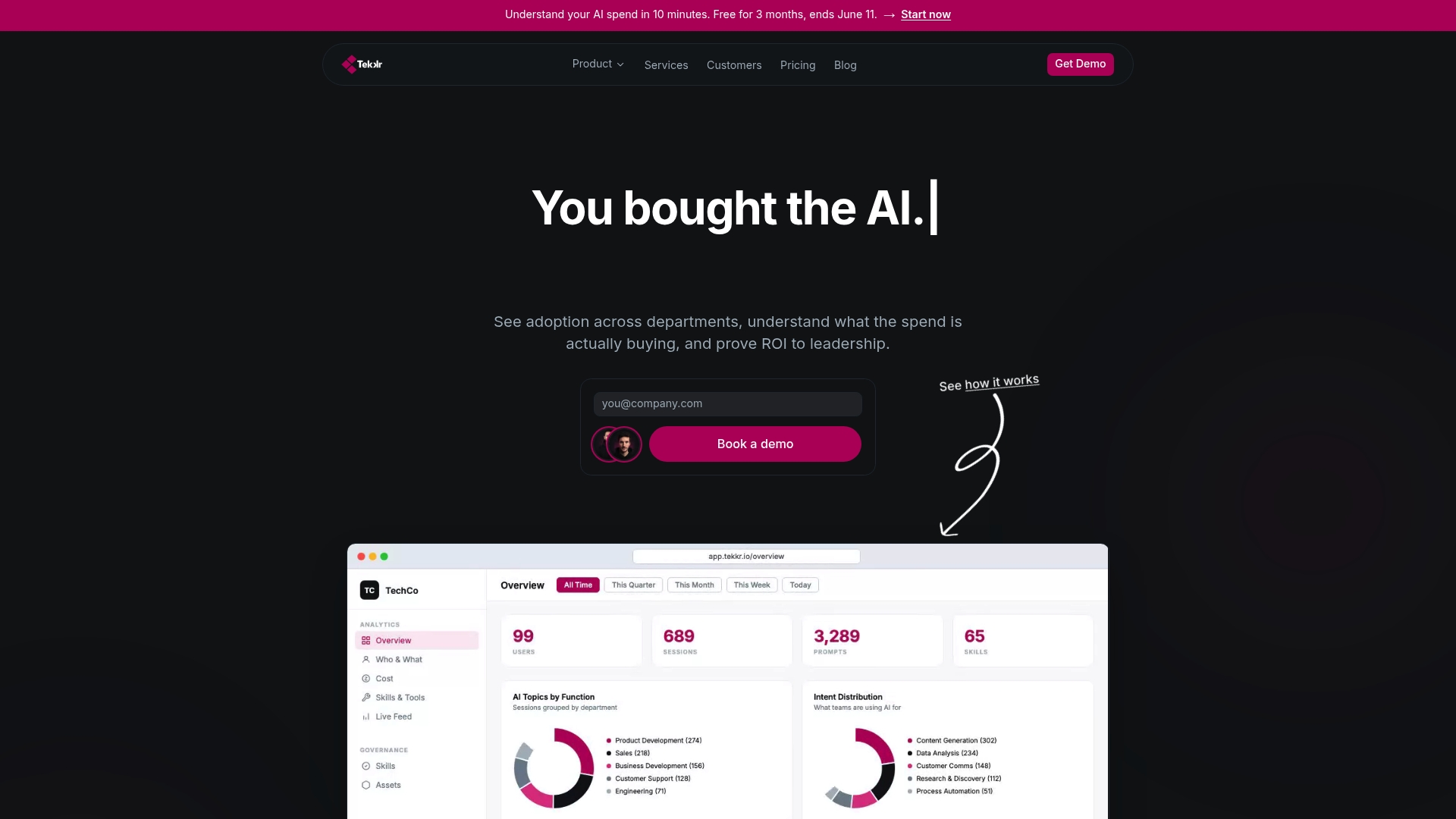
Configurato tracks usage across AI assistants including Claude and Codex, breaks costs down by team and workflow, surfaces use-case intelligence, and drives adoption through gamified rollouts and company-wide playbooks. The architecture is end-to-end encrypted, GDPR-compliant, and strips PII automatically. Initial setup takes roughly 10 minutes. There is a free tier with no credit card required.
To start a finance-backed pilot: agree the scope and baseline methodology with your CFO, deploy Configurato on one to three workflows, run the 30-day outcome review, and bring the first board-ready report to your next quarterly review. Start your pilot at Tekkr’s AI adoption solutions page and get the measurement infrastructure in place before your next budget cycle.
Sources and further reading
| Source | Why It Matters |
|---|---|
| EY: How to break out of the AI ROI trap | Governance cadence framework: monthly ops reviews and annual board reporting |
| Moweb: AI ROI Measurement Framework | Instrumentation standards and three-tier reporting cadence |
| SUPALABS: Enterprise AI ROI Assessment Methodology | Driver-tree ROI methodology and confidence-tiered haircut approach |
| BCG: Managing AI Token Costs | Token-discipline controls and workflow-level cost ownership |
| AI Advisory Practice: Measuring GenAI ROI Honestly | Full cost denominator and TCO framework |
| Barry O’Reilly: Metrics for AI Transformation | Outcome vs. activity metric framework |
| Solutions Review: Enterprises Spend Big on GenAI | Survey data on the perception vs. measurement gap |
| Tekkr: AI Integration Strategies for Executives | Integration patterns for adoption analytics platforms |
| Tekkr: Cross-Company AI Benchmarking | Benchmarking AI adoption across business units |