
Build a distributed, peer-led AI champions network using a hub-and-spoke model, a 30/90-day launch plan, and adoption metrics from day one. That’s the short answer. Here’s how to make it operational this quarter:
- Identify your pilot cohort (5–10 people across 2–3 departments) within the next two weeks. Prioritize domain experts who already use AI informally, not managers or IT staff.
- Secure a named executive sponsor before the first champion meeting. Without visible leadership backing, the program stalls at the first competing priority.
- Run a two-week champion sprint where each recruit tests one real workflow, documents what worked, and packages a one-page use-case guide. Tangible output in week two beats a month of planning.
Pro Tip: Use Tekkr’s Configurato to instrument adoption from day one. It tracks who’s using which AI tools, breaks down activity by team, and surfaces use-case intelligence without requiring browser extensions or IT involvement. Setup takes about 10 minutes.
Expect your first measurable signal within 30 days (validated use cases, peer training sessions held). Meaningful adoption lift typically shows up in the 60–90 day window once champions have run their first sprint and shared results.
Table of Contents
- What is an AI champion, and why does a distributed network matter?
- Who should you recruit as AI champions?
- How should you design the network structure?
- What does the onboarding and training playbook look like?
- What tools and resources do champions actually need?
- How do you prove the network is working?
- When and how do you scale the network?
- What mistakes kill champion programs?
- What does a maturity model look like in practice?
- Key Takeaways
- The part most playbooks skip
- Tekkr helps you measure what your champions are building
- Useful sources and further reading
What is an AI champion, and why does a distributed network matter?
An AI champion (sometimes called an AI activator) is a domain expert who bridges the gap between an organization’s AI strategy and the day-to-day work of their team. They are not IT support. They are not a governance committee. They are peers who understand the business problem well enough to judge whether an AI output is actually useful, and trusted enough that colleagues will try something new because they recommended it.
That last point is the one most leaders underestimate. OpenAI Academy describes champion networks as a transmission layer converting strategy into validated, repeatable workflows, shifting adoption from mandates to practiced routines. A mandate from the top says “use AI.” A champion two desks away shows you exactly how to use it on the report you’re writing right now.
The network effect compounds quickly. McKinsey research cited in practitioner writeups found peer-nominated AI ambassadors are present in 68% of companies reporting high AI adoption, versus 23% in companies with low adoption. That gap is not explained by tool quality or budget. It’s explained by whether someone in each team was trusted to make the tool feel safe and relevant.
GitHub’s AI activation playbook frames adoption as a change-management challenge first and a technology challenge second. Champions are the single highest-difference pillar among adoption levers, precisely because they operate at the human layer where resistance actually lives.
The expected outcomes when a network is designed well: faster validated workflow deployment, reduced dependence on external consultants, and a self-reinforcing community that surfaces shadow AI use before it becomes a compliance problem.
Who should you recruit as AI champions?
The most common mistake is recruiting the most enthusiastic person in the room. Enthusiasm without domain credibility produces champions nobody listens to.
The profile that works is T-shaped: deep expertise in one business function (finance, legal, sales ops, engineering) combined with enough curiosity to experiment and enough social capital to influence peers. Reworked’s practitioner guidance is direct on this point: upskilling existing domain experts outperforms creating new AI-hire roles because domain experts judge the business fit of AI outputs far more effectively than technical staff.
Selection criteria to apply:
- Peer credibility: colleagues already ask this person for advice on work problems
- Time availability: can genuinely commit 2–3 hours per week without it becoming a political issue with their manager
- Curiosity over expertise: has tried at least one AI tool independently, even informally
- Problem-solving orientation: frames challenges as solvable rather than escalating them
- Communication clarity: can explain a new workflow to a skeptical colleague without jargon
For cohort sizing, a ratio of approximately one champion per several dozen employees works well for a pilot. A 200-person organization might start with 8–12 champions across its main functional areas. Resist the urge to go wider too fast; a small, well-supported cohort outperforms a large, neglected one every time.
When recruiting, keep the ask concrete. A brief announcement or email should cover: what the role involves (peer coaching, workflow testing, one-page documentation), the time commitment (a few hours per week for several weeks), what they get in return (early tool access, direct line to leadership, recognition), and how to express interest. Avoid framing it as an honor or a burden. Frame it as a practical opportunity to shape how the team works.
Two profiles to avoid: managers who will treat it as a reporting function, and pure AI enthusiasts with no functional depth. Both create programs that feel disconnected from real work.
How should you design the network structure?
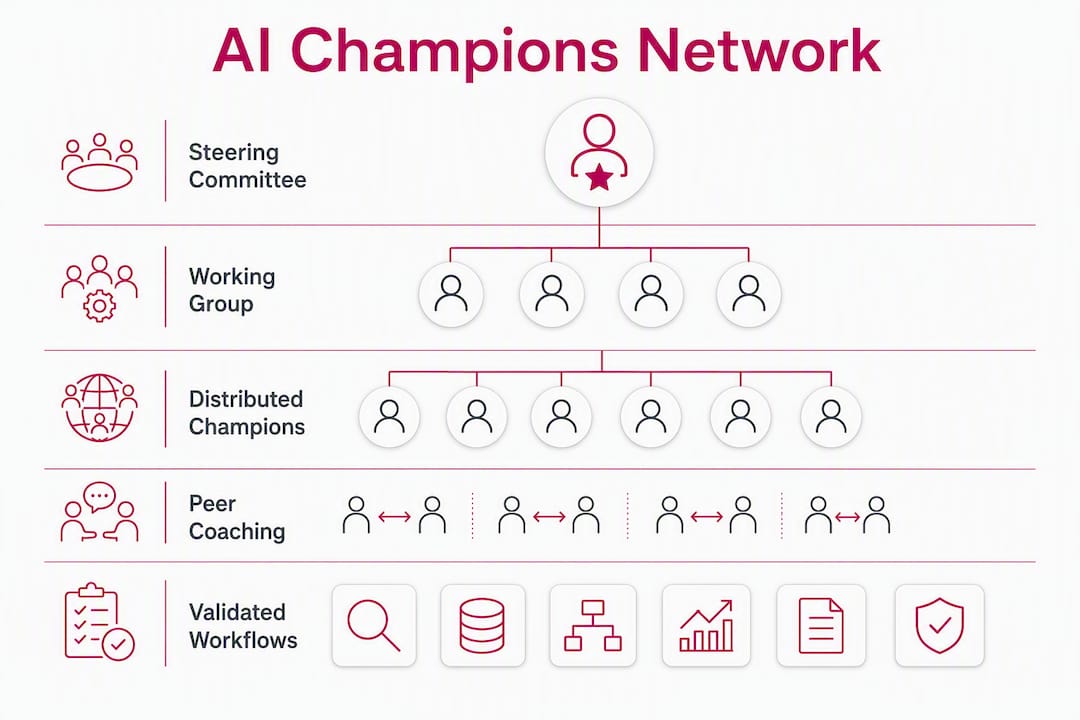
A lightweight hub-and-spoke model keeps the program moving without creating a bureaucracy that slows it down. Three layers, each with a clear job.

The steering committee sits at the hub. This is typically a delegated executive sponsor plus one or two functional leads. Their job is narrow: unblock obstacles, approve budget, and show up visibly at quarterly reviews. They do not run the program day to day.
The working group sits between the hub and the spokes. This is a small team (3–5 people) responsible for maintaining the playbook, governing templates, and coordinating across champions. They run the weekly working group call, which is the operational heartbeat of the program. Each call should produce one concrete output: a new validated use case, a resolved escalation, or an updated prompt library entry.
The distributed champions are the spokes. Each one operates within their function, running peer coaching sessions, testing workflows in live conditions, and feeding validated one-page guides back to the working group. They attend a monthly champion forum where the whole network shares wins, surfaces blockers, and calibrates on priorities.
The quarterly steering check-in closes the loop: the working group presents adoption metrics and the steering committee makes resourcing decisions.
OpenAI Academy’s guidance on champion networks reinforces keeping this structure lean. The moment the operating model requires more coordination than the actual work it produces, you’ve over-governed it. Add regional or topic leads only when a specific coverage gap appears (a large remote team with no local champion, or a specialized function like legal or security that needs its own guardrails). Don’t add them preemptively. For a deeper look at aligning this structure with executive leadership, Tekkr’s cross-team AI adoption guide covers the sponsorship and coordination model in detail.
What does the onboarding and training playbook look like?
Days 0–30: getting champions operational
The first month is about orientation and one real win. Champions should not spend it in training sessions.
- Week 1: Kick off with a half-day orientation. Cover the program’s purpose, the operating model, the tools they have access to, and the security guardrails they need to communicate to peers. Assign each champion one specific workflow to test.
- Week 2: Champions run their first two-week sprint in live conditions, not sandboxes. Practitioner guidance from Amit Kothari is clear that testing in messy, real work produces better validated guides than any controlled environment.
- Week 3: First working group call. Champions share what worked, what didn’t, and draft a one-page use-case guide. The working group publishes the best one to the shared library.
- Week 4: First peer coaching session in each champion’s team. Even one 30-minute demo of a validated workflow counts as a win at this stage.
Days 31–90: building depth and peer reach
- Expand each champion’s workflow portfolio to 2–3 validated use cases
- Run the first monthly champion forum; make wins visible to the steering committee
- Begin contributing to the prompt library and office hours rotation
- Align with managers on how champion time is being protected (this conversation often needs to happen again at the 60-day mark)
The 12-week curriculum
Hartz AI’s practitioner framework structures deeper enablement in three phases: learn, apply, mentor.
- Weeks 1–4 (Learn): AI fundamentals relevant to the champion’s function, prompt engineering basics, output evaluation, and data-handling guardrails. Two hours per week.
- Weeks 5–8 (Apply): Sprint-based workflow testing, use-case documentation, and contribution to the shared prompt library. Three hours per week including the working group call.
- Weeks 9–12 (Mentor): Champions run peer training sessions, onboard new team members to validated workflows, and contribute to the playbook governance process.
Plan a rotation or refresh at the 6-month mark. Champions who stay in role indefinitely without new challenges burn out or disengage. Bringing in one or two new champions per cohort while giving existing ones a “senior champion” or topic lead role keeps the energy moving.
What tools and resources do champions actually need?
Keep the tooling minimal. Champions who spend time managing platforms instead of coaching peers are a sign the program has drifted.
The minimum viable toolkit is four things: a dedicated communication channel (a Slack or Microsoft Teams channel works; the key is that it’s live and monitored, not a static portal), a shared prompt library that champions can contribute to and colleagues can search, basic analytics access so champions can see adoption signals in their team, and a template library with one-page use-case guides and a standard failure-note format.
GitHub’s playbook and Reworked’s guidance converge on the same principle: curate, don’t create. The working group’s job is to pull the best vendor materials, OpenAI Academy resources, and community-tested prompts into one place, then drive people into the live channel for real-time troubleshooting. A champion who can answer a colleague’s question in a Slack thread in five minutes does more for adoption than any static knowledge base.
Pro Tip: Before building a prompt library from scratch, check what your AI vendors already provide. OpenAI, Anthropic, and GitHub Copilot all publish use-case libraries and prompt guides. Curating those into your internal channel takes hours, not weeks, and gives champions credible material to start with immediately.
Playbook components each champion should maintain: a one-page use-case guide for each validated workflow (problem, tool used, prompt structure, output quality notes, time saved), a failure log that documents what didn’t work and why, and a clear escalation path for data-handling questions that fall outside their guardrails.
Security guardrails are not optional, and champions need to be able to communicate them clearly. That means knowing which data classifications are off-limits for AI tools, understanding that prompts containing PII should never go into non-enterprise AI instances, and having a named contact for compliance questions. Champions who can answer “is it safe to use AI for this?” build far more trust than ones who say “I’m not sure, check with IT.”
How do you prove the network is working?
Measurement has three tiers, and most programs only track the first one.
Leading indicators tell you the program is active: number of champions trained, peer coaching sessions held, prompts added to the shared library, and attendance at champion forums. These are easy to collect and important for early momentum reporting, but they don’t prove business impact.

Operational KPIs tell you the program is producing results: validated use cases deployed per team, estimated time recovered per workflow (collected via champion self-report or manager confirmation), and the number of employees who have adopted at least one AI-assisted workflow. These require a bit more rigor but are achievable within 90 days.
Outcome metrics tell you the program is moving the business: cost avoidance from reduced consultant hours, productivity gains measured against a pre-program baseline, and AI tool utilization rates by department.
| KPI | Source of truth | Reporting cadence |
|---|---|---|
| AI tool adoption rate by team | Tekkr Configurato / tool admin dashboards | Weekly |
| Validated use cases deployed | Champion working group log | Monthly |
| Peer training sessions held | Champion self-report | Monthly |
| Time recovered per workflow | Champion + manager estimate | Monthly |
| Cost avoidance (consultant hours) | Finance / project tracking | Quarterly |
The evidence for why this matters: McKinsey research found peer-nominated AI ambassadors present in 68% of high-adoption companies versus 23% in low-adoption ones. That correlation is the business case for measuring champion activity as a leading indicator of adoption outcomes.
Tekkr’s Configurato makes the operational KPI layer significantly easier. It tracks who’s using which AI tools across the organization, breaks costs down by team, and surfaces use-case intelligence automatically. Champions can see their team’s adoption signals without needing IT to pull a report, which means they can act on the data in real time rather than waiting for a quarterly review.
When and how do you scale the network?
Three signals tell you it’s time to scale: a visible coverage gap (a large team or region with no local champion), a backlog of validated use cases that the current working group can’t process fast enough, and persistent tool fragmentation where different teams are solving the same problem with different tools and no one is sharing results.
When those signals appear, the scale path is additive, not structural. Add regional or topic leads before adding governance layers. A regional lead is still a champion; they just coordinate a cluster of champions and attend the working group call. A topic lead (one champion who owns the prompt library for a specific function like legal or finance) adds depth without adding hierarchy.
The governance checklist for a scaled network:
- Tool ownership: one named person owns the approved tool list and reviews additions quarterly
- Escalation thresholds: champions know exactly which decisions they can make independently and which require working group or steering committee sign-off
- Data privacy guardrails: updated whenever a new tool is added to the approved list, communicated to all champions within one week
- Playbook governance: the working group reviews and updates the template library monthly; stale guides get archived, not left to confuse new champions
The transition to a Center of Excellence happens when the working group has enough validated use cases, enough champion depth, and enough executive visibility to take on a formal internal advisory function. That’s typically a 12–18 month horizon from a well-run pilot. For the executive alignment work that makes this transition possible, Tekkr’s AI integration strategies guide covers the governance and sponsorship model in detail.
The one thing to protect as you scale: champion peer credibility. The moment champions start feeling like compliance officers rather than colleagues, adoption slows. Keep their primary identity as domain experts who happen to know AI well, not as AI staff who happen to sit in business teams.
What mistakes kill champion programs?
Most programs don’t fail because of bad technology. They fail because of predictable design and operational errors.
- Treating champions as IT support: when colleagues route technical bugs to champions instead of vendors, champions burn out fast. Set the expectation clearly: champions coach on workflows, not troubleshoot software.
- No time protection: a champion with a 2–3 hour weekly commitment that their manager doesn’t know about will deprioritize it within a month. Practitioner guidance is explicit: champions need bounded, explicit time allocations (10–20% of their role) with manager alignment from day one.
- No executive air cover: when the first competing priority appears (a product launch, a budget cycle), an unsponsored champion program disappears. The executive sponsor’s job is to make the program visible and protect champion time when it gets squeezed.
- Metrics absent: a program with no measurement framework has no way to demonstrate value and no way to course-correct. Instrument from day one, even if the first metrics are simple.
- Picking the wrong people: selecting managers (who turn it into a reporting function) or pure enthusiasts (who lack domain credibility) produces a program that feels disconnected from real work.
Red flags that predict program decay: falling attendance at champion forums, the same two or three people doing all the work, no new validated use cases in 60 days, and champions who stop attending the working group call. When these appear, don’t wait for the quarterly review. Reset expectations, reallocate time, and rotate in one or two new members to change the energy.
Recognition tied to measurable outcomes increases the likelihood of repeated behaviors more than equivalent monetary rewards. Public, specific recognition (“Sarah’s finance workflow saved the team 4 hours per week”) does more for program health than a gift card.
What does a maturity model look like in practice?
A four-level maturity model gives champions and program leads a shared language for development targets and helps leaders know what “good” looks like at each stage.
Level 1 — Foundational: Champions can use approved AI tools for their own work, understand basic prompt structure, and know the data-handling guardrails. Success looks like one validated personal workflow documented.
Level 2 — Enabling: Champions can coach peers through a validated workflow, contribute to the prompt library, and run a 30-minute team demo. Success looks like two or three colleagues in their team adopting at least one AI-assisted workflow.
Level 3 — Embedded: Champions run regular office hours, contribute to playbook governance, and can independently troubleshoot common output quality issues without escalating. Deyan7’s maturity framework identifies independent troubleshooting as the capability that most reduces long-term consultant reliance.
Level 4 — Autonomous: Champions mentor new cohort members, propose new use cases to the working group, and contribute to the organization’s AI strategy through the steering committee. At this level, the champion network is self-sustaining.
Setting up Tekkr’s Configurato to support the network takes about 10 minutes. Connect your AI tools (Claude, Codex, and others), and Configurato begins tracking adoption by team, surfacing which use cases are gaining traction, and generating automated executive reports. Champions get a view of their team’s activity; the working group gets the organization-wide picture. The leaderboard and gamified rollout features give champions a visible, motivating signal to share with their teams. Everything runs on a privacy-first, end-to-end encrypted architecture with automatic PII stripping, so champions can share adoption data without triggering compliance concerns.
For organizations without a large IT function, Tekkr’s bootstrap AI adoption guide covers how to get Configurato running without IT involvement.
Key Takeaways
A well-designed AI champions network converts strategy into measurable adoption by placing trusted domain experts at the point where resistance actually lives, supported by a lightweight hub-and-spoke structure and instrumented from day one.
| Point | Details |
|---|---|
| Start with domain experts | Recruit T-shaped domain experts with peer credibility, not managers or pure AI enthusiasts. |
| Protect champion time | Secure explicit 2–3 hour weekly allocations with manager alignment before the program launches. |
| Instrument from day one | Track adoption rate, validated use cases, and peer sessions from week one to build a defensible ROI case. |
| Scale triggers, not schedules | Add regional or topic leads only when a coverage gap or use-case backlog appears, not on a fixed timeline. |
| Tekkr Configurato | Tekkr’s Configurato tracks AI tool adoption by team, surfaces use-case intelligence, and generates executive reports in about 10 minutes of setup. |
The part most playbooks skip
The hardest part of building an AI champions program isn’t the structure or the tooling. It’s the political work of making early wins visible before anyone has reason to believe the program matters.
Get your executive sponsor to mention one champion win by name in a leadership meeting within the first 30 days. Not a slide about the program’s goals. A specific person, a specific workflow, a specific outcome. That one mention does more for champion credibility and program momentum than any amount of internal communications.
The second thing most playbooks understate: champions are peers, not managers. The moment a champion starts feeling like they’re responsible for their colleagues’ AI adoption rates, the dynamic shifts from trusted colleague to internal auditor. Keep the role framed as “I found something that works and I want to show you” rather than “you need to be using AI more.” That framing is the difference between a program people want to be part of and one they tolerate.
Early wins don’t need to be dramatic. A 30-minute demo that saves one person two hours a week is a win. Document it, share it, and let it compound.
Tekkr helps you measure what your champions are building
Most champion programs produce real adoption gains that never show up in a report because no one instrumented the measurement layer. That’s the gap Tekkr closes.
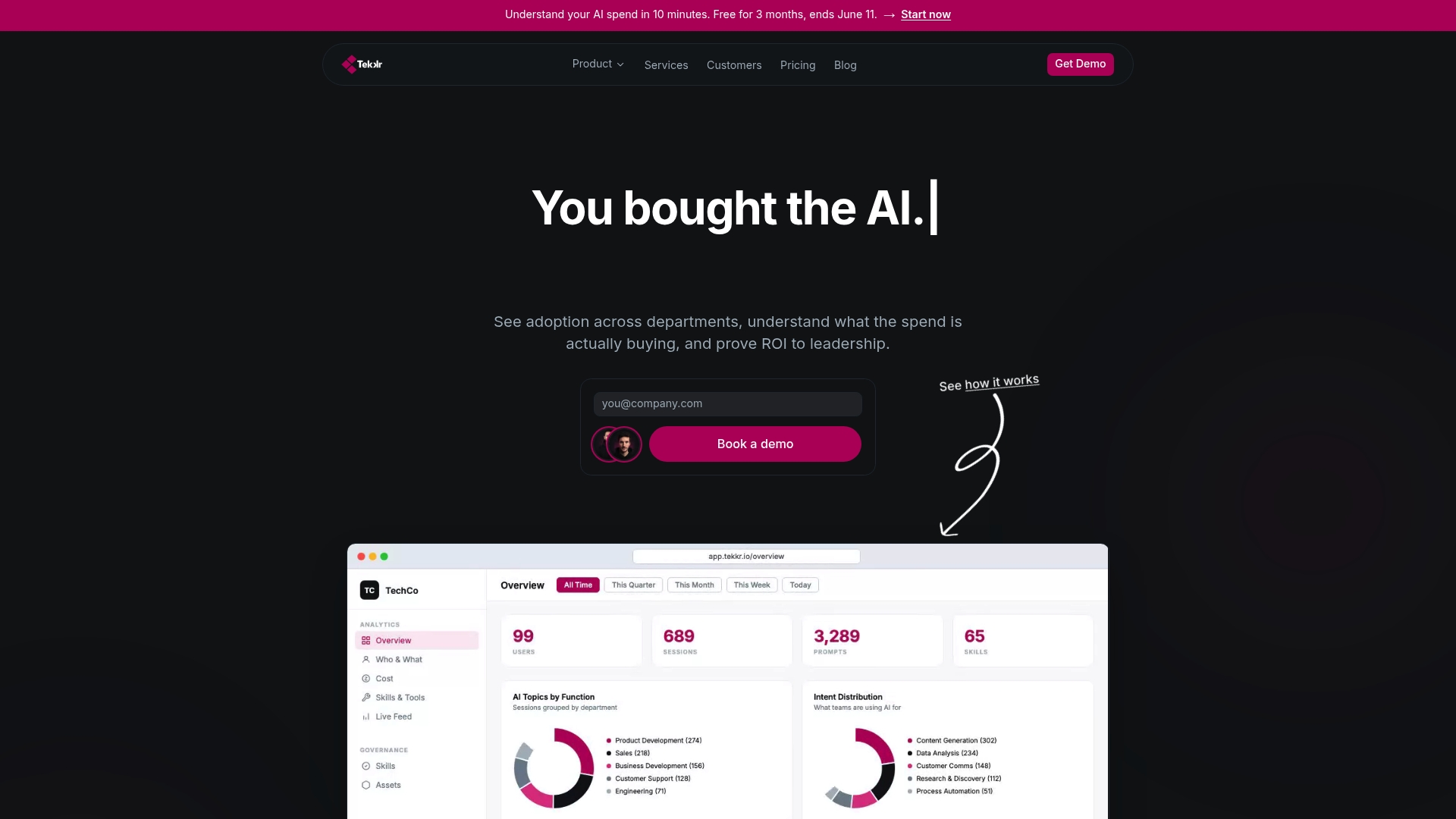
Tekkr’s Configurato gives your champion network a measurement backbone from day one: real-time AI tool adoption by team, cost breakdowns by department, use-case intelligence, and automated executive reporting. Champions get visibility into their team’s activity without waiting for IT. The working group gets the organization-wide picture. Setup takes about 10 minutes, there’s a free tier with no credit card required, and the privacy-first architecture (end-to-end encrypted, GDPR-compliant, automatic PII stripping) means your legal and compliance teams won’t push back.
If you need hands-on support beyond the platform, Tekkr’s advisory and consulting services cover AI transformation strategy and champion program implementation. Start with the AI adoption platform to see what your current adoption picture looks like, or book a demo to walk through how Configurato fits your champion network design.
Useful sources and further reading
- Grow a network of internal champions — OpenAI Academy
- Playbook series: Activating your internal AI champions — GitHub
- Setting Up an AI Champions Program in Your Department — Reworked
- Role of AI Champions Teams: Enterprise Manager’s Playbook — Tekkr
- Leadership’s Role in AI Adoption — Tekkr