
Start here: the best tools for auditing enterprise AI subscriptions are purpose-built AI adoption and spend analytics platforms, not generic SaaS management suites. Tekkr’s Configurato is the recommended pilot for finance and IT-led audits. This week, take three steps:
- Run a discovery scan across expense exports and API key logs to surface every AI line item.
- Assign a budget owner to each tool or workflow, especially any usage-based line.
- Set a monthly spend threshold with automated alerts so surprise bills stop reaching the CFO.
Configurato covers all three from a privacy-first, department-level dashboard with chargeback-ready reporting, and organizations integrating tracking from the start are far more likely to show measurable revenue growth and pass governance audits, according to Grant Thornton’s 2026 AI Impact Survey.
Key Takeaways
The single most important action is to assign a named budget owner to every AI workflow before any other governance work, because cost attribution without ownership produces reports that nobody acts on.
| Point | Details |
|---|---|
| Run discovery first | Export 12–15 months of expense data to surface every AI line item, including shadow AI. |
| Assign owners immediately | Every usage-based workflow needs a named budget owner and a monthly spend threshold. |
| Track RoAI at workflow level | Measure cost per outcome per workflow, not aggregate AI spend, for defensible CFO reporting. |
| Pilot Configurato in 30 days | Connect expense exports or API keys; inventory coverage and cost baselines are visible within minutes. |
| Embed RoAI in financial reviews | Quarterly RoAI reviews alongside headcount costs close the proof-of-value gap for the board. |
Table of Contents
- Why do enterprises need dedicated auditing for AI subscriptions?
- What metrics should you track to measure AI subscription ROI?
- What should you look for in an enterprise AI auditing tool?
- How should you phase the rollout over 12 months?
- How does Tekkr’s Configurato map to these selection criteria?
- How do you assign cost attribution at the workflow level?
- What governance controls should every enterprise put in place?
- What are the most effective cost-reduction levers for AI spend?
- What data privacy and compliance requirements apply to AI auditing tools?
- How do you validate ROI and build feedback loops?
- Who owns the AI subscription audit inside an enterprise?
- What contract and renewal management practices reduce AI spend risk?
- How do you identify and mitigate compliance, security, and financial risks?
- The metric that changes everything
- Configurato gets your pilot live in under 10 minutes
- Sources
Why do enterprises need dedicated auditing for AI subscriptions?
Traditional SaaS management tools were built for seat-based licenses. AI spend is different: it runs on metered tokens, hybrid consumption models, and embedded AI features buried inside tools you already pay for. A $500/month Copilot seat can generate five-figure token overruns if an agentic workflow goes unsupervised.
Most enterprises run dozens of AI tools and struggle with shadow AI, and only a minority maintain a comprehensive inventory. That gap complicates both governance and budgeting. The consequences are concrete: unowned spending that no department claims, AI costs misclassified between COGS and OPEX, surprise invoices from provider usage APIs, and no credible answer for the board when they ask what AI is actually returning.
Deloitte’s State of AI report confirms that even leading companies expanding sanctioned AI access still see persistent underutilization, and that agentic AI specifically requires audit trails and real-time monitoring that standard procurement workflows cannot provide. AI token economics demand FinOps discipline, including real-time forecasting and hybrid consumption strategies, that most finance teams have not yet built.
What metrics should you track to measure AI subscription ROI?
MIT Sloan’s analysis is direct: companies that fail to define an explicit AI ROI approach rarely realize credible returns. Treat AI economics like capital equipment.
The core formula is RoAI: (value of outcomes produced) divided by (total AI cost, including token spend, human review time, and operations). Build the numerator from measurable outputs — documents processed, tickets resolved, code reviews completed. Build the denominator from token costs plus the loaded hourly cost of any human in the loop. BCG recommends governing RoAI at the workflow level so leaders can see what is happening, shape cost, and decide whether to scale or stop.
Gartner advises starting with two to three metrics tied to your primary business goal, then expanding as maturity grows. Atlassian’s staged ROI map offers a useful frame: explore, optimize, enhance, transform. Early-stage teams should focus on adoption and cost-per-outcome; mature deployments add revenue attribution and error rate.
| KPI Category | Metric | Why It Matters |
|---|---|---|
| Financial | RoAI (outcomes / total AI cost) | Board-level proof of value |
| Financial | Cost per outcome | Compares workflows and models |
| Token economics | Input vs. output token split | Identifies caching and routing opportunities |
| Utilization | Active users / licensed seats | Surfaces underutilization and waste |
| System | Request error rate, latency | Flags reliability issues before they scale |
| Executive summary | Department run rate vs. budget | Enables chargeback and forecast accuracy |
TechTarget’s KPI taxonomy confirms that balanced dashboards need all four layers: system, utilization, operational, and business measures.
Pro Tip: If you are in cost-reduction mode, start with cost per outcome and department run rate. Revenue-growth focus? Lead with adoption rate and RoAI by workflow. Employee experience? Session length and active-user rate tell the real story.
What should you look for in an enterprise AI auditing tool?
Mandatory capabilities, in priority order:
- Discovery: pulls from expense exports, API key logs, and provider billing APIs, not just IT-approved lists.
- Owner attribution: every tool and workflow has a named budget owner, not just a department code.
- Token-level reconciliation: maps provider invoices to internal usage by model, workflow, and team.
- Department dashboards: automated, not manual, with C-suite summary views and drill-down access.
- Audit trails: timestamped action logs for chargebacks, compliance reviews, and security incidents.
- Tagging: product vs. internal use, model name, provider, and cost center.
- Chargeback controls: the ability to allocate AI costs back to the business unit that generated them.
Integration requirements matter as much as features. The tool must connect to your identity provider (SSO/SAML), your ERP or procurement system for PO matching, provider usage APIs (OpenAI, Anthropic, Google), and your SIEM for security logging.
Vendor red flags: no pilot option within two weeks, PII handling that requires browser extensions, inability to separate COGS from OPEX in reporting, and no support for hybrid infrastructure (cloud plus on-premise model endpoints).
How should you phase the rollout over 12 months?
- Months 1–3 (quick wins): Export 12–15 months of card and accounting data. Classify every AI line as seat-based or usage-based. Assign an owner and a monthly budget threshold to each. Connect one pilot workspace and generate an executive snapshot. This alone stops the most common failure mode: ungoverned usage-based spend with no owner.
- Months 3–6 (big rocks): Integrate provider usage APIs for real-time token data. Implement tagging across all active workflows. Run owner-level reviews for the top five token consumers. Introduce model routing guidance to shift lower-complexity tasks to cheaper models.
- Months 6–12 (longer tail): Automate chargebacks so finance receives department-level AI invoices monthly. Embed RoAI into quarterly financial reviews alongside headcount and infrastructure costs. Train power users on token discipline. Set standing monthly reviews for every workflow consuming more than 10% of total token budget.
BCG’s phased approach makes the sequencing logic explicit: quick wins fund the bigger infrastructure work, and high-token workflows need regular review to decide whether to scale, optimize, or stop them.
How does Tekkr’s Configurato map to these selection criteria?
| Selection Criterion | Configurato Capability |
|---|---|
| Discovery (expense + API) | Connects to expense exports and provider billing APIs; surfaces shadow AI |
| Owner attribution | Assigns budget owners per tool and workflow with automated alerts |
| Token-level tagging | Tags by model, provider, product vs. internal, and cost center |
| RoAI dashboards | Department-level and C-suite views with automated reporting |
| Chargeback controls | Generates department-level cost allocation reports |
| Privacy-first architecture | End-to-end encryption, automatic PII stripping, GDPR-compliant, no browser extensions |
Pilot setup takes roughly 10 minutes: connect your expense export or provider API keys, assign owners in the onboarding workflow, and the initial dashboard is live. Pilot success looks like three things: inventory coverage above 80% of known AI spend, a cost-per-outcome baseline for at least two workflows, and governance coverage where every line item has a named owner.
How do you assign cost attribution at the workflow level?
Owner assignment is where most audits stall. Finance sees a line item from OpenAI; no one knows which team or product generated it. The fix is to tag at the API key level before any other governance work. Each team or product gets its own key, and every token consumed maps to that key. From there, cost attribution becomes arithmetic, not archaeology.
Workflow-level attribution also enables the most useful CFO conversation: not “we spent $X on AI” but “workflow Y costs $Z per outcome and produces $W in value.” That framing, supported by Grant Thornton’s finding that integrated tracking drives measurable outcomes, is what separates a defensible AI budget from a line item nobody can explain.
What governance controls should every enterprise put in place?
API key discipline is the foundation. Rotate keys quarterly, scope each key to the minimum required permissions, and log every call. Without this, a single compromised key can generate thousands of dollars in token charges before anyone notices.
Tagging standards need an owner too, typically the AI program lead or a FinOps function. Every workflow gets four tags: model name, provider, cost center, and use type (product-facing or internal). Audit trails should capture not just spend but actions: who changed an owner assignment, who approved a budget increase, which workflows were reviewed and when. Chargebacks close the loop by making departments financially accountable for their AI consumption, which changes behavior faster than any policy document.
What are the most effective cost-reduction levers for AI spend?
Model routing is the highest-leverage lever available today. Routing low-complexity tasks (summarization, classification, simple Q&A) to smaller, cheaper models while reserving frontier models for complex reasoning can cut token costs significantly without degrading output quality. Prompt caching is the second lever: for workflows that repeatedly send similar context, caching the shared prefix eliminates redundant input tokens. For practical routing and output strategies, the gains compound quickly across high-volume workflows.

Training matters more than most teams expect. Engineers who understand token economics write tighter prompts. A 20% reduction in average prompt length across a high-volume workflow compounds into real savings over a quarter. Track prompt length as a KPI alongside cost per outcome.
What data privacy and compliance requirements apply to AI auditing tools?
Any tool that processes employee prompts or customer-facing AI outputs touches sensitive data. The minimum requirements for enterprise procurement: end-to-end encryption in transit and at rest, automatic PII stripping before any prompt data is logged or analyzed, and no requirement for browser extensions that intercept traffic. GDPR compliance matters even for US-headquartered companies if any EU employee data is processed. Tekkr’s security and privacy architecture covers all of these by design.
SSO integration is a compliance requirement, not a convenience. It ensures that access to audit data follows your identity governance policies and that offboarded employees lose access automatically.
How do you validate ROI and build feedback loops?
Benchmarking before and after a workflow change is the only credible validation method. Establish a cost-per-outcome baseline in month one, make one change (model swap, prompt optimization, caching), and measure the delta in month two. For worked examples of AI savings calculations that hold up in a CFO review, the key is isolating the variable.
Feedback loops require a standing review cadence. Monthly for high-token workflows, quarterly for the full portfolio. Each review answers three questions: did cost per outcome improve, did adoption increase, and did any workflow cross a risk threshold? The answers feed directly into the next budget cycle.
Who owns the AI subscription audit inside an enterprise?
No single function can run this alone. The AI program lead owns the inventory and governance framework. Finance owns budget thresholds, chargeback allocation, and RoAI reporting. IT security owns API key management, audit trails, and SIEM integration. Department heads own their workflow-level budgets and outcome targets. Without explicit ownership at each layer, the audit produces a report that nobody acts on.
What contract and renewal management practices reduce AI spend risk?
Review every AI contract 90 days before renewal, not 30. Usage-based contracts need a consumption forecast built from the last three months of token data. Seat-based contracts need an active-user audit: if fewer than 70% of licensed seats are active, negotiate down or consolidate. Embed a clause requiring 30-day notice of pricing model changes, which several major providers have exercised without warning.
How do you identify and mitigate compliance, security, and financial risks?
The three risk categories require different controls. Compliance risk: map every AI tool to the data it touches and confirm it meets your data residency and retention requirements. Security risk: audit API key permissions quarterly and review SIEM logs for anomalous token consumption patterns. Financial risk: set hard budget caps at the API key level so a runaway agentic workflow cannot exceed a defined threshold without triggering an alert.
Shadow AI is the compounding risk across all three. A tool adopted without IT review may process regulated data, use an unscoped API key, and generate costs that appear in no budget. Discovery scans run against expense data and network logs catch most of it.
The metric that changes everything
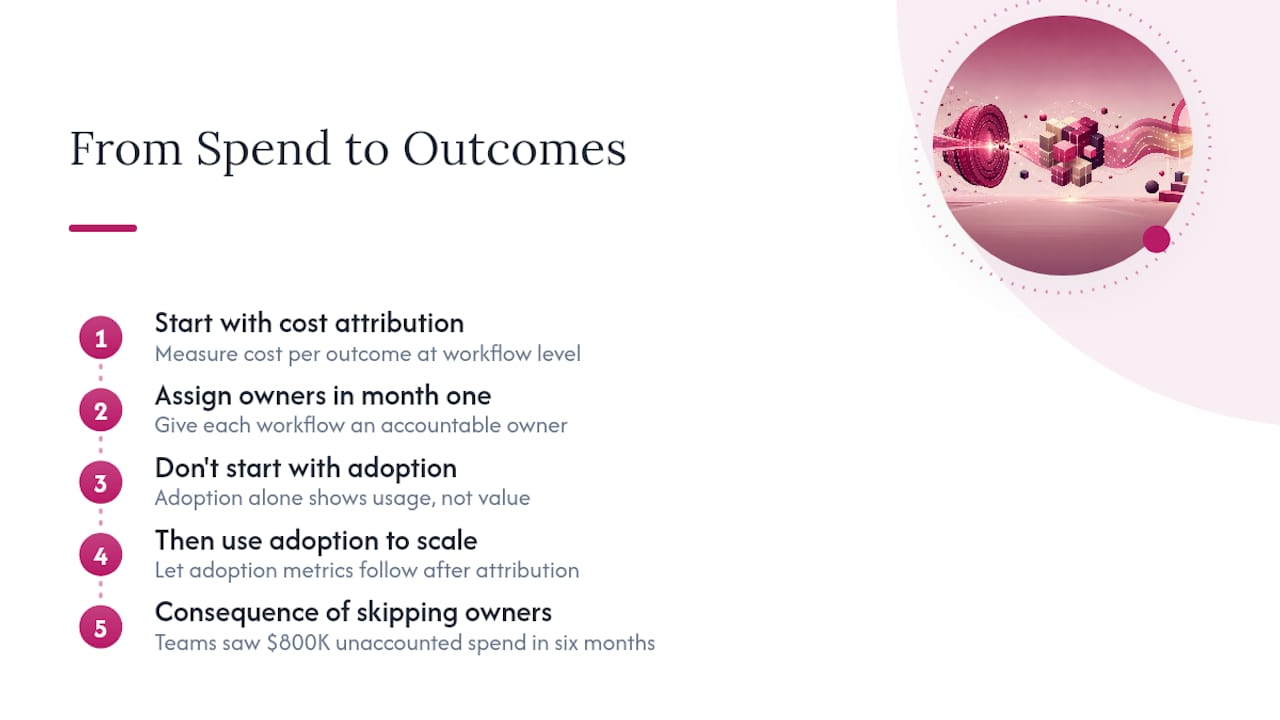
Most enterprises measure AI spend in aggregate. The ones that actually control it measure cost per outcome at the workflow level. That single shift, from “what did we spend on AI this quarter” to “what did each workflow cost per unit of output,” changes every downstream conversation: procurement, headcount planning, and the board deck.
The conventional wisdom says to start with adoption metrics because they are easy to collect. That is backwards. Adoption without cost-per-outcome data tells you how many people are using AI, not whether any of it is worth the money. Start with cost attribution, assign owners, and let adoption metrics follow once you know which workflows deserve to scale.
The teams that skip owner assignment in month one always regret it. Not because the audit fails, but because six months later they have a beautiful dashboard showing $2M in AI spend with no one accountable for $800K of it.
Configurato gets your pilot live in under 10 minutes
You have the playbook. Configurato is built to run it. Connect your expense export or provider API keys, and your first department-level dashboard is live in minutes, not weeks. Every workflow gets a named owner, every token maps to a cost center, and RoAI reporting is automated from day one.
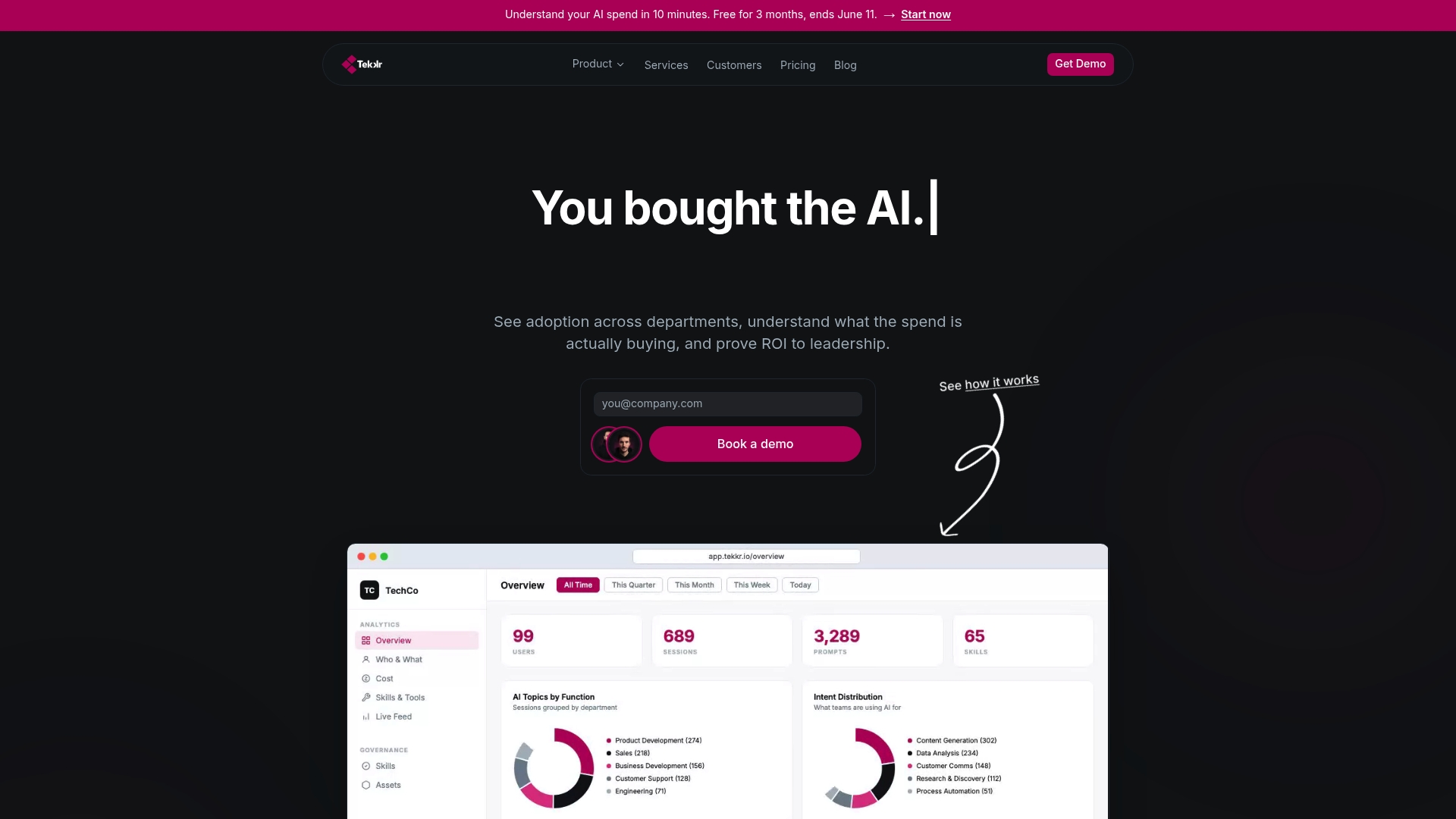
End-to-end encryption, automatic PII stripping, and SSO integration mean procurement and security sign-off is straightforward. No browser extensions, no lengthy implementation, and a free tier that requires no credit card. For enterprises ready to move from discovery to a governed AI program, start your Configurato pilot or review pricing and plan options before your next budget cycle closes.
Sources
The research behind this article draws on practitioner and analyst work worth reading in full when building an internal RoAI playbook:
- Three approaches to measuring and managing AI ROI — MIT Sloan
- AI value metrics — Gartner
- Managing AI token costs — BCG
- 2026 AI Impact Survey Report — Grant Thornton