
For enterprise finance and BI teams in 2026, Tekkr’s Configurato is the strongest pick for measuring AI return on investment. It covers the three things CFOs actually need: granular cost allocation by team and use case, organization-wide adoption tracking, and automated financial reporting that doesn’t require a data engineer to interpret.
Why it stands out for finance teams:
- CFO-grade outputs. Configurato surfaces spending breakdowns, payback windows, and adoption rates in formats finance leaders can take directly to a board review.
- Metric promotion loop. AI-generated metrics can be reviewed and promoted into a governed layer, building institutional memory rather than one-off chat answers. Enterprise-grade governance and metric promotion loops remain rare even among the top 13 platforms reviewed in 2026.
- Cost allocation plus adoption tracking in one tool. Most ROI tools measure spend or usage. Configurato tracks both, then actively drives adoption higher through playbooks and gamified rollouts.
Stat: Shadow AI spend and untracked tool usage are now among the top three CFO concerns in enterprise AI programs, according to finance leaders surveyed in 2026.
Table of Contents
- Why measuring AI ROI is now a CFO-level requirement
- What should your enterprise AI ROI tool checklist include?
- How Tekkr’s Configurato maps to the enterprise buyer checklist
- How should you actually calculate AI ROI?
- How should you budget for AI ROI tooling?
- Real-world AI ROI tool outcomes: what enterprises are seeing
- What are the hardest integration challenges, and how do you solve them?
- Key Takeaways
- What most AI ROI pilots get wrong
- Prove your AI investment is working with Tekkr
- Useful sources and further reading
Why measuring AI ROI is now a CFO-level requirement
AI investment has moved from pilot budgets to material line items. Finance teams that cannot show a return are losing the internal argument for continued spend, and in many enterprises the measurement gap is the real problem, not the AI tools themselves.
The core pain points are predictable: teams buy licenses, usage is inconsistent across departments, and no one can answer the question “what did we actually get for that?” Agentic analytics platforms that decompose drivers automatically and deliver root-cause explanations are now cutting investigation time from days to seconds, which itself represents measurable analyst-hours savings.
What finance teams are currently guessing about:
- Cost per active user versus cost per license purchased
- Value generated per use case versus total model spend
- Which departments have shadow AI spend outside approved tools
What should your enterprise AI ROI tool checklist include?
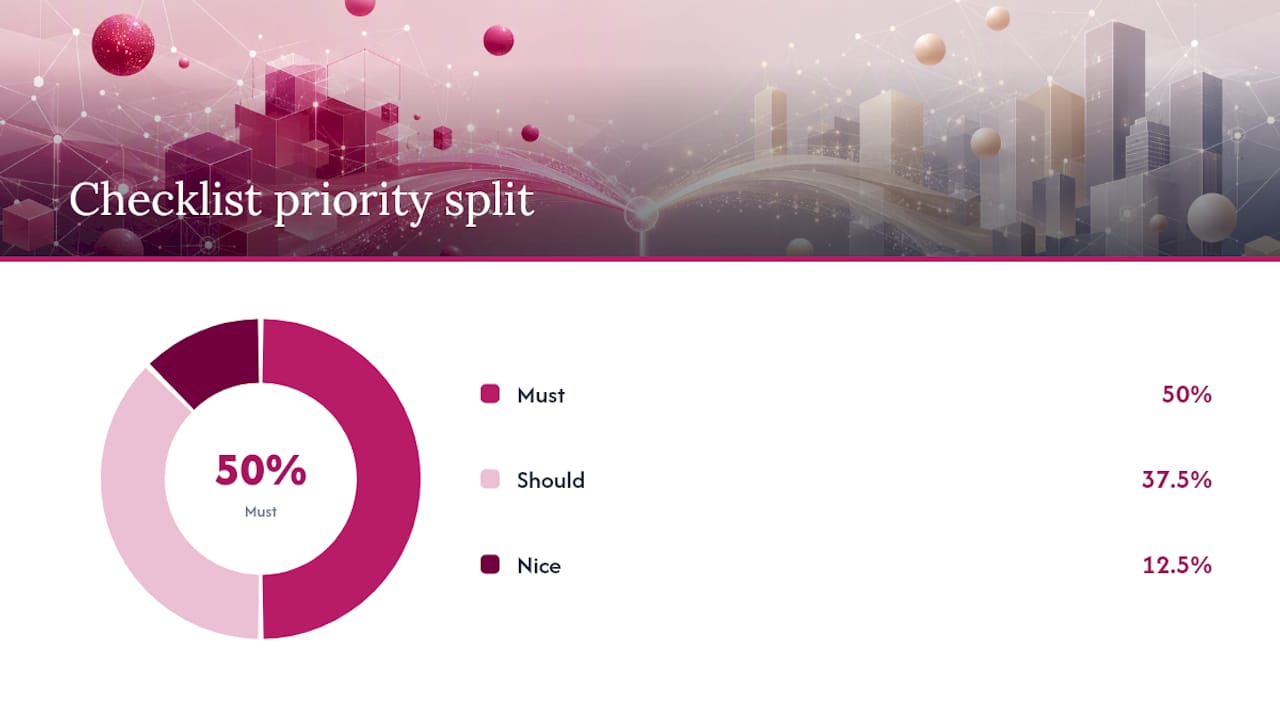
Use this prioritized checklist during vendor shortlisting. Must = non-starter if absent. Should = strong differentiator. Nice = useful but not blocking.
- Must: Governed semantic layer with metric promotion loop
- Must: Granular cost allocation by team, role, and use case
- Must: CFO-ready financial outputs (payback period, NPV, cost-per-use)
- Must: Security and compliance (end-to-end encryption, PII stripping, GDPR support)
- Should: Integrations with data warehouse, identity provider, and billing systems
- Should: Experiment support for incrementality and causal attribution
- Should: Audit trail and metric versioning
- Nice: SLA guarantees and dedicated onboarding support
Procurement questions to send vendors:
- How does your platform allocate AI spend to individual teams or cost centers?
- Can metrics generated by AI agents be reviewed, versioned, and promoted to a governed layer?
- What PII handling and encryption standards does your architecture meet?
- How long does a typical enterprise integration take, and what data sources are required?
- What does your SLA cover, and what is your average support response time?
- How do you handle data export and contract exit?
- Do you offer a pilot or free tier before full commitment?
Enterprise size note: Mid-market teams (200–2,000 employees) should weight cost allocation and adoption tracking most heavily. Large enterprises (2,000+) need to prioritize audit trails, warehouse connectivity, and metric governance before anything else.
How Tekkr’s Configurato maps to the enterprise buyer checklist
Configurato covers the full Must tier of the checklist above. It tracks every AI tool in use across an organization, including Claude and Codex, breaks spend down by team and use case, and generates executive-ready reports without requiring manual data pulls.
Feature match:
- Adoption tracking: who is using which tools, how often, and with what outcomes
- Cost allocation: spend broken down by department, role, and use case
- Metric promotion: AI-surfaced insights can be reviewed and locked into a governed layer
- Financial outputs: payback period, cost-per-user, and ROI summaries formatted for finance review
- Enablement: gamified rollouts and company-wide playbooks that lift adoption rather than just measure it
Security and compliance: Configurato runs on end-to-end encrypted infrastructure, strips PII automatically from all prompts, requires no browser extensions, and is GDPR-compliant. Setup takes roughly 10 minutes, and a free tier is available with no credit card required.
“The organizations that close the AI ROI gap fastest are the ones that connect spend data to adoption data in a single governed view — not the ones with the most sophisticated models.” — Tekkr measurement framework
For teams that need hands-on support, Tekkr pairs Configurato with optional consulting for AI transformation strategy and rollout. Integration requires connecting billing data, identity provider, and optionally a data warehouse. SSO is supported.
How should you actually calculate AI ROI?
The formula is straightforward. The execution is where most teams go wrong.
Core ROI formula:
ROI is calculated as the ratio of incremental value generated minus total AI cost relative to total AI cost, expressed as a percentage.
| Metric | Definition | Numerator or Denominator |
|---|---|---|
| Incremental revenue | Revenue attributable to AI, net of what would have occurred without it | Numerator |
| Cost savings | Reduced labor, vendor, or infrastructure costs from AI automation | Numerator |
| Total AI cost | Licenses + infrastructure + human oversight + integration + training | Denominator |
| Payback period | Total AI cost ÷ monthly incremental value | Standalone |
| NPV | Discounted future incremental cash flows minus upfront cost | Standalone |
Worked example (12-month AI coding assistant deployment):
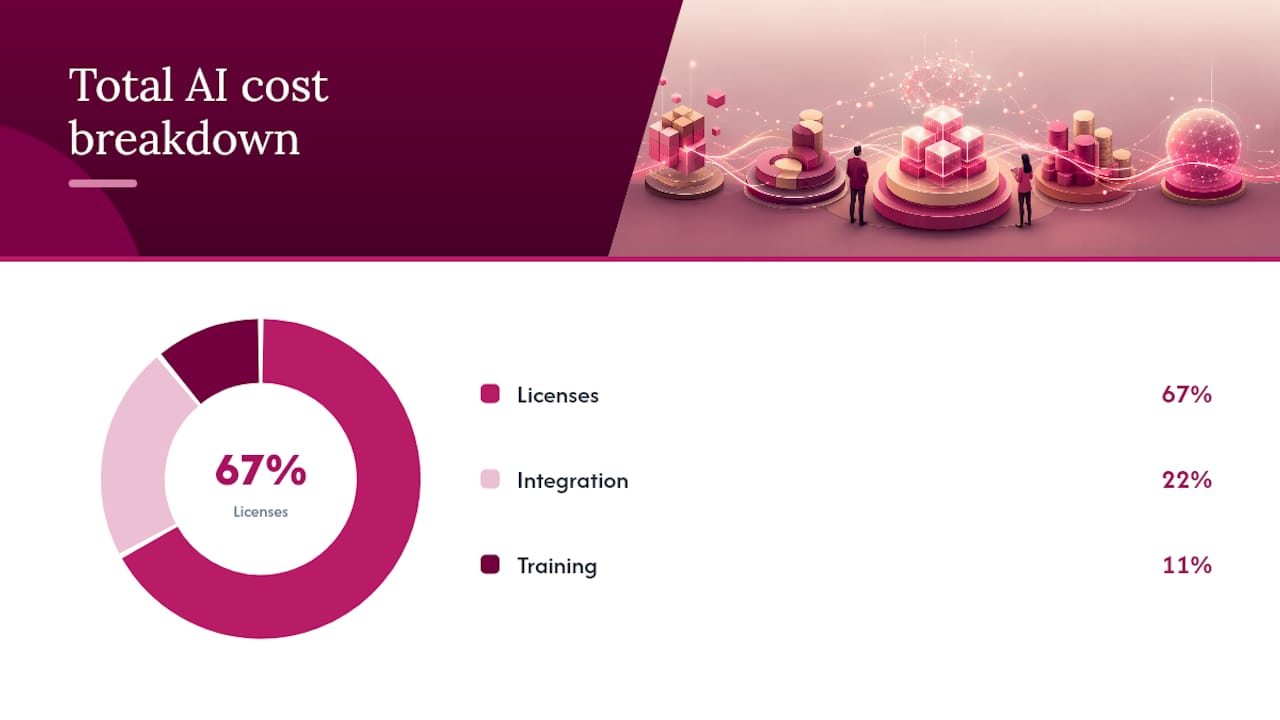
- Total cost: $180,000 (licenses $120K + integration $40K + training $20K)
- Measured time savings: 2 hours per developer per week × 50 developers × 48 weeks = 4,800 hours
- Blended developer hourly cost: $75/hour → incremental value = $360,000
- ROI is calculated as the ratio of incremental value generated minus total AI cost relative to total AI cost.
- Payback period is calculated by dividing total AI cost by monthly incremental value.
Attribution guidance: Use controlled experiments (A/B or incrementality tests) whenever finance requires audit-grade attribution. Causal, incrementality-calibrated MMM produces CFO-defensible estimates; correlational observational methods are frequently rejected in board reviews. For NPV, use a discount rate consistent with your company’s WACC. Finance teams typically prefer payback period for quick decisions and NPV for capital allocation.
How should you budget for AI ROI tooling?
| Budget line item | Typical pricing model | Notes |
|---|---|---|
| Platform license | Per-user or per-org tier | Tekkr offers a free tier; paid plans scale with org size |
| Infrastructure/consumption | Consumption-based (warehouse, AI API) | Can spike; negotiate caps upfront |
| Integration | Fixed project fee or included | Varies by data stack complexity |
| Consulting | Fixed engagement or retainer | Optional; useful for first pilot |
| Training and change management | Included or add-on | Often underbudgeted |
Procurement checklist: Confirm data export rights before signing. Verify SLA response times for enterprise support. Require a written data handling addendum covering PII and encryption. Ask for a pilot-to-production pricing path so you are not repriced at scale.
Pro Tip: Negotiate a consumption cap for warehouse and AI API charges in your first contract year. Surprise overages on infrastructure are the most common source of TCO blowouts in AI tooling deployments.
Real-world AI ROI tool outcomes: what enterprises are seeing
AI agents that automate analysis-to-action workflows are cutting analyst handoffs and compressing the time between insight and business response from days to hours. In product analytics deployments, teams using agentic platforms report building cohorts, running experiments, and pushing results to Slack or CRM systems without manual intervention.
For AI adoption programs specifically, the fastest payback occurs when spend data is connected to usage data early in the adoption process. Enterprises that establish a baseline before expanding licenses consistently report shorter payback windows than those that measure retrospectively. One common outcome: teams often find significant license underutilization, and reallocating those seats to high-adoption departments improves per-dollar return without additional spend.
The governance and semantic depth of the measurement platform matters more than most buyers expect at the shortlisting stage. Platforms without version control or metric promotion produce answers that cannot be audited or reproduced, which creates friction at every CFO review.
What are the hardest integration challenges, and how do you solve them?
The three integration points that cause the most delays are billing data normalization, identity resolution across tools, and warehouse connectivity.
Billing data arrives in different formats from every AI vendor. The fix is a normalization layer that maps vendor-specific cost fields to a unified schema before any ROI calculation runs. Tekkr’s Configurato handles this automatically for supported tools.
Identity resolution breaks when employees use personal accounts or unmanaged SSO. Requiring SSO enforcement as a precondition to the pilot eliminates most of this problem before data collection starts.
Warehouse connectivity is the longest lead-time item. If your data warehouse (Snowflake, BigQuery, Redshift) is not already connected to your identity and billing systems, budget two to three weeks for that work before the pilot clock starts. Big data dashboard integrations that connect BI layers to live warehouse data can accelerate this step for teams already running Power BI or Tableau.
The fastest pilots are the ones that scope to a single use case, a single department, and a single AI tool for the first eight weeks. Trying to measure everything at once is the most reliable way to produce nothing useful.
Key Takeaways
Tekkr’s Configurato is the strongest enterprise pick for AI ROI measurement in 2026 because it combines governed cost allocation, adoption tracking, and CFO-ready outputs in a single privacy-first platform.
| Point | Details |
|---|---|
| Connect billing and baseline first | Link AI billing data and capture a productivity baseline before expanding licenses. |
| Require a metric promotion loop | Only platforms with governed metric layers produce audit-ready ROI outputs for CFO review. |
| Use causal attribution for finance | Incrementality-calibrated methods are required for board-grade ROI; correlational estimates are routinely rejected. |
| Scope pilots tightly | One use case, one department, one tool for weeks 1–8 produces faster and more credible results. |
| Tekkr / Configurato | Covers the full Must tier: cost allocation, adoption tracking, metric governance, GDPR compliance, and a free tier to start. |
What most AI ROI pilots get wrong
The failure mode I see most often is not a technology problem. Teams skip the baseline. They deploy a measurement tool after the AI rollout is already underway, which means they have no pre-AI benchmark to compare against. Without that, every ROI calculation is an estimate dressed up as a measurement, and CFOs know the difference.
The second trap is treating the measurement tool as a reporting layer rather than a governance layer. If the metrics your platform produces cannot be versioned, audited, and promoted to a governed semantic layer, you will rebuild the same analysis from scratch every quarter. That is not measurement; it is manual reporting with extra steps.
Vendor trustworthiness is worth scrutinizing directly. Ask for audit logs, ask how metrics are versioned, and ask for references from finance teams specifically, not just engineering or product teams. A vendor that cannot show you how a metric was calculated six months ago is not ready for enterprise procurement.
Tekkr publishes executive measurement frameworks and ROI guides that are worth reviewing before you finalize your KPI template. The enterprise AI adoption guide is a practical starting point for stakeholder alignment before the pilot begins.
Prove your AI investment is working with Tekkr
Finance and BI teams that have mapped the checklist above already know what they need: a platform that connects spend to adoption, produces governed metrics, and gives the CFO something defensible. Tekkr’s Configurato delivers all three, with a privacy-first architecture that clears enterprise security review without a months-long procurement process.
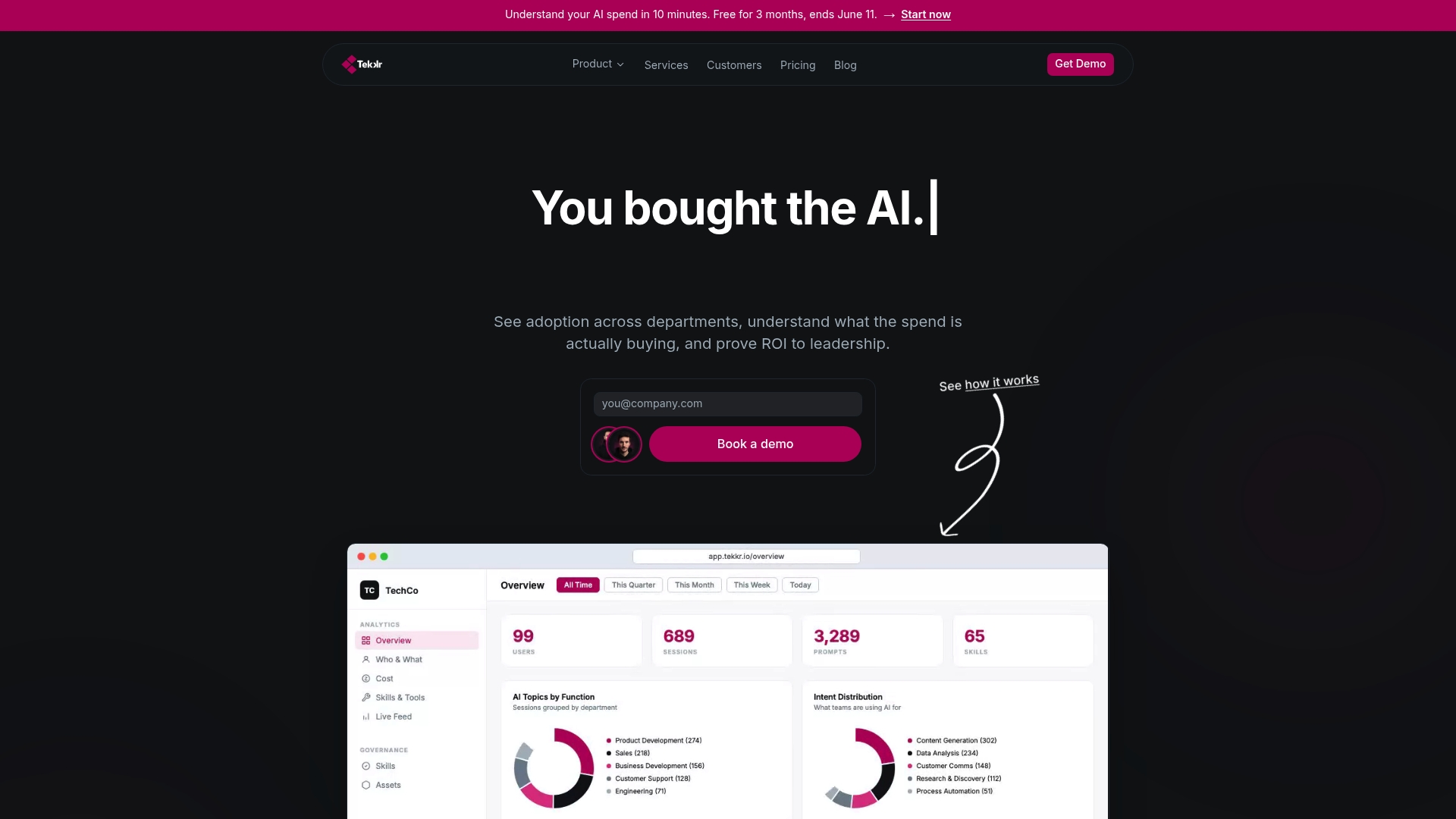
A pilot with Configurato typically produces outcomes including a clear view of which AI tools generate return, a cost-per-use breakdown by department, and a governed metric baseline that accelerates ROI conversations. Setup takes 10 minutes, the free tier requires no credit card, and Tekkr’s consulting team is available for hands-on rollout support if you need it.
Start your pilot at tekkr.io/solutions/ai-adoption.
Useful sources and further reading
- Best AI Analytics Platforms: 13 Tools Reviewed (2026)
- Top 5 Best Media Mix Modeling (MMM) Software for Proving Marketing ROI to Leadership and Finance (2026) | Measured® Best MMM Software for Proving Marketing ROI to Finance 2026
- AI Analytics Platforms 2026: 12 Tools Compared
- Unlock Agentic Analytics from Your Data Warehouse
- Amplitude AI Agents - Agentic AI Data Analytics
- Tekkr - AI Productivity, Adoption & Governance · Tekkr