
Successful AI vendor management comes down to four things happening at once: you can name every AI tool running in your company, one person owns each vendor relationship, spending has hard limits before it becomes a finance surprise, and you can prove return on investment with numbers finance actually trusts. Start this week with three moves: build a first-pass inventory, assign ownership to discovered tools and set cost limits on major unknowns. Platforms exist specifically to make that visibility and ownership continuous instead of a one-time audit.
TL;DR:
- Most organizations lack a complete, real-time inventory of AI tools, relying instead on fragmented sources like API registries and expense records.
- Tiering vendors into strategic and tactical categories guides review frequency and helps prevent runaway costs and unaccounted risks.
- Continuous assessment, monitoring, and clear ownership are essential to maintain effective AI governance throughout the vendor lifecycle.
- Many finance teams cannot monitor AI expenses in real time, leading to potential overspending from undetected API call spikes or misconfigurations.
- Automating discovery, observability, and governance processes helps scale AI management beyond manual spreadsheets and fosters proactive oversight.
Table of Contents
- What Does AI Vendor Management Actually Require?
- How Do You Build an AI Vendor Inventory That Scales?
- How Do You Get Real-Time Visibility Into AI Costs?
- What Does the AI Vendor Governance Lifecycle Look Like?
- How Do You Measure AI ROI Without Overstating It?
- What Should You Automate to Scale Governance?
- The Real Gap in AI Vendor Management
- Turn AI Vendor Visibility Into a Working System
- Where to Go Deeper on AI Vendor Governance
- Sources
What Does AI Vendor Management Actually Require?
AI vendor management is the discipline of tracking, governing, and measuring every third-party AI tool your organization uses, from the Claude subscription your product team expensed to the fine-tuned model buried in a vendor’s backend. It sits closer to IT asset management and financial operations than to traditional procurement, because the assets in question change behavior, cost, and risk profile week to week.
That distinction matters because most companies still manage AI vendors like they manage office software licenses: annual review, static contract, done. Meanwhile, a coding assistant’s token consumption can triple in a month if a team automates a new workflow, and nobody notices until the invoice lands. Enterprise AI organizations report a genuine ownership problem, not a technology problem: a substantial portion of surveyed enterprises have no single accountable owner for AI vendor decisions, and some cite vendor opacity as a barrier to control.
Fixing that starts with inventory, not policy.
How Do You Build an AI Vendor Inventory That Scales?
You cannot govern what you cannot see, and most organizations underestimate how many AI tools are already live. Discovery has to pull from multiple sources because no single system catches everything: API key registries, SaaS management platforms, procurement and expense card records, developer tool registries, and single sign-on logs all surface different pieces of shadow AI.
Once you find a tool, capture the same core fields every time so the inventory stays usable instead of becoming another spreadsheet nobody trusts:
- Product name and the underlying foundation model it runs on
- Named business owner and technical owner
- Data inputs and output permissions, especially anything touching customer or regulated data
- Criticality tier, based on business impact if the tool fails or is compromised
Tier every vendor into two buckets: strategic and critical tools that touch core workflows or sensitive data get quarterly reviews and board visibility; tactical tools get lighter, annual review cycles. That tiering alone cuts survey-reported control failures tied to unclear accountability, since many enterprises have already experienced shadow AI and some have hit runaway billing from unmonitored agent loops.
Document accountability in a short charter: who owns escalation, who signs off on new tools, and what happens when a tool crosses tiers.
Pro Tip: Assign ownership by use case, not by department. A legal team using a summarization tool and a sales team using the same tool for call notes need different risk owners, even though it’s the same vendor.
How Do You Get Real-Time Visibility Into AI Costs?
Most finance teams are flying blind on AI spend, and the data backs that up starkly: only a minority of large-enterprise executives say they can monitor AI costs in near real time; the rest rely on retrospective billing that surfaces problems weeks after they start. That lag is expensive. A single misconfigured agent looping on an API call can burn through a monthly budget in days, and you won’t know until the invoice arrives.
Real-time visibility requires instrumenting the right telemetry, not just watching the bill:
- Token counts and API call volumes by team and by application
- Compute run-time hours for anything running fine-tuned or self-hosted models
- Vector database costs and storage growth
- Infrastructure egress tied to model inference
Token spend is now a board-level concern. A recent EY survey found a large majority of executives worry about rising token usage costs, yet some have active monitoring and budget guardrails in place. That gap between concern and control is where most AI vendor management programs stall.
Close it with allocation models that assign real cost to real teams: tagging every API call by department, chargeback models where teams pay from their own budget, showback models that surface cost without direct billing, and hard guardrails like rate limits, spend caps, and per-team quotas. When you catch a runaway agent or a billing spike, the playbook should already exist: freeze the API key, notify the tool’s owner, and audit the trigger before restoring access. Tools like Tekkr’s cost breakdown guide walk through where token spend typically hides.
What Does the AI Vendor Governance Lifecycle Look Like?
Governance works as a lifecycle, not a checklist you run once at signing. The COMPEL framework for enterprise AI supply-chain governance breaks it into four repeating stages: assessment, monitoring, management, and assurance. Skip any one of them and the others lose their value fast.
Assessment happens before onboarding and at every renewal. Cover these areas at minimum:
- Vendor transparency about training data and model architecture
- Bias testing results and known failure modes
- Security posture, including SOC 2 or equivalent certification
- Data privacy handling and residency
- Incident response commitments and history
- Contractual terms covering liability, data ownership, and termination
Monitoring runs continuously, not annually. Watch for model drift, performance regression against your own benchmarks, signs of data leakage, and cascading failures when a foundation-model provider has an outage that ripples through every tool built on top of it. Vendor intelligence, tracking regulatory actions, public incidents, and a vendor’s financial stability, belongs in this same continuous layer.
Every assessment cycle should end with a recorded decision, not a shrug: approve, restrict, or retire, with an owner and a deadline attached. Executives and boards need a short set of metrics to track progress, and they’re worth standardizing across your portfolio:
| Metric | What it tells you |
|---|---|
| Portfolio coverage | Percentage of known vendors under active governance |
| Incident frequency | Rate of security, privacy, or performance incidents per quarter |
| Vendor concentration | Reliance on a small number of foundation-model providers |
| Remediation completion rate | Share of flagged issues closed within deadline |
Pro Tip: Report vendor concentration to your board even when it looks fine. A clean number today can turn into a single point of failure the moment one provider has an outage.
How Do You Measure AI ROI Without Overstating It?
Vendor pitch decks are consistently optimistic, and finance teams that take them at face value get burned. The fix is a documented baseline before deployment, not after. Measure current cycle time, error rates, or headcount hours before the tool goes live, and bring finance or internal audit into KPI definition from day one rather than after the renewal conversation.
EY’s analysis of enterprise AI ROI points to a consistent culprit: unclear KPIs and inconsistent governance keep AI investments stuck as pilots that never scale into measurable value. Fixing that means treating full total cost of ownership as mandatory, not optional. Vendor-quoted subscription costs routinely understate the real number: hidden organizational costs like data preparation, security review, change management, and internal IT support may add significantly to the vendor-quoted subscription costs.
Match your KPIs to the deployment phase instead of using one metric for the whole lifecycle:
- Pilot phase: adoption rate and output accuracy against the baseline
- Rollout phase: usage depth across teams and measured cycle-time reduction
- Steady state: headcount avoidance, revenue impact, and sustained cost per output
Three mistakes wreck otherwise solid ROI models: launching without a baseline, mixing leading indicators like adoption with lagging indicators like revenue impact in the same report, and quietly excluding the hidden costs above. Tools built for AI ROI measurement exist precisely because spreadsheets tend to lose this discipline by quarter two.
What Should You Automate to Scale Governance?
Manual spreadsheets break down once you pass roughly twenty vendors, so the tooling layer needs to automate discovery and observability, not just store records. That means discovery feeds that catch new tools automatically, usage tracking by team and individual, model dependency mapping so you know what breaks if a provider goes down, and alerting when costs spike or model outputs drift.
Workflow automation should handle the repetitive governance work: triggering reassessments on schedule, tracking remediation tasks to their deadline, and routing approvals to the right owner without someone chasing it manually.
The tooling layer is also where visibility turns into adoption, not just control. Gamified rollouts, company-wide playbooks, and leaderboards convert a governance program from something teams tolerate into something they engage with, and the resulting usage data feeds directly into the finance metrics from the ROI section above.
Governance tooling only earns trust if it respects the same privacy standards you’re asking vendors to meet: automatic PII stripping from prompts, end-to-end encryption, and no requirement to install a browser extension on every employee’s machine.
None of this replaces judgment. It just means the next audit doesn’t start from zero.
The Real Gap in AI Vendor Management
Most companies treat AI governance as a project with a start and end date. It isn’t one. The organizations getting this right run it as an operating rhythm: weekly operational checks on cost and usage anomalies, a monthly executive review of the metrics in the governance table above, and a quarterly board briefing on concentration risk and incident trends.
If you take one thing from this guide, prioritize in this order: visibility first, then a named owner, then finance-grade measurement, then a governance cadence you actually keep. Skip the order and you’ll spend a year building policy nobody follows.
— TekkrTools
Turn AI Vendor Visibility Into a Working System
Everything in this guide, the inventory, the cost guardrails, the governance metrics, the ROI baseline, is what Configurato was built to automate rather than leave to spreadsheets. It tracks AI tool usage across teams, breaks down spend by team, highlights which use cases drive real value, and supports gamified rollouts to help adoption grow instead of stalling after launch.
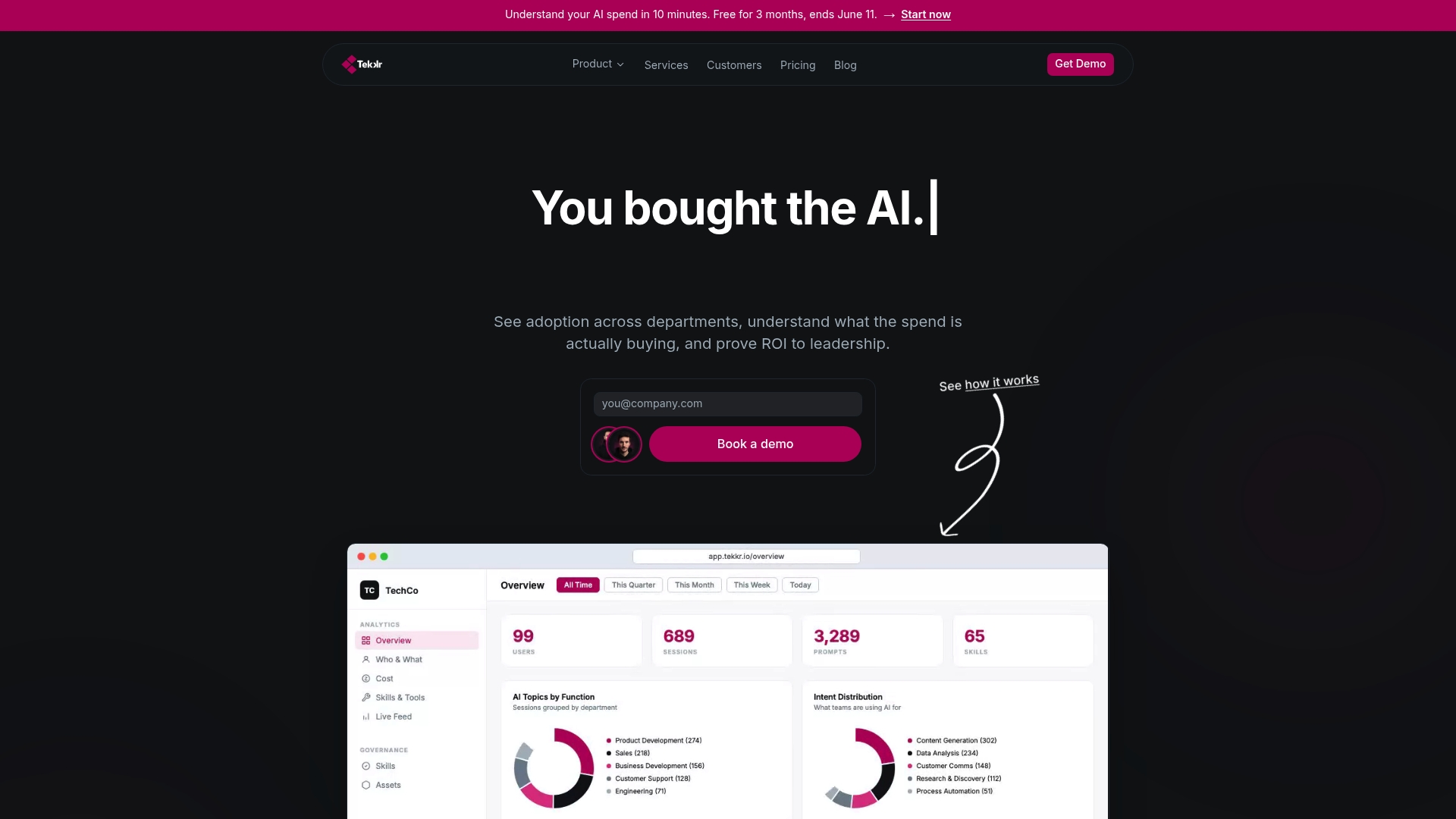
The architecture follows privacy-first principles including automatic PII stripping, encryption, and GDPR compliance, and does not require browser extensions from employees. Setup typically takes a short time, and some platforms offer a free tier with no credit card needed, enabling organizations to view their AI vendor landscape before committing. If you’re ready to replace the spreadsheet version of this playbook, start with Tekkr’s AI adoption solution and get your first inventory built this week.
Where to Go Deeper on AI Vendor Governance
A few sources back the framework in this guide and reward a closer read for teams building out their own program:
- EY’s analysis of the AI ROI trap breaks down why governance gaps and unclear KPIs stall AI value at the pilot stage.
- The COMPEL framework offers a detailed model for assessment, monitoring, and executive reporting metrics.
- VentureBeat’s reporting on the enterprise AI ownership gap documents how missing ownership drives shadow AI and runaway spend.
- CFO Dive’s coverage of AI cost visibility puts real numbers behind the retrospective-billing problem most finance teams face.
Sources
- AI cost challenges rise as firms lean coordinated agents (CFODive)
- The control gap: enterprise AI ownership problem (VentureBeat)