
The most effective enterprise AI training program is a continuous, role‑specific, workflow‑embedded enablement system measured by adoption telemetry, not a one‑time course. It runs on a 12‑week cadence of hands‑on sessions, backed by advocates and a named owner, and it tracks depth of use rather than seat counts. Tools like Tekkr’s Configurato exist to make that measurement and enablement loop practical from day one.
TL;DR:
- Continuous, role‑specific training with ongoing measurement and a designated owner boosts AI adoption beyond one-time workshops.
- Building trust and embedding AI into workflows requires advocates, recurring community forums, and governance that reduces friction, not adds it.
- Effective rollout follows a four-phase roadmap: audit, train, embed, and scale, with telemetry used to guide adjustments.
- The Intelligence Impact Quotient provides a deeper measure of AI adoption, focusing on real task usage and organizational impact rather than seat counts.
- Budgeting should prioritize people time and measurement infrastructure over software licenses to ensure program sustainability.
Table of Contents
- What Makes an AI Training Program Actually Work?
- How Do You Roll Out AI Training Step by Step?
- How Do You Measure AI Adoption Beyond Seat Counts?
- How Should Governance Reduce Resistance Instead of Adding It?
- What Does a 30/90-Day AI Training Rollout Look Like?
- How Configurato Turns Training Into Measurable Adoption
- How Much Should You Budget for AI Training?
- Why Most AI Training Advice Gets the Order Backward
- Turn AI Spend Into Something You Can Prove
- Sources
What Makes an AI Training Program Actually Work?
Most companies still buy AI training the way they buy compliance training: one workshop, one certificate, one box checked. Microsoft calls this pattern “license drop,” and it flags it as the single most common reason enterprise AI rollouts stall after an initial burst of curiosity. The fix isn’t more content. It’s a different structure built around seven pillars that reinforce each other.
- AI advocates: peer champions embedded in each department who answer day-to-day questions faster than any help desk.
- Role‑based learning paths: a sales rep and a financial analyst should never sit through the same generic AI 101 deck.
- Continuous measurement: adoption tracked weekly, not surveyed once at the end of a pilot.
- A named DRI: one directly responsible individual who owns the program’s outcomes, not a committee.
- Governance that enables: acceptable-use guardrails that reduce fear instead of adding friction.
- Right‑fit tooling: matching the AI assistant to the actual workflow, not the loudest vendor pitch.
- Communities of practice: recurring forums where employees swap prompts and use cases that worked.
Industry playbooks built around AI workforce enablement converge on the same list, and Microsoft’s own employee AI enablement pattern specifically calls out leadership role‑modeling as a maturity driver most programs skip.
Pro Tip: Assign the DRI before you pick a training vendor. Programs built around a tool rather than an owner tend to lose momentum the moment the vendor’s onboarding calls end.
How Do You Roll Out AI Training Step by Step?
A workable enterprise AI training roadmap has four phases, and none of them is a single event.
- Audit. Map real workflows before writing a single training slide. Identify which teams already show frontier-level curiosity (they’ll become your first champions) and which tasks offer the fastest visible win. Stanford’s review of 51 enterprise cases found that 77% of adoption challenges are organizational, not technical, which means the audit phase is where most future failures actually get prevented.
- Train. Run anchor workflow sessions, hands-on and specific to one real task an employee does every week, not abstract demos; for building training videos and microlearning content, explore the best AI video tools for education. Practitioner research on enterprise rollouts found that these anchor sessions plus an early “first win” moment are the strongest predictors of sustained use, with adoption climbing from low double digits toward majority use within weeks when done right. Build a train-the-trainer layer so champions can run sessions without you. Repeat the training at least three times across the first 12 weeks. One-and-done sessions are exactly the pattern Microsoft warns against.
- Embed. Turn what worked into a playbook. Set up recurring office hours. Let managers reinforce usage in their own team meetings instead of treating AI as an HR initiative.
- Scale. Document the recipes that worked in your pilot teams, expand through your champion network department by department, and adjust based on telemetry rather than guesswork about what “should” be working.
Grant Thornton’s research on AI adoption strategies that stick makes a related point worth building into every phase: training that teaches people to evaluate AI output, not just generate it, holds up better once the novelty fades.
How Do You Measure AI Adoption Beyond Seat Counts?
Seat counts tell you who has access. They tell you nothing about who’s actually integrating AI into real work, which is the number that matters to a CFO. A newer composite metric called the Intelligence Impact Quotient (IIQ) addresses this gap by combining usage recency, task novelty, complexity, and organizational leverage into a single 0 to 1,000 index, giving leaders one number that reflects depth rather than mere access.
Build your dashboard around a few core signals:
- Monthly and weekly active users (MAU/MEU) as a floor metric, not the headline
- Active-user share relative to total licensed seats
- Time saved per workflow, reported by task type
- Top-decile usage concentration, so you can see whether adoption is broad or resting on five power users
- Workflow-weighted views that separate “used AI” from “used AI on a task that matters”
Report median IIQ alongside active-user share rather than a single average. Averages get distorted by a handful of heavy users, masking the fact that adoption might be shallow across most of the workforce. A companion adoption telemetry framework, NANTE, proposes five operational stages with telemetry thresholds specifically designed to catch adoption-failure modes before they show up in a quarterly review. Set your reporting cadence at biweekly during the first 12 weeks, then move to monthly once usage stabilizes, and break every figure out by department rather than reporting one company-wide blend.
How Should Governance Reduce Resistance Instead of Adding It?
Governance done wrong slows adoption more than any training gap. Governance done right is what gets Legal, HR, and Risk to stop blocking rollouts and start co-owning them. Stanford’s review of enterprise cases found staff functions are among the most common blockers to AI adoption, precisely because they’re brought in after decisions are made instead of during design.
A workable acceptable-use policy should be short enough to read in five minutes and cover:
- What data can and can’t be pasted into an AI tool
- Which use cases require human review before output goes external
- Who to contact when an employee is unsure
Give Legal, HR, and Risk defined roles in the DRI’s governance flow instead of veto power over the whole program, and match controls to actual risk. A drafting assistant doesn’t need the same guardrails as an autonomous agent making customer-facing decisions.
Pro Tip: Over-governing a low-risk chat assistant is one of the fastest ways to convince employees the whole program is corporate theater.
What Does a 30/90-Day AI Training Rollout Look Like?
You don’t need a year to prove a training program works. You need a tight first 30 days and a disciplined next 60.
- Days 1 to 30: Complete the workflow audit, name your DRI and first wave of advocates, run the first anchor training session with one high-potential team, and stand up basic telemetry, even a simple usage dashboard beats none.
- Days 31 to 90: Repeat training with two more cohorts, publish your first internal playbook, hold your first office hours, and produce a preliminary ROI narrative for leadership using whatever telemetry you’ve captured.
- Beyond day 90: Expand the champion network into new departments and refine the program based on what the data actually shows, not what the pilot team assumed.
Quick checklist before you start: confirm your AI tools match real workflows, confirm your data-handling policy is written down, draft a repeatable training script, and pick three success metrics before session one, not after.
How Configurato Turns Training Into Measurable Adoption
Most of the roadmap above dies in the audit and measurement phases, not the training room. Teams can run a great anchor session and still have no idea three weeks later whether it stuck. That’s the gap Configurato is built to close: it tracks real usage of tools like Claude and Codex, breaks spend down by department, and surfaces which use cases are actually gaining traction versus which ones got a training session and then went quiet.
For a program built around advocates and a DRI, Configurato adds a layer most spreadsheets can’t:
- Gamified rollouts that turn adoption tracking into something champions can rally teams around, not just a report for leadership
- Company-wide playbooks that document what worked, tied to actual usage data instead of anecdote
- Automated executive reporting that shortens the ROI narrative work described in the measurement section above
- A privacy-first, end-to-end encrypted setup with automatic PII stripping, so tracking usage doesn’t mean reading employee prompts
Programs fail quietly. Nobody announces that training didn’t stick, usage just drifts back to zero and shows up as a budget line nobody can explain. The only defense is telemetry that catches the drift before the renewal conversation does.
Tekkr’s enterprise adoption solution is built for exactly this handoff between training and measurement, with setup taking about ten minutes and a free tier that doesn’t require a credit card to start.
How Much Should You Budget for AI Training?
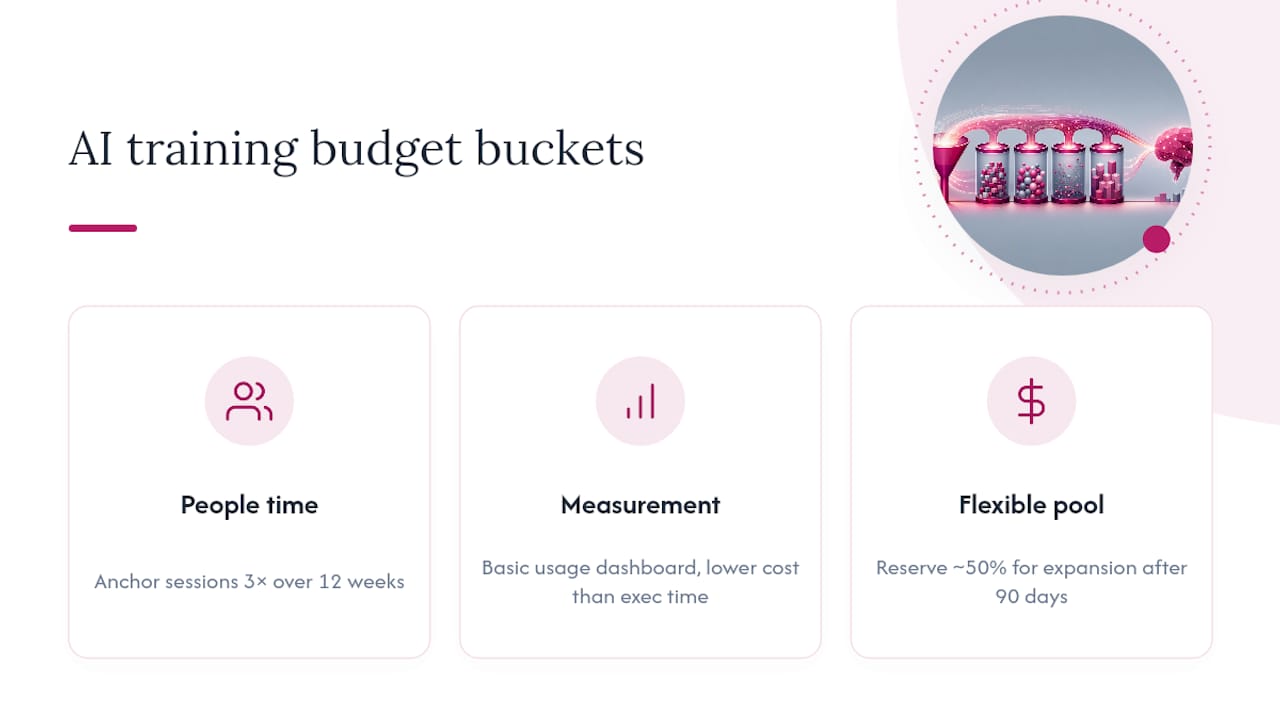
Budget for AI training programs breaks into three buckets, and most companies only plan for one of them: the tool license. That’s a mistake. The license is often the smallest recurring cost once you count staff time.
Budget first for people time, not software. Advocates need protected hours each week, not “do it if you get to it.” A DRI role, even part-time, needs to be counted as real headcount, not an unpaid addition to someone’s existing job. Anchor sessions run three times over 12 weeks require facilitator time, whether that’s an internal champion or outside support, and that repetition cost is usually underestimated by teams that budget for a single kickoff workshop.
Second, budget for measurement infrastructure. A basic usage dashboard costs far less than the executive time wasted defending an adoption claim nobody can verify. This is typically a fraction of the software license cost but gets skipped in initial planning because it doesn’t show up on a vendor’s price sheet.
Third, keep a flexible pool for the scale phase. Departments that adopt AI faster than expected will ask for more training capacity mid-year, and a budget locked entirely into Q1 planning has no room to respond. A reasonable split allocates roughly half the budget to the first 90 days and reserves the rest for expansion once you have real telemetry showing which teams and use cases deserve more investment.
Why Most AI Training Advice Gets the Order Backward
Most advice on AI training programs starts with content: what to teach, which certification to chase, which platform to license. That’s backward. The research on enterprise adoption points to a different starting point: figure out who owns the outcome and how you’ll measure it before you write a single training module.
The conventional playbook treats training as an event and governance as a brake pedal. Both assumptions collapse under scrutiny. Training that doesn’t repeat fails, and governance that doesn’t involve Legal and HR as partners becomes the very blocker it was meant to prevent.
If there’s one place to put disproportionate effort, it’s the measurement layer. Not because dashboards are exciting, but because they’re the only thing that catches a stalling program before the next budget cycle kills it. Teams that skip telemetry find out their AI investment didn’t work at renewal time, when it’s too late to fix. Teams that instrument it from week one find out in week three, when a course correction still costs almost nothing.
— TekkrTools
Turn AI Spend Into Something You Can Prove
You’ve bought the AI tools. The harder problem is knowing whether anyone’s actually using them well enough to justify the line item. There are platforms that track real usage of assistants like Claude and Codex, analyze spend and adoption by department, and support gamified rollouts and playbooks that help make training programs more durable.
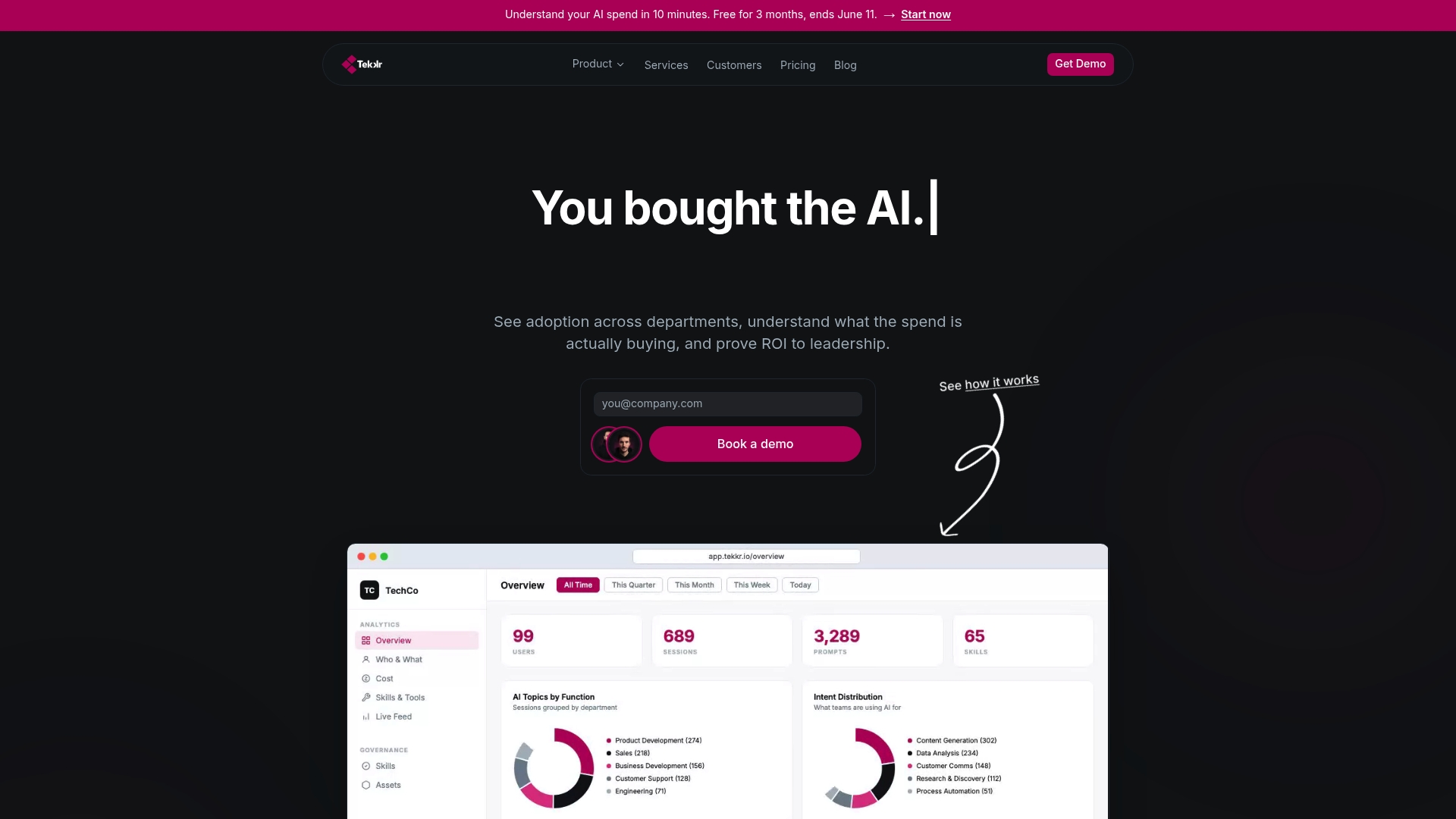
If you’re building or rescuing an enterprise AI training program, the fastest way to know where you stand is to see your current adoption numbers rather than guess at them. Tekkr’s AI adoption and consulting solution pairs the Configurato platform with hands-on rollout support, and setup takes about ten minutes with a free tier that needs no credit card. Start there, get a real read on usage across your organization, then decide what your next training cycle actually needs to fix.
Sources
For deeper reading: Microsoft’s employee AI enablement pattern covers the license-drop anti-pattern in detail. The IIQ paper lays out the measurement math. Stanford’s Enterprise AI Playbook documents governance patterns across 51 real cases. Tekkr’s own guide to measuring AI ROI translates telemetry into board-ready numbers.