
AI tool sprawl is the uncontrolled proliferation of AI models, agents, embedded SaaS features, and autonomous workflows spreading across your organization without centralized oversight. The single most important thing you can do right now: build a living AI inventory, not a one-time audit.
You cannot govern what you cannot see. A static spreadsheet compiled last quarter already misses the agents your developers spun up last week, the Copilot toggle your SaaS vendor quietly enabled, and the personal ChatGPT accounts three sales reps are using on company data. Continuous discovery is the foundation every other control depends on.
According to Palo Alto Networks, sprawl compounds fast: separate credentials, access methods, and dashboards multiply until auditing them becomes a project in itself. The inventory is not a governance artifact. It is the governance program.
- Start discovery this week using network/DNS logs, OAuth audits, and expense data
- Assign a named owner to every tool in the inventory
- Tier each tool by risk before deciding what to block, replace, or formalize
Key Takeaways
Uncontrolled AI tool proliferation is already limiting AI integration for the majority of enterprises, and the tools causing the most damage are the ones that bypassed governance entirely.
| Point | Details |
|---|---|
| Build a living inventory first | Continuous discovery using CASB, OAuth audits, and expense data beats any one-time audit. |
| Tier tools by risk, not volume | Prioritize high-data-risk and high-spend tools; apply proportionate controls rather than uniform blocks. |
| Separate agent identities | Per AWS Well-Architected, agents need distinct workload identities with least-privilege scopes, not borrowed human credentials. |
| Sequence enablement before enforcement | Launch fast-track approvals and governed alternatives before decommissioning shadow tools to avoid driving usage underground. |
| Tekkr Configurato | Provides continuous AI tool discovery, cost allocation by team, and shadow AI detection without browser extensions. |
Table of Contents
- What does AI tool sprawl actually look like inside your organization?
- Why does AI tool sprawl happen so fast in enterprises?
- What are the real risks when AI tool sprawl goes unchecked?
- How do you detect and measure AI tool sprawl across your estate?
- A six-step program to reduce AI tool and agent sprawl
- What technical controls enforce governance without slowing teams down?
- How should you prioritize remediation work and what will it cost?
- Who owns what in an AI tool governance model?
- What do the data and analyst signals actually say about this problem?
- The governance trap most enterprises fall into
- Tekkr’s Configurato gives you the visibility to govern AI spend and adoption
- Sources
What does AI tool sprawl actually look like inside your organization?
Most leaders picture sprawl as a list of redundant SaaS subscriptions. The reality is messier and harder to spot.
Shadow AI is the most common form: employees using personal or free-tier accounts for ChatGPT, Claude, or Gemini because the approved tool is too slow to procure or too restricted to be useful. The data they paste in never touches your DLP controls.
Embedded AI features inside approved SaaS products are an equally large vector. A vendor ships a new “AI assistant” toggle inside a CRM or HR platform your team already uses. No procurement review, no security assessment, no data-flow mapping. The feature is just on. Secured AI’s enterprise control guide documents how these toggles activate hidden data flows that bypass approval processes entirely.
Agent-specific sprawl has its own texture:
- Unattended agents running scheduled tasks with credentials that were never formally provisioned
- Feature-toggled assistants inside Microsoft 365, Salesforce, or ServiceNow that IT never explicitly approved
- Browser-based agents installed as extensions, operating outside endpoint management
- Developer machine agents like Copilot for CLI or local LLM runners that never touch the corporate network but process sensitive code
A concrete example: a sales team adopts an AI call-summarization tool because the approved CRM add-on has a six-week procurement queue. Marketing runs three separate image-generation tools because no one agreed on a standard. The dev team has Copilot, Cursor, and a local Ollama instance, each touching different parts of the codebase. None of these choices is irrational in isolation. Together, they are sprawl.
Why does AI tool sprawl happen so fast in enterprises?
The root causes are structural, not behavioral. Blaming employees for “going rogue” misses the point.
Experimentation velocity outpaces governance. GenAI moved from research curiosity to board-level priority in under 18 months. Teams were told to experiment, and they did. IDC found that after roughly 18 months of heavy GenAI experimentation, many enterprises had identified hundreds of use cases and launched dozens of POCs but moved only a few into production. Every stalled POC leaves a tool behind.
Procurement cycles are too slow for AI’s pace. A formal software review that takes six to eight weeks made sense for ERP systems. It kills momentum for a team trying to test a new model API. The result: people find workarounds, and those workarounds become permanent.
- SaaS vendors shipping embedded AI features without requiring a new purchase order
- Free consumer tiers that require no IT involvement to activate
- Departmental credit cards that bypass central procurement entirely
- Incentive structures that reward shipping speed over governance compliance
Decentralized decision-making is the structural accelerant. When a marketing VP, an engineering director, and a finance manager each have budget authority and different risk tolerances, you get three parallel AI stacks with no shared visibility. Each decision is locally rational. The aggregate is ungovernable.
What are the real risks when AI tool sprawl goes unchecked?
The risks are not theoretical. They show up in audit findings, breach reports, and budget reviews.
Security exposure is the most immediate. Palo Alto Networks documents how sprawl scatters credentials and API keys across local machines, CI pipelines, and SaaS dashboards, making rotation and revocation a manual nightmare. Agent impersonation becomes a real attack surface when agents share credentials or run with overly broad permissions.

Compliance and data governance failures follow quickly. Data flows to unapproved processors in unknown jurisdictions. You cannot produce an audit trail for a tool you did not know existed. Residency and retention requirements become unenforceable when you do not know where your data went.
Operational debt compounds silently. Every tool that does not integrate with your observability stack is a blind spot. Every team that builds its own integration to the same model API is duplicating work. Model and version drift across teams means the same prompt produces different outputs in different departments, and no one can explain why.
Cost is the most visible symptom but rarely the first one noticed. Duplicate subscriptions, untracked token consumption, and hidden API spend accumulate until a finance review surfaces them. By then, the contracts are already signed.
The productivity trap is the most counterintuitive risk. CIO analysis frames it plainly: the cost to integrate and maintain many small AI efforts grows faster than their incremental value. More tools increase switching costs and cognitive load. Employees spend time managing tools instead of using them.
Zapier’s survey found that tool sprawl limits AI integration for 70% of enterprises and that many tools bypass full approval paths, producing measurable negative operational outcomes.
How do you detect and measure AI tool sprawl across your estate?
A one-time audit gives you a snapshot that is already stale. The goal is continuous telemetry.
Combine discovery methods rather than relying on any single source:
- Network and DNS monitoring catches tools calling external model APIs
- CASB logs surface SaaS usage and data movement to unapproved destinations
- OAuth audit logs reveal which third-party apps have been granted access to corporate identity
- Expense and procurement data finds subscription charges that never went through IT
- Endpoint and browser extension scanning catches locally installed agents and plugins
No single method catches everything. Static procurement inventories undercount active tools by a significant margin because they miss feature toggles, OAuth-granted access, and browser-based agents entirely.
The living inventory should carry these canonical fields for every tool:
| Field | What to capture |
|---|---|
| Tool name and version | Canonical name, model version where applicable |
| Owner | Named individual accountable for the tool |
| Risk tier | High / Medium / Low based on data sensitivity and scope |
| Connectors and integrations | What systems it touches |
| Data classification | What data types flow through it |
| Last seen active | Date from telemetry, not self-reported |
| Approval status | Approved / Under review / Shadow / Retired |
| Monthly spend | License cost plus estimated token/API cost |
Key metrics to track over time:
- Total tools in inventory vs. tools with named owners
- Shadow tool percentage (unapproved tools as a share of total)
- Overlap ratio (tools performing the same function)
- Token and API spend by provider, broken down by team
- New tools added per month (velocity signal)
- Active vs. inactive tools (tools with no usage in 60+ days)
Operationally, run discovery on a two-week cadence minimum. Assign inventory update ownership to platform or IT ops, with mandatory input from finance and security. The inventory is only useful if it feeds into your security reporting, budget reviews, and procurement approvals automatically.
A six-step program to reduce AI tool and agent sprawl
Gartner’s six-step framework for managing agent sprawl gives you the right sequence. Here is what each step looks like when operationalized.
Step 1: Establish governance and policies Define who can approve AI tools, what risk tiers exist, and what the minimum documentation requirement is for each tier. The CIO and CISO co-own this. Acceptance criteria: a published policy with sign-off from legal, security, and at least two business unit heads.
Step 2: Build a centralized agent and tool inventory Start with the discovery methods above. The minimum artifact is a living registry with the canonical fields listed in the previous section. Platform or IT ops owns the registry.
Step 3: Manage agent identity, permissions, and lifecycle AWS Well-Architected guidance is explicit: separate agent identities from human accounts, apply least-privilege, use mutual TLS and signed tokens, and run periodic drift detection. The CISO owns this step. Acceptance criteria: every agent in the inventory has a distinct workload identity, a documented permission scope, and a scheduled access review.
Step 4: Apply information governance Map data flows for every tool in the high and medium risk tiers. Identify which tools touch PII, regulated data, or IP. Enforce data residency and retention policies at the tool level. Legal and privacy own this step alongside the CISO.
Step 5: Monitor, detect, and remediate Connect your AI inventory to runtime telemetry. Set alerts for new OAuth grants, unexpected API calls, and budget threshold breaches. Define a remediation workflow: who gets notified, what the response SLA is, and when a tool gets suspended vs. reviewed. Platform engineering owns the tooling; security owns the response process.
Step 6: Build culture and enablement Gartner and analyst guidance is consistent on this point: blocking all unauthorized agents drives employees toward more dangerous shadow AI. The safer path is governed alternatives and fast approval lanes. Build an AI playbook, run enablement programs, and make the approved path faster than the workaround. LOB leaders and HR co-own this step with the platform team.
90–180 day milestone plan:
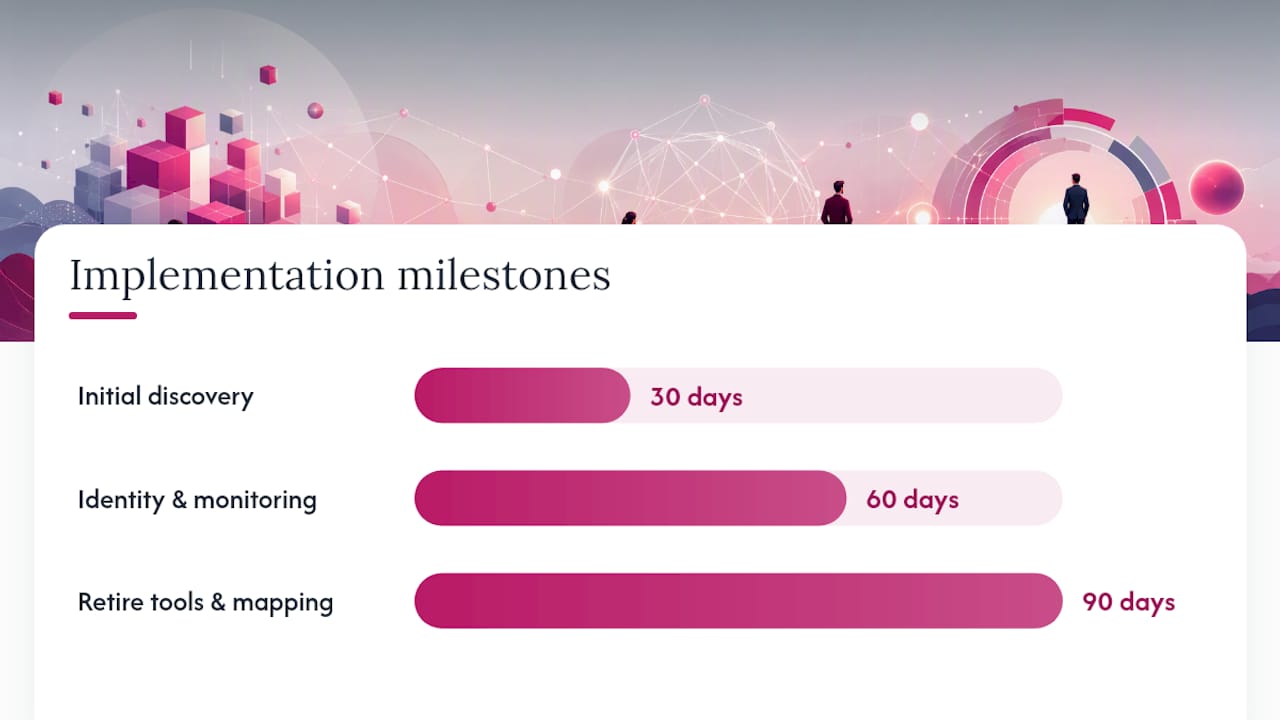
- Days 1–30: Complete initial discovery, publish inventory, assign owners, draft governance policy
- Days 31–90: Implement agent identity controls for high-risk tools, launch fast-track approval for low-risk tools, establish monitoring alerts
- Days 91–180: Retire or replace redundant tools, complete data-flow mapping for medium/high risk tier, publish first executive spend report
What technical controls enforce governance without slowing teams down?
Governance without technical enforcement is just documentation. These patterns give you real control.
The AI gateway pattern
A single API layer that mediates all traffic to external model providers gives you central policy enforcement, observability, and cost control in one place. Every team routes requests through the gateway rather than calling providers directly. You get a unified audit log, the ability to enforce rate limits and budget caps by team, and a single point for DLP inspection.
The trade-offs are real: the gateway adds latency, and it is a single point of failure if not built with redundancy. The Microsoft agent governance toolkit maps this control point to SOC 2 requirements, which helps with compliance justification. For most enterprises, the observability gain outweighs the latency cost.
Agent identity and authorization
Per AWS Well-Architected, agents must have their own workload identities, not borrowed human credentials. The mechanisms:
- Mutual TLS for service-to-service authentication
- Signed OAuth tokens with narrow, time-limited scopes
- Platform-managed workload identity (AWS IAM roles, Azure Managed Identity, GCP Workload Identity)
- Periodic drift detection to catch permission creep between access reviews
Simple SSO is insufficient for agentic workloads. An agent that acts autonomously needs an identity that can be audited, scoped, and revoked independently of the human who provisioned it.
Runtime enforcement controls
- DLP inspection at the gateway layer to catch PII or regulated data in prompts
- Semantic routing to direct requests to approved models based on task type
- Response caching to reduce token spend on repeated queries
- Budget controls that suspend a team’s API access when spend thresholds are hit
- MCP (Model Context Protocol) connection policies that restrict which data sources an agent can reach
TRiSM and behavioral monitoring
IBM frames agent sprawl risk around fragmentation: without coordination and orchestration, security and compliance exposure compounds. TRiSM (Trust, Risk, and Security Management) for AI adds model behavior telemetry, anomaly detection on output patterns, and remediation workflows when a model drifts from expected behavior. This is not optional for high-risk use cases.
How should you prioritize remediation work and what will it cost?
Not every tool in your inventory needs the same response. Prioritize by risk, not by volume.
Prioritization rules:
- High-risk first: tools that touch PII, regulated data, or have broad system access
- High-exposure teams next: teams with the most shadow AI usage or the most external-facing workflows
- High-spend tools: tools consuming significant budget without a named owner or documented ROI
- Workflow blockers: tools that, if retired without replacement, would stop a core business process
Suggested sequencing:
- Discovery and containment (days 1–30): block the highest-risk unapproved tools, build allow-lists for approved ones
- Replace and standardize (days 31–90): launch governed alternatives for the most common shadow AI use cases
- Optimize and retire (days 91–365): consolidate overlapping tools, negotiate volume discounts, retire inactive tools
| Horizon | Initiative | Sample timeline |
|---|---|---|
| Immediate (first month) | Discovery, OAuth audit, inventory v1, emergency blocks | Weeks 1–4 |
| Short-term (30–90 days) | Agent identity controls, fast-track approvals, gateway POC | Months 2–3 |
| Medium-term (90–180 days) | Gateway production, data-flow mapping, license consolidation | Months 3–6 |
| Long-term (180–365 days) | Full TRiSM integration, behavioral monitoring, annual review cycle | Months 6–12 |
Primary cost drivers to budget for:
- Discovery tooling (CASB, endpoint scanning, OAuth audit tools)
- Engineering time for AI gateway design and integration
- License consolidation (expect short-term overlap costs before savings materialize)
- People and process change (governance program management, training)
- External advisory or consulting for the initial governance design
AI integration strategy guidance for executives consistently shows that the engineering integration cost for a gateway is the largest single line item in the first year, but it pays back through license savings and reduced incident response within 12–18 months.
Who owns what in an AI tool governance model?
Governance without named owners is a policy document, not a program.
Responsibility by function:
- CIO: overall AI governance policy, budget authority, executive reporting
- CISO: agent identity standards, security classification, incident response
- Platform/IT engineering: living inventory, gateway implementation, telemetry
- Legal and privacy: data-flow mapping, residency and retention compliance, contract review
- Procurement: vendor onboarding, license management, spend tracking
- LOB owners: tool requests, use-case documentation, team-level adoption accountability
Approval flow design:
- Pre-approved category: tools already on the approved list require no additional review; teams self-provision with documented use case
- Fast-track (low risk): tools with no access to sensitive data, no external data sharing, and a free or low-cost tier; 48-hour review by platform team
- Formal review (medium/high risk): full security assessment, data-flow mapping, legal review, and CISO sign-off; target 10 business days
Lifecycle mechanics:
- Provisioning: named owner, documented use case, risk tier assigned, credentials in secrets manager
- Periodic access review: quarterly for high-risk tools, annually for low-risk
- Retirement triggers: 60 days of inactivity, owner departure, vendor end-of-life, or policy violation
- Artifact retention: keep the approval record and data-flow map for three years after retirement
The governance body should meet monthly at minimum, with representation from platform/IT, security, legal/privacy, procurement, and at least two LOB leaders. Detailed governance frameworks that map these roles to specific artifacts and approval flows are available for teams building this from scratch.
What do the data and analyst signals actually say about this problem?
The empirical picture is consistent across sources, and the numbers justify urgency.
Zapier’s survey is the most direct: tool sprawl limits AI integration for 70% of enterprises. Many tools in use have not gone through a full approval process, and a significant share of enterprises report negative operational outcomes directly tied to disconnected AI tools. The approval pipeline gap is not a minor compliance issue; it is a primary driver of the integration failures enterprises are already experiencing.
IDC’s analysis of the experimentation-to-production gap explains why the inventory keeps growing: enterprises launched dozens of POCs but moved fewer than six to production. Every abandoned POC leaves credentials, integrations, and sometimes active agents behind. IDC recommends a use-case prioritization roadmap and unified governance to break the cycle.
Gartner’s agent sprawl framework projects significant growth in autonomous agent deployments and identifies the six-step mitigation program as the recommended response. The emphasis on inventory plus adaptive, risk-based controls reflects the same conclusion IDC and Palo Alto Networks reach from different angles: visibility first, then proportionate control.
IBM’s framing adds the orchestration dimension: fragmentation is the most consequential risk because it prevents coordination. Security and compliance exposure compounds when agents operate in silos with no shared observability layer.
70% of enterprises report that AI tool sprawl limits their ability to integrate AI effectively — and the tools causing the most damage are often the ones that bypassed the approval process entirely.
The PROVE framework from Nielsen Norman Group offers a useful discipline for the experimentation phase: treat every AI tool adoption as provisional, test against a well-defined task, document trade-offs, and time-box re-evaluation. Applied consistently, it prevents the accumulation of tools that seemed promising but never proved their value.
The governance trap most enterprises fall into
The instinct when you discover sprawl is to lock things down. Block the unauthorized tools, tighten procurement, and wait for the inventory to shrink. That instinct is understandable and almost always counterproductive.
Employees adopt shadow AI because the approved path is too slow or the approved tools are not good enough. Blocking the workaround without fixing the underlying gap does not eliminate the behavior; it pushes it to less visible channels. The developer who cannot use Cursor will use a personal account on a personal device. The data still flows; you just lose the visibility.
The more durable sequence is to build the replacement before you decommission the workaround. Launch a fast-track approval lane for low-risk tools before you enforce the block list. Publish an AI playbook that makes the governed path feel like an advantage, not a restriction. Enterprise AI adoption programs that sequence enablement before enforcement consistently see lower shadow AI recurrence than those that lead with restriction.
Governance should be calibrated to risk, not applied uniformly. A developer running a local LLM on non-sensitive code is a different risk profile than a sales rep pasting customer contracts into a free-tier chatbot. Treating them identically wastes enforcement resources and creates resentment. The goal is proportionate control: tight where the data risk is real, fast and frictionless where it is not.
Tekkr’s Configurato gives you the visibility to govern AI spend and adoption
Most enterprises trying to address AI tool sprawl face the same gap: they know the problem exists but cannot quantify it well enough to prioritize or justify investment. Tekkr’s Configurato closes that gap directly.
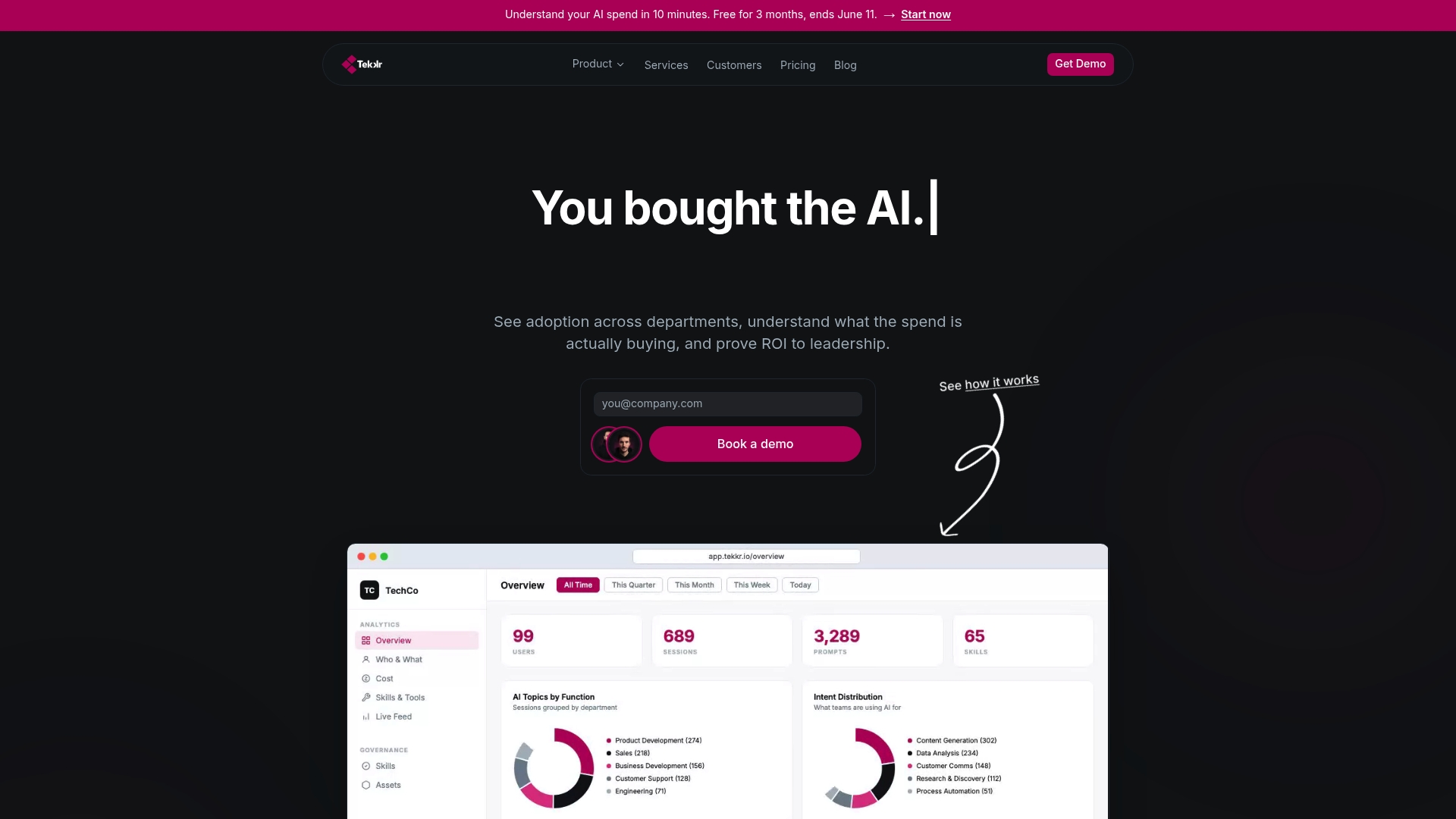
Configurato runs continuous discovery across your AI tool estate, tracking who is actually using tools like Claude and Codex, breaking down costs by team, and surfacing shadow AI without requiring browser extensions or intrusive endpoint agents. The privacy-first architecture is end-to-end encrypted, GDPR-compliant, and strips PII from prompts automatically, so your legal and security teams can support the rollout rather than block it. Setup takes about 10 minutes, with a free tier and no credit card required.
For organizations that need hands-on support, Tekkr’s consulting team works directly with CIOs and platform owners to design governance programs, build approval workflows, and run the initial discovery sprint. The combination of platform visibility and advisory depth means you get both the data and the program to act on it.
Start with Configurato to see your full AI tool inventory and spend breakdown within the first week.
Sources
These are the primary sources behind the guidance in this article. Each one is worth reading directly when building a governance business case or briefing procurement and security stakeholders.
- What Is AI Tool Sprawl? Causes, Risks, and Solutions - Palo Alto Networks
- Tool sprawl limits AI integration for 70% of enterprises
- Time to Make the AI Pivot: Experimenting Forever Isn’t an Option - IDC
- AWS Well-Architected agentic AI lens — agent identity and authorization guidance
- Gartner identifies six steps to manage artificial intelligence agent sprawl