
Enterprise AI subscription cost is best understood as a portfolio-level operating expense measured per request, attributed to business outcomes, and governed as a managed investment — not a static SaaS line item. The immediate plan: implement request-level visibility, adopt unit economics like cost-per-task, set governance guardrails, and run monthly ROI reviews.
Most organizations are flying blind. McKinsey estimates that 20–30% of AI spend goes unaccounted for due to fragmentation across providers and internal teams. The fix is not a cheaper model, but instrumentation.
- See it: Capture request-level telemetry by model, agent, workflow, and team.
- Attribute it: Map spend to business outcomes using unit economics (cost-per-ticket, cost-per-document, cost-per-deploy).
- Govern it: Set token budgets, model approval lists, and automated anomaly alerts.
- Optimize it: Apply model routing, prompt caching, and fine-tuning to reduce marginal cost.
- Re-measure it: Run formal ROI reviews at months 6, 12, and 24 with kill/scale rules.
Tekkr’s Configurato platform is built to run this entire playbook — inventory, allocation, executive reporting, and gamified adoption — without heavy engineering lift. Azure Cost Management and CloudZero are useful supplementary tools for cloud-level spend visibility.
Key Takeaways
Enterprise AI subscription cost is a portfolio-level operating expense that requires request-level visibility, unit economics, governance controls, and monthly ROI reviews to manage defensibly.
| Point | Details |
|---|---|
| Inference is a minority of TCO | Direct inference costs represent only 18–22% of total AI TCO; seven other buckets make up the rest. |
| Unit economics beat seat counts | Track cost-per-task, cost-per-ticket, and adoption by active users — not tokens or seats. |
| Governance requires enforcement | Visibility alone fails; deploy token budgets, model approval lists, and automated anomaly alerts at the gateway level. |
| Caching and routing move fastest | Prompt caching cuts repeated input-token costs by up to ~90%; model routing cuts inference cost by 40–60% on mixed workloads. |
| Tekkr Configurato runs the playbook | Configurato provides cost allocation, adoption tracking, and executive reporting with a 10-minute setup and a free tier. |
Table of Contents
- What actually drives AI subscription cost in your enterprise
- How to measure and attribute AI spending to outcomes
- What controls prevent runaway AI spend?
- Which optimization levers actually move the needle?
- How to run AI spend as a managed investment
- Your first 90 days: a prioritized implementation plan
- Why measurement beats hunting for cheaper models
- Tekkr and Configurato: from playbook to practice
- Sources
What actually drives AI subscription cost in your enterprise
The vendor invoice is the smallest part of the problem. Direct inference typically represents only a minority share of total enterprise AI TCO — the rest lives in seven additional cost categories that most finance teams never see on a single line.
Per-request cost drivers are what accumulate inside each API call:
- Input tokens: every word in your prompt, plus retrieved context from RAG pipelines and session memory resent with each turn.
- Output tokens: generated text, which costs more per token than input on most frontier models.
- Model class: a frontier model like GPT-4o costs an order of magnitude more per token than a right-sized mid-tier model for the same task.
- Tool calls: each function invocation in an agentic workflow adds latency and cost.
- Agent loops: unbounded retry logic is one of the fastest ways to multiply spend without multiplying value.
Beyond inference, the full TCO picture includes:
Audit these first.*
Treating AI like static SaaS — a fixed monthly fee per head — leads directly to budget overruns. Most enterprise AI spend is variable API consumption and agentic workflows, and that variability demands request-level telemetry to convert invoices into unit economics.
How to measure and attribute AI spending to outcomes
The core ROI formula is straightforward: ROI = (Δ revenue + Δ gross margin + avoided cost) − TCO. Payback period for operational use cases should clear two quarters; developer and productivity use cases typically land within a year.
CloudZero’s research found that 34% of finance leaders cannot produce a credible AI ROI number — because they track spend but not the fully loaded cost, and benefit but not the baseline. Both sides of the equation need instrumentation.
Core metrics to track by function:
- Support operations: cost-per-resolved-ticket, deflection rate, human-rescue rate
- Document workflows: cost-per-document, cycle time reduction, error rate
- Engineering: cost-per-deploy, PR review time, test coverage delta
- Cross-functional: daily active users on AI tools, task completion without human rescue, adoption rate by team
Attribution in three steps:
- Capture request-level telemetry: log every prompt, token count, model used, tool call, and session trace tagged to an initiative, product, or cost center.
- Map to business outcomes using impact chaining or holdout cohorts — a baseline period before rollout compared against a controlled group gives you a defensible delta.
- Compute unit economics: divide total attributed cost by volume of outcomes to get cost-per-task.
Reporting template for each initiative:
| Field | What to Capture |
|---|---|
| Baseline metric | Pre-AI value |
| Current metric | Post-AI value |
| Delta | Improvement (e.g., −5 min) |
| Volume | Monthly transaction count |
| Unit cost | Cost per outcome |
| Gross benefit | Delta × volume × unit value |
| TCO (fully loaded) | All eight buckets, not just inference |
Move away from vanity metrics like token counts and seat counts. An unused model has zero ROI, and connecting AI consumption to business KPIs — conversion deltas, cycle times, cost-per-ticket — is what makes the number defensible to a board. For practical AI ROI measurement frameworks, the sequencing matters as much as the formula.
What controls prevent runaway AI spend?
Centralize policy enforcement at a control plane or AI gateway. That single architectural decision is what separates organizations that govern spend from those that discover overruns on the monthly invoice.
Governance checklist:
- Per-agent token budgets with hard caps and soft alerts at 80% of budget
- Model approval lists: teams request access to frontier models; default routes to right-sized alternatives
- Role-based approval workflows for premium model access
- Automated anomaly alerts when cost-per-task drifts more than 50% from baseline
- A 3x spike in token usage for any single agent triggers a temporary block and mandatory review
The gateway blocks further calls, fires an alert to the AI FinOps lead and the workflow owner, and logs the session traces for review. The review reveals an unbounded retry loop on a failed tool call — fixed in 20 minutes, cost contained.
Visibility alone is not enough. Enforcement through budgets, quotas, and API gateway limits is what controls spend at scale — visibility just tells you where the fire is.
Pro Tip: Build “should-cost” benchmarks for every common unit task: expected token range, expected latency, expected cost-per-outcome. Any workflow that runs consistently above benchmark is a candidate for optimization — not a candidate for a blunt spending cap that kills value along with waste. Teams that created should-cost benchmarks spotted outliers and improved expensive workflows without restricting high-value use cases.

Which optimization levers actually move the needle?
Match requests to the right model and reduce repeated context. Those two moves alone cut marginal token cost faster than any contract negotiation.
Step-by-step, prioritized by impact:
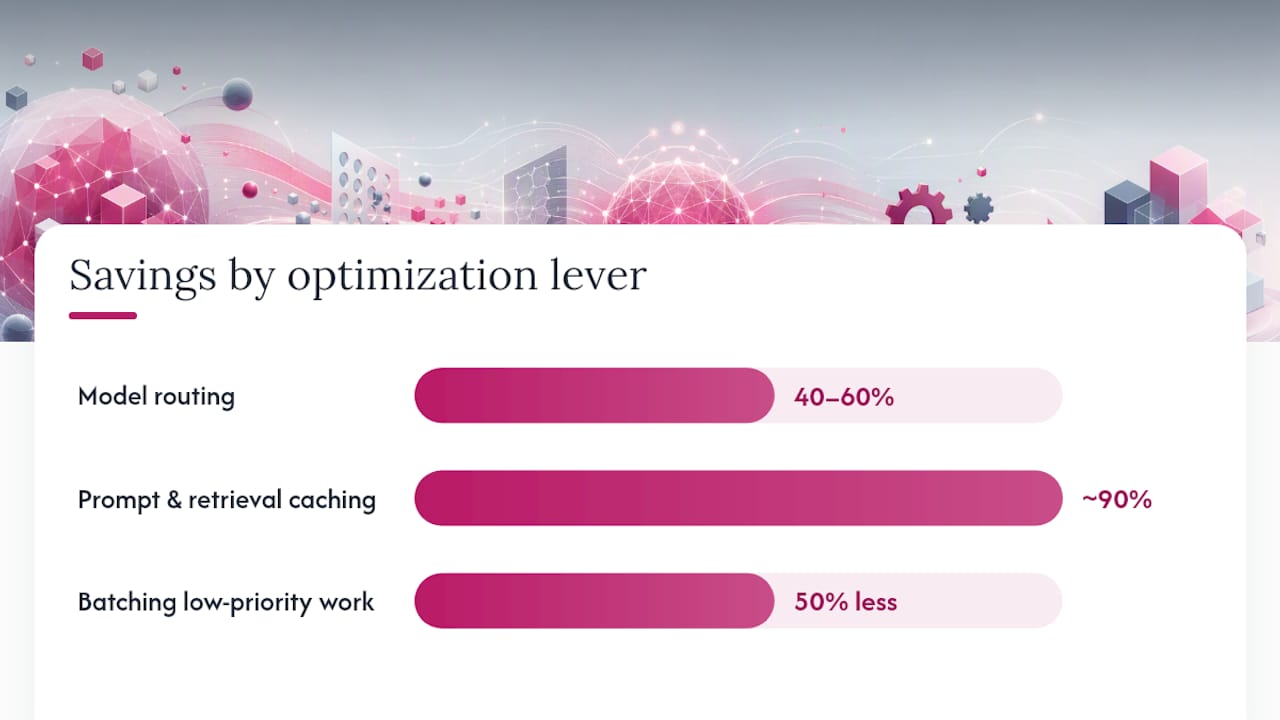
- Model routing/right-sizing: Route simple classification and extraction tasks to smaller, cheaper models. Reserve frontier models for reasoning-heavy or high-stakes outputs. This single lever often cuts inference cost by 40–60% on mixed workloads.
- Prompt and retrieval caching: Prompt caching can reduce repeated input-token costs by up to ~90% for stable prefixes in RAG pipelines and agent system prompts. Implement semantic caching for queries with near-identical intent.
- Fine-tuning for common tasks: A fine-tuned smaller model on your domain often outperforms a frontier model at a fraction of the per-token cost for repetitive, well-defined tasks.
- Memory management: Avoid resending full conversation history with every turn. Summarize or compress prior context to reduce input token volume.
- Output length caps: Set max-token limits on outputs where length does not correlate with quality — summaries, classifications, structured extractions.
- Batching low-priority work: Asynchronous batch processing for non-time-sensitive tasks (nightly report generation, bulk document tagging) typically costs 50% less than synchronous API calls on most providers.
- Tool-use minimization: Audit agent tool call sequences. Redundant or speculative tool calls add cost without adding value; prune them from workflow definitions.
Microsoft Azure’s agent optimization framework describes this as a closed loop: optimize the request at runtime, optimize the workflow over time, govern spend continuously.
Pro Tip: Start with caching and model routing — both are low-effort and high-impact. Fine-tuning and workflow redesign require more engineering time; schedule them for the 60–90 day window after you have baseline telemetry in place.
How to run AI spend as a managed investment
Set up a permanent AI FinOps function that owns visibility, forecasting, allocation, and the kill/scale cadence. This is not a one-time audit. Firms that treat ROI as an ongoing, re-measured discipline achieve more durable AI returns than teams running ad-hoc pilots.
| Role | Accountability |
|---|---|
| AI FinOps Lead | Telemetry ownership, monthly reporting, kill/scale decisions |
| Engineering | Control plane instrumentation, model routing, caching implementation |
| Finance | Cost allocation, chargeback templates, board reporting |
| Product/Business Owner | Baseline definition, outcome KPIs, use-case prioritization |
| Legal/Compliance | Governance policy, data handling, audit trail review |
Required tooling stack:
- Request-level telemetry layer (captures tokens, model, tool calls, session traces)
- AI gateway for policy enforcement and model routing
- Allocation engine that maps spend to cost centers and initiatives
- Executive dashboard with unit economics and adoption metrics
Tekkr’s Configurato provides adoption tracking, cost allocation by team and workflow, and executive reporting — without requiring a custom telemetry build. It integrates with tools like Claude and Codex, strips PII automatically, and is GDPR-compliant. Setup takes about 10 minutes. For teams building the data foundation that feeds AI cost tracking, getting ingestion and tagging right at the start saves significant rework later.
Your first 90 days: a prioritized implementation plan
Prioritize visibility first, cost control second, optimization third. Skipping to optimization without telemetry means you are guessing at which levers to pull.
30 days — Inventory and tagging:
- Audit all active AI subscriptions, API contracts, and internal deployments across every team.
- Instrument request-level telemetry: tag every call to an initiative, team, and cost center.
- Establish baselines for the top five workflows by spend volume.
- Identify the three biggest leakage sources (idle seats, duplicated pipelines, unbounded agents).
60 days — Control plane and showback:
- Deploy an AI gateway with model approval lists and token budgets.
- Publish the first showback report: cost by team, cost-per-task by workflow, adoption rate by department.
- Set should-cost benchmarks for common unit tasks.
- Run controlled rollouts with holdout groups for any new workflow going live.
90 days — Re-measurement and kill/scale:
- Run the first formal ROI review against baselines established in week one.
- Apply kill/scale rules: cut workflows below payback threshold, expand workflows above it.
- Implement prompt caching for the top three retrieval-heavy workflows.
- Deliver the first board-ready unit economics report.
Quick wins (low effort, high impact):
- Add prompt caching to any RAG or agent workflow with stable system prompts
- Set model approval lists for all teams within the first two weeks
- Create a chargeback template for one business unit as a proof of concept before rolling out org-wide
For a prioritized list of AI use cases worth funding in the first 90 days, focus on workflows where the baseline metric is already measurable and the volume is high enough to show meaningful unit economics.
Why measurement beats hunting for cheaper models
The most common mistake finance leaders make when AI costs spike is reaching for a cheaper model. That instinct is understandable and almost always wrong.
Model price is a small fraction of total cost. The real drivers are adoption gaps, unbounded workflows, and absent measurement — problems that a cheaper model does not fix. The math is not close.
Pilots that skip TCO modeling and baseline measurement rarely scale. They produce impressive demo metrics, hit a budget ceiling at month four, and get cut before the value compounds. The organizations that scale AI reliably are the ones that treat it like any other capital investment: measure the baseline, run controlled experiments, attribute outcomes, and re-measure on cadence. Tekkr’s entire product thesis is built on this — not because it is a nice philosophy, but because it is the only approach that produces numbers a CFO will defend.
Tekkr and Configurato: from playbook to practice
Knowing the playbook is one thing. Having the instrumentation to run it is another.
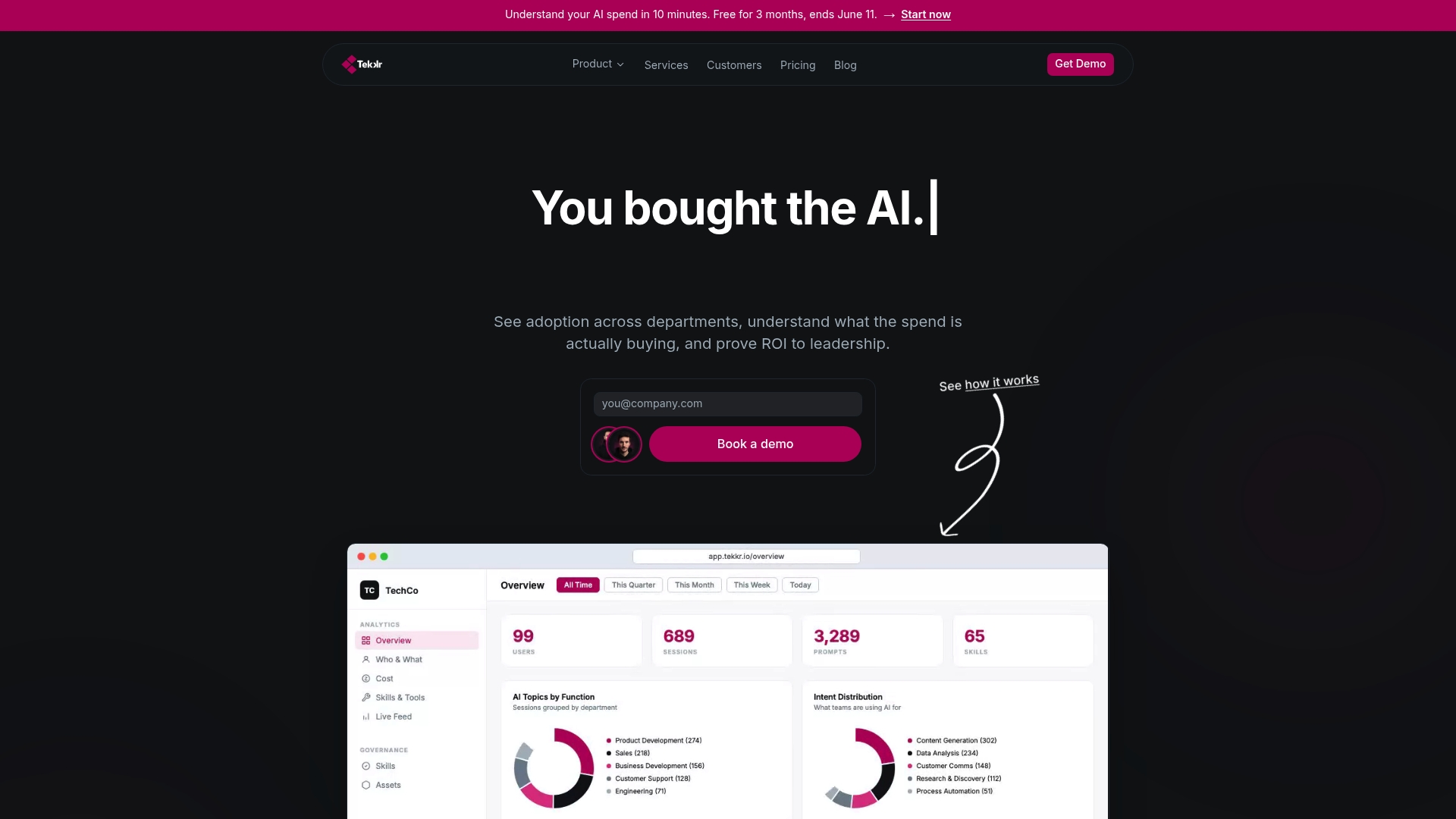
Configurato gives finance and ops teams request-level adoption telemetry, cost allocation by team and workflow, and executive-ready ROI reports — all without a custom engineering build. It tracks who is actually using Claude, Codex, and other AI tools, breaks costs down by department, surfaces use-case intelligence, and drives adoption higher through gamified rollouts and company-wide AI playbooks.
- Inventory and tagging: automatic discovery of AI tool usage across the organization
- Cost allocation: spend attributed to teams, workflows, and cost centers in real time
- Showback and chargeback: ready-made templates for finance to allocate costs to business units
- Adoption metrics: active users, task completion rates, and workflow-level engagement
- Executive reporting: board-ready dashboards with unit economics and ROI summaries
- Privacy-first architecture: end-to-end encrypted, GDPR-compliant, automatic PII stripping, no browser extensions required
Setup takes about 10 minutes, with a free tier and no credit card required. For teams ready to move from aggregate invoices to defensible unit economics, explore Configurato’s AI adoption platform or review the full product capabilities to see where it fits your current stack.
Sources
The sources below are the highest-value references for validating the claims in this guide and building board-ready materials.
- The cost of intelligence: How CIOs can manage AI demand at scale — McKinsey
- The economics of agent optimization — Microsoft Azure blog
- Three approaches to measuring and managing AI ROI — MIT Sloan Management Review
- AI ROI: How to measure the true value of AI — CIO