
Good AI spend reporting ties every dollar to a specific workload, an owning team, and a measurable business outcome, using an observability layer that finance can audit and engineering can act on. The immediate move: run a 30-day observability pilot on your five biggest AI workloads, then stand up chargeback for the top-consuming teams. Everything else, dashboards, forecasts, and vendor terms build on that foundation.
TL;DR:
- Only monitor the five highest-spending workloads initially, as full coverage often stalls progress and the biggest cost drivers are concentrated among few teams.
- Use workload-level telemetry, including workload ID, team, model, token usage, timestamp, and output, to attribute costs accurately and connect spend to measurable business outcomes.
- Implement staged governance with visibility, showback, and partial chargeback, starting with team-level spend reports and eventually billing high-consuming teams to reduce waste.
- Build dashboards focusing on spend by cost center, cost per outcome, and percentage of spend linked to measurable results, aiming to improve the ratio over time.
- Establish a quick, privacy-compliant observability platform for real-time usage tracking, anomaly detection, and integration with existing financial systems to prevent unexpected bill shocks.
Table of Contents
- Why AI Spend Reporting Breaks Traditional Finance Models
- What Workload-Level Observability Actually Requires
- Showback vs. Chargeback: Which Governance Model Actually Changes Behavior
- Which KPIs Belong on an AI Spend Dashboard
- Cost Controls You Can Put in Place This Quarter
- Forecasting AI Spend When Usage Is Bursty and Unpredictable
- How an Observability Platform Puts This Into Practice
- Data Governance and Compliance in AI Spend Reporting
- Connecting AI Spend Reporting to Your ERP and Financial Systems
- Catching Anomalies and Fraud in AI Spend Before They Hit the Bill
- Managing AI Vendor Contracts to Keep Spend Under Control
- What Boards and CFOs Actually Ask For
- See Your Real AI Spend and Adoption With Tekkr
- Sources
- FAQ
Why AI Spend Reporting Breaks Traditional Finance Models
Traditional software budgeting assumes a fixed license count and a predictable renewal date. AI spend follows neither pattern. Token consumption scales with usage, agentic workflows can multiply calls without a human approving each one, and model pricing shifts as vendors release new versions. Per-employee AI spending rose roughly 50% from 2025 to 2026, and that spending is heavily skewed across companies, meaning a handful of teams often drive most of the bill.
Finance leaders run into the same six blind spots repeatedly:
- No workload-to-team mapping, so a spend spike has no clear owner.
- Decentralized purchasing, where individual teams expense their own AI tools outside procurement.
- Missing telemetry on token usage, request volume, and model choice.
- Agentic workloads that burst unpredictably and blow through monthly estimates.
- Infrastructure and GPU costs tracked separately from software spend, hiding the real total.
- No link between spend and the business outcome it was supposed to produce.
The practical consequence: forecasts miss, board updates rely on guesswork, and every quarter brings a new explanation for why the AI line item grew again.
What Workload-Level Observability Actually Requires
You can’t govern what you can’t attribute. Workload-level observability means capturing enough detail on every AI request to answer “who spent this, on what, and did it produce anything measurable?” That is the enabling layer for routing decisions, chargeback, and ROI attribution. Without it, governance stays reactive.
The minimum telemetry set looks like this:
- Workload ID — a stable identifier for the specific use case, not just the tool.
- Owning team — mapped to your org chart, not self-reported.
- Model and provider — which model handled the request and at what price point.
- Token usage and request volume — input and output tokens, call frequency.
- Timestamp — for trend analysis and anomaly detection.
- Output link — a pointer back to what the request actually produced.
Join that data to HR and org systems to attribute cost by department, and to product metrics to connect spend with outcomes like tickets resolved or code shipped. Once you have this join, routing decisions get easier: a gateway can send routine tasks to a cheaper model and reserve frontier models for work that justifies the cost.
Pro Tip: Start the observability build with your five highest-spending workloads only. Trying to instrument everything at once is how these projects stall before they ship anything usable.
Showback vs. Chargeback: Which Governance Model Actually Changes Behavior
Showback shows a team what they spent without billing them for it. Chargeback bills the cost directly to their budget. Practitioner evidence points clearly in one direction: chargeback is the stronger lever for cutting waste, while showback alone rarely changes consumption because there’s no financial consequence attached.
That doesn’t mean you should flip a switch and bill everyone tomorrow. A staged rollout works better:
- Stage 1: Visibility. Get workload-level data flowing before you show it to anyone outside finance.
- Stage 2: Showback. Publish team-level spend, sometimes with a leaderboard, so teams see where they stand.
- Stage 3: Partial chargeback. Bill only your highest-consumption teams first, where the savings will be obvious fast.
Operationally, set a monthly billing cadence, define exemption rules for experimental or R&D workloads, and get budget owners involved before the first invoice lands. Skip that last step and chargeback becomes a fight instead of a policy.
Which KPIs Belong on an AI Spend Dashboard
Finance leaders don’t need more charts. They need the right five numbers, presented the same way every month. Build your dashboard around:
- Spend by cost center and team, tracked month over month.
- Cost per outcome (per ticket resolved, per feature shipped, per deal supported).
- Percentage of total AI spend tied to a measurable outcome.
- Forecast variance, actual versus planned.
- Contingency buffer usage.
That third metric deserves attention on its own. Across the industry, roughly four in five dollars of enterprise AI token spend has no quantified link to a business outcome. If your dashboard can’t report the inverse of that number improving quarter over quarter, the observability layer isn’t doing its job yet.
Report token spend alongside total AI TCO, not instead of it. Compute and GPU infrastructure costs are a growing share of the real bill, and vendor charges alone will understate what AI actually costs the business. Build one executive summary page, then back it with two or three drilldowns for whoever wants to dig into a specific team or workload. For a deeper framework on tying spend to outcomes, see this breakdown of measuring AI ROI.
Cost Controls You Can Put in Place This Quarter
Reporting tells you what happened. Controls stop the next bill shock before it happens. Here’s what to implement, in order of speed to value:
- Model routing. Send routine tasks to mid-tier models; reserve frontier models for work that needs them.
- Per-workload quotas. Cap token usage per use case, not just per team.
- Per-team caps. Set a monthly ceiling tied to the team’s budget, with alerts before it’s hit.
- Automated alerts. Flag any workload that jumps more than a set percentage week over week.
- Scheduled audits. Review the top 10 spending workloads monthly, not quarterly.
- Reserved discount programs. Lock in volume pricing where usage is predictable enough to commit.
Enforce these through a policy engine that requires approval above a spend threshold, with a clear escalation path when a team exceeds its quota. A prompt design training program can also cut token usage meaningfully, since shorter, better-structured prompts often produce the same output for less.
Pro Tip: Run a 30-day sprint pairing one finance analyst with one engineer per major workload. That partnership catches cost problems the finance team alone would miss and the engineering team alone wouldn’t prioritize.
Forecasting AI Spend When Usage Is Bursty and Unpredictable
Standard budget smoothing, take last quarter’s average and add a growth rate, fails badly on agentic workloads, where a single automated process can trigger thousands of calls in an afternoon. Percentile-based forecasting works better: instead of forecasting the average month, forecast the 90th-percentile month and budget toward that.
Pair this with a contingency buffer. FinOps teams commonly hold a reserve specifically to absorb agentic bursts without triggering an emergency budget freeze mid-quarter. Review a rolling 30-day and 90-day view side by side, with spike alerts on both.
A simple template: review your top 10 workloads monthly, allocate reserve capacity based on which ones show the most volatility, and adjust the buffer size as usage patterns firm up. This is also where understanding subscription versus consumption pricing matters, since the two cost structures need different forecasting math entirely.
How an Observability Platform Puts This Into Practice
A platform built for this job should let you see, within minutes of setup, which teams use which AI tools and what they cost. A suitable observability platform should track usage of AI tools, break down spend by team, and surface use-case intelligence, so you know not just what was spent but what it was spent on.
Such platforms may include features like gamified rollouts and playbooks that push adoption higher once you know where the gaps are. The architecture may run with end-to-end encryption and GDPR compliance, include automatic PII stripping on prompts, and require no browser extension. Setup can be accomplished quickly, and a free tier may be available without requiring a credit card. That combination, fast visibility plus adoption tooling, supports every stage of governance: visibility first, then showback, then chargeback for the teams that need it, with data structured to feed straight into existing finance reporting.
Data Governance and Compliance in AI Spend Reporting
AI spend data isn’t just financial data. Prompts and outputs can contain customer information, employee data, or proprietary business logic, which means your spend reporting pipeline is also handling sensitive content whether you planned for that or not.
Three things matter most. First, anonymize or strip personally identifiable information before prompt-level data ever reaches a dashboard or a finance analyst’s screen. Second, apply the same data residency and retention rules to AI telemetry that you apply to other financial records, especially if you operate under GDPR or similar frameworks. Third, restrict who can see workload-level detail versus who only needs aggregate team totals. A finance director tracking cost per team doesn’t need visibility into the actual prompts being run; an engineering lead debugging a cost spike does.
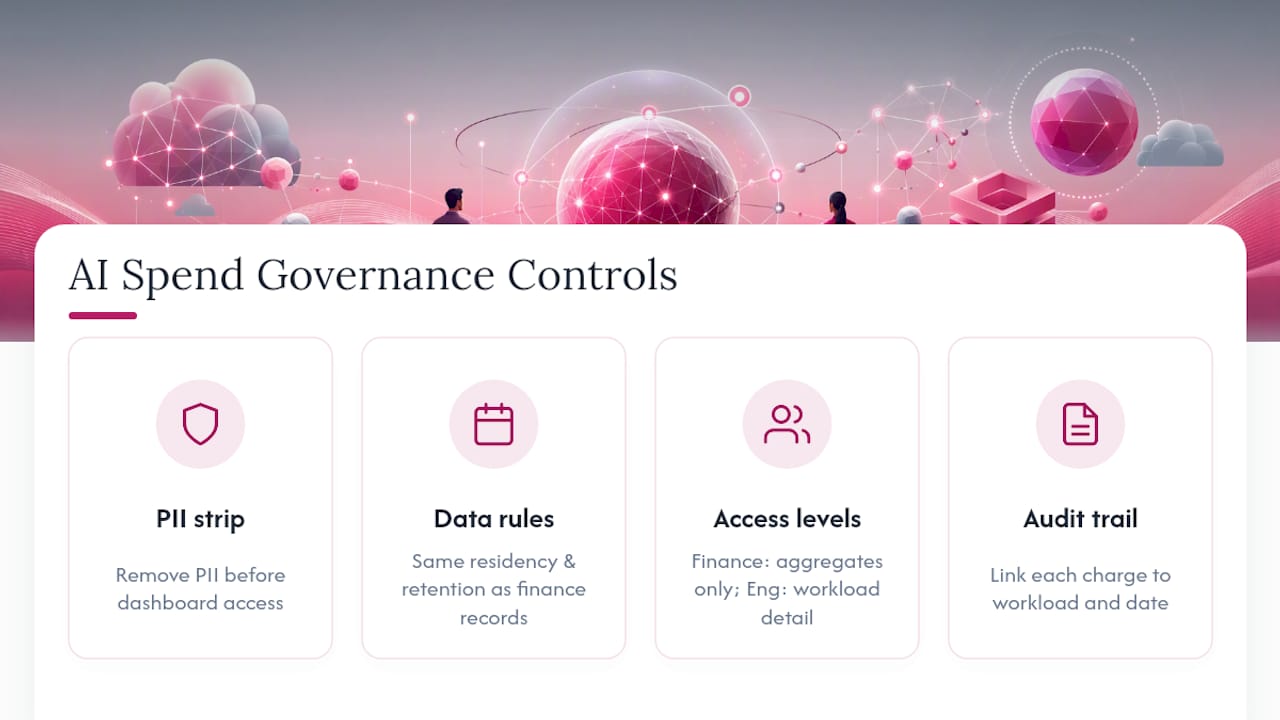
Build an audit trail into the reporting layer itself, not as an afterthought. Every chargeback dispute eventually comes down to “prove it,” and if your observability data can’t reconstruct exactly which workload generated a charge on a given day, the chargeback model loses credibility fast. This is also where compliance and finance need to talk to each other early. A reporting pipeline designed only for cost tracking often misses the access controls and retention policies that legal and security teams will require once AI spend data starts feeding board reports.
Connecting AI Spend Reporting to Your ERP and Financial Systems
AI spend data that lives only in a vendor dashboard is invisible to finance. It needs to land inside the systems your finance team already trusts, which usually means your ERP, your general ledger, and whatever cost allocation tool handles chargeback for other shared services.
The practical path is an API-level feed from your observability layer into your ERP’s cost center structure, mapped to the same team and department codes finance already uses for every other budget line. This avoids the common failure mode where AI spend gets tracked in a spreadsheet parallel to the “real” financial system, which almost guarantees the two eventually disagree.
Match your AI cost centers to existing org codes rather than creating a new taxonomy just for AI. When AI spend data uses the same cost center IDs as payroll, software licensing, and cloud infrastructure, your existing month-end close process can absorb it without a separate reconciliation step. That consistency also makes forecast variance easier to explain to a CFO who’s used to seeing every other line item roll up the same way.
Timing matters too. Most AI usage data arrives near real time, while ERP close cycles run monthly. Decide upfront whether your dashboard shows live usage with a monthly reconciliation, or whether every number waits for the close. Mixing the two without labeling which is which is a fast way to erode trust in the numbers.
Catching Anomalies and Fraud in AI Spend Before They Hit the Bill
Anomaly detection on AI spend looks different from traditional expense fraud detection, because the fraud vector is often technical rather than human. A compromised API key, a misconfigured agent that loops indefinitely, or a script accidentally left running over a weekend can each generate a spend spike that dwarfs anything a person could rack up on a corporate card.
Set alert thresholds at the workload level, not just the account level. A 20% week-over-week jump on a single workload is a more useful signal than a company-wide spend increase, which can hide a single runaway process inside otherwise normal growth. Pair that with rate limiting at the API gateway so a single credential can’t generate unlimited spend even if something goes wrong upstream.
Review access logs alongside spend data. If a workload’s cost spikes at the same time an unusual number of API calls originate from a new IP range or an inactive account, that’s worth escalating immediately rather than waiting for the monthly audit. Scheduled audits still matter, monthly reviews of your top 10 workloads catch slower-moving problems like gradual scope creep in an agent’s permissions, but real-time alerting catches the expensive mistakes before they become a quarter’s worth of overspend.
Build the escalation path before you need it: who gets notified, who has authority to pause a workload, and how fast that decision can happen without waiting for a committee.
Managing AI Vendor Contracts to Keep Spend Under Control
Vendor and contract management is where a lot of AI spend optimization actually happens, often before a single token gets used. Pricing models across providers vary enough that the same workload can cost meaningfully different amounts depending on which model and which contract tier handles it.
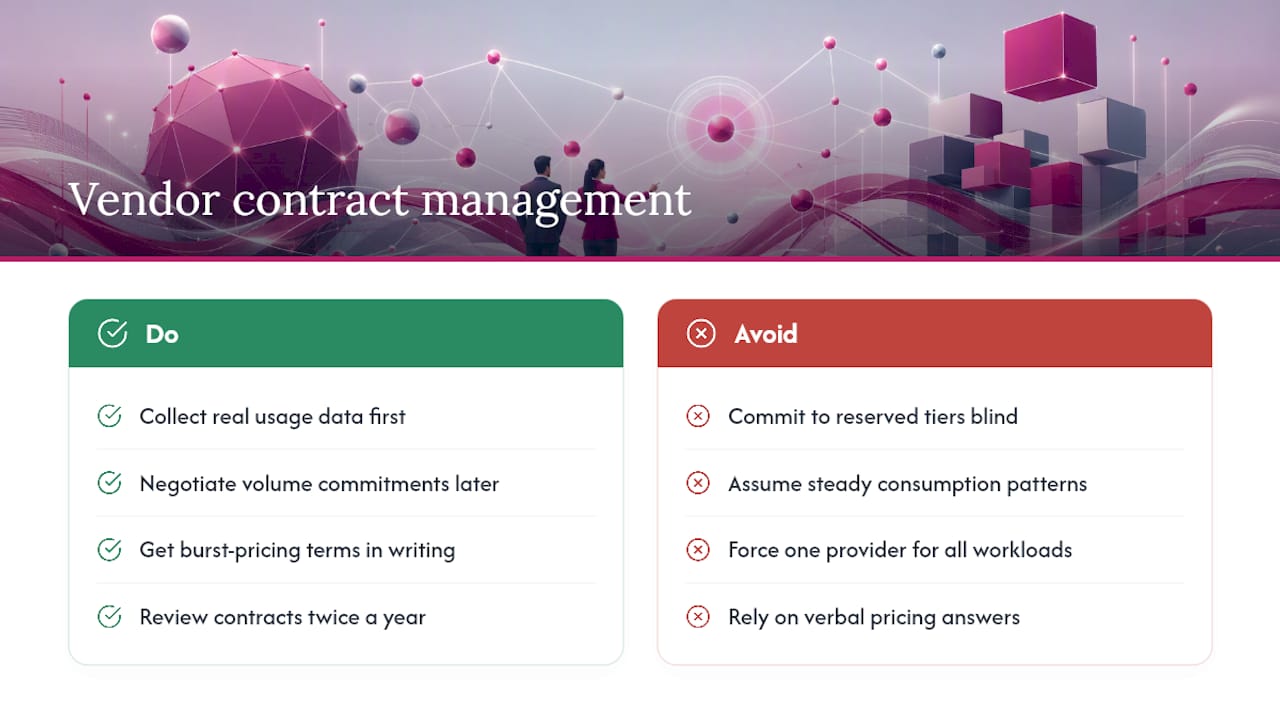
Negotiate volume commitments only after you have real usage data. Committing to a reserved discount tier before you understand your actual consumption pattern locks in a number that may not match reality six months later. This is another reason workload-level observability comes first: you need usage history before you can negotiate from a position of knowledge rather than guesswork.
Build contract terms that account for the agentic and bursty nature of AI workloads specifically. A contract written for steady, predictable consumption doesn’t fit a workload that can spike 10x during a product launch. Ask vendors directly how their pricing handles burst usage, and get that answer in writing before you sign.
Consolidate vendor relationships where it makes sense, but don’t force every use case onto a single provider just for contract simplicity. Some workloads genuinely perform better, or cost less, on a different model, and routing decisions covered earlier in this article depend on keeping that flexibility. Review contracts at least twice a year against actual usage, since AI pricing and capability shifts fast enough that a great deal from a year ago may no longer be your best option today.
What Boards and CFOs Actually Ask For
Every board conversation about AI spend eventually narrows to the same question: who owns this number, and can you defend it? The organizations that answer well aren’t the ones spending less. They’re the ones who can trace a dollar from the invoice to the workload to the outcome without a single gap in the chain.
Before your next board update, confirm you have:
- A named owner for AI spend, not a committee.
- A consistent KPI set used the same way every month.
- Forecast accuracy tracked and reported, not just the forecast itself.
- A chargeback plan, even if you’re still in the showback stage.
- An audit trail that survives a skeptical question.
— TekkrTools
See Your Real AI Spend and Adoption With Tekkr
Every control in this article, observability, cost attribution, chargeback, forecasting, depends on having clean workload-level data in the first place. That’s the gap Tekkr’s Configurato closes: it shows you who’s actually using tools like Claude and Codex, breaks down spending by team, and surfaces which use cases are driving cost versus which are driving results.
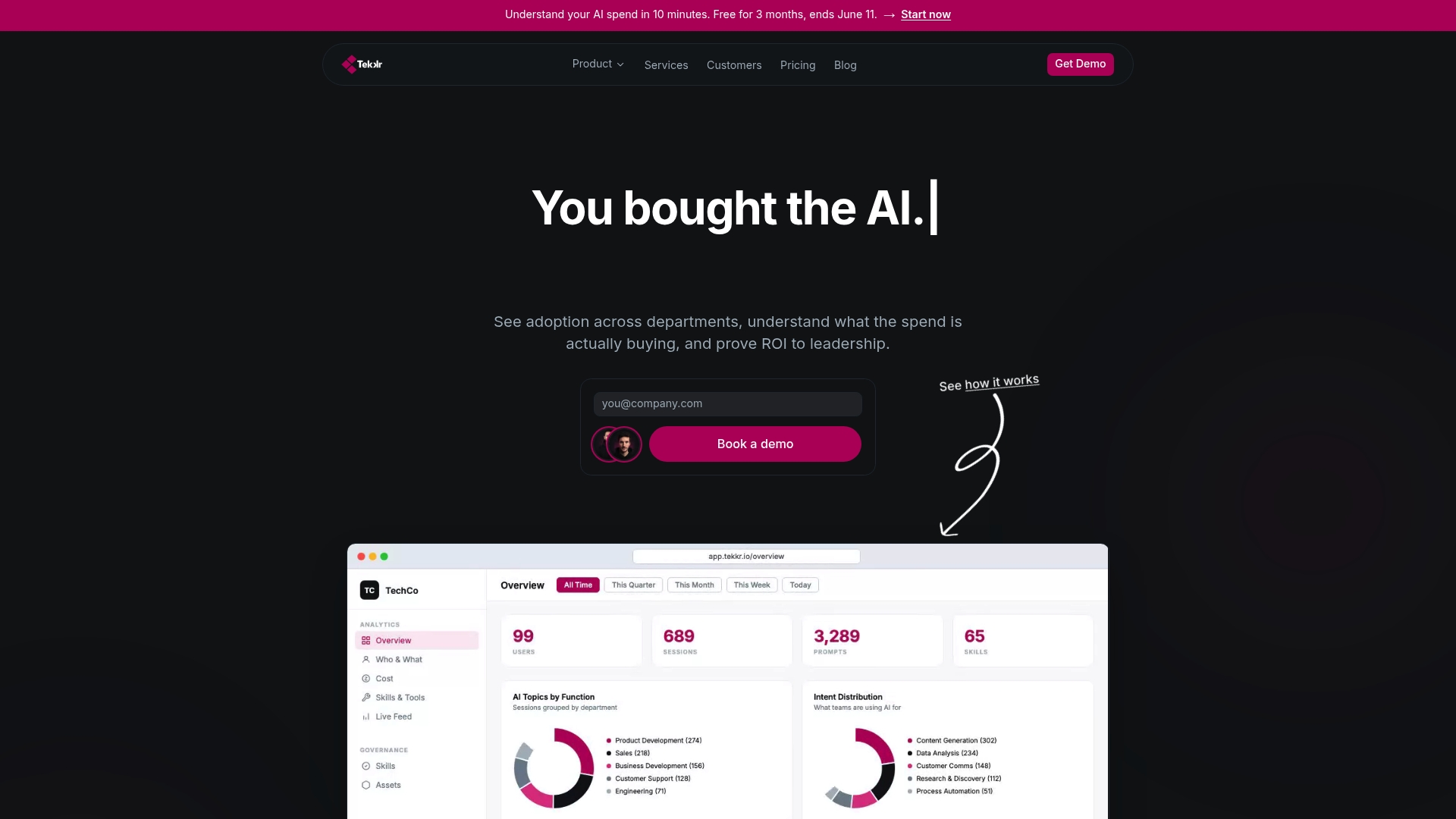
Setup takes about 10 minutes, runs on a privacy-first architecture with automatic PII stripping, and needs no browser extension. A free tier is available with no credit card required, which makes it a low-friction way to see your own spend picture before committing to anything larger. If you’re further along and ready to build showback or chargeback into your reporting, the AI adoption and governance solution pairs Configurato with hands-on consulting for the rollout itself. Start with the free tier and see what your organization’s AI spend actually looks like broken down by team.
Sources
- AI tokenomics guide for CIOs | Accenture
- How much are firms spending on AI (and what will happen to headcounts)? | Atlanta Fed
- 2026 AI Index: Economy (Stanford HAI)
FAQ
What Is the 30% Rule in AI Spending?
There’s no single standardized “30% rule” in AI financial reporting; the figure varies by source and use case. If you encounter it in vendor material, treat it as a rule of thumb rather than an industry standard, and verify it against your own workload-level data instead.
What Counts as a High-Value AI Role or Budget Line?
There’s no fixed dollar threshold that defines a high-value AI role or budget line across industries; it depends heavily on company size, sector, and how directly the role or workload ties to revenue or cost savings. Focus on cost-per-outcome for a given workload rather than headline salary or budget figures, which vary too widely to generalize.
Is the AI Spending Bubble Bursting?
Enterprise AI spend is still climbing, with per-employee spending rising roughly 50% from 2025 to 2026 and heavily concentrated among the largest spenders rather than shrinking broadly. Whether specific valuations in the AI sector are overextended is a separate question from enterprise operating spend, which shows no broad sign of pulling back.
How Much Will Companies Spend on AI Going Forward?
Exact forecasts vary by source and methodology, but per-employee AI spending is already trending sharply upward year over year, and infrastructure costs are rising as a growing share of total AI investment. Rather than anchoring to one macro number, build your own forecast from workload-level usage data and percentile-based modeling, since company-specific consumption patterns vary far more than any industry average.
Does Showback or Chargeback Work Better for Controlling AI Costs?
Chargeback is the stronger lever for changing spending behavior because it attaches a real budget consequence to usage, while showback alone often fails to reduce consumption. Most organizations get better results starting with showback to build accountability, then moving high-consumption teams to chargeback once the data and trust are in place.