
Cutting AI spend starts with visibility, not negotiation. Instrument per-request tracing so every dollar is attributable to a team, application, and model, then attack cost at three speeds: runtime (routing and caching), workflow (prompt and agent design), and governance (gateway budgets and hard limits). Skip visibility and every other lever is a guess.
TL;DR:
- Visibility into token billing, retries, and infrastructure costs is essential before implementing any cost reduction measures.
- Model routing, prompt caching, and workflow trimming offer quick wins that can significantly lower costs without model retraining.
- Gateway-based governance with budgets, request tagging, and anomaly detection reduces overall AI spend by proactively preventing overspending.
- Tracking cost per successful outcome, including retries and accuracy, is vital for measuring true savings rather than just lower per-request expenses.
- Implementing a phased 90 to 120 day plan helps systematically identify, optimize, and govern AI costs while building organizational accountability.
Table of Contents
- What Actually Drives AI Spend
- The Core Levers to Reduce AI Spend
- Turning Visibility Into Governance
- How to Measure Whether It’s Working
- A 90 to 120 Day Roadmap to Cut AI Spend
- How Tekkr Operationalizes AI Spend Optimization
- Run AI Like a Managed Investment
- Put Adoption and Spend Data to Work
- Sources
- FAQ
What Actually Drives AI Spend
Most finance leaders staring at an inference bill see one number and no explanation. The real drivers hide inside line items that never make it onto an invoice.
Tokenized billing is the first culprit. Providers charge separately for input and output tokens, and repeated prefixes (system instructions, tool definitions, few-shot examples) get billed again on every single call unless caching intervenes. A second driver is agent behavior itself: a single user request can trigger five, ten, or twenty model calls as an agent plans, calls a tool, reflects, and retries. Loops caused by bad error handling or unclear stopping conditions multiply that further.
Fixed infrastructure adds a third layer: provisioned throughput, dedicated GPU capacity, and priority deployments carry cost whether or not they’re fully used.
- Input and output tokens, billed at different rates, with repeated prefixes charged every call
- Multi-step agent loops that turn one user request into many model invocations
- Provisioned throughput and priority deployment fees that run independent of usage
- Retries and error recovery that silently double or triple a request’s real cost
A monthly invoice bundles all of this into one number, which is exactly why attribution by team, application, and model matters more than the total figure itself.
The Core Levers to Reduce AI Spend
Once you know where the money goes, the fixes fall into a rough hierarchy: cheap and fast at the top, expensive and slow at the bottom. Microsoft’s framework for agent cost optimization breaks this into optimizing each request at runtime, optimizing each workflow over time, and governing spend continuously. Treat it as a sequence, not a menu.
- Model routing. A router matches each request to the cheapest model that can still deliver the required quality, running in cost-first, quality-first, or balanced mode depending on the task. Simple classification or extraction tasks rarely need a flagship model.
- Prompt and semantic caching. Stable content, like system prompts, tool schemas, and few-shot examples, should sit at the front of a prompt so caching engines can match the prefix and skip reprocessing it. AWS reports that prompt caching on Amazon Bedrock cuts both cost and latency for repeatable agent prefixes. Cache placement matters too: a gateway-level cache serves shared traffic across teams, while a model-level cache is faster to implement but narrower in scope.
- Prompt and agent workflow trimming. Summarize conversation history instead of replaying it in full, scope tool definitions down to what the task actually needs, and add loop detection so an agent stops after a fixed number of failed attempts instead of retrying indefinitely.
- Batching and provisioned throughput. Predictable, non-urgent jobs (nightly summarization, bulk classification) belong in batch queues or on provisioned-throughput units, which cost less per token than on-demand calls.
- RAG before fine-tuning. AWS’s guidance on generative AI cost optimization recommends starting with retrieval-augmented generation and better prompt engineering before touching fine-tuning, since data curation and phased testing are far cheaper than training a custom model. Fine-tune only when the same task runs at high volume and a smaller, specialized model can consistently match a larger model’s output quality.
Pro Tip: Order matters more than any single lever. A checklist of runtime cost levers from implementer teams found that combining several small changes, routing, trimming, caching, and fixing retry logic, usually beats one expensive overhaul, and it’s far less risky to roll back if something breaks.
Turning Visibility Into Governance
Optimization without enforcement is just a report nobody acts on. The fix is to push controls into the AI gateway itself, the layer every request already passes through, so spend gets capped before it happens rather than explained after the fact; for practical examples of such workflow optimization, see AI for Agencies: Scale Client Work Without Burnout.
- Set hard budgets and quotas per team, application, and environment at the gateway, with circuit breakers that halt requests once a threshold is hit
- Tag every request with team, application, model, and environment metadata so chargeback reports are accurate without manual reconciliation
- Run anomaly detection on spend patterns and route alerts to the team owning the budget, not just a monthly dashboard
- Pilot governance on your two or three highest-spend teams first, then expand once the tagging and alerting pipeline is proven
Gateway-based enforcement isn’t a theoretical improvement. Stigg’s research on AI cost governance found enterprises using gateway controls reported cost reductions in the 40 to 60 percent range, with added latency of only a few milliseconds. That’s the difference between a governance layer that slows engineers down and one they barely notice.
The organizational piece matters as much as the technical one. AWS’s cost framework argues that FinOps principles for AI work best when ownership stays decentralized (each team is accountable for its own spend attribution) while the platform team supplies the tagging standards and enforcement tools centrally. Neither side can do it alone: engineers won’t self-police without limits, and a central team can’t tag requests it never sees.
How to Measure Whether It’s Working
Cost per request is a misleading number on its own. If an optimization causes more retries or forces an agent into extra reasoning turns, the true cost to reach a correct answer can rise even as the per-call price drops. The metric that matters is cost per successful outcome: what it costs, in total tokens and retries, to get a task done correctly.
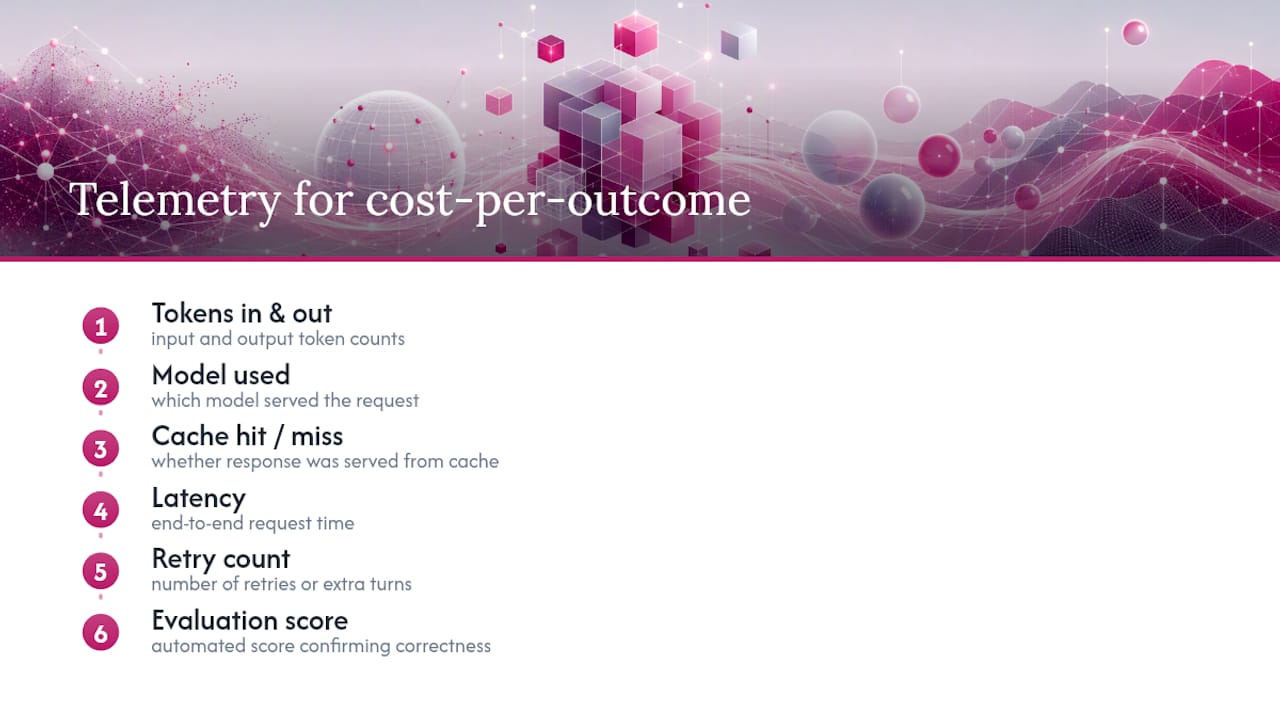
Tracking that requires per-request telemetry across a specific set of fields: tokens in and out, model used, cache hit or miss, latency, retry count, and an evaluation score confirming the output was actually correct. Without an evaluation score, you’re measuring cost without measuring whether the cheaper path still works.
By the numbers: Azure’s optimization framework and implementer guides converge on the same rule: never ship a cost optimization without validating it against an evaluation set that scores task success alongside cost and latency. A router or cache change that saves 30% on tokens but drops task accuracy is a net loss, not a win.
Report cost-per-outcome trends on a recurring executive dashboard, broken out by team and application, using spend analysis practices built for finance audiences rather than raw engineering logs.
A 90 to 120 Day Roadmap to Cut AI Spend
Spreading this work across four phases keeps each stage small enough to actually finish.
- Days 0 to 30: instrument first. Deploy per-request tracing, tagging, and dashboards. Identify your top three spend drivers by team and model before changing anything.
- Days 30 to 60: take the runtime wins. Roll out routing policies, trim prompts, set caching rules, and cap output length on high-volume endpoints. These changes ship fast and need no model retraining.
- Days 60 to 90: go structural. Move predictable jobs to batching or provisioned throughput, and evaluate fine-tuning candidates only where RAG and prompting have plateaued.
- Days 90 to 120: lock in governance. Launch gateway budgets, chargeback reporting, and a continuous evaluation cycle so future changes get validated automatically instead of shipped on faith.
Pro Tip: Don’t wait for Phase 4 to start tagging. Retrofitting attribution onto six months of untracked spend is far harder than building it in from day one, even if governance enforcement comes later.
How Tekkr Operationalizes AI Spend Optimization
The platform turns this roadmap into a running system instead of a quarterly project. It tracks usage of AI tools, breaks spend down by team and department, and surfaces use-case intelligence so leaders see which workflows justify their cost and which don’t.
- Per-team and per-application spend attribution that supports gateway-level chargeback models
- Gamified rollouts and company-wide playbooks aimed at encouraging effective model use
- A privacy-first architecture with encryption and compliance to data protection standards
- Quick setup and availability of a free tier prior to any paid commitment
Wasted subscriptions, seats paid for but never opened, are as much a governance problem as inference overspend, and reducing that waste fits the same 90 to 120 day discovery and enforcement cycle described above.
Run AI Like a Managed Investment
AI spend doesn’t stabilize itself. It needs the same continuous ownership as any other line item that scales with usage, which means cross-functional accountability, not a one-time audit. TekkrTools sees the biggest gap not in what leaders measure, but in what they enforce once the report is on the screen.
— TekkrTools
Put Adoption and Spend Data to Work
Most teams find the gap between “we bought AI tools” and “we know what they cost per team” only after finance asks a question nobody can answer fast. Configurato closes that gap directly: it maps AI adoption and spend by department, flags subscriptions nobody opens, and runs gamified playbooks that push usage toward the models that actually earn their price.
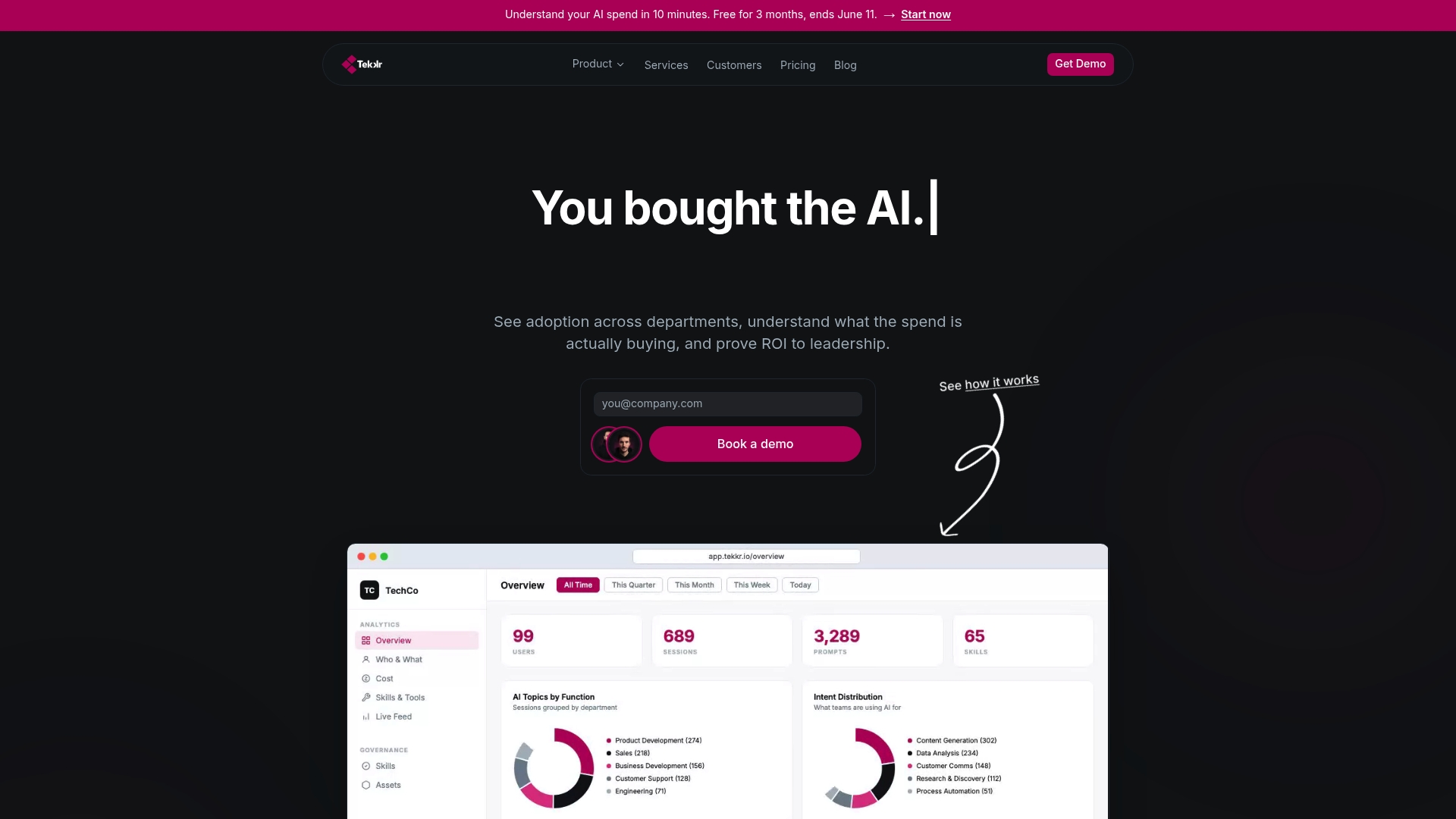
Setup is designed to be quick, with a free tier that does not require a credit card, and the architecture ensures encrypted and GDPR-compliant operation without the need for browser extensions. Consulting for AI transformation planning is also available for teams looking for additional support. If you’re carrying an AI bill you can’t fully explain to your CFO, start with the observability and ROI platform and get the attribution data before your next budget review.
Sources
- AI cost management: From AI pilots to measurable ROI | Microsoft Azure Blog
- Dit
- AI Cost Optimization: Track, Control & Reduce AI Spend | Stigg
FAQ
What Is AI Spend Optimization?
AI spend optimization is the practice of reducing AI inference and operational costs through visibility, runtime routing, caching, prompt and agent efficiency, and governance controls, without degrading task quality.
What’s the Fastest Way to Cut AI Costs?
Prompt caching and model routing deliver savings within days because they require no retraining. Enterprises using gateway-based governance report substantial cost reductions once enforcement layers are added on top of those runtime wins.
Should We Fine-Tune a Model to Save Money?
Only after exhausting retrieval-augmented generation and prompt engineering. AWS’s cost optimization guidance recommends fine-tuning only for high-volume, well-defined tasks where a smaller model can match quality.
How Do We Track AI Spend by Team?
Tag every request with team, application, model, and environment metadata at the gateway level, then route that data into dashboards for chargeback. Platforms like Tekkr’s Configurato automate this attribution without manual log parsing.
What Metric Actually Proves an Optimization Worked?
Cost per successful outcome, not cost per request. A cheaper call that triggers more retries or lowers task accuracy can raise total cost even as the per-call price drops.