
AI spend governance is the discipline of tying every dollar of AI consumption to an owner, a budget, and a measurable outcome, before the invoice arrives rather than after. The single best next step for most organizations is establishing request-level visibility with a named owner today, because you cannot govern spend you cannot trace back to a team, workflow, or agent. Budgets, model routing, and a regular review cadence come next, once that visibility exists.
TL;DR:
- Establish request-level visibility by tagging every API key and workflow to accurately trace AI costs to specific teams or processes.
- Implement budgeting and quota controls, including soft alerts at 70%, hard limits at 100%, and automate enforcement in the request path to prevent runaway spend.
- Focus on routing low-stakes tasks to cheaper models, caching repeated prompts, and controlling agent loops to reduce costs without slowing workflows.
- Conduct monthly AI spend reviews with clear ownership, tracking top spenders, budget breaches, and the effectiveness of workflows to stay ahead of rapid cost increases.
- Use key metrics such as tokens per request, cost per outcome, and cache hit rate to assess ROI, with alerts for sudden changes in frontier model usage or cache efficiency.
Table of Contents
- What Does AI Spend Governance Actually Cover?
- Why Unmanaged AI Spend Threatens Your Margins
- The Five Control Pillars That Actually Prevent Runaway Spend
- How to Roll Out AI Spend Governance in 90 Days
- Who Owns AI Spend and How Often Should You Review It?
- What Metrics Actually Prove AI Investment Is Working?
- A Practical Checklist for Rolling Out Governance
- What We’ve Learned Building Governance Tools for Enterprise AI Rollouts
- See Your AI Spend and Adoption in One Place
- Where to Go Deeper on AI Cost Governance
- Sources
What Does AI Spend Governance Actually Cover?
AI spend governance links three things that usually live in separate systems: identity (who or what is making the request), policy (what they’re allowed to spend), and accounting (where that cost lands on the books). Without that link, finance sees a lump-sum vendor bill and engineering sees usage logs, and nobody can answer “which feature is burning $40,000 a month in tokens?”
The cost surface is wider than most finance teams assume. It’s not just per-token API charges. Governance has to account for:
- Inference and API costs across every model provider a team touches, including shadow usage on personal accounts
- Underlying compute and GPU costs for any self-hosted or fine-tuned models
- Data costs: storage, retrieval-augmented generation pipelines, vector databases
- Agent orchestration costs, which multiply fast because one user prompt can spawn dozens of downstream calls
- Developer tooling and coding assistants billed per seat or per completion
Tracking is passive: it tells you what happened last month. Governance is active: it attributes cost to a decision maker and enforces a limit before the next charge posts. A FinOps-style approach treats AI the way mature organizations treat cloud infrastructure, with visibility and accountability built into the workflow rather than reconciled after the fact.
Why Unmanaged AI Spend Threatens Your Margins
AI costs don’t scale like traditional software licenses. A single misconfigured agent can loop through thousands of API calls in an afternoon, and nobody notices until the invoice lands. Unlike a SaaS seat count that grows predictably with headcount, token consumption scales with usage patterns nobody modeled in the budget, which is exactly why agentic workloads are flagged as one of the top drivers of runaway token bills.
The core problem: most finance teams are forecasting AI spend the way they forecast a fixed software contract, when the actual cost curve behaves more like a variable utility bill that can spike 10x in a bad week.
The failure modes repeat across organizations of every size:
- Agent loops: a workflow calls itself recursively without a step ceiling, and one bad prompt turns into a five-figure bill overnight
- Untagged API keys: a shared key across three teams makes it impossible to know who’s driving the spend, so nobody owns the fix
- Experimentation leaks: a proof-of-concept from Q2 never gets decommissioned and quietly keeps billing through Q4
- Frontier-model default: engineers route every request to the most expensive model available because nobody set a cheaper default
Industry reporting on AI cost management consistently points to the same root issue: organizations struggle to forecast AI spend accurately and often can’t classify it consistently as COGS or OPEX, which means finance is flying without the basic instrumentation it has for every other line item. That’s not a technology gap. It’s a governance gap, and it compounds every month it goes unaddressed.
The Five Control Pillars That Actually Prevent Runaway Spend
Governance breaks down into five interlocking pillars. Skip one and the others weaken, because visibility without enforcement is just a nicer report, and enforcement without attribution punishes the wrong team.
- Visibility. Every request needs request-level telemetry: which model, which workflow, which user or service account, and what it cost. Without this layer, everything downstream is guesswork.
- Attribution. Cost has to route to a team, feature, customer, or specific agent, not just a vendor line item. This is what turns a bill into a decision.
- Budgets and quotas. Set token budgets at the request, session, and team level, with soft limits that alert and hard limits that block. A team that hits 70% of quota should get a notification, not a surprise at 150%.
- Model routing and caching. Route routine, low-stakes tasks to cheaper models and reserve frontier models for work that actually needs the extra capability, using practical cloud cost optimization patterns from Cost Beacon to save costs effectively. Cache repeated prompts so the same question doesn’t rebill the API every time. Reporting on the industry’s AI cost scramble consistently names routing and caching as the two levers that cut spend without slowing teams down.
- Enforcement patterns. Kill switches for runaway agents, retry ceilings so a failed call doesn’t retry infinitely, and concurrency caps that stop a single workflow from monopolizing your rate limit.
The most durable version of this stack enforces controls in the request path itself, using a governance proxy that tags and checks budgets before the request ever reaches the vendor API, rather than reconciling the damage after the invoice arrives, a pattern increasingly common in mature AI cost governance setups.
Pro Tip: *Start attribution with your five highest-volume workflows, not your whole organization.
Model routing deserves special attention because it’s the lever with the least organizational friction. Nobody has to change how they work. Set a routing ladder where classification, summarization, and internal tooling default to a lower-cost model, and only escalate to a frontier model when the task genuinely requires it. Practical guidance on prompt design and conversation trimming can shave real cost off high-volume assistant use before you touch a single budget setting.
How to Roll Out AI Spend Governance in 90 Days
Governance programs fail when they try to boil the ocean in month one. A phased rollout gets you real cost visibility fast, then layers in the harder structural work once you’ve proven the model.
- Months 0 to 3: quick wins. Tag every API key by team and workflow. Build a small dashboard showing top spenders by model and department. Set soft alerts at 70% of an informal budget baseline, even before formal quotas exist. This phase is about visibility, not enforcement.
- Months 3 to 6: the big rocks. Publish a model catalogue with an approved routing ladder (which model for which task class). Define chargeback or showback rules by department. Set experimentation budgets for R&D and prototype work so exploration doesn’t quietly become production spend.
- Months 6 to 12: the long tail. Integrate AI cost data into your broader FinOps and software asset management systems so entitlements and licenses get normalized alongside consumption. Renegotiate vendor contracts using twelve months of real usage data instead of vendor sales estimates. Automate budget enforcement directly in your platform layer rather than relying on manual review.
Funding mix should shift as you mature. Guidance from enterprise AI investment research points to a phased ratio: early on, a majority of AI investment goes to foundational infrastructure and platform work, with a smaller portion funding actual use cases. As governance and platform maturity increase, that ratio should flip toward 20% foundation and 80% use-case investment, because the plumbing is built and the marginal dollar produces more value applied directly to a business problem.
Resist the urge to formalize chargeback in month one. Centralize foundation costs first and shift to charging business units incrementally as their use cases reach production. Charging teams for experimentation before you’ve proven a workflow works tends to kill exploration before it has a chance to pay off.
Who Owns AI Spend and How Often Should You Review It?
Ownership fails when it’s assumed rather than assigned. The workable split gives platform or infrastructure teams ownership of the technical controls (routing, caching, rate limits), product and engineering ownership of workflow-level budget decisions, and finance ownership of the reporting cadence and chargeback policy. Name one person as the platform owner accountable for the overall spend number. A committee cannot answer for a $200,000 overage. A person can.
Run a monthly cost review, not a quarterly one. AI spend moves too fast for a quarterly cadence to catch problems before they compound. A useful agenda covers:
- Top five spend consumers by team and workflow, compared to the prior month
- Which budget limits fired, and whether they were soft alerts or hard blocks
- RoAI check-ins on the workflows you funded last quarter: are they still earning their spend?
- Any new agent or automation added since the last review, and whether it has attribution tags
Pro Tip: Treat your kill switch like a fire drill, not a last resort. Test it quarterly on a non-production workflow so the first time someone pulls it isn’t during an actual $50,000 emergency.
Showback (reporting cost to a team without actually billing them) works well in the first two phases of the rollout model above. Chargeback, where teams’ budgets are actually debited, belongs later, once workflows are stable enough that a team can reasonably plan around the number.

What Metrics Actually Prove AI Investment Is Working?
Return on AI investment isn’t one number. It’s a small set of unit economics that, tracked together, tell you whether a workflow is earning its keep or quietly bleeding budget.
| Metric | What it tells you | Review frequency |
|---|---|---|
| Tokens per request | Whether prompt design is bloated or efficient | Weekly |
| Cost per outcome (not per call) | Whether the workflow is solving the problem cheaply | Monthly |
| Cost per active user | Adoption-adjusted spend, catches “expensive but unused” tools | Monthly |
| Cache hit rate | How much repeated spend you’re eliminating | Weekly |
| % of requests on frontier models | Whether routing discipline is holding | Monthly |
The RoAI formula is simple in structure and hard in practice: value generated divided by total cost of ownership. The denominator trips people up. It has to include token spend, yes, but also the human time spent prompting, reviewing, and correcting AI output, plus the infrastructure supporting it. A workflow that looks cheap on token cost alone can be a net loss once you count the hours an employee spends fixing its mistakes.
Build alerts around these metrics rather than just dashboards people forget to check. A cache hit rate that drops 15 points in a week or a sudden jump in frontier-model usage should trigger a Slack message, not wait for the monthly review.
A Practical Checklist for Rolling Out Governance
Before you build anything elaborate, confirm these basics are in place. Most organizations skip one of them, and it’s usually the one that would have prevented last quarter’s overage.
- Every API key and service account tagged by team, workflow, and environment
- Soft budget alerts set at 70% of allocation, hard limits set at 100%
- Per-agent step caps to catch loops before they compound (a reasonable starting ceiling is 15 to 20 steps per task)
- A tested kill switch that any platform owner can trigger without waiting for approval
- A monthly review meeting on the calendar with a fixed agenda, not an ad hoc check-in
One pitfall shows up again and again: enforcing chargeback before workflows are stable. Teams that get billed for experimentation stop experimenting, and you lose the exact discovery work that justified the AI investment in the first place. Centralize early costs, showback the numbers, and only shift to hard chargeback once a use case has proven itself in production. Aligning these guardrails to a recognized structure like the NIST AI Risk Management Framework also gives you a defensible answer when auditors or regulators ask how spend decisions map to accountability.
What We’ve Learned Building Governance Tools for Enterprise AI Rollouts
Every organization we’ve talked to about AI spend starts in the same place: a finance leader staring at a vendor invoice with no idea which team, tool, or workflow drove it. The fix isn’t more dashboards. It’s privacy-first, request-level tracking that anonymizes prompts before they ever touch a report, so governance doesn’t turn into surveillance.
The pattern we see consistently: organizations that tag and attribute spend in the first 90 days find their quick wins fast, often catching one or two workflows burning budget nobody had noticed. The bigger win comes later, when routing discipline and monthly reviews turn AI spend from a mystery line item into a number finance can actually forecast. That mirrors the phased approach outlined above: visibility first, enforcement second, optimization as an ongoing habit rather than a one-time project.
Governance done well doesn’t slow adoption down. It’s what lets a CFO say yes to the next AI investment with actual confidence instead of a shrug.
— TekkrTools
See Your AI Spend and Adoption in One Place
Most of the controls above require someone to build tagging, dashboards, and budget enforcement from scratch, which is exactly the kind of project that stalls in Q2 because engineering has three higher priorities. Some AI productivity platforms provide visibility without the build. They track who is actually using AI tools, break down spend by team, surface cost-per-outcome, and enforce budgets in the same place you review adoption.
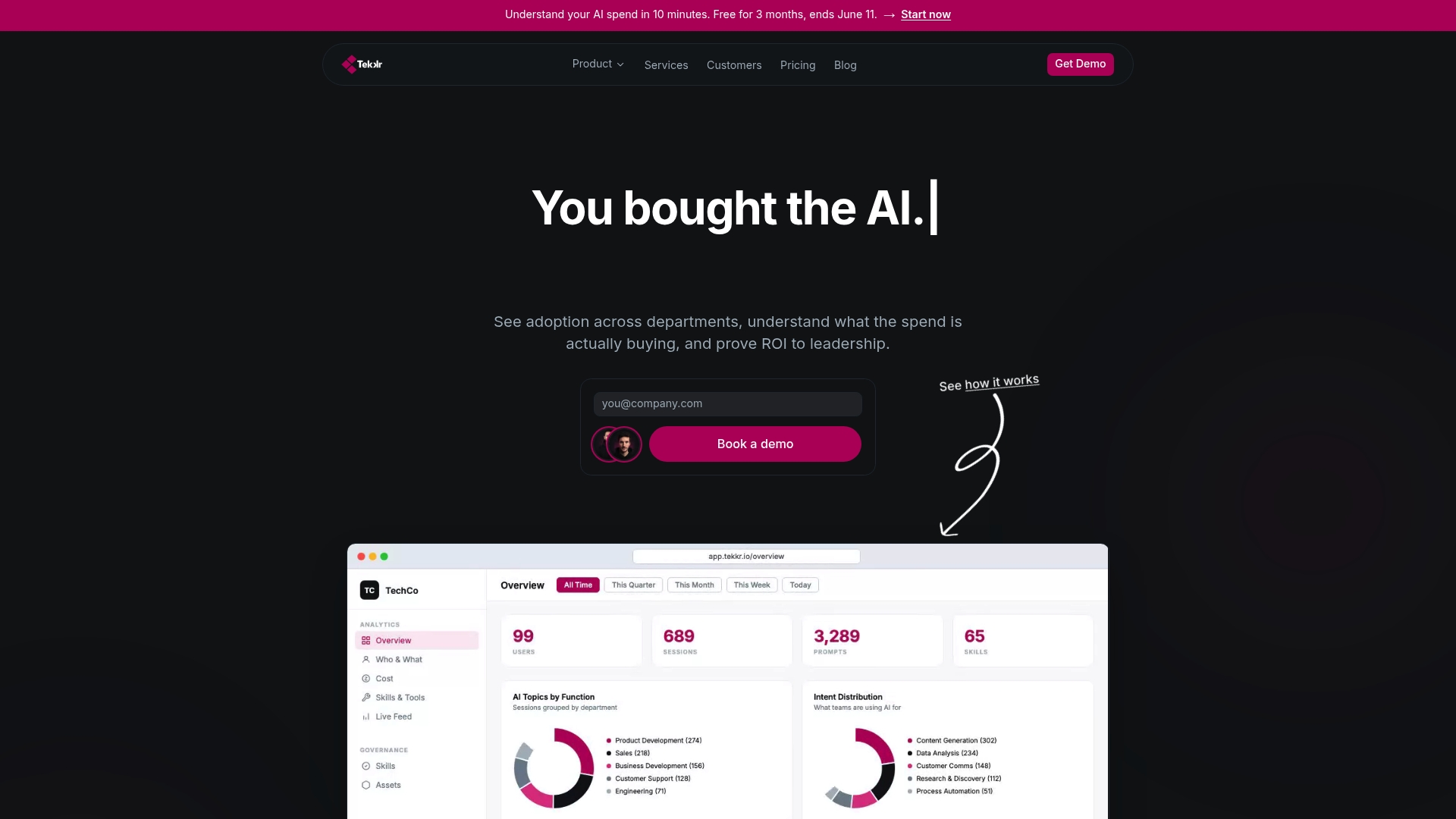
Setup can be quick, and some platforms offer a free tier without requiring a credit card. Prompts may be anonymized with automatic PII stripping in an end-to-end encrypted, GDPR-compliant architecture, helping governance programs avoid privacy liabilities while addressing cost management. If you’re ready to see where your AI budget is actually going, explore how Configurato supports enterprise AI adoption or check the Configurato product details to see the dashboards and gamified rollout tools for yourself.
Where to Go Deeper on AI Cost Governance
The frameworks and working groups below informed the recommendations in this guide, and they’re worth bookmarking if you’re building a governance program from scratch:
- FinOps Foundation’s Token Economics Working Group for practical guidance and certification on consumption-based cost discipline
- NIST’s AI Risk Management Framework for accountability and traceability standards
- Bain’s research on extending FinOps to AI for the visibility-attribution-optimization model
- Stanford Digital Economy Lab’s reporting on agentic token spend for the academic view on agent-driven cost risk
Sources
- FinOps for AI: From Managing Costs to Maximizing Value | Bain & Company
- The token bill comes due: inside the industry’s scramble to manage AI’s runaway costs | TechCrunch
- NIST AI Risk Management Framework
- FinOps Foundation — Token economics working group