
The most effective workplace AI policy is short, specific, and built around a tiered list of approved tools, clear rules on what data can and can’t be entered into them, explicit prohibited uses, a human accountable for every AI-assisted decision, and a no-blame way to report problems. This article gives you copy-ready clauses for each of those pieces, plus the annex templates (tool register, data-tier table, incident form) that turn a policy from a PDF nobody reads into something your teams actually follow, mapped to the NIST AI Risk Management Framework and CISA’s deployment guidance.
TL;DR:
- Most organizations adopt five to six AI tools without approval, highlighting the importance of regularly auditing actual tool use compared to the tool register.
- Data classifications should specify actual examples like customer contracts and financial reports to ensure clarity on sensitive information.
- Enforcement relies on a named human reviewer for all AI-generated content used externally, with clear attribution and accountability requirements.
- Embedding technical controls such as logging AI tool usage and monitoring for unauthorized deployment helps detect shadow AI and prevent data exposure.
- Regular updates, at least quarterly, and after any policy-relevant incident or tool change, are crucial to keep AI governance effective and aligned with evolving risks.
Table of Contents
- Six Copy-Ready AI Policy Clauses You Can Paste Into a Draft
- What Each Clause Actually Needs to Cover
- Rolling Out the Policy: A Practical Sequence
- Templates Worth Attaching as Annexes
- Turning the Policy Into Something You Can Measure
- Getting Employees to Actually Follow the Rules
- How AI Policies Differ Across Industries
- Comparing the Major AI Policy Frameworks
- The Legal and Ethical Lines Every Policy Has to Draw
- What Actually Trips Up Companies Writing These Policies
- Get Your AI Policy Off the Page and Into Practice
- Sources
- FAQ
Six Copy-Ready AI Policy Clauses You Can Paste Into a Draft
Most companies don’t need forty pages of AI philosophy. They need six clauses that hold up in a compliance review and make sense to a new hire on day one. Here’s the skeleton, written the way you’d actually find it in a policy document.
- Purpose and scope. “This policy governs the use of artificial intelligence tools by all employees, contractors, and vendors with access to company systems or data, and applies to any AI-assisted work product used in business communications, code, or decision-making.”
- Approved tool tiers. “AI tools fall into three tiers: Tier 1 (fully approved, enterprise contract in place), Tier 2 (conditional use, restricted to non-sensitive data with manager sign-off), and Tier 3 (prohibited for business use). The current tier assignments are maintained in the approved tool register.”
- Data-entry rules by tier. “Public and internal data may be used with Tier 1 tools. Confidential and restricted data, including customer records, financial forecasts, and unreleased product information, may never be entered into a public or third-party AI tool without a signed data processing agreement.”
- Prohibited uses. “Employees may not use AI to make automated decisions with legal or financial effect on individuals, process personally identifiable or regulated data outside approved tools, generate deceptive content, support political campaigning, or assist in any illegal activity.” This mirrors language in the Salesforce AI acceptable use policy, which bans a nearly identical list.
- Human review and attribution. “All AI-generated content used in external communications, contracts, or code deployed to production must be reviewed by a named human owner before release, and that person is accountable for its accuracy.”
- Incident reporting. “Employees who identify a policy violation, data exposure, or AI output that appears biased, false, or harmful must report it through [incident channel] as soon as possible. Reports made in good faith will not result in disciplinary action against the reporter.”
Adapt the wording to your industry, but keep the structure. A policy that reads like a legal contract gets ignored. One that reads like these six lines gets followed.
What Each Clause Actually Needs to Cover
A clause is only useful if the people applying it know what counts. Scope should name employee categories, contractors, and vendors separately, because contractor access to your systems often slips through unnoticed until an audit finds it.
Data classification needs real examples, not abstractions. “Confidential” should list customer contracts and unreleased financials by name so nobody has to guess whether a spreadsheet qualifies.
Tool tiers hinge on four questions: does the vendor contract prohibit training on your inputs, what’s the data retention period, where is data stored, and is it encrypted in transit and at rest? A tool that trains its next model on whatever you paste in belongs in Tier 3, no exceptions, regardless of how good the output is.
Human accountability works best with a template, not a rule, as detailed in the Role of AI in creative processes: Transforming Digital Ads - Palmador Blog. Require a named reviewer field and a one-line attribution note (“drafted with AI assistance, reviewed by [name]”) on any AI-assisted deliverable that leaves the building.
Vendor contracts should require data deletion on request, a written non-training clause, and a current security attestation such as SOC 2 or ISO 27001. Enforcement needs an intake point, a triage owner, and a defined trigger for revisiting the policy itself, typically a new tool category, a near-miss incident, or a regulatory change.
Rolling Out the Policy: A Practical Sequence
Writing the clauses is the easy part. Getting the organization to actually run on them takes a sequence, not a memo.
- Form a governance committee. Pull in HR, legal or compliance, IT/security, and one or two department leads who already use AI heavily. Four to six people is enough.
- Audit current tool use. Survey teams on what they’re already using. Most organizations find employees have quietly adopted five or six tools nobody approved.
- Map data flows and classify data. Identify where sensitive data could realistically end up in a prompt.
- Build the approved tool register using the tiers above.
- Pilot with one department for two to four weeks before a company-wide launch.
- Train, then enforce. Monitor adoption and violations, and adjust before rolling out further.
Technical controls matter as much as the written policy. CISA’s guidance on deploying AI systems securely recommends logging AI tool usage and monitoring for unauthorized deployments, which is the only reliable way to catch shadow AI before it causes a data exposure.
Pro Tip: Set a quarterly review cadence from day one, and add an automatic trigger for any vendor contract change. Policies that only get revisited after an incident are always one step behind.
Templates Worth Attaching as Annexes
A policy without annexes forces every reader to hold the whole framework in their head. Attach these four artifacts instead, following the structure used in Velum’s AI usage policy template.
The approved tool register needs columns for tool name, tier, approved use cases, data types permitted, and the contract owner. The data-tier table should look like this:
| Data Tier | Examples | AI Tool Rule |
|---|---|---|
| Public | Marketing copy, published reports | Any approved tool |
| Internal | Meeting notes, internal roadmaps | Tier 1 or Tier 2 tools only |
| Confidential | Customer contracts, salaries | Tier 1 tools with signed DPA only |
| Restricted | Health data, legal case files | No AI tool without legal sign-off |
An incident report form needs fields for date, tool involved, data type exposed, reporter contact, and escalation owner. A one-page staff card can boil the whole policy down to two sentences: “Check the tool register before using any AI tool with company data. If you’re unsure whether something qualifies as sensitive, ask before you paste it.”
Turning the Policy Into Something You Can Measure
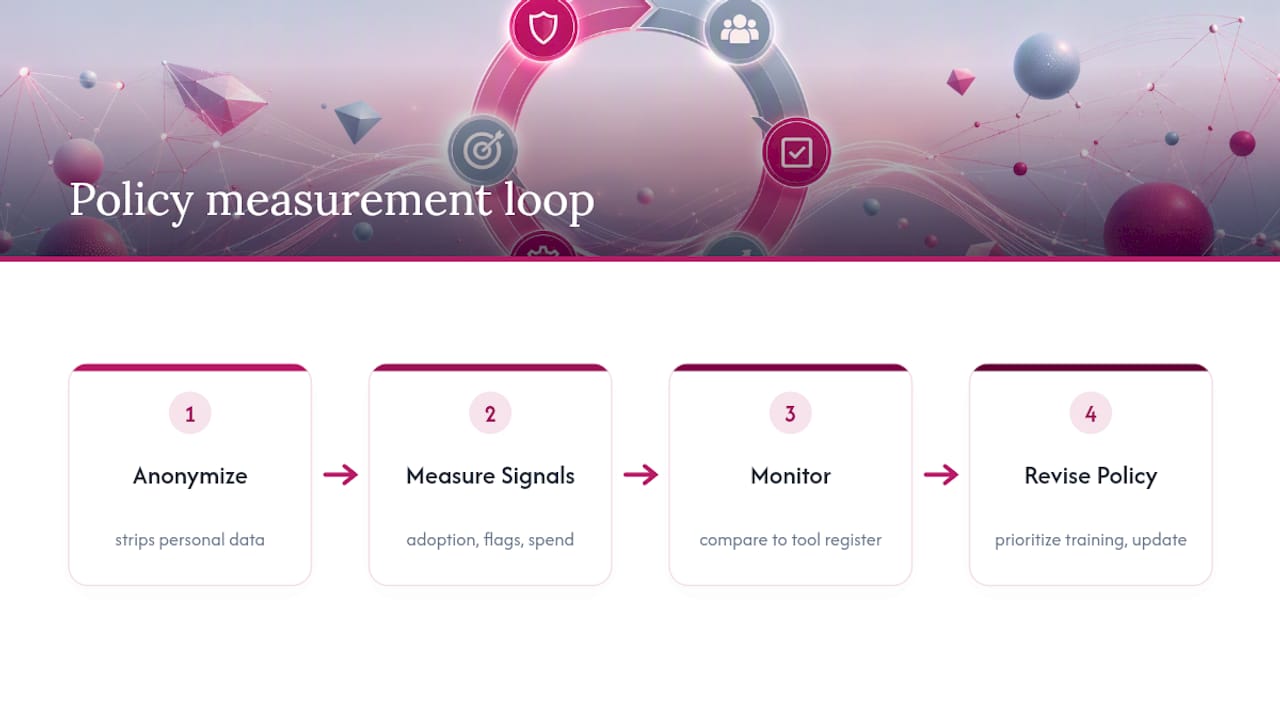
A written policy tells people what to do. It doesn’t tell you whether they’re doing it. That gap is where most AI governance efforts quietly fail, and it’s the specific problem Tekkr’s Configurato was built to close, by tracking real tool usage, spend by department, and use-case patterns across an organization.
Instead of guessing which teams are following the tool tiers, you can see adoption rates by department, flag activity in tools outside the approved register, and prioritize training where usage is lowest. The architecture strips personal data from prompts automatically, so this visibility doesn’t come at the cost of privacy. Watch adoption rate against your tool register, the volume of flagged or blocked prompts, and which use cases are driving spend. Those three numbers tell you exactly where your policy needs a revision before your next incident does.
Getting Employees to Actually Follow the Rules
A policy rollout without change management produces a document employees skim once and forget. Training needs to happen in the flow of work, not as a one-time onboarding slide.
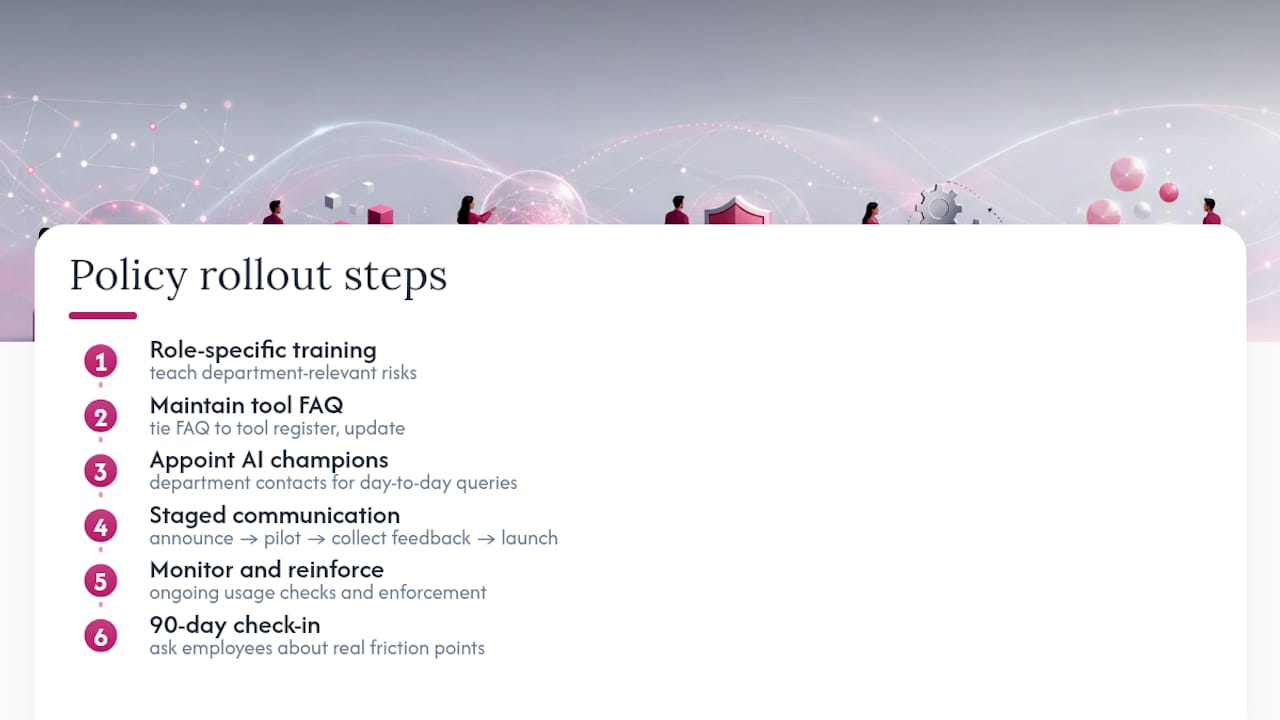
Start with role-specific sessions rather than a company-wide webinar. Engineers need to understand code-generation risks and IP exposure; marketing needs to understand disclosure requirements for AI-assisted content; finance needs to know what data tiers apply to forecasting tools. A single generic training session leaves most departments unclear on what applies to them.
Build a short FAQ tied to the tool register and update it every time a new tool gets approved or blocked. Assign “AI champions” in each department who field day-to-day questions so the compliance team isn’t the bottleneck for every judgment call.
Communicate the policy in stages: announce it, run the pilot, collect feedback, then launch company-wide with visible leadership backing. OpenAI’s usage policies note that rules alone don’t change behavior. Ongoing monitoring and reinforcement do. That’s consistent with what most compliance teams find in practice: a policy announced once and never mentioned again has a short shelf life. Schedule a 90-day check-in specifically to ask what employees are actually running into, not just what leadership assumed would be the friction points.
How AI Policies Differ Across Industries
A financial services firm and a marketing agency need very different AI policies, even though the six core clauses stay the same.
Higher education offers a useful range of models. University policy examples run from outright bans to conditional use with mandatory disclosure to fully unrestricted use, depending on the risk tolerance of the specific department. That same spectrum applies inside a company: legal and finance functions often need conditional-use rules closer to a “no AI” default, while marketing and product teams can operate under unrestricted-with-disclosure terms.
Public-sector and university employers have started publishing formal internal policies, not just classroom guidance. St. John’s University’s workplace AI policy sets out disclosure obligations, scope definitions, and reporting procedures that translate directly into a corporate setting.
Healthcare and financial services organizations tend to add stricter data-tier rules because regulated data (protected health information, account numbers) carries legal exposure that a marketing agency’s customer list doesn’t. Software companies often lean harder on the tool-tier structure, since engineers adopt new AI coding assistants faster than any other department, creating shadow AI risk that a slower-moving industry rarely faces at the same pace.
Comparing the Major AI Policy Frameworks
None of the available frameworks hands you a finished policy. Each gives you a different piece of the structure.
The NIST AI Risk Management Framework is the most widely referenced starting point in the United States. It’s organized around four functions, govern, map, measure, and manage, and works best as the skeleton for how your organization thinks about AI risk, not as a source of specific clause language.
CISA’s joint guidance on deploying AI systems securely focuses narrowly on technical and operational controls: logging, monitoring, and secure deployment practices. It’s the right reference for your IT and security team, less useful for HR-facing policy language.
Vendor acceptable-use policies, like the ones published by Salesforce and OpenAI, show you what prohibited-use language looks like in practice, but they govern use of that vendor’s product, not your organization’s broader AI governance. Practical template providers such as Velum and ISACA fill the gap between frameworks and finished documents, offering annex structures you can adapt directly. ISACA’s own research found that only about 28% of organizations had a formal, comprehensive AI policy in place, which tells you most companies are still working from vendor terms and improvisation rather than an internal standard. The practical approach: use NIST for structure, CISA for technical controls, and a template provider for the actual clause language.
The Legal and Ethical Lines Every Policy Has to Draw
Two separate risks sit inside every AI policy, and conflating them is where most drafts go wrong.
The legal risk centers on data protection, intellectual property, and liability for automated decisions. If an AI tool touches personal data, your policy needs to align with applicable privacy law in your jurisdiction, and that obligation doesn’t disappear because an employee used a personal account instead of a company-approved tool. IP ownership over AI-generated work product is still being litigated across industries, so a conservative attribution and review requirement protects you more than an optimistic assumption that output is automatically company property.
The ethical risk centers on bias, transparency, and accountability. An AI tool used in hiring, performance review, or credit decisions carries real potential for discriminatory outcomes, which is why a human-review clause isn’t a formality. It’s the mechanism that keeps a flawed model output from becoming a flawed business decision with someone’s name on it. Vendor usage policies are explicit that they aren’t a substitute for an organization’s own legal and ethical obligations. Your internal policy is what actually closes that gap, not the terms of service you clicked through.
What Actually Trips Up Companies Writing These Policies
The biggest mistake is writing a policy that bans everything vague, “no unauthorized AI use”, without defining what’s authorized. Vague enforcement rules don’t get enforced. The second mistake is treating the policy as a document instead of an operating system: without a tool register and adoption metrics, nobody knows if it’s working. If you only fix one thing this quarter, fix the tool register. Everything else in the policy hangs off it.
— TekkrTools
Get Your AI Policy Off the Page and Into Practice
A written policy tells employees the rules. It doesn’t tell you whether anyone is following them, which tools are actually in use, or where your AI spend is going department by department. That’s the gap Tekkr’s Configurato closes: it tracks real adoption of tools like Claude and Codex, breaks down cost by team, and surfaces which use cases are actually driving value, so your governance committee is working from data instead of guesses.
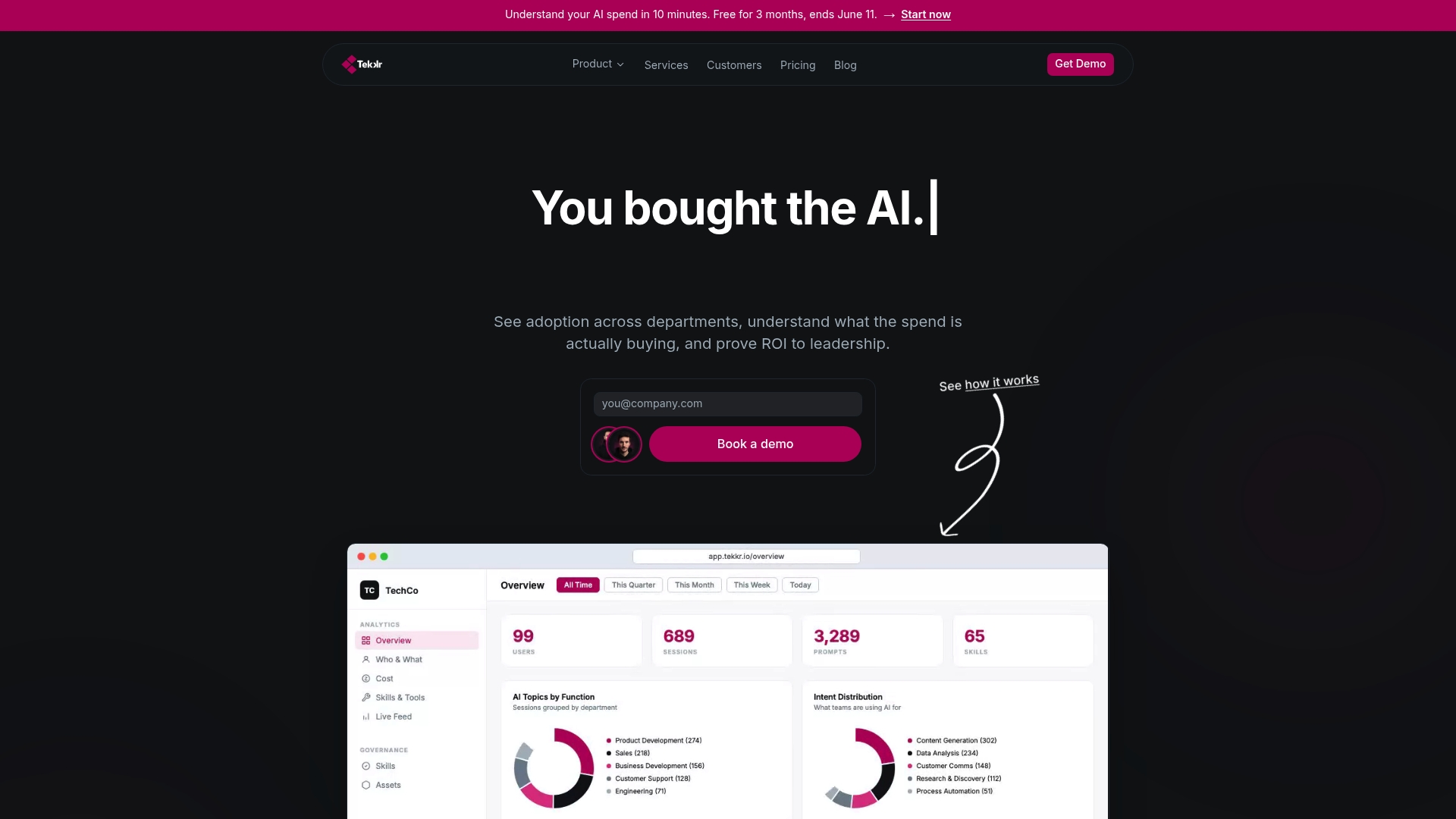
It also gives you the enforcement layer a policy needs but rarely gets: gamified rollouts and company playbooks that push adoption toward the tools your tiered register actually approves, instead of leaving employees to drift toward whatever’s convenient. If your policy is finished but you have no way to tell whether it’s working, that’s the next step to take.
Sources
FAQ
Does the United States Have a Federal AI Policy?
The United States doesn’t have a single comprehensive federal AI law. Instead, it relies on a mix of sector-specific regulation, executive guidance, and voluntary frameworks like the NIST AI Risk Management Framework, which most organizations use as their internal governance baseline.
What Are Some Examples of AI Governance Policies?
Real-world examples include university workplace policies like St. John’s University’s Policy 1038, vendor acceptable-use policies from companies like Salesforce and OpenAI, and template-based policies built around a tiered tool register, data classification table, and incident reporting form.
Which Jobs Are Considered Most at Risk From AI?
No credible source identifies exactly three specific jobs guaranteed to disappear; risk varies by task composition, not job title. Roles built heavily around repetitive data entry, basic transcription, and routine first-draft content tend to see the most disruption, while roles requiring judgment, physical presence, or relationship management tend to be more insulated.
What Is the 30% Rule in AI?
There’s no single, universally recognized “30% rule” in AI governance. If you’ve seen the term used, it likely refers informally to a specific vendor’s or analyst’s adoption benchmark rather than an established standard, so treat any specific percentage claim skeptically unless it’s sourced.
How Often Should We Update Our AI Policy?
Review the policy at least quarterly, and immediately after any vendor contract change, new tool adoption, or reported incident. Tools like Tekkr’s Configurato make this easier by surfacing usage and spend shifts that signal when your tool register is falling out of date.