
An AI playbook template is a copyable set of documents, mainly a PRD or opportunity brief, an evaluation plan, launch gates, a governance checklist, and prompt templates, that turns AI adoption into a repeatable, auditable process instead of a series of one-off pilots. The fastest path is to grab the checklist below, fill in the three required fields per artifact, and run it through a real pilot within 30 to 60 days.
TL;DR:
- Most AI initiatives fail due to a lack of clearly defined success metrics and structured artifacts before deployment, rather than model quality issues.
- Filling out key artifacts such as opportunity briefs, evaluation plans, and governance checklists within 30 to 60 days significantly increases the chances of a successful and measurable AI deployment.
- Implementing strict launch gates aligned with each artifact ensures models meet quality, safety, operational, and business value thresholds before full-scale rollout.
- Using a standardized prompt framework like CO-STAR with few-shot examples improves model reliability and prompt clarity across teams.
- Continuous measurement and live artifact updates, supported by tracking tools, are essential for scaling AI efforts beyond pilot phases and maintaining governance.
Table of Contents
- Core Components of an AI Playbook Template
- A Ready-to-Copy AI Playbook Template: Checklist and Fill-In Artifacts
- Prompt-Engineering Playbook Section (CO-STAR and Few-Shot Guidance)
- Governance, Launch Gates, and Evaluation Metrics
- How to Adapt and Pilot This Template in 30 to 60 Days
- TekkrTools: Real Assets to Measure and Scale Your Playbook
- Why Playbooks Must Be Living Artifacts
- Authoritative Playbooks and Template Repos to Consult
- Sources
- FAQ
Core Components of an AI Playbook Template
Most AI initiatives stall not because the model is bad, but because nobody defined what “good” looked like before launch. A working template fixes that by forcing five decisions onto paper before anyone writes a line of production code.
The Stanford Digital Economy Lab’s analysis of 51 enterprise AI deployments found that closing the gap between pilot and measurable return depends on human-in-the-loop oversight and strict data quality standards baked into the artifacts, not bolted on afterward. That is the whole argument for structure over improvisation.
The essential artifacts are:
- AI opportunity brief / PRD: names the customer problem, defines scope boundaries, and sets success metrics before any prompt gets written.
- Evaluation plan: lists quality metrics, edge case tests, and the acceptance thresholds a model has to clear before it ships.
- Trust and safety checklist: covers PII handling rules, human-in-the-loop review roles, and a live risk register.
- Operational readiness plan: monitoring dashboards, cost observability by team, and a documented rollback path.
- Business readiness memo: a one-page executive decision document with ROI thresholds tied to a go or no-go call.
Skip any one of these and you get a familiar failure mode: a model that works in the demo and quietly drifts, overspends, or leaks sensitive data six weeks after launch.
A Ready-to-Copy AI Playbook Template: Checklist and Fill-In Artifacts
Here is the sequence, in order, with the minimum fields each artifact needs. Copy this into a shared doc or a lightweight repo and start filling blanks.
- Opportunity brief. Purpose: justify why this use case deserves engineering time. Fields to fill: problem statement, target user, expected business impact.
- AI PRD. Purpose: turn the opportunity into a buildable spec. Fields to fill: scope boundaries, success metrics, out-of-scope exclusions.
- Evaluation plan. Purpose: define what “passing” looks like before testing starts. Fields to fill: quality metric (accuracy, relevance, latency), edge case list, acceptance threshold.
- Human review protocol. Purpose: assign who checks outputs and when. Fields to fill: reviewer role, review frequency, escalation path.
- Launch gate. Purpose: force a documented go or no-go decision. Fields to fill: gate owner, pass criteria, rollback trigger.
- Post-launch review. Purpose: catch drift and cost creep after shipping. Fields to fill: monitoring cadence, drift threshold, cost ceiling.
On structure: a single shared document works fine for a first pilot with one team. Once two or more teams adopt the same process, split it into a modular repo, one folder per artifact, so ownership stays clear and nobody edits someone else’s evaluation plan by accident. Open-source PM playbook repositories follow this same six-step sequence, which is a decent sign it holds up across different team structures.
Prompt-Engineering Playbook Section (CO-STAR and Few-Shot Guidance)
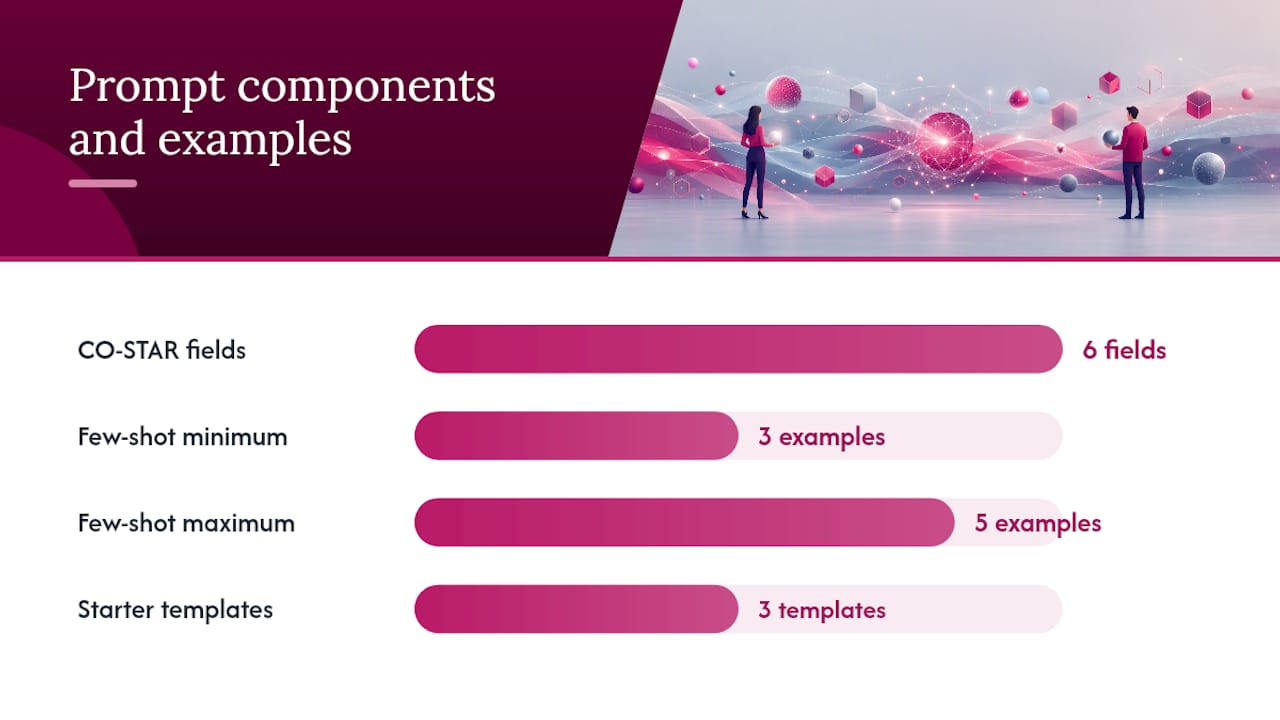
Every playbook needs a standard way to write prompts, otherwise every team invents its own format and nobody can debug anyone else’s work. The CO-STAR framework, used in government prompt-engineering playbooks, captures six fields for every prompt:
- Context: background the model needs before it can respond usefully.
- Objective: the specific task, stated as an action.
- Style: the writing or output format expected.
- Tone: formal, casual, technical, or persuasive.
- Audience: who will read or use the output.
- Response: the exact format the output should take (bullet list, JSON, paragraph).
For harder tasks, add 3 to 5 few-shot examples showing input-output pairs in the exact format you want. Research on few-shot prompting treats this range as the practical standard for improving reliability and format adherence on anything beyond simple lookups.
Pro Tip: Store your few-shot examples in a shared file, not scattered across individual prompts. When the model updates, you only have to re-test the examples once instead of hunting through a dozen documents.
Three starter templates: a content generation prompt (Context: brand voice guide; Objective: draft a product description; Response: 100 words, three bullet features), a summarization prompt (Context: source document; Objective: condense to key decisions; Response: five bullets max), and an extraction prompt (Context: raw text; Objective: pull named entities; Response: structured JSON).
Governance, Launch Gates, and Evaluation Metrics
A playbook without gates is just documentation nobody enforces. The AI Product Playbook framework organizes launch decisions around five gates, each tied to a specific artifact:
- Customer value gate: does the use case solve a real, measured problem? Pass criteria come from the opportunity brief’s stated impact.
- AI quality gate: does the model clear the evaluation plan’s accuracy and edge case thresholds?
- Trust and safety gate: are PII controls, human-in-the-loop review, and the risk register all active?
- Operational readiness gate: is monitoring live, and does a rollback plan exist?
- Business value gate: does projected ROI clear the threshold set in the executive memo?
A model can pass the quality gate and still fail the business value gate if the cost per query outweighs the time saved, which is a more common outcome than most teams expect going into a pilot.
Governance artifacts worth tracking permanently: a risk register with fields for likelihood, impact, and owner; documented PII stripping rules; named human-in-the-loop reviewers per use case; and audit logs that timestamp every model decision touching customer data. Practitioners increasingly treat these as a default state built into every artifact rather than a compliance step added after the fact.
How to Adapt and Pilot This Template in 30 to 60 Days
Speed matters more than polish in the first pass. Here is the sequence that gets you from template to evidence.
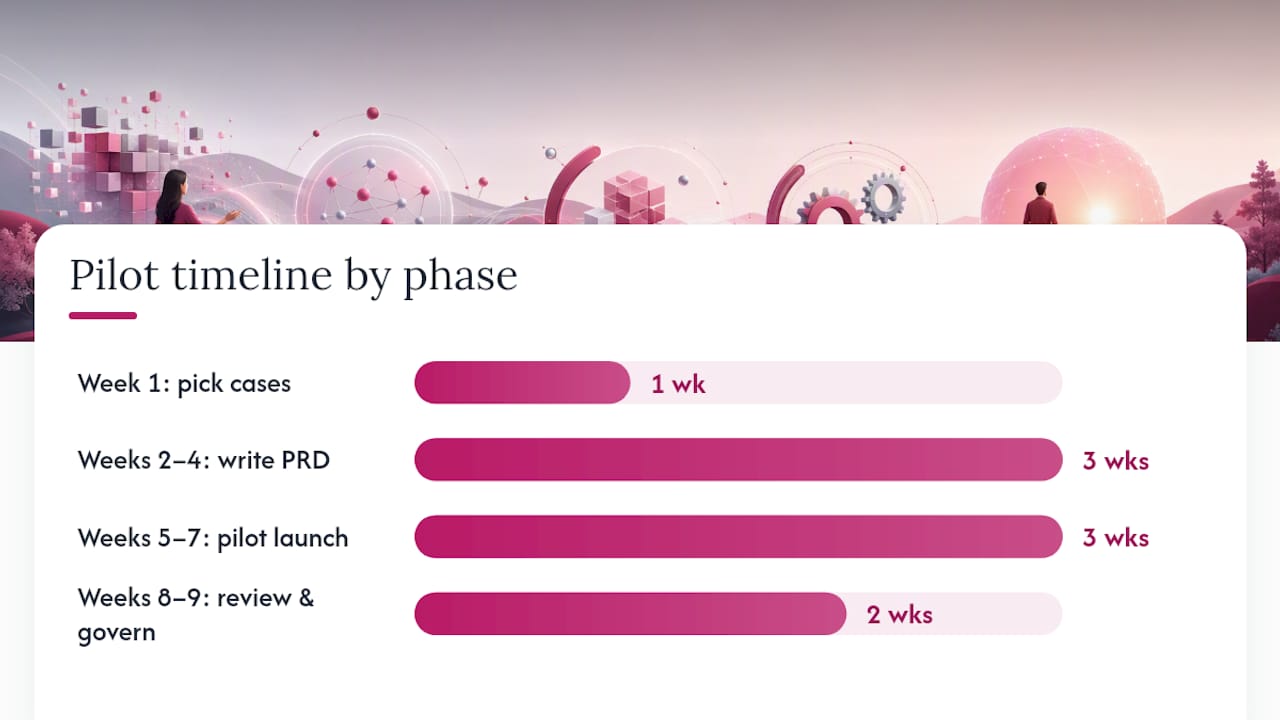
- Week 1: pick three use cases, name a sponsor for each. Choose problems with a clear owner and a measurable outcome, not the flashiest idea in the room.
- Weeks 2 to 4: fill out the opportunity brief and AI PRD for each use case. Run the evaluation plan against a small test set before touching production data.
- Weeks 5 to 7: pilot one use case through the launch gates. Track adoption, cost per team, and quality metrics against your acceptance thresholds.
- Weeks 8 to 9 (day 60): review results and decide scale criteria. Set a recurring governance review, monthly at minimum, and track adoption rate, cost per active user, and error rate as your ongoing scorecard.
The Stanford Digital Economy Lab findings back this timeline: deployments that reconciled pilot results against measurable ROI, with human reviewers checking outputs the entire way, were the ones that survived past the pilot stage.
Pro Tip: Assign one person to own the governance review cadence from day one. Playbooks that die usually die because nobody owned the follow-up meeting, not because the template was wrong.
TekkrTools: Real Assets to Measure and Scale Your Playbook
A checklist tells you what to build. Measuring whether people actually use it is a different problem, and it’s the one most playbooks skip. Tekkr’s Configurato tracks adoption, spend, and ROI by team, showing exactly who’s using tools like Claude and Codex and what it’s costing.
- Team-by-team cost allocation, so finance sees spend without guessing
- Use-case intelligence surfaced automatically from real usage
- Gamified rollout tools that push adoption past the pilot stage
- A 30-day analytics playbook for executives that pairs directly with the checklist above
Why Playbooks Must Be Living Artifacts
Static playbooks fail. Teams that build automated evaluation loops, drift monitors, and scheduled review cycles into the artifacts themselves outperform teams treating the document as a one-time write-up. Start small, measure honestly, and keep every artifact minimal enough that someone actually updates it.
— TekkrTools
Authoritative Playbooks and Template Repos to Consult
For deeper technical artifacts, review the CMS AI Playbook for governance maturity models, and the TAF AI Eval Playbook for evaluation and drift monitoring examples.
If you’re building this for a small team rather than an enterprise rollout, partner guidance on adapting AI playbooks for entrepreneurs covers a lighter version worth borrowing from, and finance-focused teams may find the cross-functional AI strategy insights from Byram Advisory Group useful for framing ROI conversations with leadership.
Ready to move past the template into measured results? Tekkr’s AI adoption solution pairs Configurato’s tracking with hands-on consulting to help you fill these artifacts and prove the ROI leadership actually asked for.
Sources
- Enterprise AI Playbook — Stanford Digital Economy Lab (April 2026)
- arXiv: Few-shot prompting guidance (2025/2026 guidance)
FAQ
What Is the 30% Rule in AI?
If you’ve seen it referenced, it likely points to a specific vendor’s benchmark or an informal rule of thumb about pilot success rates rather than an industry standard.
Which Jobs Are Least Likely to Be Replaced by AI?
Roles built on physical dexterity, in-person trust, and judgment under ambiguity, like skilled trades, hands-on healthcare work, and complex negotiation, tend to be the hardest for AI to automate, though this evolves as tools improve.
Where Can I Find a Playbook Template?
Start with the checklist in this article, then reference the CMS AI Playbook or open-source AI-PM-Playbook repo for additional structural examples you can adapt.