
An AI governance framework is a structured set of policies, roles, and controls that manages how an organization builds, buys, and deploys AI systems throughout their lifecycle. The frameworks worth knowing are the NIST AI RMF, the OECD AI Principles and its companion playbook, ISO/IEC 42001, the EU AI Act, UNESCO’s ethics recommendation, and Singapore’s IMDA Model AI Governance Framework. Nearly all of them organize work around four functions: GOVERN, MAP, MEASURE, and MANAGE.
TL;DR:
- Frameworks like NIST and ISO are best suited for internal controls and audits, while OECD and EU law address strategic and legal compliance needs.
- The four core functions—Govern, Map, Measure, and Manage—must be infused throughout the AI lifecycle and assigned to appropriate organizational roles.
- Building effective AI governance starts with securing executive sponsorship, creating an inventory, and classifying risks before developing policies and controls.
- You should align governance controls with the SVRNOS 7-Layer Model to directly trace and audit AI decisions during incidents and compliance activities.
- Continuous measurement of operational KPIs and staff training tailored to each role are crucial for proving that governance policies are practiced and enforced.
Table of Contents
- What Is an AI Governance Framework? Top Standards at a Glance
- The Four Functions Behind Every Serious AI Governance Model
- How to Build and Roll Out AI Governance Step by Step
- Matching the Right Framework to Your Role and Risk Profile
- Where Do Governance Controls Actually Live? The SVRNOS 7-Layer Model
- Governing Agentic AI: New Risks, New Guardrails
- Metrics That Prove Your AI Governance Framework Is Working
- Getting Stakeholders Aligned Without Slowing Everything Down
- Navigating Compliance Across Multiple Jurisdictions
- Fitting AI Governance Into Existing Risk and Corporate Governance Structures
- Testing for Bias and Fairness in Production AI Systems
- Training Employees So Governance Doesn’t Live Only in Policy Documents
- Why Governance Only Works When You Can Prove It’s Happening
- Turning Governance Policy Into Operational Evidence
- Primary Sources and Standards Worth Bookmarking
- Sources
What Is an AI Governance Framework? Top Standards at a Glance
Every enterprise governance program ends up borrowing from the same handful of sources, and knowing which one solves which problem saves months of committee debate. None of them alone gives you a finished program. Each covers a different layer of the problem, from voluntary risk guidance to binding law.
- NIST AI RMF 1.0: A voluntary, sector-agnostic framework built around four functions. It’s the default starting point for U.S. organizations because it maps cleanly to existing risk programs and doesn’t require legal interpretation to apply. Best for building an internal risk taxonomy and control library from scratch.
- OECD AI Principles and AI Governance Playbook: The OECD Principles set the ethical baseline (fairness, transparency, accountability) that most national policies now echo. The AI Governance Playbook translates those principles into twelve concrete directives across strategy, risk and compliance, workforce readiness, and operations. Use it when you need boardroom language and executive buy-in, not just technical controls.
- ISO/IEC 42001: The first certifiable management-system standard for AI, structured like ISO 27001 with clauses on leadership, planning, support, operation, and improvement. Best for organizations that already run ISO-based quality or security systems and want AI governance to slot into existing audit cycles.
- EU AI Act: Binding law for any organization placing AI systems on the EU market or affecting EU residents, with tiered obligations by risk category. U.S. companies selling into Europe or embedding AI in EU-facing products need this regardless of where they’re headquartered.
- UNESCO Recommendation on the Ethics of Artificial Intelligence: A global normative instrument adopted by member states, useful for organizations operating across many jurisdictions that need a shared ethical vocabulary rather than enforceable rules.
- Singapore’s Model AI Governance Framework and IMDA agentic AI guidance: Practical, implementation-oriented guidance that’s become an unofficial global reference, especially for its recent work on agentic AI oversight.
The quick selection rule: use NIST or ISO when you need internal controls and audit structure, OECD when you need executive-level strategy and communication tools, and the EU AI Act when a specific product or use case falls under binding legal obligations.
The Four Functions Behind Every Serious AI Governance Model
Strip away the branding differences between frameworks and you’ll find the same four jobs repeating in nearly every serious AI governance model. NIST names them explicitly, and understanding them makes every other framework easier to parse, because ISO, OECD, and the EU AI Act all handle versions of the same four jobs with different vocabulary.
- GOVERN sets the foundation: policies, roles, accountability structures, and culture. NIST treats GOVERN as cross-cutting rather than a one-time step. It has to be infused throughout the AI lifecycle, not checked off before development starts. In practice, this means a named AI governance owner, a documented escalation path, and a policy that says who can approve a new AI use case.
- MAP identifies context: what the system does, who it affects, and what could go wrong. This is where you build an AI inventory, classify use cases by risk tier, and document data lineage. A retail company mapping a recommendation engine will flag different risks than one mapping an AI tool that screens job applicants.
- MEASURE applies metrics and testing: bias audits, performance benchmarks, explainability checks, and security testing. This function turns abstract risk categories into numbers, thresholds, and pass/fail criteria that a compliance team can actually act on.
- MANAGE operationalizes the response: monitoring in production, incident response, and continuous improvement based on what MEASURE turns up. A drift alert that fires a MEASURE metric is only useful if MANAGE has a defined playbook for what happens next.
Mapped against organizational pillars, GOVERN lives with leadership and accountability, MAP and MEASURE live with data governance and technical teams, and MANAGE spans security operations and incident response. A useful gut check for maturity: if your organization can name who owns MANAGE for a specific AI tool but not who owns MAP, you have policy without follow-through. If you have technical testing but no governance layer connecting it to leadership, you have engineering discipline without organizational accountability. Both gaps are common, and they usually surface in different departments.
How to Build and Roll Out AI Governance Step by Step
Most governance programs stall not from lack of frameworks but from lack of sequence. Trying to write policy before you know what AI systems exist in the organization is backward. Here’s the order that actually works.
- Secure executive sponsorship and define scope. Governance without a named executive owner dies in committee. Decide upfront whether the program covers only generative AI tools, all machine learning systems, or every automated decision process, because scope creep here kills momentum fast.
- Build an AI inventory and classify risk tiers. You cannot govern what you cannot see. Catalog every AI tool in active use, who owns it, what data it touches, and what decision it influences. Tier each entry by potential harm, not by how exciting the technology sounds.
- Run risk and impact assessments (MAP). For each high-tier system, document the intended use, likely failure modes, and affected populations. This is also where you follow a due-diligence sequence like the OECD’s six-step process: embed policy commitments, identify impacts, prevent or mitigate them, track outcomes, communicate findings, and remediate when something goes wrong.
- Design controls and set measurement thresholds (MEASURE). Translate each identified risk into a testable control: a bias audit cadence, an accuracy floor, a human review gate for certain outputs.
- Operationalize monitoring and incident response (MANAGE). Assign an on-call path for AI failures the same way you would for a security incident. Build a feedback loop so production monitoring data flows back into your risk classifications.
- Produce governance artifacts. Written policies, delegation of authority documents, playbooks for common scenarios, and evidence records that prove the process actually ran. Auditors and regulators care less about intent than about paper trails.
Pro Tip: Start your AI inventory with finance and procurement records, not IT. Shadow AI tools purchased on a department credit card almost never show up in a formal software registry, and that gap is usually where the real risk hides.
A practical guide to responsible AI policy can help you draft the artifacts this roadmap produces without starting from a blank page.
Matching the Right Framework to Your Role and Risk Profile
No organization needs to implement every framework in full. The right combination depends on where you sit in the AI value chain and how exposed you are to regulation.
Start by naming your role honestly:
- Builders who develop foundation models or custom AI systems face the deepest technical obligations, especially model documentation and testing requirements.
- Buyers who purchase AI tools from vendors need vendor due diligence, contractual assurances, and inventory controls more than model-level testing.
- Deployers who take a third-party model and apply it to their own use case (a bank fine-tuning a vendor’s LLM for credit decisions, for instance) inherit obligations from both ends and often carry the most legal exposure.
- Mixed organizations, which describes most large enterprises, need all three postures running in parallel across different teams.
From there, apply a few decision heuristics. If you sell into the EU or your product affects EU residents, the EU AI Act’s tiered obligations apply regardless of where you’re headquartered, and high-risk categories carry documentation and conformity assessment duties that voluntary frameworks don’t. If you operate in a regulated sector such as finance or healthcare, existing sector rules likely already dictate model risk management practices that your AI governance program should absorb rather than duplicate. If your systems are largely internal productivity tools with limited autonomy, NIST’s risk functions probably give you enough structure without the overhead of a certifiable management system.
A workable mapping: use NIST AI RMF to build your internal risk functions, use ISO/IEC 42001 when you want a certifiable management system that plugs into existing ISO audits, and treat the EU AI Act as a compliance checklist specifically for in-scope, high-risk product lines. Determining where your organization sits in the AI value chain before picking a framework combination avoids the common mistake of over-engineering governance for low-risk internal tools while under-governing the one high-risk system that actually needs it.
Where Do Governance Controls Actually Live? The SVRNOS 7-Layer Model
Policy documents tell you what should happen. They rarely tell you where a control technically lives when something breaks in production, which is the gap the SVRNOS 7-Layer Model was built to close. It decomposes an AI deployment into seven layers, from the compute substrate up through application-level enforcement, and assigns governance questions to each one.
- Compute substrate: Where does the model actually run, and who controls that infrastructure?
- Provenance: Can you trace a given output back to the exact model version and training data that produced it?
- Routing: Which requests get sent to which model or agent, and on what basis?
- Evidence transport: How do audit logs and decision records move between systems without gaps?
- Session state: What context persists between interactions, and who can access it?
- Risk interpretation: Where does a raw output get translated into a risk score or flag?
- Application enforcement: Where does a policy actually block, allow, or modify a final action?
This matters most during audits and incident triage. A single unexplained decision from an AI system used to trigger a scramble across engineering, legal, and compliance to figure out where things went wrong. Mapping controls to these seven layers means a compliance officer can point directly at the “evidence transport” layer when audit logs go missing, instead of treating the whole system as an unauditable black box. It’s the layer that turns a framework like NIST or ISO from a policy document into something an engineer can actually locate in a system diagram.
Governing Agentic AI: New Risks, New Guardrails
Agentic AI systems that take multi-step actions on their own, often chaining outputs from one step into inputs for the next, break assumptions that most existing governance frameworks were built on. A traditional model produces a prediction that a human reviews before acting. An agent can execute the action itself, and if that action is irreversible (sending a payment, deleting a record, emailing a customer) the review has to happen before the action, not after.
Singapore’s IMDA addressed this directly in its guidance for agentic systems, and the core controls it recommends are worth adopting even outside Singapore’s regulatory scope:
- Bounded scope: Define exactly what actions an agent can take and what systems it can touch, rather than granting broad access by default.
- Significant checkpoints: Require human sign-off before high-impact or irreversible actions, not just periodic spot checks.
- Access controls: Treat agent credentials like any other privileged account, with least-privilege permissions and expiration.
- Traceability: Log every action an agent takes, along with the reasoning or prompt chain that produced it, so a chained decision can be reconstructed later.
- Staged rollout: Expand an agent’s permissions and scope gradually, based on observed behavior, rather than deploying full autonomy on day one.
Continuous human oversight of every agent action doesn’t scale once an organization has more than a handful of agents running in production, which is exactly why checkpoints and access controls matter more than blanket supervision. The practical answer is accountability checkpoints tied to risk tier, not universal human review of every step.
Metrics That Prove Your AI Governance Framework Is Working
A governance program that can’t produce numbers is a policy document, not a program. The metrics that matter split into two categories.
Operational KPIs track whether the machinery is running: percentage of AI systems covered by the inventory, number of risk assessments completed against the number due, average time-to-remediate for flagged issues, and incidents detected before versus after deployment.
Quality signals track whether the machinery is running well: evidence completeness (can you produce the paper trail an auditor asks for, on demand?), explainability instrumentation coverage, and the frequency of drift alerts on production models.
- Report coverage and completion rates monthly to the governance committee.
- Report incident trends and time-to-remediate quarterly to executives.
- Reserve annual reporting for framework-level maturity assessments against NIST or ISO benchmarks.
Pro Tip: Boards rarely want a raw metrics dump. Translate coverage and remediation numbers into a single trend line: is exposure going up or down quarter over quarter? That’s the question executives actually ask. Board-level reporting examples show how other organizations frame this. AI-driven risk monitoring tools are also changing how finance and technology teams surface these signals faster than manual review ever could.
Getting Stakeholders Aligned Without Slowing Everything Down
Governance fails quietly more often than it fails loudly. It gets ignored because nobody outside the compliance team understood why it existed. Getting stakeholder buy-in starts with treating different audiences differently instead of sending one policy memo to the entire company.
Engineers need concrete technical requirements, not ethical principles. Tell them exactly what logging format an audit needs and where in the pipeline it has to be captured. Legal and compliance teams need to see how the governance program maps to specific regulatory obligations, not a generic risk narrative. Executives need trend lines and business impact, not function-by-function detail. Frontline employees who use AI tools daily need plain-language guidance on what they can and can’t do, delivered in the tools they already use rather than buried in a policy portal.
Communication cadence matters as much as content. A governance program that only surfaces during incidents trains people to associate it with blame, not support. Regular, low-stakes updates (a quarterly summary of new AI tools approved, a short note on a policy change) keep the program visible without turning every interaction into a compliance review. Cross-functional governance committees with rotating representation from engineering, legal, HR, and business units also catch blind spots that a compliance-only team misses, particularly around how a new tool actually gets used day to day versus how it was pitched during procurement.
The organizations that get this right tend to treat governance communication as an ongoing relationship, not a one-time rollout announcement.
Navigating Compliance Across Multiple Jurisdictions
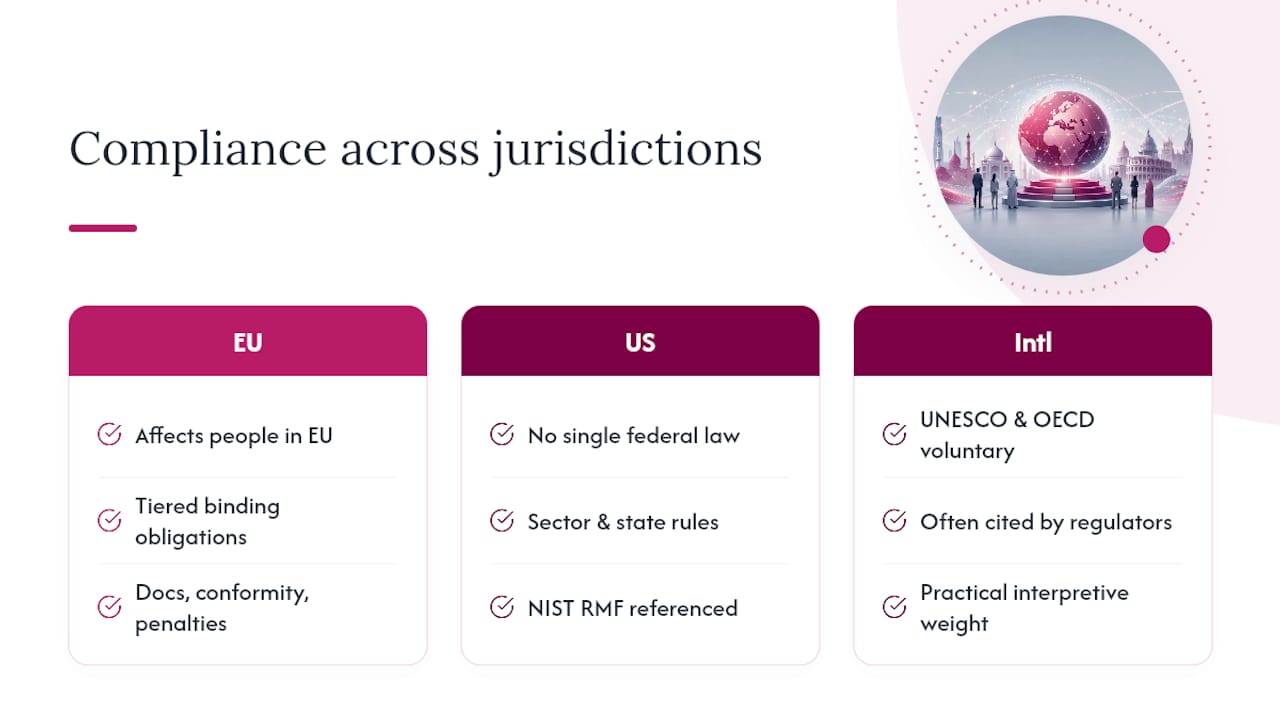
Nearly every enterprise running AI at scale ends up subject to more than one legal regime, and the frameworks covered earlier are not interchangeable with local law. The EU AI Act imposes binding, tiered obligations on providers and deployers of AI systems that affect people in the EU, regardless of where the company is headquartered. That includes documentation duties, conformity assessments for high-risk categories, and penalties for noncompliance.
In the United States, there’s no single comprehensive federal AI law equivalent to the EU AI Act. Instead, obligations come from a patchwork of sector-specific rules (financial services model risk guidance, healthcare privacy law, employment discrimination law) plus state-level AI legislation that continues to expand. This makes the voluntary NIST AI RMF unusually important domestically: it’s often the closest thing to a common baseline that regulators, auditors, and courts reference even without a statutory mandate to follow it.
UNESCO’s ethics recommendation and the OECD Principles don’t carry direct legal force in most member states, but national regulators increasingly cite them when interpreting what “responsible AI” means in enforcement actions, which gives them practical weight beyond their voluntary status.
The safest compliance posture for a multinational organization is to build controls to the strictest applicable standard (usually the EU AI Act for in-scope systems) and treat that as the floor everywhere else, rather than maintaining separate, lighter control sets per jurisdiction. Fragmented compliance programs are also where audit failures tend to originate, since nobody can articulate which rule applied to which system at the time a decision was made.
Fitting AI Governance Into Existing Risk and Corporate Governance Structures
Building AI governance as a standalone silo, disconnected from enterprise risk management, is one of the most common early mistakes. Most large organizations already have functioning structures for operational risk, third-party vendor risk, and information security. AI governance should extend those structures, not duplicate them with a parallel bureaucracy.
Practically, this means routing AI risk assessments through the same enterprise risk committee that handles other operational risk, rather than creating a separate AI risk committee that never talks to it. It means folding AI vendor due diligence into existing third-party risk management processes instead of building a new intake form specifically for AI vendors. And it means treating AI incidents as a category within existing incident response, with AI-specific playbooks rather than an entirely separate escalation path.

The board-level reporting structure benefits from the same logic. Rather than adding a standalone “AI governance” line item that competes for board attention against every other risk category, the more durable approach folds AI risk reporting into existing risk committee reporting cycles, with AI called out as a named category the way cybersecurity or regulatory risk already are. Organizations that treat AI governance as core strategy rather than a compliance afterthought tend to get faster executive sponsorship precisely because it’s framed in language the board already understands: risk exposure, control effectiveness, and return on a specific investment.
Testing for Bias and Fairness in Production AI Systems
Bias mitigation is where governance frameworks tend to get most abstract, and where practitioners most need concrete methods rather than principles. Fairness assessment starts with defining which fairness metric actually applies to the use case, because different metrics can conflict with each other mathematically. A hiring tool optimized for equal selection rates across groups and one optimized for equal false-negative rates across groups will not always produce the same outcome for the same candidate pool.
Practical bias mitigation happens at three points in the lifecycle. Pre-processing addresses skewed or unrepresentative training data before a model ever sees it. In-processing constrains the model during training itself, penalizing outcomes that violate a chosen fairness criterion. Post-processing adjusts model outputs after the fact, recalibrating thresholds for different subgroups when retraining isn’t practical or fast enough.
None of these methods work as a one-time check. A model that passes a fairness audit at launch can drift as the underlying population or use case shifts, which is exactly why the MEASURE function under NIST’s framework treats bias testing as continuous rather than a pre-deployment gate. Fairness assessments should run on a fixed cadence, tied to the same monitoring infrastructure that catches performance drift, with clear ownership for who reviews the results and what threshold triggers a retraining or rollback decision. Documentation matters here as much as the technical method: an auditor asking “how do you know this system isn’t biased” needs a specific answer, not a description of good intentions.
Training Employees So Governance Doesn’t Live Only in Policy Documents
A governance framework that only exists in a policy repository nobody reads accomplishes nothing. Training is where governance either becomes muscle memory or stays theoretical, and the two groups that need it look almost nothing alike.
General employees using AI tools day to day need short, practical guidance: what data they can paste into a chatbot, which tools are approved for which tasks, and who to contact when an AI output looks wrong. This works best as brief, recurring modules tied to actual tool usage rather than a single annual compliance video nobody remembers by March.
Technical teams building or fine-tuning models need deeper training on the specific control requirements tied to their framework of choice: what NIST’s MEASURE function expects from a bias audit, what documentation ISO/IEC 42001 requires for a management review, what conformity assessment evidence the EU AI Act demands for an in-scope system.
Managers and executives need training focused on decision rights: when they can approve a new AI use case themselves versus when it needs to escalate, and what questions to ask before green-lighting a new tool. Training that treats every employee tier identically wastes time and attention on the wrong details for each audience.
The most effective programs pair initial training with just-in-time reminders embedded in the tools people actually use, since a policy learned once in an onboarding session rarely survives contact with a real deadline six months later.
Why Governance Only Works When You Can Prove It’s Happening
Most AI governance programs fail for a boring reason: nobody can prove the policy actually ran. A framework document sitting in a compliance folder doesn’t stop a shadow AI tool from processing sensitive data, and an ethics statement doesn’t tell an auditor which team owns remediation when a model drifts. Practitioner guidance on this point is blunt: governance succeeds as a business and risk exercise, documented and enforceable, not as an aspirational ethics statement that nobody operationalizes.
That’s the piece most conventional governance advice underweights. Frameworks like NIST and ISO give you the vocabulary and the structure, but they don’t hand you observability into what’s actually happening across your organization’s AI usage. You can write the policy, define the risk tiers, and build the committee, and still have no reliable answer to “which teams are using which AI tools, at what volume, for what purpose, right now.” That gap is where evidence collection lives, and evidence collection is what separates a governance program from a governance document.
This is also why measurable adoption data belongs inside the governance conversation, not next to it. Knowing tool usage by department, spend against budget, and which use cases are actually driving value gives a governance committee the same kind of continuous signal that MAP and MEASURE demand from a technical risk perspective, just applied to the organizational layer. Without it, governance stays reactive: something breaks, then you investigate. With it, governance becomes something closer to what OECD’s playbook envisions, a set of operational directives running continuously rather than a binder reviewed once a year.
— TekkrTools
Turning Governance Policy Into Operational Evidence
Every framework in this article eventually asks the same underlying question: what is actually happening across your organization’s AI usage, and can you prove it? A platform like Configurato can track which AI tools employees are really using, including assistants like Claude and Codex, break down spend by team and department, and surface use-case intelligence showing where AI is driving productivity versus sitting unused after procurement.
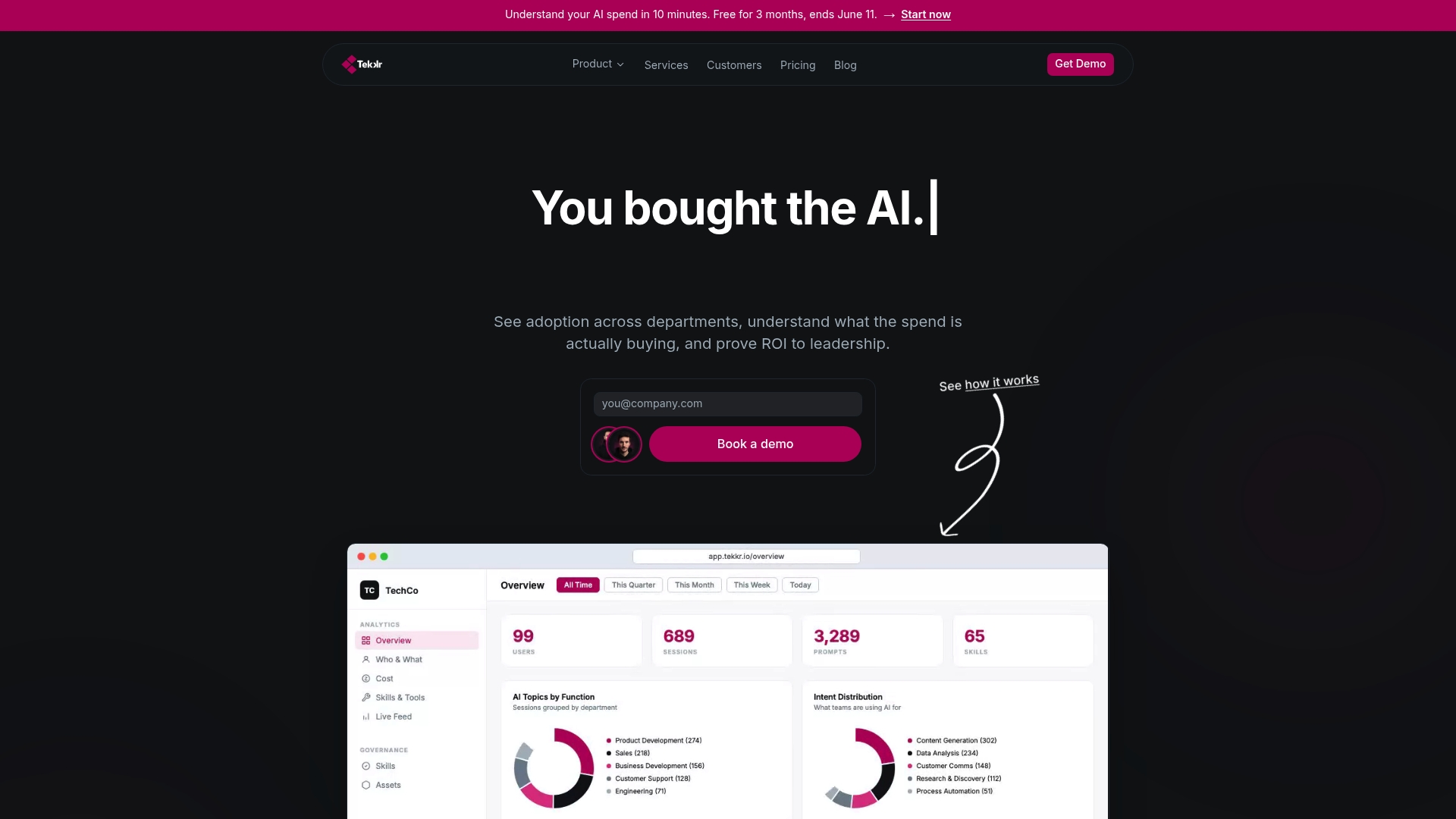
That data maps directly onto governance obligations most frameworks assume you already have covered. An accurate AI inventory, the foundation of NIST’s MAP function, starts with knowing what’s actually in use, not what procurement approved. Executive dashboards that report adoption and spend trends give governance committees the continuous evidence auditors ask for instead of a point-in-time snapshot. And because Configurato runs on a privacy-first, end-to-end encrypted architecture with automatic PII stripping and no browser extensions required, the evidence capture itself doesn’t create a new compliance liability while your program collects it.
Setup takes about 10 minutes, there’s a free tier with no credit card required, and you can see exactly how Tekkr’s observability and ROI features work before committing to anything. For governance teams that also want the security and privacy specifics reviewed upfront, the security and privacy page walks through the encryption and data-handling architecture in detail.
Primary Sources and Standards Worth Bookmarking
The frameworks and guidance covered in this article all publish their own primary documentation, and it’s worth going directly to the source rather than relying on secondhand summaries when you’re drafting policy language.
- NIST AI Risk Management Framework (AI RMF 1.0) and its official landing page
- OECD AI Governance Playbook
- OECD due diligence guidance for responsible AI
- Model AI Governance Framework for Agentic AI (IMDA, Singapore)
- SVRNOS 7-Layer Model of AI Governance
- AI governance: A practical guide for organisations (Twobirds)
Sources
- NIST AI Risk Management Framework (AI RMF 1.0)
- Oecd
- Model AI Governance Framework for Agentic AI (IMDA)
- SVRNOS 7-Layer Model of AI Governance
- OECD due diligence guidance for responsible AI (2026)