
Executives should prioritize measurable value, clear accountability, and board-level oversight, and the fastest way to get there is a fixed set of questions asked at every leadership review. Answering them exposes whether an AI initiative is actually working or just generating activity. Use the numbered list below in your next executive or board meeting rather than waiting for a formal governance review to surface the gaps.
TL;DR:
- Answers to data ownership and quality should be concrete, as unclear ownership can hide risks in model outputs and compliance.
- Clear success metrics like adoption rates, ROI per use case, and error rates are essential for measuring progress beyond vague productivity improvements.
- Regular discussions at least quarterly are necessary for monitoring vendor security, data lineage, and incident response, with immediate escalation of major failures.
- Red flags such as long pilots with no outcomes, missing incident plans, shifting ownership, or lack of monitoring indicate a project should be halted.
- Metrics must be broken down by department and use case to prove AI investments generate measurable value, not just stay as uncontrolled experiments.
Table of Contents
- Ai Executive Questions To Ask In Every Leadership Review
- How To Use These Questions In Board Meetings
- What Separates a Strong Answer From a Weak One
- Why Most Boards Ask the Wrong Questions First
- Turn These Questions Into a Board-Ready Dashboard
- Sources
Ai Executive Questions To Ask In Every Leadership Review
Most AI programs stall not because the technology fails, but because nobody asked the right question early enough. The eight questions below are ordered by priority, from strategic fit down to vendor risk, and each one comes with what a credible answer sounds like versus a vague one.
1. How does this initiative map to our core business model and competitive advantage? A real answer names the specific business process being changed and the metric it moves. A vague answer talks about “staying competitive” without naming a process. Ask for the one-page case tying the initiative to revenue, cost, or retention.
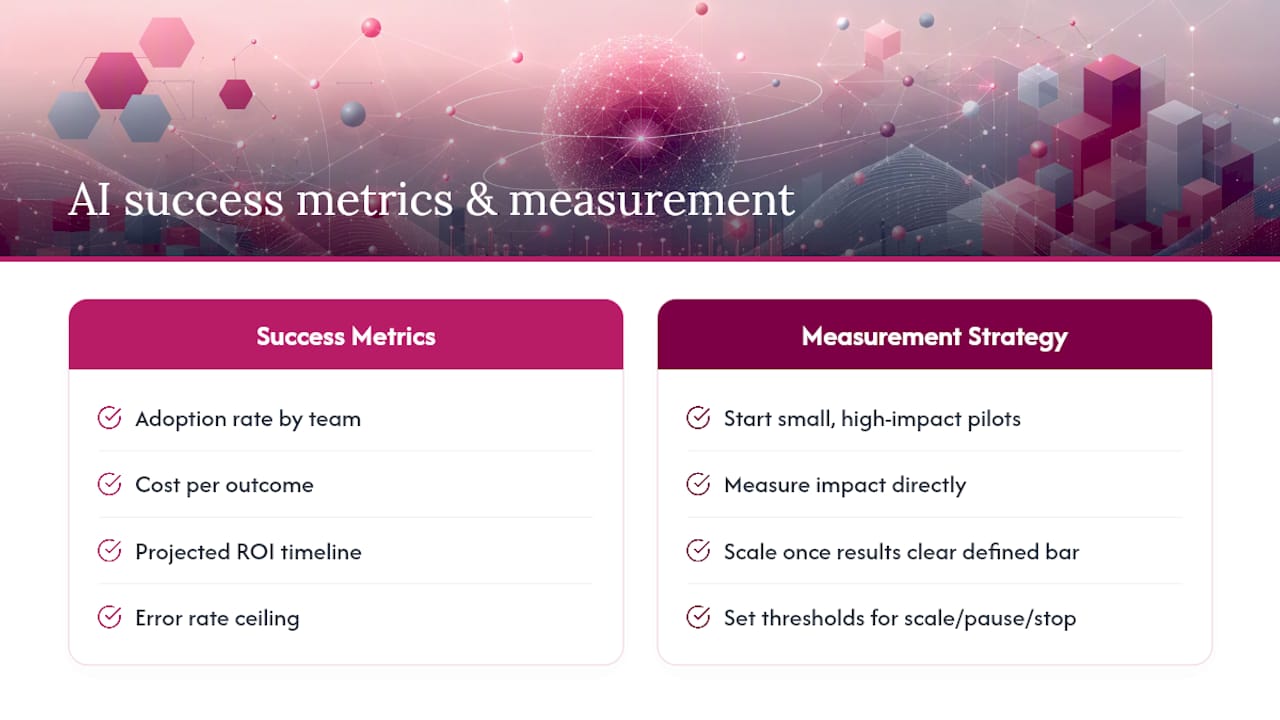
2. What outcomes and metrics define success, and by when? Push for adoption rate by team, cost per outcome, and a projected return timeline, not a general sense that “productivity will improve.” Practical guidance from Google Cloud recommends starting with a small set of high-impact pilots, measuring impact directly, and only scaling once results clear a defined bar.
3. Where does the data live, who owns it, and how is quality verified? Data lineage and ownership sound like technical details until a model produces a bad output nobody can trace back to its source. If nobody in the room can answer who owns the underlying dataset, that’s the finding.
4. Who is accountable for deployment, monitoring, and incident response? Every initiative needs a named owner for what happens after launch, not just before it. Directors are increasingly on the hook for this specifically. Legal and governance analysis from Harvard Law’s Corporate Governance forum notes that boards now expect concrete escalation paths and documented incident response plans, not general assurances that “the team is on it.”
5. What are the high-risk use cases, and what’s the mitigation plan? Some AI applications carry more downside than others, customer-facing decisions and regulated processes chief among them. A good answer ranks use cases by risk and names a mitigation owner for each one.

6. What gates determine whether we scale, pause, or stop? Pilots without exit criteria run forever. Demand specific thresholds: adoption above a set percentage, ROI inside a defined window, error rates under a ceiling.
7. What roles change, what training is planned, and how will adoption be measured? AI initiatives fail more often on the people side than the technology side. Ask which jobs shift, what training rolls out, and how leadership will know it worked.
8. What due diligence and testing results can you show us on this vendor? Request the actual artifacts: security testing, red-team results, data handling terms. KPMG’s AI governance principles for boards call for active technology and security oversight as a standing board responsibility, not a one-time checkbox.
Pro Tip: Ask each question twice, once at the pilot stage and once before any scale-up decision. The answer to “who owns this data” often changes entirely between those two moments, and that shift is exactly what you need to catch.
How To Use These Questions In Board Meetings
Treat this list as a recurring agenda, not a one-time interrogation. Board of Innovation’s practitioner guidance argues the real shift executives need to make is moving the conversation from isolated pilots to a durable operating model, and that only happens with repetition.
A workable cadence looks like this:
- Monthly: a metrics dashboard reviewed by the executive sponsor, covering adoption and spend by team.
- Quarterly: a deeper session with the audit or risk committee covering vendor diligence, testing results, and data lineage.
- Immediate: any security incident, compliance breach, or material model failure escalates to the board within days, not at the next scheduled meeting.
Guidance from NACD’s Director Essentials series recommends briefings more frequent than the standard quarterly rhythm in fast-changing environments, and AI adoption qualifies. An EY review of Fortune 100 proxy disclosures found that only about 12% of companies disclosed board-level AI training, which suggests most boards are reviewing AI decisions without the grounding to challenge them effectively. Fix that gap before adding more dashboards.
Convert findings into a decision at each gate: fund the next phase, pause for more evidence, or stop. PwC’s board oversight guidance recommends folding AI oversight into existing audit, risk, and strategy committee remits rather than standing up a separate structure, which keeps accountability inside channels that already report to the board.
What Separates a Strong Answer From a Weak One
The gap between an initiative that scales and one that quietly dies in “pilot” status usually shows up in the metrics leadership tracks, or fails to track.
Demand these specific KPIs rather than general updates: adoption rate broken out by team or cohort, ROI calculated per use case rather than company-wide, the rate of errors or hallucination incidents, and cost allocated by department rather than lumped into a single IT line. A Forbes analysis of executive ROI questions makes the point directly: measuring adoption and return at the department level, not just across the whole company, is what proves AI investments create value instead of staying permanent experiments. Tekkr’s own breakdown of ways to measure AI ROI covers this in more detail.
On the evidence side, request testing and red-team reports, a documented vendor due-diligence checklist, data lineage records, and a written incident response plan. If those documents don’t exist yet, that’s the finding, not a reason to skip the request.
Four red flags should stop a rollout cold:
- A pilot running for months with no measurable outcome attached to it.
- No incident response plan if the model fails or produces a harmful output.
- Ownership that shifts depending on who you ask in the room.
- No monitoring in place once the tool goes live company-wide.
Why Most Boards Ask the Wrong Questions First
Most boards default to asking “are we using AI enough,” which is the wrong question entirely. The right one is whether the AI use already happening is producing anything measurable, and whether anyone owns what happens when it breaks. Those are governance questions dressed up as technology questions, and treating them as a separate committee agenda item, rather than folding them into existing risk and audit remits, is one of the more common mistakes we see boards make.
The uncomfortable truth is that most executive teams can name their AI tools faster than they can name who’s accountable for the data those tools touch. That imbalance is where liability quietly accumulates. Fixing it doesn’t require a bigger AI budget. It requires someone at the table willing to ask the accountability question before the adoption question, every single time.
— TekkrTools
Turn These Questions Into a Board-Ready Dashboard
Asking the right questions only gets you halfway. The harder part is producing evidence fast enough that a board meeting doesn’t stall while someone scrambles to pull numbers from six different tool dashboards.
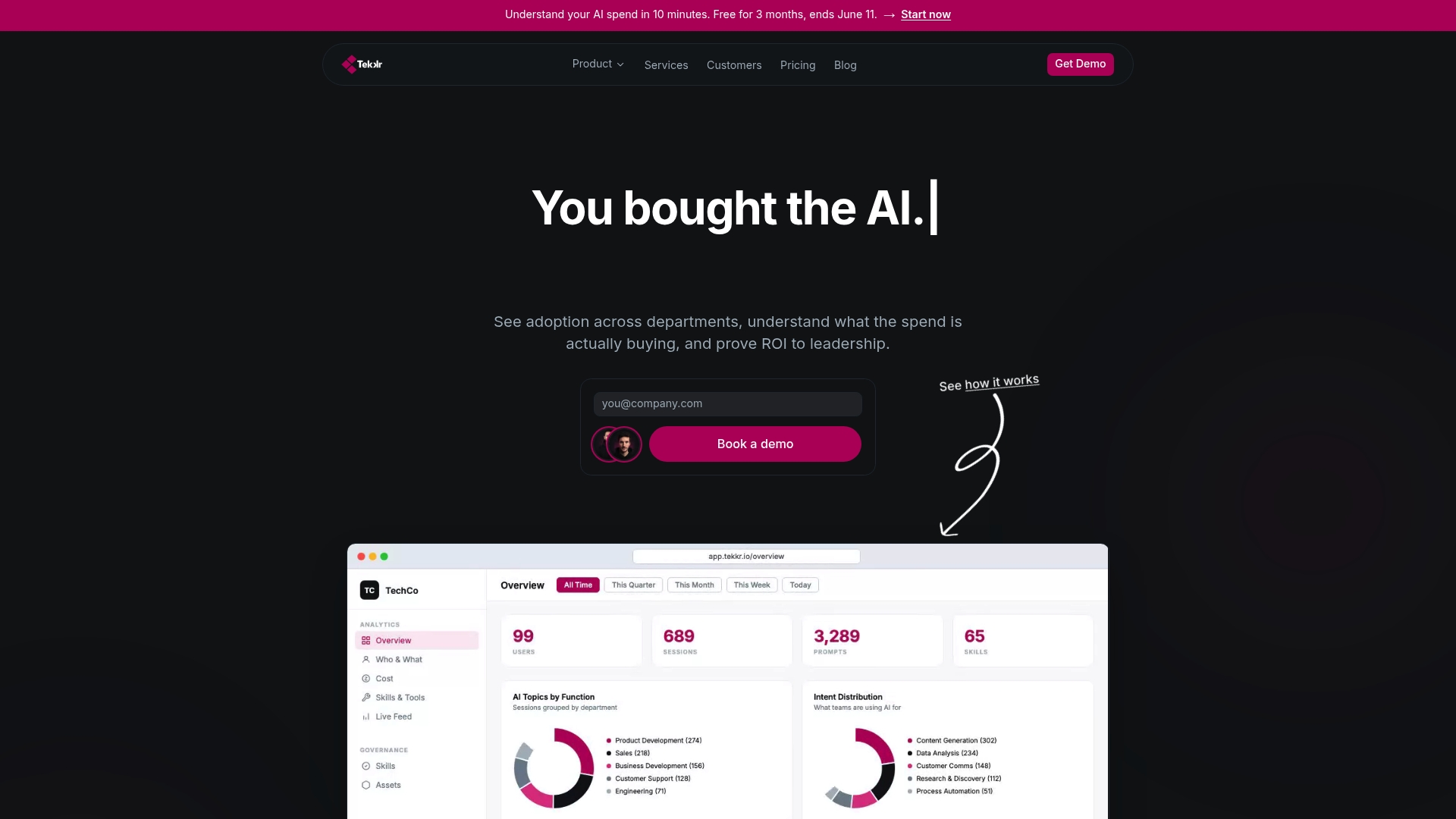
Tekkr’s Configurato tracks adoption, spend, and return across every team using tools like Claude and Codex, then breaks the results down by department so you can answer the ROI question with a real number instead of an estimate. It builds the artifacts a board actually asks for: an adoption leaderboard by team, a cost-by-team breakdown, and use-case intelligence that flags where AI spending isn’t translating into measurable output. Everything runs on a privacy-first, end-to-end encrypted setup with automatic PII stripping, so the reporting itself doesn’t create a new compliance risk. Setup takes about 10 minutes with a free tier and no credit card required. Visit Tekkr’s AI adoption solution to see what a board-ready report looks like before your next review.
Sources
- Board oversight of AI transformation: PwC
- AI Governance Principles for Boards — KPMG
- Director essentials: implementing AI governance — NACD / Director Essentials
- 10 AI questions every executive should be asking — Board of Innovation
- Board oversight of AI — Harvard Law / Corporate Governance