
Vendors typically default to short retention windows for API traffic, but zero data retention (ZDR), abuse-monitoring carve-outs, and covered-model floors all change that picture fast. Compliance teams should treat every AI vendor contract as both a legal document and an engineering control. The core job: identify what legally must be kept, negotiate retention terms with the vendor, and build technical proof that deletion actually happens. This guide maps vendor models to policy language, legal drivers, and an audit-ready checklist.
TL;DR:
- Vendors’ default retention varies, with some offering zero data retention, brief abuse monitoring, or longer standard periods, often with exceptions for flagged content and specific endpoints.
- Legal obligations, such as preservation orders or sector-specific regulations, can override vendor promises, requiring organizations to adapt their retention policies accordingly.
- Implementing automated technical controls like TTL settings and encryption, combined with clear data categorization and regular audits, is essential to enforce retention policies effectively.
- Data minimization should precede retention efforts, reducing the risk and scope of data retained by limiting input to only what is necessary for operational purposes.
- Cross-jurisdiction data handling requires tagging data by region and applying tailored retention schedules to comply with international laws and privacy rights.
Table of Contents
- AI Data Retention Models: ZDR, Standard Retention, and Vendor Carve-Outs
- How Legal Requirements Shape Your AI Retention Policy
- Building an AI Data Retention Policy: Structure and Sample Schedules
- Technical Controls That Actually Enforce Your Retention Policy
- A Practical Checklist for Implementing AI Data Retention
- How Tekkr Helps Compliance Teams Operationalize Retention
- Why Data Minimization Is the First Line of Retention Defense
- AI Retention and the Right to Be Forgotten
- Over-Retention and Under-Retention: Two Different Failure Modes
- Managing AI Retention Across Multiple Jurisdictions
- Anonymization and Pseudonymization for Retained AI Data
- Retention Rules for Training Data and Model Updates
- Sequencing Your AI Governance Work: What Actually Comes First
- Turning Retention Policy Into Proof With Tekkr
- Where to Verify AI Vendor Retention Claims
- Sources
- FAQ
AI Data Retention Models: ZDR, Standard Retention, and Vendor Carve-Outs
Most AI vendors offer some version of three retention postures: zero data retention, modified abuse monitoring, and standard (default) retention. ZDR means the vendor doesn’t store inputs or outputs after processing a request, though eligibility usually requires an approval process and doesn’t cover every endpoint. Modified abuse monitoring sits in the middle: the vendor keeps data briefly, often around 30 days, specifically to screen for policy violations, then deletes it. Standard retention is the vendor’s default, and it varies enormously by product tier and endpoint.
The carve-outs are where compliance teams get burned. Anthropic’s data retention documentation lists a 30-day floor for what it calls Covered Models, plus separate rules for flagged content that trips safety review. OpenAI’s developer guide documents Zero Data Retention and Modified Abuse Monitoring as distinct controls, with eligibility that depends on the specific endpoint you’re calling. Google’s Gemini and Google Cloud AI products follow the same pattern: retention behavior shifts based on which API surface you use and whether you’ve enabled enterprise data controls.
Watch for these recurring exceptions across vendors:
- Flagged or safety-reviewed content often bypasses your negotiated retention window entirely.
- Certain endpoints, like conversation history or assistant objects, may stay ineligible for ZDR even after you enable it elsewhere.
- Covered or frontier models frequently carry a mandatory retention floor regardless of your account-level settings.
- Consumer-tier and free-tier products usually retain data longer, or use it for training, unlike enterprise API tiers.
How Legal Requirements Shape Your AI Retention Policy
Retention policy isn’t just a privacy exercise. It has to survive contact with actual legal obligations, and those obligations can override whatever the vendor promises in its terms of service. The storage limitation principle, a cornerstone of most modern privacy frameworks, requires that personal data be kept no longer than necessary for the purpose it was collected for. That principle has to be reconciled with retention rules that pull in the opposite direction: preservation orders, litigation holds, and statutory disclosure obligations.
In the United States, certain federal statutes require providers to preserve or disclose records within their possession, custody, or control. 18 U.S.C. provisions addressing electronic communications and remote computing service records illustrate how a legal order can compel a vendor to retain data well past its stated deletion schedule. If your AI vendor promises 30-day deletion but receives a valid preservation order, that promise doesn’t hold.
Legal drivers that commonly override standard retention:
- Active litigation holds tied to pending or reasonably anticipated legal claims.
- Regulatory investigations that require preservation of specific records.
- Sector rules like HIPAA, which impose minimum retention periods for health-related records regardless of vendor defaults.
- Cross-border transfer restrictions that require data to stay within a specific residency zone before it can even be retained anywhere.
ISO’s AI system lifecycle guidance offers a useful anchor here: ISO’s documentation breaks the AI lifecycle into defined stages, each with associated data actions, which gives compliance teams a defensible way to map retention decisions to specific lifecycle points rather than applying one blanket rule to every dataset.
Building an AI Data Retention Policy: Structure and Sample Schedules
A retention policy that only says “we delete data when appropriate” won’t survive an audit. IAPP’s guidance on retention policy for personal information now explicitly accounts for AI-generated artifacts, and the structure it points toward looks like this:
- Scope — which systems, vendors, and data types the policy covers, including shadow AI tools employees adopt without formal approval.
- Data taxonomy — categorize inputs (prompts, uploaded files), outputs (completions, generated artifacts), and metadata (logs, usage telemetry) separately.
- Retention buckets with rationale — session data can often be ephemeral; operational logs might run 30 to 90 days; training or evaluation artifacts may need longer holds tied to model validation cycles; flagged content follows the vendor’s own carve-out window; legal holds override everything until released.
- Roles and ownership — who approves exceptions, who executes deletion, who signs off on vendor contract terms.
- Vendor controls — documented ZDR eligibility, endpoint-level exceptions, and contractual deletion guarantees.
- Exceptions and appeals — a defined process for when business teams request longer retention for legitimate use cases.
- Audit and metrics — how you’ll prove the policy is actually being followed, not just written down.
The hardest part is reconciling business demand for long-term data (better model tuning, richer analytics) against legal exposure. Document that tension explicitly with a risk-mapping exercise rather than letting it get resolved informally by whichever team shouts loudest.
Pro Tip: Don’t let “training and evaluation artifacts” become a catch-all bucket with no expiration. Give it a defined review cycle, even if that cycle is 12 months, so it doesn’t quietly become permanent storage.
Technical Controls That Actually Enforce Your Retention Policy
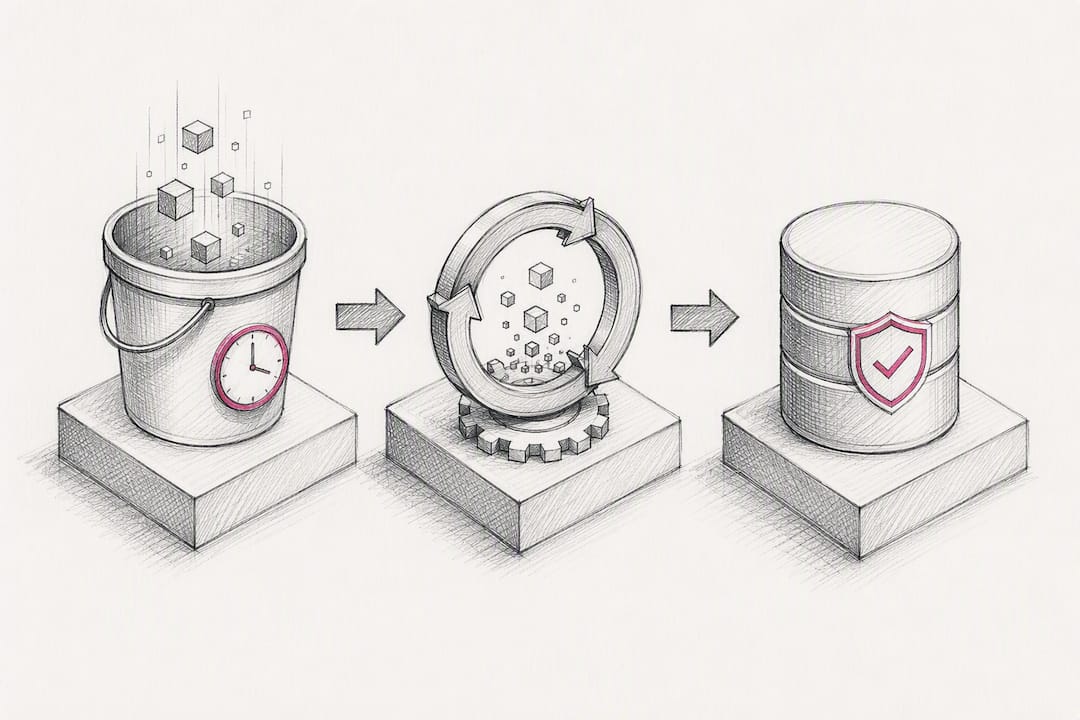
A written policy means nothing without engineering controls that enforce it automatically. Automated time-to-live (TTL) settings on storage buckets and databases should mirror your policy’s retention buckets exactly, not approximate them, combining with AI-powered SEO content creation and publishing for audit-ready governance. Deletion APIs, where vendors expose them, need to be called on a schedule rather than triggered manually, and every deletion should generate a tamper-evident log entry that compliance can pull during an audit.
Access controls and encryption form the second layer. Data should be encrypted both at rest and in transit, with role-based access limiting who can even view retained AI interactions. Stripping personally identifiable information from prompts before they ever reach a third-party model, sometimes through tokenization, reduces what a vendor retention failure could expose in the first place. AWS’s prescriptive guidance on generative AI data pipelines recommends exactly this combination: PII stripping, encryption, least-privilege access, and audit logging as baseline controls, not optional extras.
Track a small set of metrics that matter to auditors:
- Deletion success rate against your stated TTLs.
- Retention drift, meaning data still present past its scheduled deletion date.
- Number and resolution time of retention exceptions or legal holds.
Vendor attestations alone rarely satisfy a high-risk audit. Pairing them with automated deletion tests and your own logs gives you independent proof, not just a vendor’s word.
A Practical Checklist for Implementing AI Data Retention
Start with visibility, then move to enforcement. Skipping the inventory step is the most common reason retention programs stall halfway through.
- Inventory every AI endpoint in use across the organization, including tools procured outside formal IT channels.
- Classify data flowing through each endpoint by sensitivity and legal category (PII, health data, financial records, general business content).
- Assign retention buckets from your policy to each data category and endpoint pair.
- Negotiate vendor controls, including ZDR eligibility, business associate agreements (BAAs) where health data is involved, and documented endpoint carve-outs.
- Implement TTLs and deletion proof at the technical layer, tied to the buckets you defined.
- Verify continuously with automated purge tests, vendor attestation reviews, and periodic retention audits, plus a specific playbook for handling flagged content that falls outside normal timelines.
Governance doesn’t end at rollout. Schedule quarterly retention reviews and set a clear SLA for how fast exceptions and legal holds get processed once flagged.
Pro Tip: Run your first purge test on a low-risk endpoint before rolling it out organization-wide. It’s much easier to catch a broken deletion API on test data than on records tied to an active legal hold.
How Tekkr Helps Compliance Teams Operationalize Retention
Policy documents and checklists only get you partway there. Someone still has to answer, in real time, which teams are using which AI tools, what retention settings are actually configured, and whether that matches what the policy says should happen. Configurato tracks organization-wide AI adoption, including which tools like Claude and Codex are actually in use, and turns that visibility into compliance-ready reporting rather than a static spreadsheet someone updates twice a year.
Tekkr’s architecture matters here as much as the reporting layer. It’s built privacy-first, with end-to-end encryption and automatic PII stripping applied to prompts before they’re analyzed, which limits what’s exposed if a vendor retention setting drifts or an audit request comes in unexpectedly.
Practical benefits for compliance and governance teams include:
- Visibility into which vendors and endpoints are in use.
- Cost and usage breakdowns by department that support retention scoping.
- Reports generated to support compliance efforts.
- A data pipeline designed to help reduce exposure from vendor retention issues.
Why Data Minimization Is the First Line of Retention Defense
The least risky data is the data you never collected. Data minimization means limiting what enters an AI system to only what’s strictly necessary for the task at hand, and it functions as the first control layer before retention policy even applies. If a prompt doesn’t need a customer’s full account history to generate a useful response, that history shouldn’t be in the prompt.
This matters more for AI systems than for traditional databases because AI pipelines tend to accumulate context. A chatbot session might pull in customer records, prior conversation history, and internal documents just to answer one question, and each of those inputs becomes a retention liability the moment it leaves your infrastructure. Teams that skip minimization end up trying to solve a data sprawl problem with retention rules alone, which is backwards. Retention limits how long you keep something; minimization limits what you have to manage in the first place.
Practical minimization for AI workflows starts with prompt design. Strip unnecessary identifiers, truncate context windows to what the model actually needs, and avoid passing raw customer records when a summarized or tokenized version would work. Tools that automatically strip PII before it enters an AI system reduce both your retention exposure and your negotiating burden with vendors, since there’s simply less sensitive data for a vendor’s retention policy to touch.
Minimization also simplifies your retention schedule. Fewer data categories flowing into AI systems means fewer buckets to track, fewer exceptions to negotiate, and a shorter list of endpoints that need ZDR or BAA coverage. Teams that treat minimization as step one, not an afterthought, generally spend far less time untangling retention exceptions later.
AI Retention and the Right to Be Forgotten
Long or opaque AI retention windows create a direct tension with user rights like the GDPR’s right to erasure. If a user requests deletion of their personal data, but that data has already been ingested into a vendor’s training pipeline or logged for abuse monitoring, honoring that request gets complicated fast. Deleting a record from your own database doesn’t help if a copy still lives inside a third-party model provider’s retained logs.
This is why endpoint-level retention details matter so much for privacy rights, not just contract risk. If flagged content triggers an extended retention window at the vendor level, and that flagged content contains personal data subject to an erasure request, your organization needs a documented process for escalating that deletion request to the vendor, not just deleting your own copy and calling it resolved. Few organizations have this escalation path built out, and it’s one of the more common gaps regulators flag during AI-specific privacy audits.
Data residency compounds the problem. Where data is stored and how long it’s kept are separate obligations, and conflating the two is a common mistake in vendor negotiations. A vendor might guarantee data stays within a specific region while still retaining it far longer than your policy allows, or vice versa. Both dimensions need separate contract language and separate verification.
Practically, this means your data subject access and erasure request process has to include a step for checking AI vendor retention status, not just internal databases. Build that into your privacy rights workflow now, because retrofitting it after a regulator asks how you handle erasure requests involving AI-processed data is a much harder conversation.
Over-Retention and Under-Retention: Two Different Failure Modes
Over-retention and under-retention fail in opposite directions, and AI systems make both failure modes worse than traditional data stores do. Over-retention means keeping AI interaction data, training artifacts, or logs longer than any legal or business purpose justifies. It expands your breach surface, increases e-discovery costs during litigation, and directly violates storage limitation principles baked into most privacy frameworks. A model provider that quietly keeps six months of prompts “just in case” is a liability every time a new privacy request or subpoena arrives.
Under-retention cuts the other way. Deleting data too aggressively can destroy records you’re legally required to keep for audit, tax, or regulatory purposes, and it can also erase the evidence you’d need to demonstrate compliance in the first place. If a regulator asks how a specific AI-generated decision was made and the underlying prompt and output were purged on a 7-day cycle with no exception process, you have no way to reconstruct that decision. Some organizations reference general recordkeeping guidance suggesting multi-year retention for specific document categories, but the applicable period always depends on the record type and jurisdiction, not a single universal rule.
AI systems amplify both risks because the data volume is larger and the categories are murkier. A single chatbot session might generate a prompt, a completion, embeddings, log entries, and a training-eligible interaction record, each with a different appropriate retention period. Treating all of it as one undifferentiated blob and applying either “keep everything” or “delete everything fast” guarantees you’ll get one of the two failure modes wrong. The fix is the same risk-mapping exercise from your policy draft: match retention windows to the actual legal and business purpose of each data category, not a single default applied uniformly.
Managing AI Retention Across Multiple Jurisdictions
Operating AI systems across borders means reconciling retention rules that don’t agree with each other. A retention window that satisfies one jurisdiction’s storage limitation requirement might violate another jurisdiction’s mandatory minimum retention period for the same category of record, particularly in regulated sectors like finance or healthcare.
The practical complication is that most AI vendors operate infrastructure across multiple regions, and where your data is processed doesn’t always match where your organization or your users are legally based. A European user’s prompt processed by a US-based model provider raises transfer questions independent of retention questions, and the two get tangled together in vendor contracts that don’t clearly separate them.
Sectoral rules add another layer. Health data processed through an AI tool needs to meet HIPAA’s requirements in the US, which may mean an entirely different retention floor than what applies to general business data flowing through the same vendor. If your organization operates internationally, you likely need multiple retention schedules running in parallel, mapped to jurisdiction and data category, rather than one policy applied globally.
The practical fix is treating jurisdiction as a first-class field in your data taxonomy, not an afterthought. Every data category in your retention policy should carry a jurisdiction tag alongside its retention window, so that when a user’s location or a vendor’s processing region changes, the applicable rule is immediately visible rather than requiring a legal review each time. This also matters for GDPR-specific obligations that apply regardless of where your AI vendor happens to store the data, since GDPR follows the data subject, not the server location.
Anonymization and Pseudonymization for Retained AI Data
Not all retained data carries the same risk, and anonymization or pseudonymization can lower that risk substantially for data you need to keep. Anonymization removes identifying information so thoroughly that re-identification becomes practically impossible, which can take data outside the scope of privacy regulations entirely in some frameworks. Pseudonymization replaces identifiers with tokens or reference keys, keeping data usable for analysis while separating it from directly identifying information, though it typically remains regulated data since re-identification is technically possible with the right key.
For AI systems specifically, the technique you choose depends on what you need to do with the retained data. Training and evaluation artifacts that need to preserve statistical patterns for model validation often work better pseudonymized, since anonymization can strip away the exact signal you need to detect model drift or bias. Data retained purely for audit trail purposes, where you need to prove a decision was made but don’t need the specific identity behind it, is a stronger candidate for full anonymization.
A common mistake is treating pseudonymization as equivalent to anonymization for compliance purposes. If a token can be mapped back to an individual through a key your organization still holds, that data hasn’t left the scope of most privacy regulations, and it doesn’t reduce your retention obligations the way true anonymization does. Document which technique applies to which retention bucket, and be explicit in your policy about where the re-identification key is stored and who can access it.
Applying either technique before data reaches a third-party AI vendor, rather than after, gives you the strongest protection. Once raw identifying data has already been transmitted and processed, pseudonymizing your own copy afterward doesn’t undo the vendor’s exposure to the original version.
Retention Rules for Training Data and Model Updates
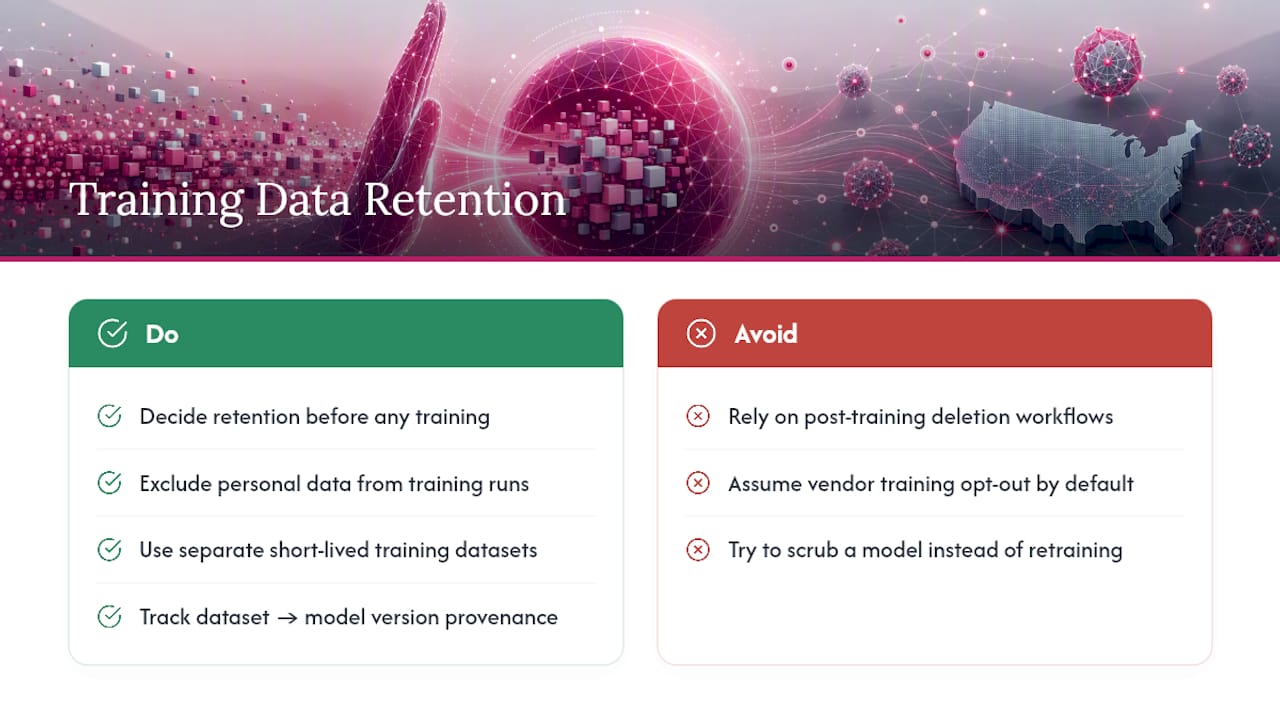
Training data retention works differently from operational data retention, and that difference trips up a lot of otherwise solid AI governance programs. Once data has been used to train or fine-tune a model, deleting the original record doesn’t necessarily remove its influence from the model’s learned parameters. This is a meaningfully different problem than deleting a database row, and most standard deletion workflows aren’t built to handle it.
For organizations fine-tuning their own models, this means retention decisions have to happen before training, not after. If a dataset contains personal data subject to an erasure request, the cleanest solution is excluding it from training runs entirely rather than trying to retroactively scrub its influence from a trained model. Some organizations maintain separate, shorter-lived datasets specifically for training purposes, distinct from their operational data stores, so that deletion requests can be honored cleanly without needing to retrain a production model.
Model update cycles add another wrinkle. Each time a model gets retrained or fine-tuned on new data, that update potentially creates a new retention obligation tied to whatever data went into that specific training run. Track training data provenance carefully, including which dataset version fed which model version, so that if a deletion request arrives, you know exactly which trained models might be affected and can make an informed decision about whether retraining is necessary.
Vendor-hosted foundation models complicate this further, since most enterprise customers using API access to models like Claude, GPT-based models, or Gemini aren’t contributing their data to the underlying model’s training set at all, provided the correct retention and training opt-out settings are configured. Verify that setting explicitly in your vendor contract rather than assuming it by default, since consumer-tier products from the same vendors often handle training opt-in very differently than enterprise API tiers.
Sequencing Your AI Governance Work: What Actually Comes First
Start with the endpoints carrying the highest legal exposure, health data, financial records, anything under a preservation order, before spending time on lower-risk categories. Scaling controls outward from there beats trying to cover everything simultaneously.
Ownership has to be shared deliberately. Legal defines what must be retained, security builds the technical enforcement, product decides what data actually needs to flow through AI tools, and procurement negotiates the vendor terms that make all of it possible. Give each team a clear SLA, not just a role.
The most common mistake: applying enterprise-grade retention controls to consumer or free-tier AI accounts employees signed up for independently. Those accounts rarely support ZDR or BAAs at all.
— TekkrTools
Turning Retention Policy Into Proof With Tekkr
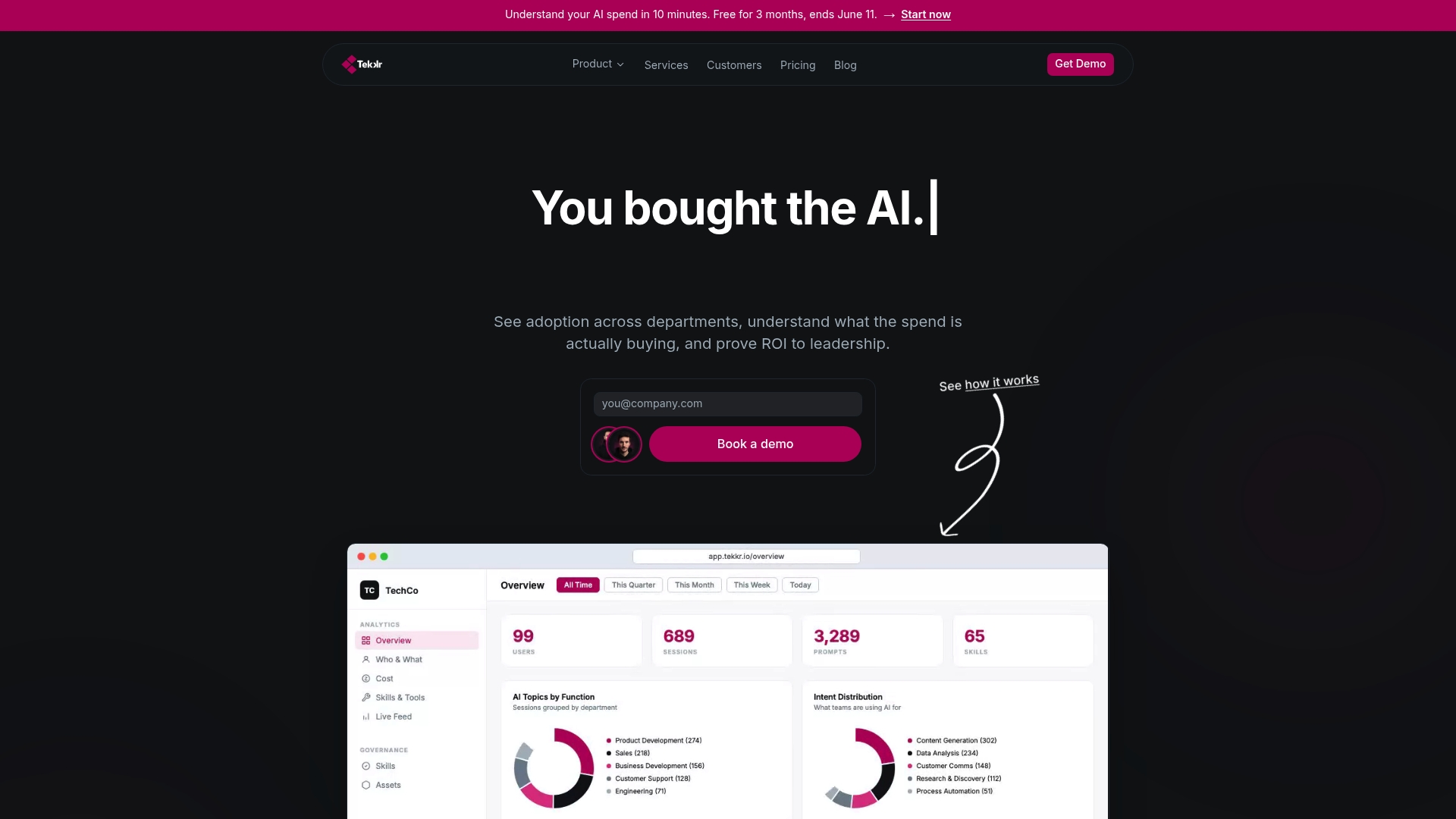
Writing a retention policy is one project. Proving your organization actually follows it, across every AI tool employees have adopted, is a different and much harder project. Tekkr’s Configurato was built for that second problem: it gives compliance and governance teams a live view of which AI tools are in use, how much each department is spending, and how usage maps against the retention and data controls you’ve negotiated with vendors.
Because the platform runs on a privacy-focused architecture, end-to-end encrypted with automatic PII stripping applied before analysis, it reduces exposure while organizations assess vendor retention settings across different tools. Setup is designed to be fast, there is a free tier available, and it operates without requiring browser extensions.
If your organization needs more than visibility, Tekkr’s AI governance and adoption services offer hands-on support for building the policy, vendor negotiation, and rollout work this article covers. Check Tekkr’s pricing to see which plan fits your organization’s size, or explore Configurato’s observability features directly to see what compliance-ready reporting looks like before your next audit.
Where to Verify AI Vendor Retention Claims
Before finalizing any retention policy, check the primary sources directly rather than relying on secondhand summaries. Vendor policy pages change, and endpoint-level carve-outs are easy to miss in a general overview.
- Vendor retention and feature eligibility pages: Anthropic and OpenAI both publish endpoint-level tables.
- IAPP’s retention policy guidance for aligning AI artifacts with existing privacy frameworks.
- ISO’s AI lifecycle standard for lifecycle-stage documentation auditors recognize.
- The U.S. Code provisions governing preservation and disclosure obligations.
This article is general information, not a substitute for advice from a qualified lawyer. Consult a qualified legal professional about your own circumstances before acting on anything here.
Sources
- U.S. Code (example preservation/disclosure provisions)
- ISO AI system life cycle guidance
- IAPP: Creating a data retention policy for personal information and AI
- Anthropic: API and data retention (Claude)
- OpenAI: Developer guide — your data
- AWS: Data considerations for generative AI (prescriptive guidance)
FAQ
Does AI Retain Your Data?
It depends entirely on the vendor, the product tier, and the specific endpoint you’re using. Enterprise API tiers from providers like Anthropic and OpenAI often support zero data retention on request, while consumer-facing apps commonly retain data longer or use it for training unless you opt out.
What Is the 7 Year Retention Policy?
There’s no single universal “7 year” rule for AI data. Some organizations apply a 7-year retention period to specific record categories, like financial or tax-related documents, based on sector recordkeeping requirements, but that window doesn’t apply uniformly to AI interaction logs or conversational data, which typically follow much shorter vendor defaults.
What Is the 10/20/70 Rule for AI?
This isn’t a recognized data retention or compliance standard, and definitions of it vary widely depending on the source. If you’ve encountered this framing in the context of AI skills or adoption, it’s unrelated to retention policy and shouldn’t be applied as a data governance rule.
Does ChatGPT Have Zero Data Retention?
OpenAI offers Zero Data Retention as an approved option for eligible API customers and specific endpoints, not as a universal default across all ChatGPT products. Standard ChatGPT consumer accounts follow different retention behavior, and eligibility for ZDR depends on your account tier and which endpoint you’re calling.