
AI cost per seat is the vendor’s seat fee plus that seat’s fair share of every consumption charge and operational cost stacked behind it, not the number printed on the pricing page. The short verdict: per-seat pricing buys budget certainty; usage-based pricing usually buys efficiency. Which one wins depends on how concentrated your usage is and whether you have engineering capacity to manage the metering.
A quick number to anchor this: a typical enterprise seat runs $16 to $30 a month, while raw token consumption for a model like GPT-4o can run $2.50 to $10.00 per million tokens, depending on input versus output. Tell your CFO this: the invoice total is never just seats times price.
Key Takeaways
True AI cost per seat is the vendor fee plus consumption and overhead divided across active users, and that number should drive whether you buy per-seat or usage-based.
| Point | Details |
|---|---|
| Sticker price understates cost | Seat fees of $16 to $30 a month rarely include the token or GPU-hour spend layered on top. |
| Apply the 70/90 rule | Usage-based wins under 70% active seats; per-seat wins at 90% or higher. |
| Model before you sign | Run the seat count × price plus consumption formula across light, concentrated, and hybrid scenarios first. |
| Fix governance gaps | Set spending caps, separate developer API keys from user seats, and require chargeback reporting by team. |
| Use Configurato for visibility | Tekkr’s Configurato tracks adoption and spend by team so finance can catch anomalies before invoices land. |
Table of Contents
- What Counts Toward True AI Cost Per Seat
- Common AI Pricing Models and 2026 Unit Rates
- Hidden Costs That Push Per-Seat Higher Than the Sticker Price
- When to Buy Per-Seat vs. Usage-Based
- A Forecasting Template You Can Run in Ten Minutes
- Controlling and Allocating AI Cost Per Seat
- Procurement Checklist Before You Sign
- How Configurato Tracks the Cost You’re Actually Paying
- Frequently Asked Questions
- Sources
What Counts Toward True AI Cost Per Seat
The vendor’s flat seat fee is only the starting line. A complete per-seat number blends two categories of spend.
- Direct consumption: tokens, GPU hours, or per-conversation charges tied to actual usage.
- Ancillary costs to allocate: integration work, engineering time, monitoring, fine-tuning, data storage, security review, admin overhead, and training.
How you split those ancillary costs across seats matters. Equal division works fine for small, uniform teams. Activity-weighted allocation (splitting cost by actual usage logs) fits organizations with a handful of power users skewing the average. Most finance teams land on a hybrid: a flat per-seat baseline plus a variable surcharge for teams that consume disproportionately.
Common AI Pricing Models and 2026 Unit Rates
Vendors bill AI access in roughly four shapes, and each one carries a different forecasting risk. Per-seat pricing charges a flat monthly rate per user, which is easy to budget but can overpay for light users. Per-token or per-request pricing charges by consumption, tracking actual value delivered but swinging hard month to month. Consumption or GPU-hour billing charges for raw compute time, common in custom model hosting. Per-conversation pricing charges per session, popular in support and chat tools. Hybrid models, increasingly the norm, combine a seat fee with metered usage on top.
OpenAI’s business plan lists $20 per user per month with token-based enterprise options layered in. Claude Enterprise does the same: $20 per seat per month, then usage billed at API rates. That pairing is not an edge case. It is becoming the default enterprise structure.
| Model | Typical 2026 Rate | Forecasting Difficulty |
|---|---|---|
| Per-seat | $16 to $30/user/month | Easy, predictable |
| Per-million tokens | $2.50 to $10.00 (GPT-4o input/output) | High variance |
| Hybrid (seat + usage) | $20/seat plus metered API costs | Moderate |
Hidden Costs That Push Per-Seat Higher Than the Sticker Price
The invoice line item is rarely the real number. Total AI cost typically lands well above the sticker seat price once you count compute, engineering, and governance work.
- Integration and implementation: SSO setup, SaaS connectors, and provisioning often take real engineering weeks before a single seat goes live.
- Engineering and DevOps: fine-tuning, model hosting, and failover infrastructure. Development sprints often trigger consumption spikes that dwarf steady-state usage.
- Governance and compliance: data retention policy, PII scrubbing, audit logging, and legal review of vendor terms.
- Administrative overhead: seat churn, minimum-seat contract requirements, overage charges, and the reporting infrastructure needed to track any of it.
Pro Tip: Run a 90-day pilot with a representative team before signing an annual contract. The consumption spike during onboarding and fine-tuning almost always exceeds steady-state usage, and that gap is exactly what gets missed in a first-year budget.
When to Buy Per-Seat vs. Usage-Based
Here’s the rule: if fewer than about 70% of your licensed users are actively using the tool and you have engineering capacity to manage API metering, usage-based pricing usually wins.
The logic follows adoption shape. Distributed light use across many employees favors per-seat, since usage-based billing would nickel-and-dime dozens of small, occasional sessions. Concentrated power-user or batch workloads favor usage-based, since a handful of heavy users on a flat per-seat plan quietly subsidize everyone else who barely logs in.
There’s a governance trade-off buried in this choice too. Per-seat gives budget predictability but hides the actual signal of who’s using what. Usage-based exposes real cost signal but risks throttling, fair-use clause disputes, and less month-to-month predictability. Read the fine print either way. Most enterprise contracts turn out to be hybrids once you actually read the overage language.
A Forecasting Template You Can Run in Ten Minutes
The math is simple: seat count × seat price + shared consumption + operational overhead = total monthly cost. Divide by seat count for your real per-seat figure.
Three scenarios show how much the outcome shifts depending on usage shape.
Notice the concentrated scenario: fewer seats, but per-seat cost balloons because a small group is driving nearly all the token volume. This is the exact case where usage-based billing, or at least a hybrid contract, tends to make more financial sense than an all-you-can-use seat plan.
Run this quarterly. If token rates drop, GPU pricing shifts, or your seat count grows past a threshold, rerun the model. Static budgets built on launch-month numbers age badly.
Controlling and Allocating AI Cost Per Seat
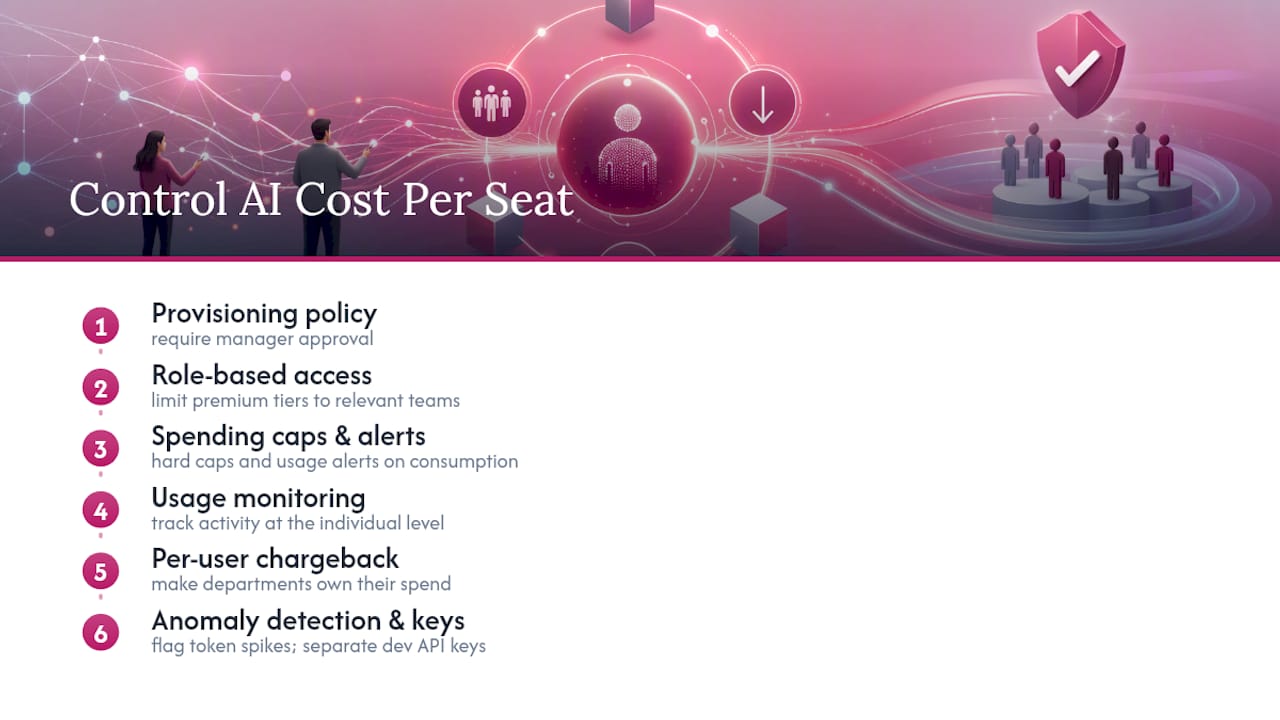
Runaway invoices almost always trace back to the same gaps: no spending caps, no role-based provisioning, and no visibility into who’s actually using what. Fix the structural issues first. Set a seat provisioning policy that requires manager approval, enforce role-based access so only relevant teams get premium tiers, and put hard spending caps and usage alerts on any consumption-based line item.
Then layer in tooling: usage monitoring that tracks activity at the individual level, per-user chargeback so departments own their own spend, and anomaly detection that flags a token spike before it hits the invoice. Keep developer API keys separate from end-user seats. Mixing the two is one of the fastest ways to double-pay for the same workflow, once through a seat license and again through metered API calls nobody reconciled.
Pro Tip: If you can’t answer “which team drove last month’s token spike” within five minutes, you don’t have cost control. You have an invoice you’re hoping stays flat.
Procurement Checklist Before You Sign
Before signing any AI vendor contract, get these answers in writing, not in a sales call.
- Ask for explicit fair-use thresholds, overage rates, seat minimums, and included usage allowances.
- Confirm whether seat licenses include API usage or whether consumption is billed separately, and whether usage credits pool across the team or reset per user.
- Request historical billing data or run a short pilot with a comparable team to measure real consumption before committing to volume.
- Clarify throttling behavior once you exceed included limits. Some vendors slow response times; others simply bill overage.
Why Visibility Changes the Budget Conversation
Once finance can see actual per-seat consumption instead of guessing from an invoice total, the decision rule stops being theoretical. Predictability satisfies the CFO. Real usage signal tells the product leader where AI is actually earning its keep.
How Configurato Tracks the Cost You’re Actually Paying
Every calculation in this guide depends on knowing who’s using what, and most finance teams don’t have that visibility until the invoice arrives. Configurato closes that gap by tracking actual adoption of tools like Claude and Codex, breaking down spend by team, and flagging anomalies before they become a surprise line item on next month’s bill.
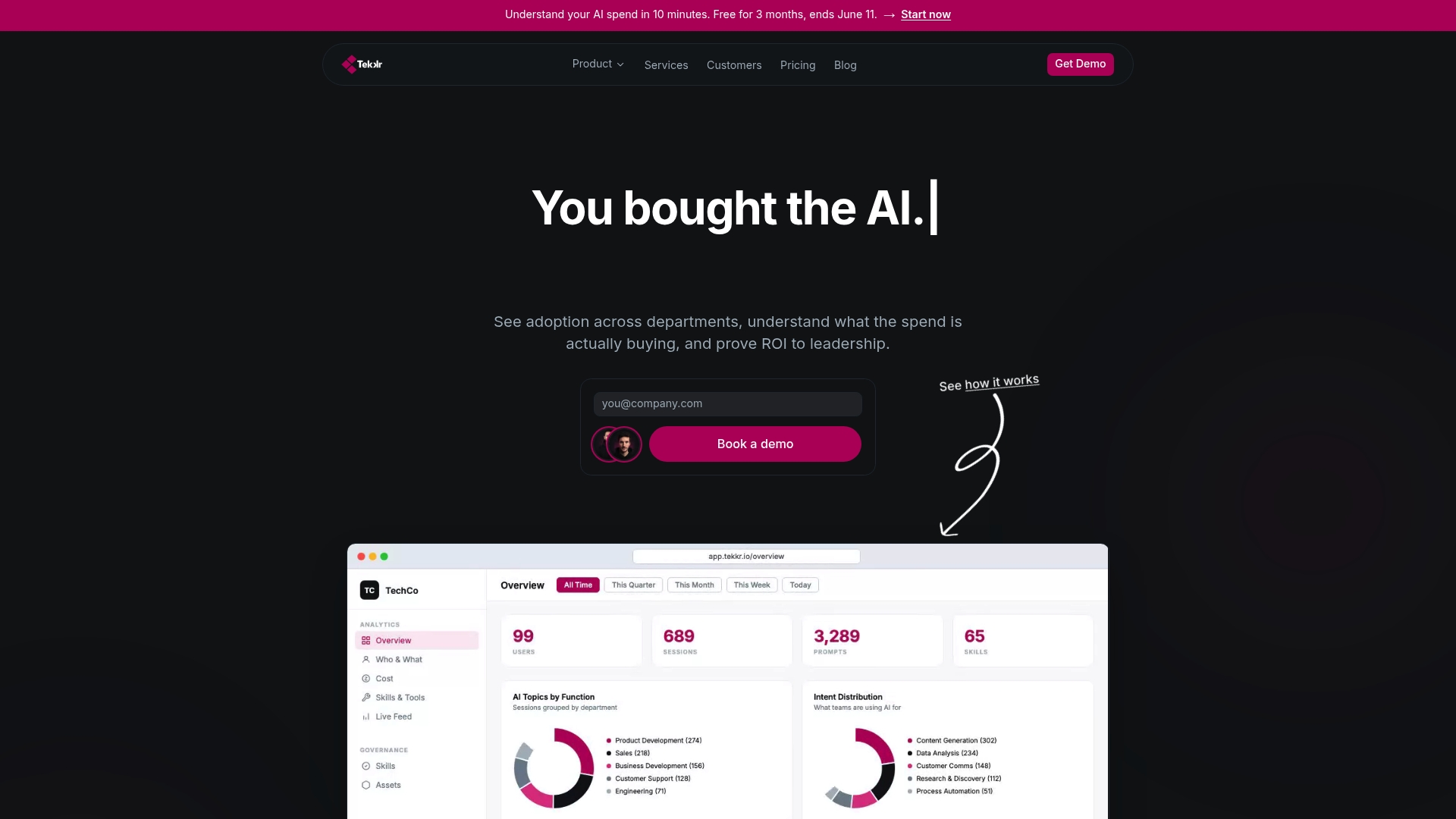
Instead of reconciling seat licenses against API usage manually, Configurato’s AI adoption platform surfaces which departments are driving consumption, which seats sit idle, and where a hybrid contract would beat a flat per-seat plan. Setup takes about 10 minutes, runs on a privacy-first architecture with automatic PII stripping, and starts with a free tier. Check Tekkr’s pricing page to see which plan fits your seat count before your next renewal.
Frequently Asked Questions
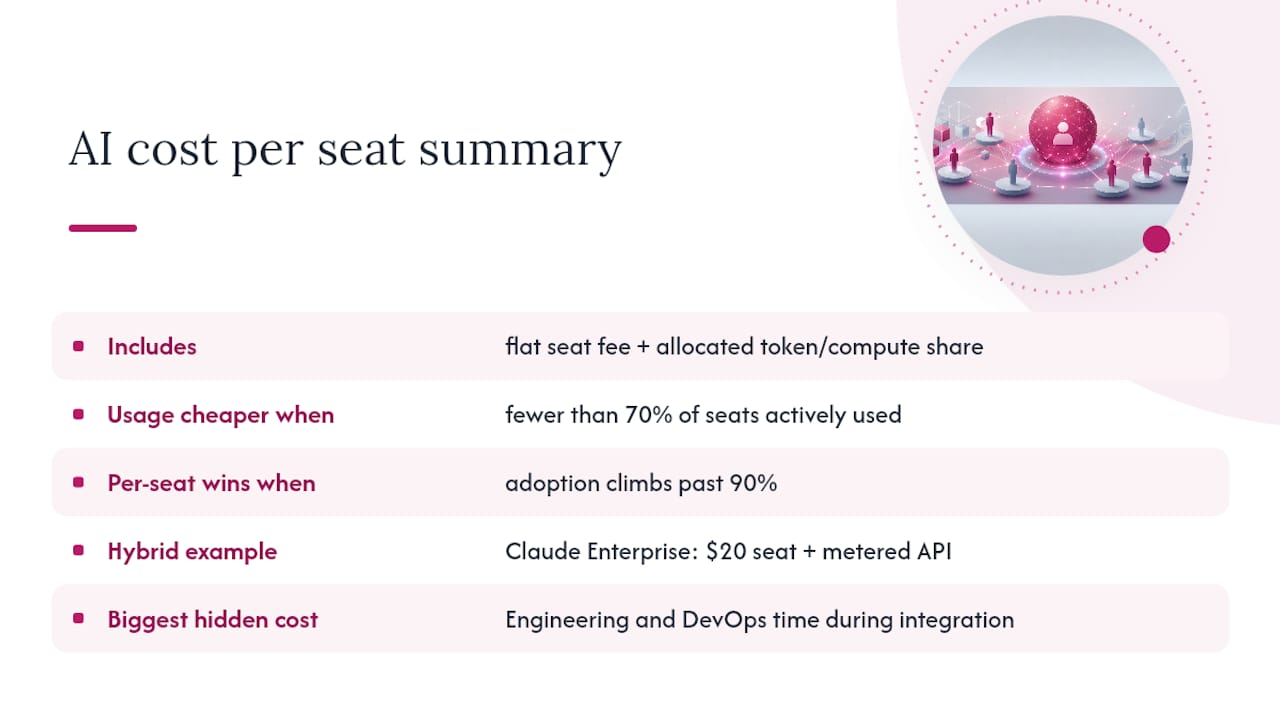
What does “AI cost per seat” actually include? It includes the vendor’s flat seat fee plus that seat’s allocated share of token or compute consumption, integration work, monitoring, and governance overhead, not just the number on the pricing tier.
Is per-seat or usage-based pricing cheaper? It depends on adoption. Usage-based tends to cost less when fewer than 70% of licensed seats are actively used; per-seat tends to win once adoption climbs past 90%, according to this pricing framework.
Why do hybrid pricing models exist? Hybrid billing, like Claude Enterprise’s $20 seat fee plus metered API usage, lets vendors offer budget predictability while still capturing revenue from heavy users who would otherwise be underpriced on a flat seat plan.
How do I forecast AI costs before signing a contract? Use the formula seat count times seat price, plus shared consumption, plus operational overhead, divided by seat count. Run it across a light-usage, a concentrated power-user, and a hybrid scenario to see how much the per-seat number actually moves.
What’s the biggest hidden cost teams miss when budgeting for AI? Engineering and DevOps time during fine-tuning and integration. Development-phase consumption spikes often exceed steady-state usage, which is exactly the gap a short pilot period is designed to expose.
Sources
Rates and thresholds referenced above come from CloudZero’s AI pricing breakdown, the per-seat vs. usage-based guide, OpenAI and Claude pricing pages, and Stripe’s pricing model resources. For procurement-side tooling, see Tekkr’s AI usage tracking guide.